
THE ARCHITECTURE OF RELIGIOUS INDIFFERENTISM: HOW BROADCAST RELIGION, RE REFORM, AND TEACHER-TRAINING SECULARISATION REMADE THE BRITISH SOUL
The Quiet Re-Engineering of a Nation
The secularisation of Britain did not occur through revolt, nor through an aggressive rejection of the Christian religion, nor even through the triumph of militant unbelief. It came instead through a gentle, meticulously institutionalised substitution of doctrinal faith with sentimental moralism.¹ A nation that had been shaped for centuries by the worship of God was quietly reshaped by a new kind of “worship” — one designed not for the Church, nor for the faithful, but for the secular school, the multicultural classroom, and the increasingly neutralised public square. The shift was not sudden. It was the cumulative effect of three structural developments, each documented with clarity in the historical and academic record: the mediated spirituality of broadcast religion, the reformulation of Religious Education into a comparative discipline, and the secularisation of teacher training that left the profession unable — and often unwilling — to teach the Christian faith.²
Broadcast Religion and the Liturgy of Mood
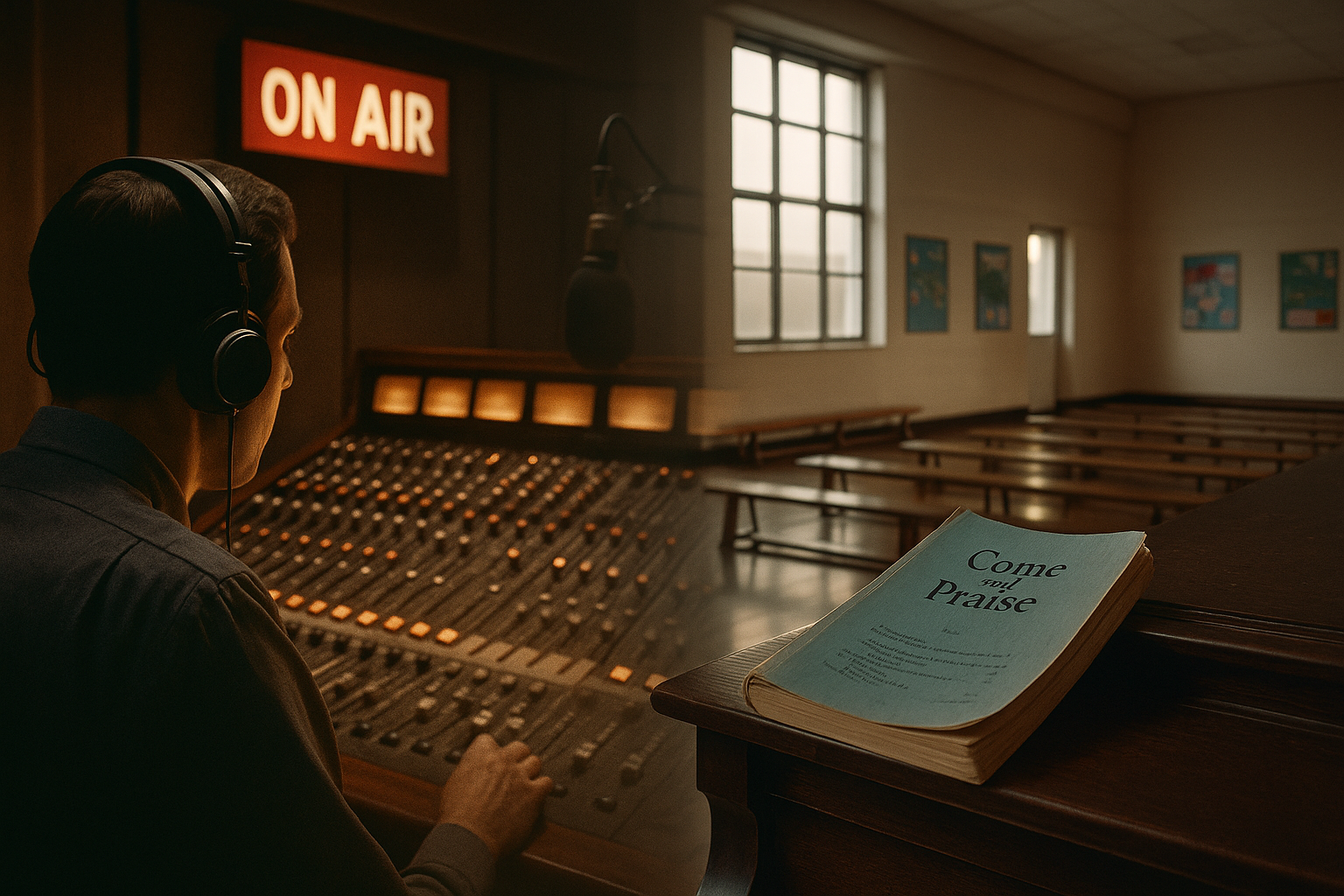
Broadcast religion, especially through the BBC Schools Broadcasting Service, was the first great architect of this transformation. As Stephen Parker has demonstrated in his studies of mid-century BBC religion and broadcasters such as John G. Williams, the corporation developed a distinctive notion of “childhood piety” that placed atmosphere above doctrine, feelings above truth, and moral comfort above repentance.³ Worship for children was redesigned as a soft, narrative-driven experience. Music, tone, storytelling, and emotional resonance replaced proclamation, catechesis, or theological clarity.⁴ Worship became something one felt, not something one entered into as a response to God’s revelation. In this way, the BBC did not simply broadcast religious content; it modelled an entirely new prototype for school worship — a liturgy of mood rather than a liturgy of truth.⁵
This mediated model of religion flowed naturally into the evolution of Religious Education itself. Beginning in the 1960s, influential academics, policymakers, and pressure groups pushed RE away from its confessional roots.⁶ As Freathy and Parker document, secularists and humanists pressed for a syllabus free of doctrinal commitment, while educational authorities embraced pluralism as both politically prudent and culturally necessary.⁷ Christianity, once the normative foundation, became a single element in a comparative framework in which “understanding other people’s beliefs” replaced the transmission of revealed truth.⁸
The Transformation of Religious Education
The intellectual weight behind this shift was immense. Figures such as Ninian Smart insisted that RE must be neutral, descriptive, and phenomenological, bracketing out truth claims in favour of cultural observation.⁹ Smart’s approach aligned closely with broader developments in comparative religion and secular education theory across Europe and North America.¹⁰ John Hull went further, declaring confessional Christian education “educationally unjustifiable” in the state system and urging a pedagogy centred on empathy, experience, and shared values.¹¹ In an astonishingly short span, RE ceased to be a formational discipline and became a kind of cultural anthropology for children — a course on how to understand other people’s religion without ever being called to faith oneself.¹²
Yet this curricular shift could never have taken root without the transformation of the teaching profession itself. As Parker’s work on RE teacher professionalisation shows, teachers were increasingly trained not in theology or catechesis, but in sociology, anthropology, and comparative religion.¹³ Their identity was not that of Christian witnesses but of neutral facilitators.¹⁴ Meanwhile, as Grace Davie observed, the teaching workforce secularised far more rapidly than wider society; by the 1980s, most teachers were either nominally religious or not religious at all.¹⁵ They inherited legal obligations to deliver Christian worship, but they lacked both conviction and formation to do so. The result was predictable: worship had to be rendered harmless — stripped of doctrine, free of exclusivity, and emptied of supernatural claim.¹⁶
The Hymnal of Indifferentism
At this intersection of mediated religion, pluralistic curriculum, and secularised pedagogy stands Come and Praise — the hymnbook that became the liturgical voice of an indifferentist age. Its pages contain almost no doctrinal Christianity.¹⁷ Christ appears only as moral exemplar. God is a benevolent presence, never Judge or Redeemer. Sin, repentance, sacrifice, the Cross, and Resurrection — the very grammar of Christian worship — are conspicuously absent. Instead, the book offers songs of kindness, sharing, friendship, nature, peace, unity.¹⁸ These themes are not bad; they are simply not worship. They are spirituality without revelation, morality without a moral lawgiver, uplift without obedience, warmth without truth.
Yet this is precisely why Come and Praise succeeded. It was worship that secular teachers could feel comfortable leading. It was religion that caused no offence in multicultural settings. It was “Christian” enough to satisfy statutory requirements while being empty enough to require no belief.¹⁹ In that sense, Come and Praise did not change British religion. It merely revealed what British religion — at least in the schools — had become.
And in that quiet shift lies the deeper cultural consequence. A generation raised on assemblies in which worship was mood, doctrine was absent, and spirituality was sentimental emerged into adulthood without the structural resources of the Christian imagination: no sense of transcendence, no moral absolutes rooted in divine authority, no conception of the human person as made in God’s image, no understanding of sin or redemption.²⁰ Into that vacuum stepped the pseudo-religions of the secular age — most notably the cluster of ideologies now known as Critical Social Justice. These movements mimic Christian structure — confession, penance, moral purity, excommunication, saints, martyrs, liturgical language — but offer no salvation, no forgiveness, no God.²¹ They thrive in a world where the forms of religion have been retained, but the content removed.
What the BBC softened, the RE curriculum relativised, and teacher training neutralised, Come and Praise sang into the hearts of children: worship without doctrine, faith without truth, spirituality without God. The academic research reveals every structural piece of this transformation. But the spiritual consequences belong to a nation now struggling to remember what it once believed.
¹ Callum Brown, The Death of Christian Britain (2001).
² Linda Woodhead & Rebecca Catto, Religion and Change in Modern Britain (2012).
³ Stephen G. Parker, “Mediatising Childhood Religion,” Journal of Beliefs & Values 36:1 (2015).
⁴ Parker, “School Worship, John G. Williams and the Idea of Childhood Piety,” International Journal of Christianity & Education (2014).
⁵ Stewart Hoover, Religion in the Media Age (2006).
⁶ Rob Freathy & Stephen G. Parker, “Secularists, Humanists and RE,” History of Education 42:2 (2013).
⁷ Grace Davie, Religion in Britain Since 1945 (1994).
⁸ Clive Erricker et al., The Politics of Religious Education (1997).
⁹ Ninian Smart, The Religious Experience of Mankind (1969).
¹⁰ Bryan Wilson, Religion in Secular Society (1966).
¹¹ John M. Hull, What Prevents Christian Education in Schools? (1984).
¹² Michael Grimmitt, Religious Education and Human Development (1987).
¹³ Stephen G. Parker, “The Professionalisation of Teachers of RE,” in On the Profession of Religious Education (2015).
¹⁴ David Stephens, “The Professional Identity of RE Teachers,” British Journal of Religious Education (1998).
¹⁵ Linda Woodhead, “The Private and Public Lives of Atheists,” in The Oxford Handbook of Atheism (2013).
¹⁶ Andrew Wright, Critical Religious Education (2007).
¹⁷ Analysis of Come and Praise content in Parker’s BBC research; hymnbook texts.
¹⁸ Primary hymnbook analysis (BBC Publications, 1978–1990).
¹⁹ Colin Crouch, Post-Democracy (2004) — on institutions performing forms without substance.
²⁰ Alasdair MacIntyre, After Virtue (1981) — moral fragmentation after loss of teleology.
²¹ James Lindsay & Helen Pluckrose, Cynical Theories (2020).
RELATED ARTICLES


latest ARTICLES
- Today’s homily: Christ the KingThe homily reflects on Christ’s kingship as seen in the Gospel narrative. It contrasts earthly authority with divine truth, emphasising that true allegiance to God requires genuine obedience and transformation. Believers are called to examine their personal commitments and respond to Christ’s demands in everyday life, ultimately recognising their identity as bearers of God’s image.
- Sermon for Christ the KingToday marks the celebration of Christ the King and the Twenty Second Sunday after Pentecost, a feast asserting Christ’s sovereignty against totalitarianism. St. Paul emphasised Christ’s supremacy over power and principalities, challenging early Gnostic beliefs. The early Church’s victory over evil is affirmed in Christ’s resurrection, offering hope and unity amidst contemporary struggles.
- Today’s Mass: October 25 SOVEREIGNTY OF OUR LORD JESUS CHRIST, SUPREME KINGThe Feast of the Sovereignty of Our Lord Jesus Christ celebrates Christ’s dual kingship by birth and conquest. Established by Pius XI, it aims to deepen faith and counter anti-clericalism. The liturgical observance underscores His authority as King, advocating for societal recognition of His reign to bring peace and harmony.
- TRADITION BEHIND THE FENCEThe Vatican’s prohibition of the traditional Ad Petri Sedem pilgrimage to St Peter’s Basilica has sparked controversy, especially among traditional Catholics. While some cite scheduling conflicts, the broader issue lies in the restrictive policies of Traditionis custodes, which may confine traditional liturgical practices to specific enclaves, risking the transmission and recognition of Catholic Tradition within the wider Church.
- Today’s Mass: October 24 St Raphael the ArchangelThe Feast of Saint Raphael the Archangel highlights his healing powers as depicted in the Book of Tobit, where he aids Tobit and his son, Tobiah. Venerated as a protector of travellers and the blind, Raphael is celebrated for his miraculous interventions. His legacy includes support for nurses, matchmakers, and Catholic studies.





Leave a Reply