
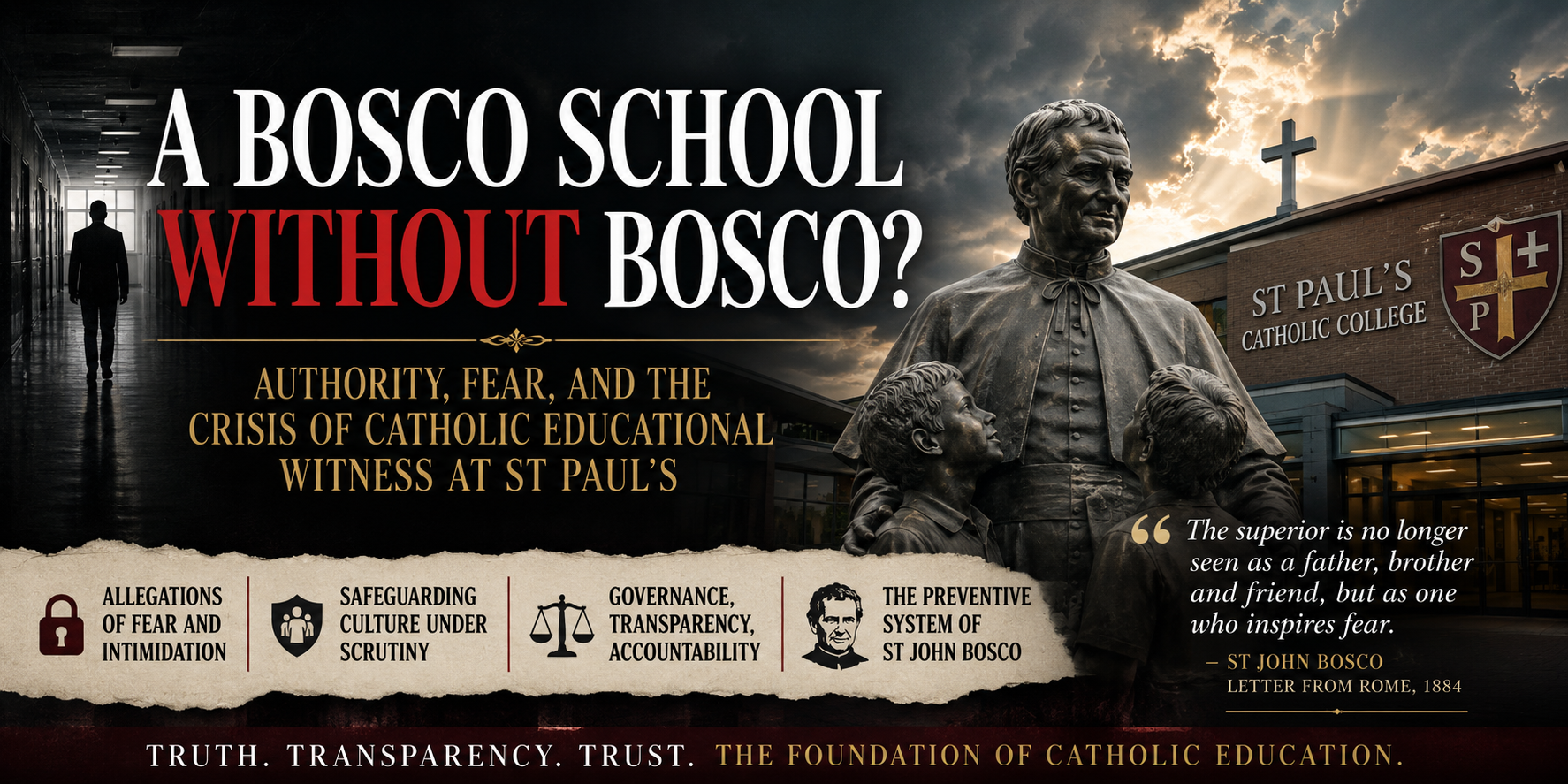
A Bosco School Without Bosco? Authority, Fear, and the Crisis of Catholic Educational Witness at St Paul’s

There are moments when a controversy ceases to be local and becomes instead emblematic. The allegations now surrounding St Paul’s Catholic College—serious, contested, and as yet unproven—have already crossed that threshold. For what is at stake is not merely the reputation of a single school, nor even the internal governance of an academy trust, but a deeper and more searching question: whether Catholic institutions still understand the nature of the authority they claim to exercise, and whether they remain faithful to the charisms they publicly invoke.
The claims, reported in detail by Nicola Woolcock, Education Editor of The Times, are stark. Former members of staff have described an institutional culture allegedly characterised by fear, control, psychological pressure, and intimidation, including references to late summonses, perceived threats to career progression, disproportionate disciplinary processes, and an environment in which staff felt unable to raise concerns freely.¹ Around fifteen former staff members are reported to have contributed testimony, with the National Education Union calling for a fully independent external investigation.² More serious still are allegations touching safeguarding, including claims that concerns regarding pupil behaviour and harassment were not adequately addressed by leadership. These remain allegations—no more and no less. They have not been tested in a court of law nor adjudicated by an independent inquiry. The Bosco Catholic Education Trust has rejected any suggestion of systemic wrongdoing, pointing to safeguarding frameworks, whistleblowing procedures, and formal governance structures already in place.³ Justice demands that this be stated clearly. But justice also demands that allegations of this gravity be examined with equal seriousness.
Modern safeguarding doctrine, shaped by painful experience across public institutions and the Church alike, is unequivocal: culture is decisive. A school may possess impeccable policies and yet fail those within its care if the lived environment discourages challenge, suppresses criticism, or induces fear. The Department for Education’s statutory guidance Keeping Children Safe in Education is explicit that safeguarding is not merely procedural but cultural, requiring “a culture of vigilance” in which concerns can be raised and acted upon without hesitation or reprisal.⁴ Where fear governs, safeguarding weakens—not because policies disappear, but because people cease to trust them.
It is precisely at this point that the controversy acquires a distinctly Catholic—and specifically Bosconian—gravity. For St Paul’s does not exist merely as a Catholic school in the abstract. It operates within a trust that explicitly invokes the educational charism of St John Bosco, one of the Church’s greatest architects of youth formation. Bosco’s educational vision was not a peripheral inspiration; it was a coherent and demanding system grounded in theology, anthropology, and pastoral realism.
Don Bosco’s preventive system was constructed in conscious opposition to educational models rooted in fear, coercion, or punitive control. Its famous triad—reason, religion, and loving-kindness—was not sentimental rhetoric but a disciplined method. Authority was to remain real and binding, but it was to be exercised through presence, trust, and paternal care.⁵ Bosco did not abolish discipline; he perfected it by rooting it in charity. He governed difficult and often unruly boys, yet refused to rely upon fear as the primary instrument of order.
His warning, issued in the 1884 Letter from Rome, stands as one of the most penetrating diagnoses of institutional decay ever written within Catholic pedagogy:
“The superior is no longer seen as a father, brother and friend, but as one who inspires fear.”⁶
This is not merely a historical observation; it is a perennial criterion. When authority ceases to be experienced as paternal and begins to be experienced as fearful, something essential has already been lost. The institution may continue to function; its results may remain strong; its external reputation may endure. But its moral integrity has begun to erode from within.
If even a portion of the allegations made by former staff were to be substantiated by an independent investigation, the implication would be unavoidable: not simply a failure of governance, but a failure of charism. A Bosco school without Bosco is not merely inconsistent—it is incoherent. The saint may remain on the crest and the website, but the spirit by which he built schools has already departed.
The governance dimension sharpens this concern further. Public reporting has noted that the executive headteacher holds a senior strategic role within the trust, while the trust itself is led by a close family member. The trust maintains that all appropriate declarations of interest and governance safeguards are in place in accordance with charity law and academy trust regulation.³ Yet public confidence in governance depends not only upon legal compliance but upon visible independence and transparency. In Catholic institutions—where moral authority is inseparable from credibility—the appearance of concentrated authority, even where lawful, invites scrutiny. The Nolan Principles of public life—selflessness, integrity, objectivity, accountability, openness, honesty, and leadership—apply with particular force in educational settings entrusted with the formation of the young.⁷
Nor does the present controversy emerge in isolation. Previous disputes involving the school and the trust—concerning GCSE options, parental consultation, and complaints procedures—have already drawn scrutiny from investigative reporting and regulatory attention.⁸ While these earlier matters did not establish formal wrongdoing, they contribute to a broader pattern in which questions of governance culture and transparency have repeatedly surfaced. Patterns do not prove guilt, but they shape trust—and trust, once weakened, is not easily restored.
Catholics, of all people, must resist two equal and opposite temptations. The first is defensive tribalism, which treats criticism of Catholic institutions as inherently hostile. The second is uncritical credulity, which treats allegation as proof. The Church’s recent history has demonstrated, at immense cost, the dangers of both. Institutions that close ranks prematurely do not protect their credibility—they forfeit it. Transparency is not betrayal. Accountability is not disloyalty. Truth is not the enemy of the Church; it is its condition of renewal.
This is why the call for an independent external inquiry must be taken with utmost seriousness. Independence is not an admission of guilt; it is an acknowledgement that confidence has been shaken. If allegations are unfounded, independence offers vindication. If failures exist, independence provides the clarity necessary for reform. In either case, it serves justice.
Yet beyond governance, beyond safeguarding, beyond institutional reputation, there remains a more profound question—one that reaches to the heart of the Church’s witness in a disillusioned age. What does it mean for a Catholic institution to exercise authority credibly in a society already sceptical of power? What does it mean to invoke a saint while failing to embody his principles? What becomes of Catholic education if its internal culture contradicts the very virtues it seeks to inculcate?
The crisis of authority in the modern West is not merely political; it is moral. Institutions have lost trust not simply because they err, but because they conceal, deflect, and protect themselves at the expense of truth. The Church cannot afford to replicate this pattern. If Catholic schools are to speak credibly of virtue, dignity, and moral formation, they must demonstrate those realities internally, not merely proclaim them externally.
For Don Bosco did not build institutions that merely functioned efficiently. He built environments in which young people flourished because they were known, loved, and guided—not managed through fear or subdued by control. His system did not weaken authority; it redeemed it. It did not abolish discipline; it transfigured it.
And so the question now confronting St Paul’s Catholic College is not simply whether allegations can be answered, nor even whether governance can be defended. It is whether the institution still recognises the standard by which it must ultimately be judged.
At present, these remain allegations. That must be said, and said without equivocation. But allegations of this seriousness demand more than reassurance, more than procedural compliance, more than carefully worded statements. They demand truth—tested, independent, and transparent.
For where fear governs, truth falls silent; and where truth falls silent, no Catholic institution—however decorated—can claim to stand in the light.
- Nicola Woolcock, “Outstanding Catholic School Faces Investigation Over Bullying Allegations,” The Times (London), 14 May 2026.
- National Education Union statements reported in Woolcock, The Times, 14 May 2026.
- Bosco Catholic Education Trust, governance documents and register of interests; see also trust response cited in Woolcock, The Times, 14 May 2026.
- UK Department for Education, Keeping Children Safe in Education, statutory guidance for schools and colleges (London: DfE, September 2025), Part Two, paras. 135–142.
- The Preventive System in the Education of Youth, in The Biographical Memoirs of St John Bosco, trans. Diego Borgatello (New Rochelle, NY: Don Bosco Publications), esp. pedagogical principles section.
- Letter from Rome, in The Biographical Memoirs of St John Bosco, vol. 17 (New Rochelle, NY: Don Bosco Publications), 107–115.
- UK Committee on Standards in Public Life, The Seven Principles of Public Life (The Nolan Principles) (London: Cabinet Office, 1995; updated guidance).
- Warwick Mansell, “Inside a Governance ‘Hornets’ Nest’: The Extraordinary Story of a Dispute with a Catholic School and Academy Trust,” Education Uncovered, 2021–2024 series.
RELATED ARTiCLES


LATEST ARTICLES
- Today’s homily: Feria II of the Fifteenth Sunday Post PentecostSt Paul urges us not to grow weary in doing good: every prayer, sacrifice, act of charity and fidelity is seed sown for eternity. Our task is to persevere in the sowing and trust God for the harvest.
- Today’s Mass: September 07 Feria of Sunday XV Post PentecostThe Sunday XV Post Pentecost Mass emphasises the importance of living a life governed by the Holy Spirit, encouraging Christians to act with grace, charity, and humility. St Paul’s teachings remind believers to bear one another’s burdens and avoid self-deceit, ultimately striving for spiritual growth and communion with God through the Eucharist.
- Crisis is the Cause; Necessity is the EffectThe SSPX has clarified its rationale for episcopal consecrations, arguing that a crisis in the Church has led to a “state of necessity” for preserving the Catholic Faith. This distinction stresses the need to prove the necessity and proportionality of their measures against church law, highlighting a significant theological and canonical issue that requires serious examination from both SSPX and Rome.
- A Name on the Letterhead: Grech, Farrell and the Synodalisation of Amoris LaetitiaAdVaticanum reports that Cardinal Farrell’s dicastery might lack substantial input into the October Amoris Laetitia meeting, with Cardinal Grech’s Synod Secretariat effectively leading preparations. This raises concerns about the balance of roles, highlighting potential tensions in handling doctrinal issues, particularly regarding the sacramental practice stemming from Amoris Laetitia.
- Today’s homily: Fifteenth Sunday Post PentecostIn the Gospel of Naim, two processions converge—one of life led by Christ and another of death following a young man. Christ’s compassion interrupts the funeral, symbolising hope amid despair. This message resonates today as Catholics face challenges, encouraging perseverance in faith, tradition, and prayer for revival in families and community.
CURRENT EDITION


DAILY MASS ONLINE
One of the earliest online apostolates dedicated to the Traditional Latin Mass, Old Roman TV began broadcasting the Holy Sacrifice on the Feast of the Assumption, 15 August 2008. During the COVID-19 pandemic, additional programming — devotions, catechesis, and conferences — was added to support the faithful in prayer and formation.
Support the daily Holy Mass on Old Roman TV by offering a Mass intention — for loved ones, thanksgiving, or the repose of souls. Your intention helps sustain the sacred liturgy and brings grace to those you remember before God’s altar.
SUPPORT THE DAILY MASS ONLINE
Likely the world’s longest-running daily online broadcast of the
Traditional Latin Mass, streaming faithfully since the
Feast of the Assumption 2008.

This apostolate cannot continue without immediate help
Please support us with a contribution toward
chapel rent, sacristy supplies, operating costs, and web-hosting.
Our essential monthly costs reach £1,000.
MASS INTENTIONS
If your offering is for a Mass Intention, kindly complete the form below in full so we may correctly match it to your donation. For anniversary intentions — birthdays, wedding anniversaries, anniversaries of death — please be sure to include the relevant date.


Today’s Mass Propers
- Today’s Mass: September 07 Feria of Sunday XV Post Pentecost
 The Sunday XV Post Pentecost Mass emphasises the importance of living a life governed by the Holy Spirit, encouraging Christians to act with grace, charity, and humility. St Paul’s teachings remind believers to bear one another’s burdens and avoid self-deceit, ultimately striving for spiritual growth and communion with God through the Eucharist.





Leave a Reply