
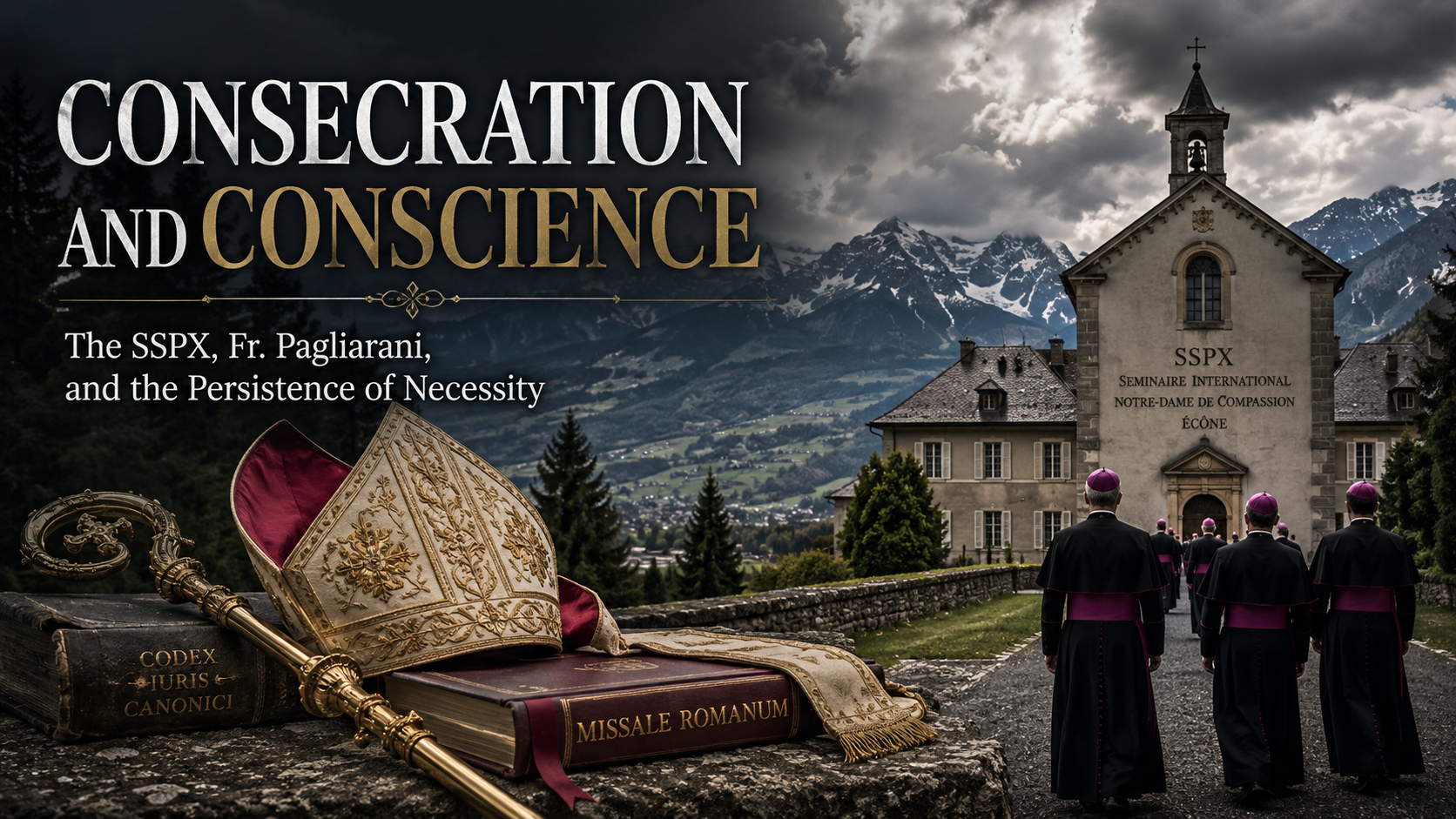
Consecration and Conscience: The SSPX, Fr. Pagliarani, and the Persistence of Necessity
The publication of Fr. Davide Pagliarani’s internal exhortation ahead of the episcopal consecrations at Écône on 1 July 2026 is not merely a pastoral gesture. It is a theological declaration: that the crisis invoked by Archbishop Lefebvre in 1988 has not abated but intensified, and that the burden of preserving Catholic Tradition now falls once more upon extraordinary means.

The release on 21 May 2026 of Fr. Davide Pagliarani’s message to the members of the Society of Saint Pius X marks a moment of unusual clarity in the modern history of the Society. Presented under the modest guise of a spiritual exhortation, it is in truth a document of considerable ecclesiological weight. For it does not merely prepare the faithful for the episcopal consecrations scheduled for 1 July at Écône; it seeks to form the very lens through which those consecrations must be understood. It is, in effect, a work of interior governance, an attempt to discipline not action, but interpretation — to ensure that what is about to occur is neither misconstrued as rebellion nor reduced to mere institutional necessity, but received as an act undertaken under the burden of conscience.¹
The key to that interpretation lies in a single sentence, offered without flourish yet bearing the full weight of the Society’s self-understanding: “While the state of necessity could already be invoked in 1988, this state of necessity is, unfortunately, even more evident in 2026.”² In that judgment, the past is not merely recalled; it is reactivated. The events of Écône in 1988, when Archbishop Marcel Lefebvre consecrated four bishops without pontifical mandate, are not treated as a closed chapter but as the beginning of an unresolved trajectory. What was once exceptional is now presented as continuous; what was once contested as a moment is now claimed as a condition.³
It is precisely here that the fault line emerges. For the consecrations of 1988 were judged by Pope John Paul II to constitute a schismatic act, an act of disobedience touching the unity of the Church in its most sensitive point: the transmission of episcopal authority.⁴ Yet Archbishop Lefebvre himself rejected that judgment, insisting that necessity, not defiance, governed his decision.⁵ That tension — between juridical order and claimed emergency — has never been resolved. It has instead hardened into two parallel readings of the same reality: one viewing the act as rupture, the other as preservation.
Fr. Pagliarani’s intervention does not attempt to adjudicate that dispute anew. It assumes it. The argument is not reopened; it is extended. If the crisis that justified extraordinary action in 1988 has not only persisted but intensified, then the logic of that action must also persist. The claim is not that authority has ceased to exist, nor that the structures of the Church have dissolved, but that those structures, in their present exercise, no longer suffice to guarantee the transmission of what the Society understands as the fullness of Catholic Tradition. Thus the question is no longer whether extraordinary measures are desirable, but whether they are unavoidable.
Within that framework, the consecrations are presented not as an assertion of independence but as an act of custodianship. “It is a matter of preserving the Faith,” Pagliarani writes, “and all the means necessary to transmit it.”⁶ The language is carefully chosen. The Society does not claim ownership of Tradition; it claims responsibility for its continuity. This distinction is critical. It allows the Society to maintain, at least in principle, that it stands not over against the Church, but within her — not as a rival, but as a guardian in a time of perceived dereliction.
That self-understanding is stated with striking clarity: “The Society is nothing more than a means of remaining faithful to the Church.”⁷ There is here no attempt to construct an alternative ecclesiology. The Society does not claim to be the Church, nor to replace her visible structures. It claims instead to preserve, by extraordinary means, what it believes those structures no longer adequately safeguard. Whether one accepts that claim or rejects it, it cannot be dismissed as incoherent. It is, rather, a profoundly uncomfortable proposition, for it suggests that fidelity and disobedience may, under certain conditions, converge.
Yet if necessity provides the intellectual framework of the document, it is charity that governs its tone. This is perhaps its most striking feature. For in a moment that might easily lend itself to rhetoric of resistance, vindication, or even quiet triumph, Pagliarani instead insists upon restraint — not merely external, but interior. “We must never succumb to bitterness.”⁸ The warning is not casual. It is repeated, elaborated, and grounded in the theology of Saint Paul. Charity, he reminds his readers, is patient, kind, unprovoked, unselfish, and incapable of rejoicing in injustice: *Caritas patiens est… caritas non irritatur… caritas non quærit quæ sua sunt.*⁹
These are not pious embellishments. They are strategic constraints. For the Society stands at the threshold of a moment that will inevitably provoke misunderstanding, criticism, and perhaps condemnation. The danger is not only that it will be judged harshly, but that it will begin to judge in return. Against this, Pagliarani erects a spiritual discipline: firmness without hardness, clarity without contempt, resistance without resentment. Most tellingly, this discipline is directed not toward outsiders, but toward the hierarchy itself: “We must nevertheless show neither contempt nor irritation… especially towards the hierarchy of the Catholic Church.”¹⁰ Whatever the Society’s critique of ecclesiastical authority, it refuses — at least in principle — to relinquish charity toward it.
This insistence places the Society in a paradoxical position. It prepares for the possibility of being declared schismatic while denying the justice of such a declaration; it anticipates sanction while refusing to internalise condemnation; it acts in a manner that appears externally confrontational while demanding internally that no spirit of confrontation take root. “If we come to be declared excommunicated and schismatic,” Pagliarani writes, “this would not mean that we seek such a sanction or rejoice in it, for it would be objectively unjust.”¹¹ The response, however, is not defiance, but endurance. The ultimate criterion, he insists, will not be juridical vindication, but fidelity to charity: “The ultimate proof that we are in the truth will be our ability to maintain this spirit of charity.”¹²
Here, the argument reaches its deepest point. For it relocates the question of legitimacy from the external forum to the internal. The Society does not expect immediate recognition; it expects trial. Its claim to fidelity will not be confirmed by canonical status, but by the manner in which it bears contradiction. This is a high claim — and a dangerous one — for it places extraordinary weight upon subjective disposition. Yet it is also consistent with the Society’s long-standing self-understanding: that it acts under necessity, and that necessity, if genuine, must be accompanied by sacrifice.
And still the central tension remains unresolved. How long can necessity endure without transforming itself into permanence? How many extraordinary acts can be undertaken before they constitute, in effect, an alternative normality? The Society answers implicitly that the duration of necessity is determined by the duration of crisis. Rome, by contrast, maintains that no crisis suspends the fundamental structure of ecclesial authority. Between these positions lies not merely disagreement, but divergence — a difference in how the present state of the Church itself is interpreted.
What, then, will Écône signify in 2026? Not merely the consecration of bishops, nor even the repetition of a contested act, but the reassertion of a claim that has never been resolved: that under conditions of profound crisis, fidelity to Tradition may require actions that strain, and perhaps exceed, the ordinary exercise of obedience. Rome sees in such actions a danger to unity. The Society sees in their absence a danger to continuity. Between these fears lies the unsettled inheritance of the postconciliar Church — an inheritance that neither side has yet succeeded in reconciling.
¹ Society of Saint Pius X, “Episcopal Consecrations: What Fr. Pagliarani Told the Members of the Society of Saint Pius X,” FSSPX News, 21 May 2026.
² Ibid.
³ Archbishop Marcel Lefebvre, Sermon at Écône, 30 June 1988.
⁴ Pope John Paul II, Ecclesia Dei Adflicta (2 July 1988), §§3–5.
⁵ Lefebvre, Sermon at Écône, 1988.
⁶ FSSPX News, 21 May 2026.
⁷ Ibid.
⁸ Ibid.
⁹ Ibid.; cf. 1 Corinthians 13:4–6.
¹⁰ FSSPX News, 21 May 2026.
¹¹ Ibid.
¹² Ibid.
RELATED ARTiCLES


LATEST ARTICLES
- Today’s homily: St Nicholas TolentinoThe reflection celebrates Saint Nicholas of Tolentino, emphasising that holiness is achieved not through personal efforts but through grace. It highlights his life of service, prayer, and self-discipline, suggesting that his true sanctity stems from dependence on God. The message reinforces the importance of a single-hearted focus on God in one’s spiritual journey.
- Today’s Mass: September 10 St Nicholas of TolentinoSaint Nicholas of Tolentino, born around 1246 in Italy, became a devout Augustinian hermit known for his piety and dedication to preaching. He spent his later years in Tolentino, promoting virtue, and maintaining his chastity until his death in 1306. Canonised in 1446, his tomb is revered by the faithful.
- Today’s Mass: September 09 Day II in the Octave of The Nativity of the Blessed Virgin MaryThe feast of Our Lady’s Nativity, of ancient Eastern origin and established at Rome by the time of Pope St Sergius I, celebrates Mary as the immaculate New Eve and the dawn of salvation, the chosen tabernacle from whom the Redeemer would take His flesh. Today the Church also commemorates St Gorgonius, an officer of the imperial household at Nicomedia who, with his companion Dorotheus, embraced the Faith and suffered martyrdom under Diocletian in A.D. 303; his relics were later translated to Rome.
- NOMEN MANET, RES DEEST ~ The Name Remains; the Reality Is Lacking: Spiritual Conference for Nuntiatoria CXXIIThe content emphasises the disconnect between the names associated with Catholicism and the actual practices of faith. It highlights the importance of embodying belief through genuine actions, urging self-examination rather than mere external observance. Ultimately, it advocates for a restoration of sincerity in faith, calling individuals to authentically reflect their beliefs through their lives and worship.
- Mary Is Co-Redemptrix: Cardinal Burke Reopens Rome’s Marian ControversyCardinal Raymond Leo Burke has declared the Virgin Mary as “Co-Redemptrix” amidst controversy over the Vatican’s restriction on this title. The debate revolves around the appropriateness of certain theological language and whether terminology historically used can still accurately express Marian cooperation in Redemption without compromising Christ’s unique role.
CURRENT EDITION


DAILY MASS ONLINE
One of the earliest online apostolates dedicated to the Traditional Latin Mass, Old Roman TV began broadcasting the Holy Sacrifice on the Feast of the Assumption, 15 August 2008. During the COVID-19 pandemic, additional programming — devotions, catechesis, and conferences — was added to support the faithful in prayer and formation.
Support the daily Holy Mass on Old Roman TV by offering a Mass intention — for loved ones, thanksgiving, or the repose of souls. Your intention helps sustain the sacred liturgy and brings grace to those you remember before God’s altar.
SUPPORT THE DAILY MASS ONLINE
Likely the world’s longest-running daily online broadcast of the
Traditional Latin Mass, streaming faithfully since the
Feast of the Assumption 2008.

This apostolate cannot continue without immediate help
Please support us with a contribution toward
chapel rent, sacristy supplies, operating costs, and web-hosting.
Our essential monthly costs reach £1,000.
MASS INTENTIONS
If your offering is for a Mass Intention, kindly complete the form below in full so we may correctly match it to your donation. For anniversary intentions — birthdays, wedding anniversaries, anniversaries of death — please be sure to include the relevant date.


Today’s Mass Propers
- Today’s Mass: September 10 St Nicholas of Tolentino
 Saint Nicholas of Tolentino, born around 1246 in Italy, became a devout Augustinian hermit known for his piety and dedication to preaching. He spent his later years in Tolentino, promoting virtue, and maintaining his chastity until his death in 1306. Canonised in 1446, his tomb is revered by the faithful.




Leave a Reply