
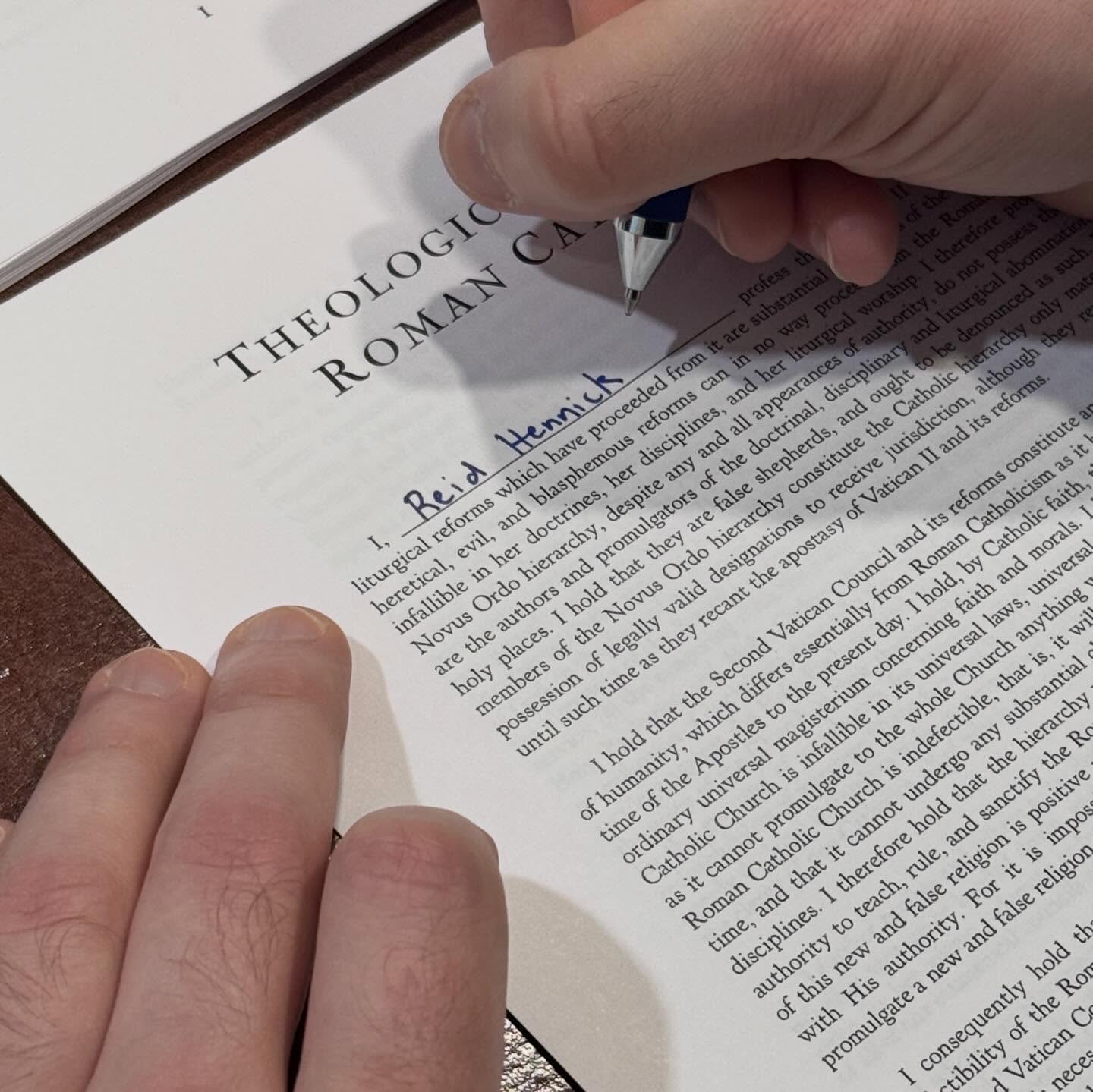
Fr Reid Hennick’s Reception into the Apostolate of Bishop Donald Sanborn: Context, Consequence, and the Unresolved Crisis
The departure of Fr Reid Hennick from the Society of St. Pius X on 12 February 2025—and his subsequent reception, in March 2026, into the apostolate of Bishop Donald Sanborn—must be understood not as an isolated personal decision, but as a development situated within a long-standing and deeply contested theological dispute within contemporary Catholic traditionalism.
The Society of St. Pius X (SSPX) was founded in 1970 by Archbishop Marcel Lefebvre in response to what he and others perceived as doctrinal, liturgical, and disciplinary ruptures introduced in the Catholic Church following the Second Vatican Council. The Society maintains that the post-conciliar reforms—particularly in liturgy, ecumenism, and religious liberty—represent serious departures from prior magisterial teaching. At the same time, however, it continues to recognise the Popes promulgating these reforms as legitimate successors of St Peter, adopting a practical posture often summarised as “recognise and resist.”¹
Fr Reid Hennick, an American priest ordained for the SSPX in 2016 by Bishop Alfonso de Galarreta, was formed within this theological framework. His early intellectual involvement included acknowledged assistance in the SSPX publication True or False Pope?, a work intended as a comprehensive refutation of sedevacantism.² His later departure from the Society must therefore be understood as the result of sustained theological reflection rather than reaction or instability.
In his letter announcing his departure, Fr Hennick stated that his decision arose from “theological conviction and the demands of conscience,” and specifically from his conclusion “that the Holy See has been vacant since the Second Vatican Council.”³ For clarity, sedevacantism (from the Latin sede vacante) is the position that recent claimants to the papacy have not been true Popes, generally on the grounds that public adherence to doctrinal error is incompatible with holding the papal office.⁴ This position is explicitly rejected by the SSPX, which insists that—even in crisis—the continuity of the papal office must be maintained.⁵

At the time of his February 2025 letter, Fr Hennick explained that he had attempted to reconcile his developing convictions with continued ministry within the SSPX, but had concluded that such an arrangement was “unsustainable in the long run.”³ This statement is critical, because it signals the practical implications of his theological conclusion: if the papal office is judged to be vacant, then continued ministry within a body that recognises a reigning Pope becomes internally inconsistent.
That implication became explicit in March 2026, when Fr Hennick was received into the apostolate associated with Bishop Donald Sanborn. This apostolate—often referred to as the Roman Catholic Institute—does not simply hold a general sedevacantist position, but adheres to a specific theological framework known as the Cassiciacum Thesis.
The Cassiciacum Thesis was formulated in the 1970s by the Dominican theologian Michel-Louis Guérard des Lauriers, who had previously served as a consultant to the Holy Office and contributed to theological work during the pontificate of Pope Pius XII.⁶ The thesis represents an attempt to resolve a central problem raised by the post-conciliar situation: namely, how it can be that those widely regarded as Popes have promulgated teachings or reforms which appear to conflict with prior magisterial doctrine, without concluding that the Catholic Church herself has defected—something Catholic theology holds to be impossible.⁷
To address this difficulty, the thesis employs the classical scholastic distinction between matter and form, drawn from Aristotelian-Thomistic metaphysics.⁸ It proposes that a man elected according to the Church’s external procedures may validly receive the material designation to the papal office. In this sense, he is “pope materially” (papa materialiter), meaning that he occupies the position externally and is recognised in the visible order of the Church.
However, to possess the papacy in the full theological sense, he must also possess the form of the office—namely, the authority that flows from adherence to the Catholic faith in its integrity. According to the Cassiciacum Thesis, the post-conciliar claimants lack this formal element due to their adherence to doctrinal novelties. As a result, they are not “formal popes” (papa formaliter) and do not possess true papal authority.⁹
This distinction allows proponents of the thesis to preserve two essential principles simultaneously. First, the visibility and continuity of the Church’s structure, since there remains a materially identifiable line of papal claimants. Second, the indefectibility of the Church, since the Church herself cannot be said to teach error authoritatively if those responsible for such teachings do not possess formal authority.¹⁰
Within this framework, the present situation is understood not as a simple vacancy in the absolute sense, but as a condition in which the papal office is materially occupied but formally vacant—a state of privation rather than total absence. The restoration of normal ecclesial order would therefore require the conversion of a materially designated Pope to the fullness of the Catholic faith, thereby receiving the form of the papacy and exercising true authority.
Fr Hennick’s reception into this apostolate must therefore be interpreted as a movement toward theological coherence. His earlier conclusion regarding the vacancy of the Holy See finds, in the Cassiciacum Thesis, a structured explanation that seeks to reconcile doctrinal integrity with ecclesial visibility without conceding that the Church herself has defected.

The broader significance of this development lies in what it reveals about the internal tensions within traditionalist Catholicism. The SSPX’s “recognise and resist” position represents one attempt to navigate the crisis by maintaining formal continuity with the hierarchy while limiting obedience in practice. The Cassiciacum Thesis represents another, more radical attempt to resolve the same tension by distinguishing between the external possession of office and its internal reality.
Fr Hennick’s trajectory—from assisting in the refutation of sedevacantism to adopting its central premise, and finally aligning with a defined theological articulation of that premise—illustrates the persistence of unresolved questions concerning authority, continuity, and the nature of the papacy in the post-conciliar era.
It is essential, however, to note the manner in which this transition has been undertaken. Fr Hennick explicitly requested that his departure not be used to inflame divisions among clergy and faithful, and there is no indication that his subsequent actions have contradicted that request. His decision appears to have been governed not by polemical intent, but by a desire for theological coherence and fidelity to conscience.
For those within the SSPX, his departure will be felt as a genuine loss. For others, it will be seen as confirmation of conclusions already held. For many, it will serve as a prompt to reconsider questions that have often been deferred rather than resolved.
What remains clear is that the issues raised by this case—concerning the nature of the papacy, the limits of obedience, and the visibility of the Church—are not peripheral, but central. Until they are resolved at the level of the Church’s own authority, they will continue to manifest themselves in cases such as this, where personal decisions become expressions of a wider and still-unfolding crisis.
In the meantime, the appropriate response is neither polemic nor indifference, but prayer: for Fr Hennick, as he continues his priestly ministry; for those who remain within the structures he has left; and above all for the restoration of clarity, unity, and truth within Holy Mother Church.
¹ Marcel Lefebvre, Declaration of 21 November 1974, in They Have Uncrowned Him (Kansas City: Angelus Press, 1988), pp. 218–222.
² True or False Pope? Refuting Sedevacantism and Other Modern Errors (Winona, MN: Angelus Press, 2015), acknowledgements section.
³ Reid Hennick, “Letter on Departure from the SSPX,” 12 February 2025 (circulated publicly with permission).
⁴ Robert Bellarmine, De Romano Pontifice, Book II, ch. 30; cf. The Catholic Encyclopedia, s.v. “Heresy,” New York: Robert Appleton Company, 1912.
⁵ Society of St. Pius X, “Position of the SSPX on Sedevacantism,” official doctrinal statements, SSPX.org.
⁶ Michel-Louis Guérard des Lauriers, Cahiers de Cassiciacum (Rome: privately circulated theological notebooks, 1979–1981).
⁷ Vatican Council I, Pastor Aeternus (1870), DS 3070–3075.
⁸ Thomas Aquinas, Summa Theologiae, I, q. 3, a. 2; cf. Aristotle, Metaphysics, Book VII.
⁹ Guérard des Lauriers, Cahiers de Cassiciacum, thesis on papa materialiter et non formaliter.
¹⁰ Vatican Council I, Pastor Aeternus, chap. 4; cf. Ludwig Ott, Fundamentals of Catholic Dogma (Rockford, IL: TAN Books, 1974), pp. 282–287.
Related Articles


Latest Articles
- 25.10.26 Nuntiatoria CXXIX: CHRISTUS REXThe text discusses the relationship between Christ’s kingship and authority within the Church amidst contemporary challenges. It contrasts ecclesiastical power with genuine faith, emphasising that authority must protect divine truth rather than alter it. The witness of imprisoned priests illustrates the enduring significance of fidelity to Christ over institutional conformity.
- THE DOMESTIC CHURCH: 25 October – 2 November 2026 A Home with Room for Heaven: Preparing for All Saints and All SoulsThe content outlines a week’s plan for traditional Catholic families to prepare for the feasts of All Saints and All Souls. Emphasising daily prayers, remembrance of the deceased, and engagement with children’s activities, it aims to integrate Catholic customs into family life, enriching spiritual practices and fostering a shared faith experience.
- ORDO w/c 25.10.26The text outlines the liturgical calendar for the last week of October and the beginning of November, highlighting key celebrations. Notable events include the Feast of Christ the King, St Evaristus, the Vigil of Saints Simon and Jude, and the Feast of All Saints, emphasising themes of holiness, unity in faith, and the Church’s teachings.
- Christ the King: The Sovereignty of the Crucified RedeemerThe Mass of Christ the King articulates core Catholic beliefs about Jesus’ divine authority, redemptive sacrifice, and the essence of His Kingdom. It emphasises Christ as Prophet, Priest, and King, whose sovereignty is inseparable from His mission of reconciliation, calling the faithful to acknowledge His authority and embrace moral duties rooted in divine truth.
- THE CONSECRATION OF THE HUMAN RACE TO THE SACRED HEART OF JESUSOn 25 October, traditional Catholics will renew the Consecration of the Human Race to the Sacred Heart of Jesus, affirming Christ’s sovereignty over humanity. This act, historically significant, highlights the relationship between divine authority and human responsibility, countering contemporary misunderstandings of faith and moral truth, which increasingly fade from Catholic consciousness.


Leave a Reply