
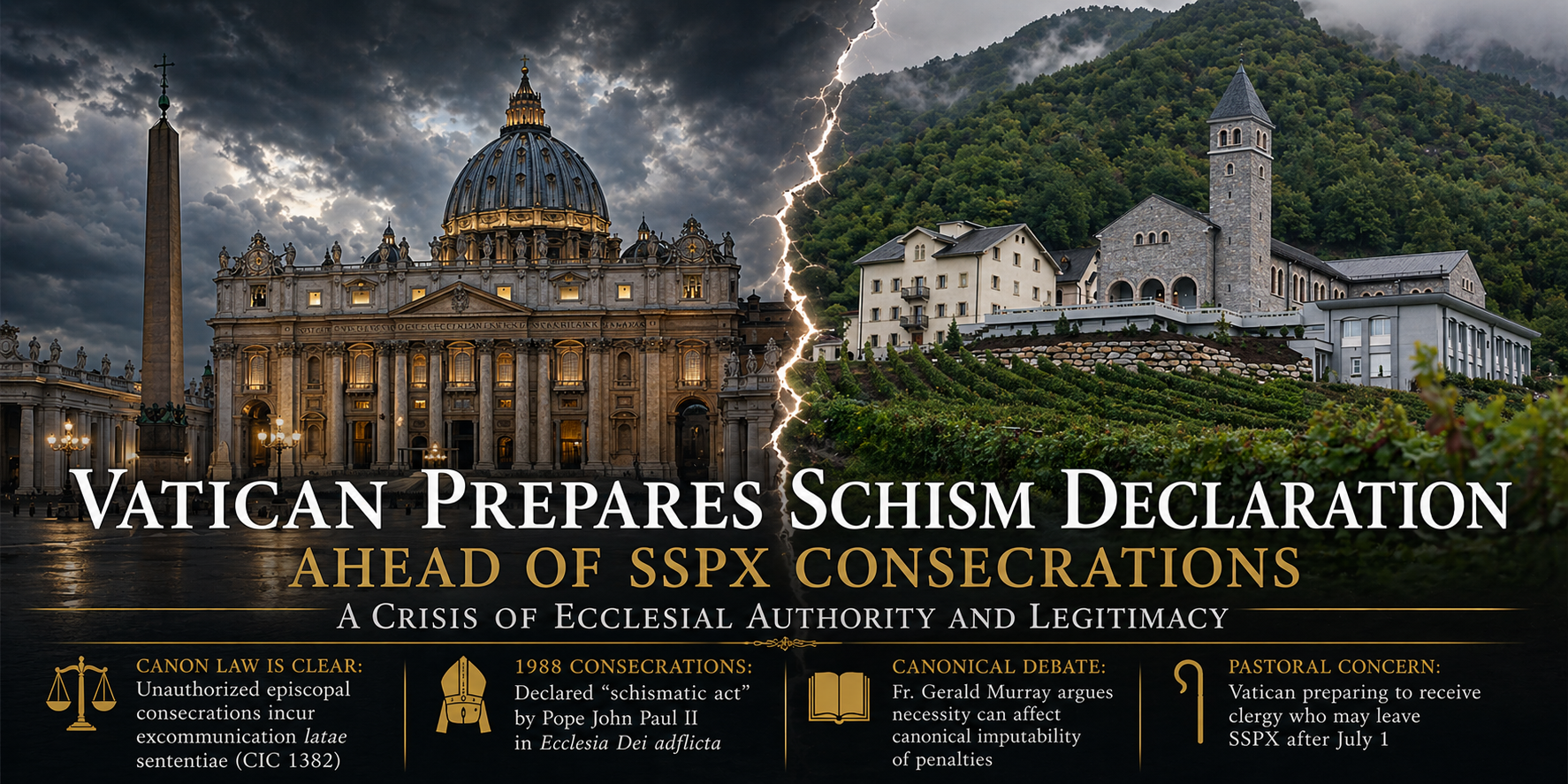
Montagna Report: Vatican Preparing Schism Declaration Ahead of SSPX Consecrations — A Crisis of Ecclesial Authority and Legitimacy

The report published on 28 April 2026 by Diane Montagna, drawing on information attributed to Italian Vatican journalist Nico Spuntoni, that the Dicastery for the Doctrine of the Faith has prepared a declaration of schism in anticipation of episcopal consecrations by the Society of St. Pius X on 1 July at Écône must be treated with exacting precision. It is not an official decree; it is a sourced report of internal preparation. Yet precisely as such, it reveals the operative assumptions guiding Rome’s anticipated response—and exposes a deeper crisis in the exercise and reception of ecclesial authority.
Montagna reports that “informed sources… confirmed… that the Dicastery for the Doctrine of the Faith is already prepared for a scenario of schism,” while also indicating concern for “the pastoral care of the persons… connected to the Society who do not intend to remain in it after a further break with Rome.”¹ This dual preparation—juridical sanction alongside pastoral accommodation—immediately signals that the issue is not merely canonical, but structural.
At the level of positive law, the framework is settled. The 1983 Code of Canon Law provides that a bishop who consecrates another bishop without pontifical mandate, and the one who receives consecration, incur a latae sententiae excommunication reserved to the Apostolic See.² This norm was explicitly invoked in the decree of excommunication issued following the 1988 Écône Consecrations.³ The unity of the episcopate is not ancillary; it is constitutive of the Church’s visible communion.
Yet canon law does not operate mechanistically. It presumes conditions under which penalties are justly imputable. The same Code provides that no penalty is incurred where a person acts under necessity or grave fear, unless the act is intrinsically evil or tends to the harm of souls.⁴ It is precisely this canonical principle that underpinned the reasoning of Marcel Lefebvre, who justified his actions in 1988 on the basis of a status necessitatis arising from the postconciliar crisis.
The canonical complexity of that claim was recognised, albeit critically, by Gerald E. Murray in his doctoral thesis. Murray argued that the application of automatic penalties in such cases cannot be abstracted from the actor’s perception of necessity and the objective conditions of the Church. While ultimately concluding that the consecrations were illicit, he acknowledged that the presence of a claimed necessity introduced a non-trivial question regarding the full canonical imputability of the penalty.⁵ This assessment remains one of the most rigorous canonical treatments of the 1988 events.
What has changed since 1988 is not the law, but the context in which necessity is evaluated. The doctrinal and liturgical tensions following the Second Vatican Council have not resolved into a stable consensus. On the contrary, they have intensified. The promulgation of Traditionis Custodes asserted that the liturgical concessions of previous pontificates had been exploited to foster division.⁶ Yet reporting on the 2020 consultation of bishops—again brought to prominence by Montagna—indicates that many bishops did not identify the traditional liturgy as a principal source of ecclesial discord.⁷ The tension between internal consultation and external policy has contributed to a widening perception gap.
This perception gap is decisive. Authority in the Church is not sustained by validity alone; it depends upon recognition. It must be seen to operate in continuity with the Church’s received doctrine and consistent pastoral practice. Where this perception weakens, obedience becomes strained, and disciplinary measures risk appearing less as acts of justice than as assertions of control.
It is in this light that the reported Vatican strategy must be read. The preparation of a declaration of schism represents a reaffirmation of juridical authority. The simultaneous preparation for the reception of clergy departing the Society reflects an acknowledgement of internal differentiation and potential fracture. This is not a purely punitive posture; it is a managed containment strategy.
The broader magisterial context reinforces this reading. In Ecclesia Dei adflicta (1988), issued in response to the original consecrations, Pope John Paul II described the act as “a schismatic act” and warned that “formal adherence to the schism is a grave offense against God.”⁸ At the same time, he extended pastoral provisions for those wishing to maintain attachment to the traditional liturgy within full communion—an early example of the same dual-track approach now reportedly being prepared.
More recently, in accompanying explanations to Traditionis Custodes, Roman authorities have emphasised the necessity of unity in liturgical expression as a manifestation of ecclesial communion.⁹ Yet this assertion, when juxtaposed with conflicting internal assessments, has raised questions about the coherence of governance.
The interventions of figures such as Athanasius Schneider further illuminate the present tension. Bishop Schneider has publicly acknowledged “a doctrinal crisis” within the Church while rejecting the legitimacy of unauthorised consecrations.¹⁰ His position effectively concedes the existence of the crisis while disputing the proportionality of the proposed response. This narrows the argumentative gap between Rome and its critics, even as it preserves canonical obedience.
Thus the approaching events at Écône must be understood as a test not simply of discipline, but of credibility. If Rome proceeds with a declaration of schism, it will act within its juridical competence. But unless that action is perceived as grounded in transparent continuity with the Church’s tradition—doctrinally, liturgically, and pastorally—it risks diminishing its persuasive force. Authority may be asserted; whether it is received remains another matter.
Conversely, if the Society proceeds with consecrations, it does so under the grave claim of necessity. Such a claim imposes a burden of proof not only theological but prudential. For an appeal to necessity that results in further fragmentation risks undermining the very unity it seeks to preserve.
The deeper crisis, therefore, lies beneath the immediate confrontation. It is the growing divergence between authority as exercised and authority as recognised. The Montagna report, grounded in Spuntoni’s sourcing, does not resolve that divergence. It reveals that Rome is preparing to act within it. And until that underlying tension is addressed—through clarity, consistency, and demonstrable continuity—the fundamental question will remain unresolved: not whether the Church can command, but whether, in commanding, she is still believed.
- Diane Montagna, “Report: Vatican Preparing for Aftermath of SSPX Consecrations,” Substack, 28 April 2026, citing Nico Spuntoni: “informed sources… confirmed… that the Dicastery… is already prepared for a scenario of schism,” with concern for “pastoral care” of clergy.
- Codex Iuris Canonici (1983), can. 1382; revised as can. 1383 in the 2021 Book VI reform: excommunication latae sententiae for episcopal consecration without pontifical mandate.
- Congregation for Bishops, “Decree of Excommunication,” 1 July 1988, declaring that Archbishop Lefebvre and the consecrated bishops incurred excommunication for a “schismatic act.”
- Codex Iuris Canonici (1983), can. 1323 §4; can. 1324 §1 n.5: exemption or mitigation of penalties in cases of necessity or grave fear.
- Gerald E. Murray, The Canonical Status of the Society of St. Pius X in the Light of Ecclesiology and Canon Law (Pontifical Gregorian University, 1995), analysis of imputability under canons 1323–1324.
- Traditionis Custodes, Pope Francis, 16 July 2021: rationale citing the need to restore unity in liturgical practice.
- Diane Montagna, April 2026 reporting on the 2020 Congregation for the Doctrine of the Faith consultation regarding Summorum Pontificum, indicating limited episcopal concern over the Traditional Latin Mass as a source of division.
- Pope John Paul II, Ecclesia Dei adflicta, 2 July 1988, §§3–5.
- Congregation for Divine Worship, “Responsa ad dubia” on Traditionis Custodes, 4 December 2021, emphasising liturgical unity as an expression of ecclesial communion.
- Athanasius Schneider, various interviews and writings (2019–2024) acknowledging doctrinal crisis while rejecting illicit consecrations.
related articles


Latest articles
- Today’s Mass: September 25 Feria of Sunday XVII Post PentecostThe Feria of Sunday XVII Post Pentecost focuses on the commandment of charity towards God and neighbour, emphasising unity in faith. It recalls the story of Saints Placidus and Maurus, disciples of St. Benedict. The Gospel highlights Jesus’ teaching on loving God and neighbour as foundational to the Law.
- Today’s homily: Our Lady of WalsinghamThe Mass reflects on the significance of Walsingham, Loreto, and the Christian soul as “Holy Houses” that embody the connection between heaven and earth. It highlights Mary’s central role in the Incarnation and emphasises the importance of inner conversion by inviting believers to reflect on their own hearts as dwelling places for God.
- Today’s Mass: September 24 Our Lady of WalsinghamThe Feast of Our Lady of Walsingham commemorates the vision of Mary that inspired Richeldis de Faverches to build a replica of her house in Nazareth in 1061. This shrine became a significant pilgrimage site, attracting royal visits until its destruction in 1538. The revival of pilgrimage in the 20th century reaffirmed its spiritual importance.
- Sermon for Blessed Virgin Mary of RansomToday, we commemorate the feast of the Blessed Virgin Mary of Ransom, which honours the Mercedarians, a religious order founded in 1218 to free Christian captives from the Moors in Spain. Their mission persists today, highlighting the ongoing relevance of ransoming captives amidst contemporary persecution, combining spiritual redemption with social responsibility.
- OUR LADY OF RANSOM: THE MOTHER OF THE REDEEMER AND THE BREAKING OF CHAINSThe Feast of Our Lady of Ransom, celebrated on 24 September, commemorates the Mercedarian Order’s mission to redeem Christian captives, embodying the concept of liberation from sin through Christ’s sacrifice. This day’s significance links historical devotion with England’s Catholic restoration, connecting the feast to both the Incarnation and personal spiritual freedom.





Leave a Reply