

Division and Its Discontents: German Defiance, Papal Correction, and the Crisis of Ecclesial Unity

In a recent intervention addressing the trajectory of doctrinal and pastoral developments within the Church—widely understood to concern the German episcopal leadership represented by Reinhard Marx—the Roman Pontiff warned that practices which depart from the integrity of sacramental doctrine risk introducing division into the life of the Church. The response from elements within the German Catholic establishment was swift and revealing. “What causes division,” it has been asserted in defence of these developments, “is not the blessings, but discrimination and exclusion.” This formulation, now circulated with increasing confidence, does not merely contest a disciplinary judgment; it redefines the very terms upon which ecclesial unity is understood.
The present controversy must be situated within the ongoing processes of the Synodal Way, initiated in 2019 and sustained through successive assemblies of bishops and lay representatives. From its inception, the Synodal Way has sought to advance a programme of reform encompassing sexual ethics, ecclesial authority, and sacramental discipline. Among its most contested proposals has been the introduction of liturgical blessings for same-sex unions. Cardinal Marx himself, speaking within this context, has argued that the Church must “develop further” her teaching in light of contemporary understandings of human relationships, insisting that existing moral frameworks fail adequately to reflect lived experience.¹ This appeal to development, framed as pastoral necessity, has become the organising principle of the German position.
Yet against this trajectory stands the consistent and authoritative teaching of the universal Church. In its 2021 Responsum ad dubium, the Congregation for the Doctrine of the Faith declared without ambiguity: “The Church does not have, and cannot have, the power to bless unions of persons of the same sex.”² The rationale offered was doctrinal, not disciplinary. Such unions, the document states, “are not ordered to the Creator’s plan,” and therefore cannot be the object of a blessing, which by its very nature presupposes an objective orientation toward the good. This principle is neither novel nor isolated. It is rooted in the Church’s perennial teaching on marriage and the moral life, reaffirmed by Pope John Paul II in Familiaris Consortio, where he teaches that the Church cannot recognise as morally licit a state of life that contradicts the sacramental sign it professes.³ The logic is consistent: what the Church teaches she cannot deny in practice; what she cannot affirm in doctrine she cannot bless in sign.
The German response proceeds from a fundamentally different premise. By asserting that exclusion, rather than innovation, causes division, it shifts the locus of unity from truth to inclusion. Unity is no longer the fruit of shared adherence to revealed doctrine, but the product of social and affective recognition. Within this framework, the refusal to bless certain unions is recast as discrimination, and fidelity to moral teaching becomes the source of ecclesial rupture. The moral grammar of the Church is thus inverted. The question is no longer whether a given reality conforms to divine law, but whether it is experienced as affirming or excluding.
Such a shift cannot be reconciled with the Catholic understanding of charity. As Thomas Aquinas teaches, “Charity rejoices in the truth” (caritas gaudet de veritate).⁴ To will the good of another is to will that good in accordance with reality as revealed by God, not as constructed by human desire. The suggestion that fidelity to truth constitutes exclusion rests upon a misunderstanding of both charity and justice. It reduces the moral life to the avoidance of perceived harm, rather than the pursuit of objective good.
At a deeper level, the controversy reveals an emerging ecclesiological divergence. The posture adopted by significant elements within the German episcopate suggests a practical reconfiguration of authority. Papal interventions are received, but not determinative; doctrinal clarifications are acknowledged, but not binding in practice. The result is an implicit model of ecclesial life in which local bodies exercise a form of theological autonomy under the language of discernment. Yet such a model sits uneasily with the Catholic understanding of the episcopate as a college united with and under the successor of Peter. As the Second Vatican Council teaches, bishops must act “in hierarchical communion with the head and members of the college.”⁵ Communion is not merely affective; it is doctrinal and juridical.
Nor can the question be reduced to a benign diversity of pastoral approaches. The blessing of unions is not a neutral or symbolic gesture. It is a public ecclesial act that signifies moral approval and invokes divine favour. To bless that which the Church teaches to be disordered is to introduce a contradiction into the Church’s sacramental language. The faithful are left with a dissonant message: that which is said to be incompatible with divine law is nevertheless publicly affirmed in liturgical form. Such incoherence does not preserve unity; it erodes it.
The claim that blessings do not cause division must therefore be examined with greater precision. Division arises not from the articulation of truth, but from its contradiction. Where doctrine and practice diverge, unity becomes unsustainable. The appearance of inclusion may be maintained for a time, but at the cost of internal coherence. The result is not communion, but fragmentation concealed beneath the language of pastoral care.
What is now emerging is not a transient disagreement, but a principled impasse. On one side stands the conviction that truth governs pastoral practice; on the other, the belief that pastoral inclusion must reshape the articulation of truth. These positions cannot be harmonised without altering the substance of Catholic teaching or abandoning the practices in question. The language of “exclusion” serves to obscure this reality, but it cannot resolve it.
The Church has faced such moments before, and the resolution has never been found in ambiguity. It has been found in clarity—in the reaffirmation of what has been received, not in its revision. The present crisis will prove no different. For the question now confronting the Church is not whether she can adapt her language, but whether she can remain faithful to her identity as custos veritatis.
A unity purchased at the price of truth is not unity at all. It is only the postponement of division—and when truth is silenced, division does not disappear; it hardens into structure.
¹ Reinhard Marx, statements and interventions during the German Synodal Way process, 2019–2023, including calls for doctrinal “development” in sexual ethics.
² Congregation for the Doctrine of the Faith, Responsum ad dubium regarding the blessing of the unions of persons of the same sex, 22 February 2021.
³ Pope John Paul II, Familiaris Consortio, 1981, §84.
⁴ Thomas Aquinas, Summa Theologiae, II–II, q. 28, a. 1.
⁵ Second Vatican Council, Lumen Gentium, 1964, §23.


LATEST
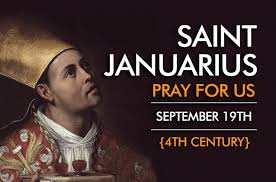
- Today’s Mass: September 19 St. Januarius, Bishop and Companion MartyrsSt. Januarius and companion martyrs were martyred during the persecution under Diocletian. St. Januarius, patron of the city of Naples and bishop of Beneventum, was beheaded with his deacons and some others.
- Sermon for St. Januarius and his CompanionsToday we celebrate the feast of St. Januarius and his companions. About St. Januarius little is known except that he was among the many martyrs during the great persecution under the Emperor Diocletian.
- 20.09.26 Nuntiatoria CXXIV: QUOD ACCEPIMUS, CUSTODIMUS ET TRADIMUSThe editorial emphasises the importance of understanding our inheritance as custodians rather than owners. It highlights the obligation to preserve and transmit the Christian Faith, sacraments, and traditions to future generations. Through gratitude and fidelity, those who receive must ensure that what has been entrusted does not end with them.
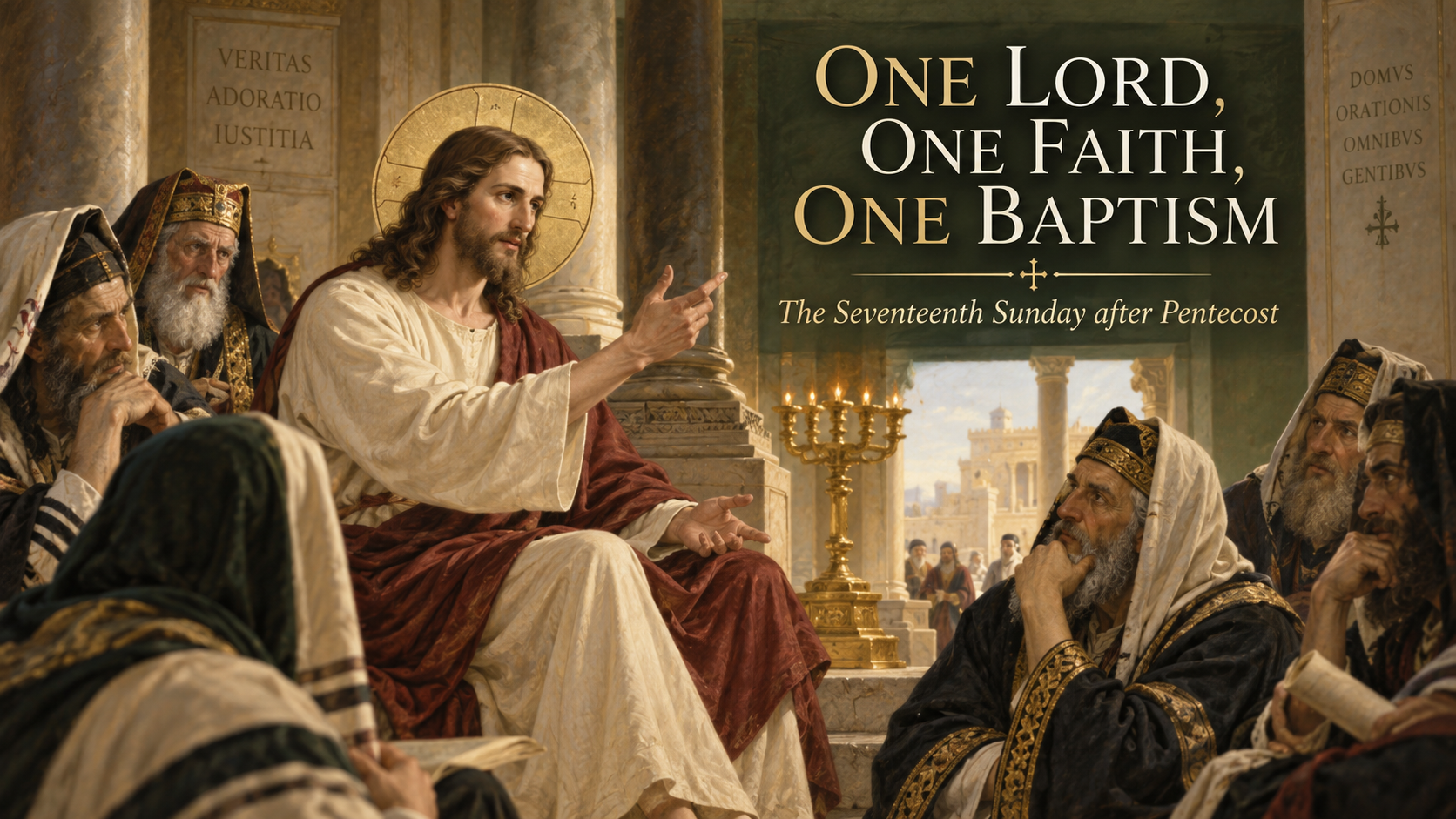
- ONE LORD, ONE FAITH, ONE BAPTISM: The Seventeenth Sunday after PentecostThe Seventeenth Sunday after Pentecost emphasises the love of God and neighbour, rooted in divine justice. The Mass articulates the necessity of one faith and baptism, ensuring charity is not sentimental but deeply theological. The Gospel challenges believers to recognise Christ’s dual nature as both David’s son and Lord, reinforcing true Christian charity.
- AN AWARD IS NOT A MEETINGLambeth Palace has withdrawn the Hubert Walter Award given to Hafiz Tahir Ashrafi for reconciliation, citing previously unknown controversial comments. This raised questions about the vetting process prior to the award. While Ashrafi has defended his record of protecting minority rights, the Palace must clarify why such issues were overlooked initially.



Leave a Reply