

The Limits of Obedience: Cardinal Müller, the Vincentian Canon, and the Question of Necessity

The recent intervention of Cardinal Gerhard Ludwig Müller, rejecting the Society of Saint Pius X’s appeal to a status necessitatis, must be understood not as a passing disciplinary remark but as a theological judgment of considerable weight. It reaches beyond the question of the 1988 episcopal consecrations carried out by Archbishop Marcel Lefebvre and touches the deeper problem now confronting the Church: whether fidelity to the deposit of faith may, under certain conditions, require resistance to those who presently exercise authority within her visible structures.
Cardinal Müller’s argument proceeds with clarity and with a notable degree of theological rigour. He explicitly rejects any notion that the faithful may exercise selective adherence to conciliar teaching, insisting that “a graded assent… cannot mean that an individual… chooses what to accept.”¹ The implication is unmistakable: the method often attributed to the traditional movement—accepting what accords with prior teaching while suspending assent from what appears novel—is, in his view, intrinsically incompatible with Catholic obedience.
From this premise, Müller advances a stronger claim still. To question the doctrinal coherence of the Second Vatican Council, he argues, would be to imply that “the highest doctrinal authority had erred… and endangered salvation.”² Here the debate is elevated beyond prudential disagreement. It becomes an ecclesiological boundary: if the Magisterium cannot err in such a manner, then the conciliar texts must be continuous in substance, and any resistance to them must be unjustified.
It is within this framework that Müller rejects the appeal to necessity. The Church, he contends, has not failed in her essential mission. The sacraments remain available, the hierarchy persists, and the Apostolic See endures. Indeed, he states explicitly that the faithful cannot claim necessity, since “none… is deprived of baptism and penance.”³ From these premises he concludes that the conditions required to invoke a “state of necessity” do not exist, and therefore that extraordinary acts—such as episcopal consecrations without papal mandate—cannot be justified.
This reasoning possesses an internal coherence. Yet it depends upon a decisive narrowing of the concept of necessity. It treats necessity as a question of sacramental survival, whereas the tradition of the Church has consistently understood it in relation to the preservation of the Faith in its integrity and clarity—salus animarum suprema lex.⁴ Müller’s position ultimately reduces to this: that even widespread confusion, doctrinal ambiguity, and pastoral disorder do not constitute a state of necessity, so long as sacramental access remains intact.
The Vincentian Canon as Norm
At this juncture the analysis must be governed by the principle articulated by Vincent of Lérins: quod ubique, quod semper, quod ab omnibus creditum est.⁵ This canon is not an ornament of theological discourse but its rule of judgment in times of dispute. It requires that doctrinal claims, particularly those presented as developments, be measured against the universal and continuous witness of the Church. Continuity cannot be presumed; it must be demonstrated.
This principle reflects the broader patristic mind. St. Athanasius, in the Arian crisis, appealed to the faith handed down from the Apostles as the norm of orthodoxy,⁶ while St. Augustine expressed confidence in the Apostolic See precisely because it safeguarded that received faith.⁷ It is this continuity—not novelty—that constitutes the Church’s claim to authority.
It is precisely here that the contemporary difficulty emerges, for certain teachings of the Second Vatican Council present, at minimum, apparent tensions with prior magisterial formulations. These tensions do not establish rupture; but neither can they be dismissed without examination. They demand the application of the Vincentian rule.
Religious Liberty and the Question of Public Error
The declaration Dignitatis Humanae affirms: “This Vatican Council declares that the human person has a right to religious freedom… immunity from coercion in civil society.”⁸ This formulation is frequently presented as a legitimate development grounded in human dignity. Yet earlier magisterial teaching—particularly that of Pius IX—condemns the proposition that “every man is free to embrace and profess that religion which… he shall consider true.”⁹ Likewise, Leo XIII insists that liberty must not be construed as a right to propagate error in the public order.¹⁰
The theological question therefore presses with urgency: does the conciliar teaching articulate a more precise account of immunity from coercion, or does it introduce a principle that effectively recognises a civil right to the public profession of error? If the former, continuity must be demonstrated not by assertion but by substantive reconciliation with prior teaching; if the latter, the Vincentian Canon identifies a doctrinal tension requiring resolution.
Ecclesiology and the Language of “Subsistit in”
A parallel difficulty arises in the dogmatic constitution Lumen Gentium, which states: “This Church… subsists in the Catholic Church.”¹¹ Prior magisterial teaching had expressed this identity without qualification. Pius XII writes unequivocally: “The Mystical Body of Christ and the Roman Catholic Church are one and the same thing.”¹² The introduction of the phrase subsistit in has therefore occasioned sustained theological debate.
Does this formulation represent a legitimate metaphysical precision—affirming full identity while acknowledging elements of sanctification outside visible boundaries—or does it imply a broader ecclesial reality extending beyond the Catholic Church in a manner not previously articulated? The Vincentian Canon again requires demonstration, not presumption. Development must preserve identity; any shift in meaning must be shown to remain eodem sensu eademque sententia, as reaffirmed by the First Vatican Council.¹³
These Are Not Isolated Cases
It must be stated plainly: these examples are not exceptional or selectively chosen anomalies. They are representative instances within a wider pattern of conciliar formulations that have generated sustained theological debate. Questions have likewise been raised concerning ecumenism, where Unitatis Redintegratio speaks of separated communities as possessing “means of sanctification,” a formulation requiring careful reconciliation with earlier insistence upon the necessity of return to the one true Church.¹⁴ The recurrence of such questions across multiple doctrinal loci is itself significant. It indicates not merely isolated misunderstandings, but the presence of formulations whose interpretation is not self-evident in continuity with prior teaching.
It is noteworthy that such concerns are not confined to those operating outside regular canonical structures. Bishop Athanasius Schneider has acknowledged that certain conciliar texts admit of ambiguity and have been subject to conflicting interpretations, calling for clarification in continuity with prior magisterial teaching.¹⁵ To this must be added the intervention of Benedict XVI, who identified a “hermeneutic of discontinuity and rupture” contrasted with a “hermeneutic of reform in continuity.”¹⁶ This distinction, often cited as a solution, is in fact an admission that divergent interpretations exist and persist.
The point is not that rupture has been demonstrated, but that the burden of demonstrating continuity remains unmet in a manner that satisfies the Vincentian standard. Where multiple areas of doctrine give rise to comparable tensions, the appeal to presumption becomes increasingly insufficient. When continuity must be constantly explained, it begins to appear no longer as continuity received, but as continuity constructed.
Authority, Unity, and the Limits of Obedience
Cardinal Müller rightly insists upon the necessity of unity with the Successor of Peter. Yet his argument rests upon a decisive assumption: that the Church’s indefectibility guarantees the doctrinal coherence of conciliar teaching in such a way that resistance is excluded in principle. This position, while internally consistent, effectively forecloses the very process of doctrinal verification required by the Vincentian Canon.
The Catholic tradition has never proposed obedience as an absolute divorced from truth. Authority is ministerial, ordered to the safeguarding of the deposit entrusted to the Church. St. Thomas Aquinas teaches that human law may fail in particular cases where adherence would be harmful to the common good,¹⁷ and St. Paul records that he “withstood Peter to his face” when conduct endangered the truth of the Gospel.¹⁸ Such examples do not undermine authority; they illustrate its proper orientation to truth.
The Nature of Necessity Reconsidered
The restriction of necessity to sacramental deprivation is historically and theologically inadequate. Necessity may arise not only when the sacraments are unavailable, but when the Faith itself is obscured through ambiguity, contradiction, or unstable formulation. The supreme law of the Church—salus animarum—requires that the integrity of the Faith be preserved, not merely its outward administration.
The history of the Church offers precedent: during periods of doctrinal crisis, orthodoxy has at times been preserved by those who adhered to the received faith in the face of widespread confusion. The appeal to necessity, therefore, is not inherently schismatic; it is a claim that the ordinary means of safeguarding the Faith have been compromised.
Whether that claim is justified in the present circumstances is precisely the question at issue.
Toward a Vincentian Resolution
If the present dispute is to be resolved, it cannot be by assertion alone—neither by the presumption of continuity nor by its denial. The Vincentian Canon demands a process both rigorous and transparent. The task is not to defend positions, but to demonstrate truth.
First, a systematic comparison must be undertaken between contested conciliar formulations and the prior magisterium. This requires identifying precise doctrinal propositions, distinguishing their level of authority, and testing whether they preserve the same meaning and judgment. Such work reflects the method employed by the Fathers, who resolved doctrinal crises by returning to the apostolic deposit.
Secondly, authoritative clarification is required. The Church has never left significant doctrinal tensions unresolved indefinitely. From Nicaea to Trent, ambiguity has been addressed through precise definition. The First Vatican Council affirms that the Holy Spirit was not given to the successors of Peter so that they might “make known some new doctrine,” but that they might “guard and faithfully expound the revelation handed down through the Apostles.”¹⁹
Thirdly, a clear distinction must be maintained between irreformable doctrine and prudential application. Not all conciliar statements carry the same doctrinal weight. Only by maintaining this distinction can genuine development be recognised without collapsing into either relativism or rigidity.
Finally, such a resolution demands intellectual honesty. Apparent tensions must be acknowledged, not dismissed. The Church’s indefectibility is not safeguarded by the suppression of difficulty, but by its resolution in continuity with what has always been believed.
Such a path does not weaken authority; it restores its credibility. It demonstrates that the Church does not ask for blind assent, but for rational and faithful adherence grounded in truth.
Conclusion: A Question That Cannot Be Dismissed
Cardinal Müller’s rejection of the “emergency defence” is coherent within its own framework. Yet precisely because it is coherent, it sharpens the conflict it seeks to resolve. For if the Magisterium cannot err, then the tensions must be only apparent; but if those tensions are real, then the question of how the faithful are to respond cannot be dismissed by appeal to authority alone.
The Vincentian Canon does not permit that dismissal. It demands examination—patient, rigorous, and rooted in the Church’s continuous witness. Until such examination yields a demonstration of continuity that is not merely asserted but shown, the question of necessity will remain. It will persist not as an act of defiance, but as a problem of conscience—rooted not in opposition to the Church, but in fidelity to her enduring Tradition.
¹ Gerhard Ludwig Müller, Communio / Herder interview, 2026.
² Ibid.
³ Ibid.
⁴ Codex Iuris Canonici (1983), can. 1752.
⁵ Vincent of Lérins, Commonitorium, ch. 2.
⁶ Athanasius, De Decretis Nicaenae Synodi.
⁷ Augustine, Sermon 131.
⁸ Second Vatican Council, Dignitatis Humanae (1965), §2.
⁹ Pius IX, Quanta Cura (1864).
¹⁰ Leo XIII, Libertas (1888).
¹¹ Second Vatican Council, Lumen Gentium (1964), §8.
¹² Pius XII, Mystici Corporis Christi (1943).
¹³ First Vatican Council, Dei Filius (1870), ch. 4.
¹⁴ Second Vatican Council, Unitatis Redintegratio (1964); cf. Pius XI, Mortalium Animos (1928).
¹⁵ Athanasius Schneider, Christus Vincit (2019).
¹⁶ Benedict XVI, Address to the Roman Curia (22 December 2005).
¹⁷ Thomas Aquinas, Summa Theologiae, I–II, q.96, a.6.
¹⁸ Galatians 2:11.
¹⁹ First Vatican Council, Pastor Aeternus (1870).
related articles


Latest articles
- Omnia autem probate: quod bonum est tenete ~ Prove all things; hold fast that which is good: Spiritual Conference for Nuntiatoria CXXVIThe conference reflects on St Paul’s assertion to “prove all things” in relation to self-judgement and the Church. It explores themes of synodality, ecumenism, and the importance of discernment, emphasising the need for humility in understanding truth and the challenge of maintaining genuine holiness in the midst of contemporary ecclesiastical crises.
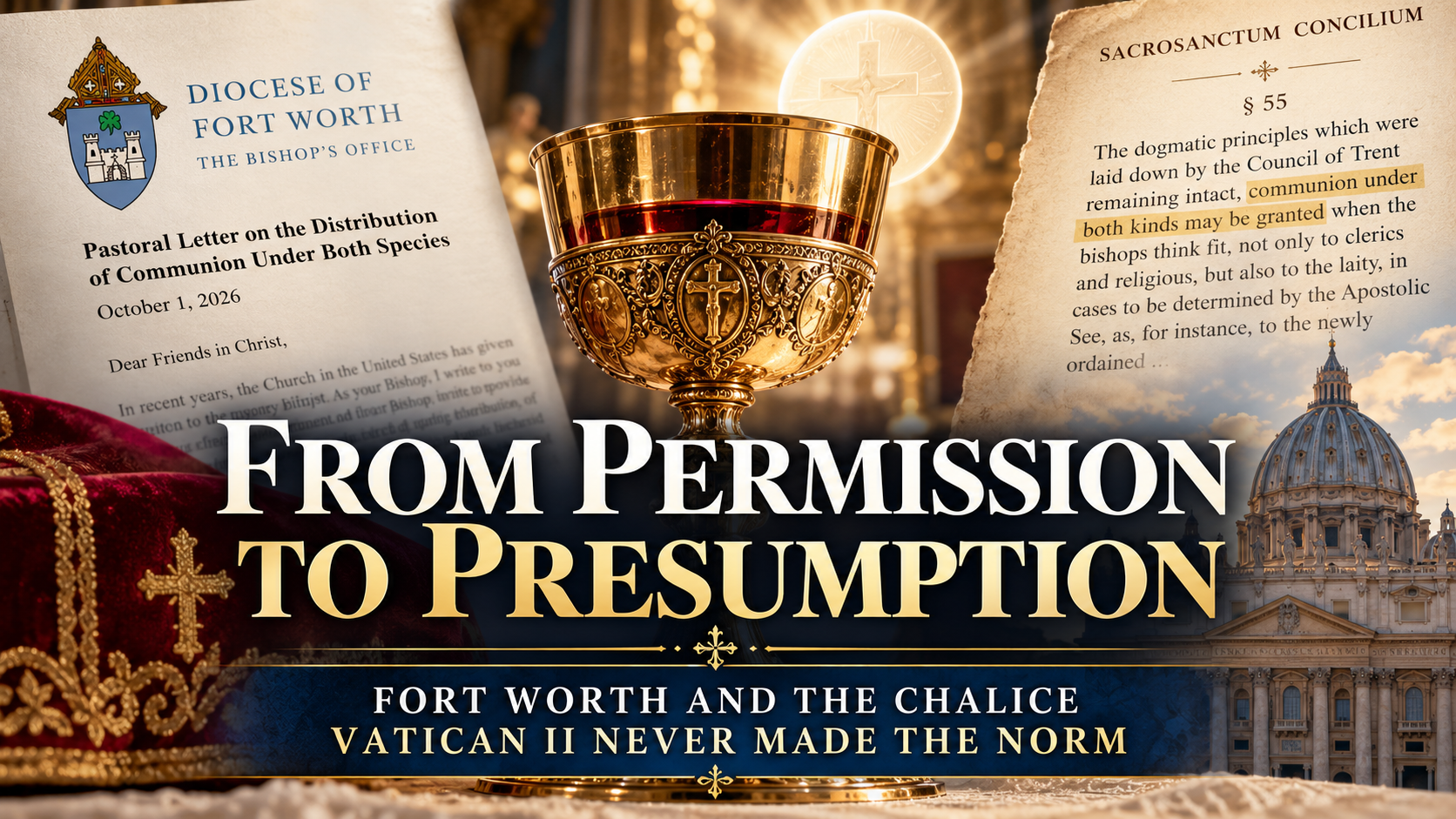
- FROM PERMISSION TO PRESUMPTION: Fort Worth and the Chalice Vatican II never made the NormBishop Michael Olson has implemented strict limitations on the distribution of Communion under both species in the Diocese of Fort Worth, prompting a discussion on the historical evolution of liturgical practices following Vatican II. This decision aims to reaffirm the doctrine of the Eucharist, emphasising that Christ is fully present under either species, while addressing misconceptions surrounding modern practices.
- AUGSBURG 2030: Can Rome commemorate a Confession it once confuted?Pope Leo XIV aims to revitalise the ecumenical spirit of the Augsburg Confession for its 2030 anniversary. However, historical responses from Rome highlight significant doctrinal differences between Catholics and Lutherans. True reconciliation must acknowledge these unresolved issues, as merely celebrating commonality risks glossing over critical theological distinctions that led to the Reformation.
- Today’s homily: St BrunoThe text reflects on Saint Bruno’s journey towards a life of solitude, prayer, and contemplation, emphasising the importance of genuine pursuit of God amidst distractions. It highlights that true spiritual growth requires silence and self-examination, urging believers to reclaim quiet moments for reflection, repentance, and devotion in daily life.
- Today’s Mass: October 06 St Bruno, ConfessorSaint Bruno, born in 1030 in Cologne, founded the Carthusian Order, embracing solitude and prayer. After studying theology and serving as a chancellor, he established a hermitage in the Chartreuse Mountains, combining hermitic and monastic lives. Bruno died on October 6, 1101, leaving a legacy of asceticism and contemplation.




Leave a Reply