
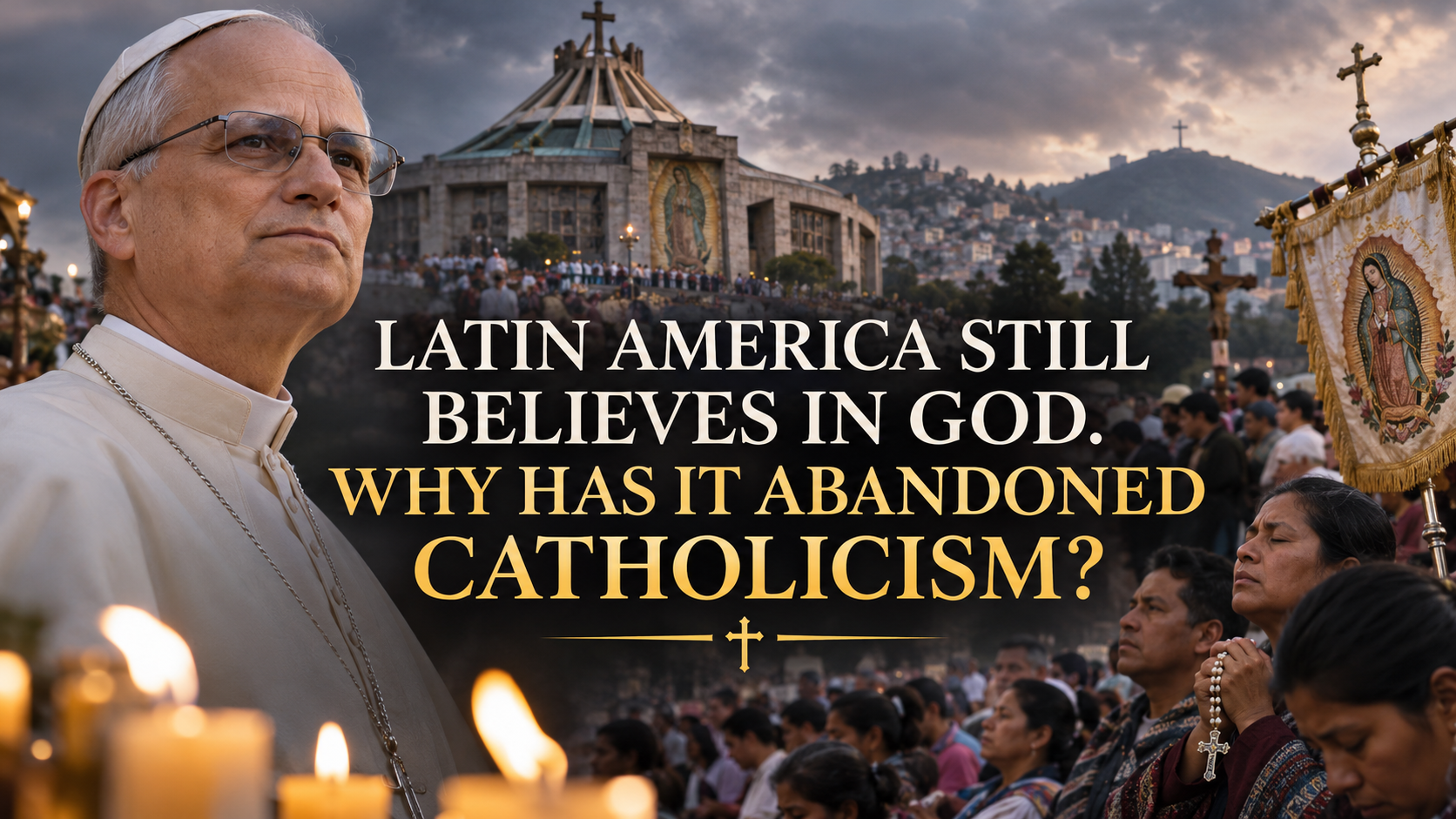
As Pope Leo XIV visits a continent once overwhelmingly Catholic, new research reveals the continuing collapse of Catholic allegiance despite widespread belief in God. The figures invite an examination of sixty years of pastoral reform, the decline of traditional devotion and a theological tendency which has increasingly placed man’s earthly circumstances at the centre of Christianity, obscuring the supernatural end for which the Church exists.
Pope Leo XIV arrived in Montevideo on 6 November to begin a twelve-day journey through Uruguay, Argentina and Peru. His itinerary includes some of Latin America’s most celebrated Catholic shrines, among them Luján in Argentina, where generations have entrusted themselves to Our Lady. The familiar religious culture remains visible throughout much of the continent. Marian processions still attract crowds, patronal feasts retain their place in communal life, and household images of the Sacred Heart and the Blessed Virgin have by no means disappeared. Yet the populations among whom these practices developed are becoming progressively less Catholic. The contrast between surviving devotion and declining allegiance presents the Pope with a problem considerably older than his pontificate, and more serious than the language of contemporary pastoral planning generally admits.¹
The Pew Research Center’s findings, published in January 2026, provide a measure of the deterioration. In 1950, Catholicism accounted for an estimated 95 per cent of Argentina’s population, 93 per cent of Brazil’s, 89 per cent of Chile’s, 91 per cent of Colombia’s, 96 per cent of Mexico’s and 95 per cent of Peru’s. By 1970, the proportions remained remarkably stable in five of these countries. Argentina recorded 91 per cent, Brazil 92, Colombia 95, Mexico 96 and Peru 95. Chile had already declined to 76 per cent, while Uruguay, whose secular political culture long preceded the Council, remained at approximately 63 per cent. Across Latin America as a whole, Catholic identification stood at an estimated 94 per cent in 1910 and 92 per cent in 1970.²
The 2024 surveys present a different picture. Among adults, 58 per cent in Argentina identified as Catholic, 46 per cent in Brazil and Chile, 60 per cent in Colombia and 67 per cent in Mexico and Peru. The historical estimates include children, whereas the recent surveys concern adults, so they should not be treated as measurements of precisely equivalent populations. Pew’s directly comparable adult surveys nevertheless establish that the contraction has continued during the past decade. Between 2013–14 and 2024, Catholic identification fell by thirteen percentage points in Argentina, fifteen in Brazil, eighteen in Chile, nineteen in Colombia, fourteen in Mexico and nine in Peru.³
A considerable part of this decline occurred during the decades following the Second Vatican Council, although religious disengagement began earlier in certain countries and developed within societies undergoing extensive political, economic and cultural change. The figures cannot establish that the Council caused the collapse. They do, however, establish the historical circumstances in which the consequences of post-conciliar reform must be examined. The Catholic hierarchy undertook an extensive reorganisation of worship, catechesis and pastoral activity, frequently justified by the need to make Christianity more accessible and effective in the modern world. The years which followed witnessed an extraordinary contraction in the proportion of the population professing the Catholic faith. Those responsible for the reforms, and their successors, cannot reasonably expect their intentions to serve indefinitely as evidence of their success.
Pew’s findings become more arresting when religious belief is considered separately from denominational allegiance. Ninety-eight per cent of Brazilians say they believe in God, together with 97 per cent of Colombians and Peruvians, 94 per cent of Mexicans, 90 per cent of Argentinians and 89 per cent of Chileans. Such belief may be vague, inconsistent or unaccompanied by religious observance. It does not establish a corresponding commitment to Christian doctrine. Nevertheless, the retreat from Catholic identification has far outpaced the disappearance of theistic belief. Millions have become estranged from the Catholic Church without necessarily losing their religious convictions.
There are several possible explanations, and no responsible investigation could exclude secularisation, urbanisation, political upheaval, migration, clerical scandals or the growing competition of Protestant communities. Yet another consideration deserves greater attention: whether the Catholic hierarchy progressively weakened the religious culture through which successive generations had received, practised and transmitted the faith.
In much of Latin America, Catholicism had never depended exclusively upon what happened in church on Sundays. Religious observance entered the home through the family Rosary, novenas, images of Our Lady and the saints, prayers for the dead, devotion to the Sacred Heart and the celebration of the ecclesiastical year. Confraternities, processions, pilgrimages and patronal feasts connected the sacred calendar with the occupations and relationships of everyday life. The faithful were not uniformly instructed, still less uniformly devout, but their religious inheritance possessed a continuity which formal catechetical programmes alone could never have supplied. Children learnt to pray from their parents and grandparents. The supernatural order was introduced into domestic life through repeated practices whose meaning gradually became familiar.
These customs were especially consequential among the poor, for whom religious books, advanced education and regular access to clergy were not always available. A mother who taught her children to invoke Our Lady, or a family which prayed for its departed relatives, communicated something of the Church’s teaching concerning grace, intercession, judgement and eternal life. The devotions were sometimes imperfectly understood and occasionally mingled with genuine superstition. Such defects required correction, as Catholic pastors had long recognised. They did not render the practices themselves expendable.
During the twentieth century, influential tendencies within the Liturgical Movement developed an increasingly critical attitude towards aspects of popular religion. The proper desire to restore the centrality of the sacred liturgy sometimes encouraged impatience with inherited devotional observances, particularly where these were thought insufficiently biblical, liturgical or intellectually mature. Among progressive clergy, the accusation of superstition could serve as a convenient judgement upon customs which ordinary Catholics had practised for generations. Following the Council, the criticism acquired practical consequences as pastoral and liturgical reorganisation altered the circumstances in which many devotions had traditionally flourished.
An instructive example occurred in September 1964, when the instruction Inter Oecumenici discontinued the obligation to recite the Leonine Prayers after Low Mass. These prayers, including the invocation of St Michael the Archangel, had formed part of the ordinary experience of generations of Catholics. Their removal did not prohibit private recitation, nor can one decision plausibly be made responsible for decades of religious decline. It illustrates, nevertheless, how an established communal devotion could disappear from its customary setting through the exercise of ecclesiastical authority. Similar consequences could follow wherever Rosary devotions, Benediction, confraternities or traditional parish observances ceased to receive clerical encouragement. A custom need not be formally prohibited to become extinct.⁴
The Second Vatican Council itself had commended popular devotions in Sacrosanctum Concilium, provided they were properly ordered towards the sacred liturgy. It also affirmed that Christian spiritual life could never be confined to liturgical participation alone. The subsequent abandonment of traditional practices cannot therefore be attributed indiscriminately to the Council’s express prescriptions. The difficulty concerns interpretations which gained influence during its implementation, the pastoral preferences of those responsible and the assumption that inherited religious culture could be substantially altered without weakening the transmission of Catholic belief.
By December 2001, the Congregation for Divine Worship and the Discipline of the Sacraments was acknowledging the consequences. Its Directory on Popular Piety and the Liturgy identified the hasty abandonment of inherited devotions, the spiritual emptiness which could follow and the unjustified criticism of popular religion undertaken in pursuit of an imagined purity of faith. It also warned against the contrary danger of allowing devotional exercises to displace the primacy of the liturgy. Paragraph 59 acknowledged that post-conciliar generations in some countries had never experienced the devotional practices familiar to their predecessors. The Roman authority responsible for liturgical discipline was recognising a deficiency which many of the faithful had encountered long before it received official expression.⁵
The Congregation’s analysis deserves attention beyond the immediate question of devotional practice. It recognised that the liturgy could not adequately permeate a Christian life deprived of personal prayer and the spiritual dispositions fostered through traditional religious observance. In its treatment of popular piety, it also acknowledged the contribution which such practices had made to preserving the faith, particularly where regular pastoral care was unavailable. These were precisely the circumstances in which domestic and communal devotion had acquired such importance throughout Latin America.
There is a further theological development which helps explain why this inheritance could come to be regarded as less important. Since the 1960s, influential currents within several Christian denominations have increasingly interpreted religion through anthropological and sociological categories. The concerns of humanity in the present world have come to occupy a growing proportion of theological discussion and institutional activity. Within Catholicism this tendency became particularly apparent in political interpretations of evangelisation and certain approaches to liturgical reform. Comparable developments occurred in liberal Protestantism and Anglicanism, where questions of social justice, personal identity, political liberation and changing moral expectations acquired increasing prominence in ecclesiastical deliberation.
These developments were neither universal nor uncontested. Evangelical Protestant movements, for example, frequently resisted doctrinal accommodation and continued to insist upon conversion, biblical authority and the necessity of salvation. Nor is the study of society or human experience improper to theology. The difficulty appears when such considerations cease to illuminate the reception of revealed truth and begin instead to determine what Christianity is expected to teach. The changing assumptions of society then become a measure against which inherited doctrine is judged. Questions of justice and compassion are increasingly considered apart from the supernatural end which gives Christian charity its ultimate meaning.
At the heart of this development lies a misunderstanding of the relationship between the two great commandments of the Law. Our Lord commanded the love of God with the whole heart, soul and mind, and joined to it the commandment to love one’s neighbour as oneself (Matthew 22:37–40). God is the supreme good of man, whose ultimate destiny is communion with Him. The second commandment cannot therefore be properly understood independently of the first. To love one’s neighbour with Christian charity is to desire his true good, above all his participation in the divine life through grace and his attainment of eternal beatitude.
St Thomas Aquinas explains the principle in the Summa Theologiae, II–II, question 25. Charity extends to our neighbour because we love him for God’s sake and desire his participation in the divine good. A rightly ordered love of oneself likewise requires the desire for one’s own supernatural happiness. Such love includes concern for bodily welfare, material necessity and the demands of justice, since man is an embodied and social creature. It cannot, however, terminate in earthly comfort, social equality or political emancipation. These goods remain subordinate to the final end for which man was created.⁶
The distinction is essential to Catholic social teaching. The temporal common good is genuine, and the Church is obliged to defend the dignity of persons, the rights of families, justice in economic relationships and the welfare of those suffering deprivation. The Christian cannot profess love of God while neglecting the neighbour whose need lies before him. Yet the full meaning of charity cannot be established through humanitarian categories alone. A person may relieve suffering without believing in God; a political movement may pursue justice without acknowledging man’s eternal destiny. Such activities can accomplish genuine good. They do not exhaust the supernatural mission entrusted to the Church.
The theological error arises when the temporal common good becomes, in practice, the governing end of Christian activity. Compassion is increasingly understood through the alleviation of suffering, liberation through the removal of oppressive structures, and pastoral success through conformity with contemporary expectations concerning dignity and personal fulfilment. These considerations may involve real moral obligations. They become inadequate when detached from the truth about man’s condition before God. Christian charity must sometimes call a person to repentance, self-denial or obedience to a moral law which he finds difficult. Mercy does not cease to be merciful because it requires conversion. Indeed, a compassion which leaves a person ignorant of his supernatural destiny has neglected the greatest good it could desire for him.
The consequences for ecclesiastical life are considerable. Where the Church is understood principally as an agency for improving human circumstances, her public concerns increasingly resemble those of secular organisations. Political advocacy, humanitarian relief and social reform can gradually overshadow preaching, sacramental life and the cultivation of holiness. Moral teaching becomes vulnerable to the shifting assumptions of society, particularly where acceptance and affirmation are treated as the principal expressions of pastoral charity. An ecclesiastical institution may become highly responsive to contemporary social questions while growing less capable of explaining why anyone should become, or remain, a practising Catholic.
Pope Paul VI had recognised the danger by 1975. In Evangelii nuntiandi, paragraph 32, he warned against reducing the Church’s mission to a temporal project, her aims to an anthropological programme and the salvation she proclaims to material welfare. In the following paragraphs he insisted upon the connection between genuine human liberation and salvation in Christ, while refusing to identify the two. The warning came only ten years after the Council, when the tendencies in question were already apparent. Paul VI understood that the Church might become involved in every contemporary social controversy while gradually losing sight of the specifically religious purpose of evangelisation.⁷
Latin American Liberation Theology supplies a particularly relevant illustration. Emerging prominently during the late 1960s and 1970s, and associated with figures including the Peruvian theologian Gustavo Gutiérrez, it directed considerable theological attention towards poverty, political oppression and social transformation. Its concern for injustice drew upon genuine obligations within Catholic moral teaching. The controversy concerned methods of interpretation, especially where Marxist categories or revolutionary understandings of liberation threatened to subordinate Christian salvation to political emancipation. Cardinal Joseph Ratzinger addressed these dangers in the Congregation for the Doctrine of the Faith’s 1984 instruction Libertatis nuntius, followed by the fuller treatment of Christian freedom in Libertatis conscientia two years later.⁸
There is no evidence that Liberation Theology alone explains the decline of Catholicism in Latin America, nor would it be just to dismiss the sacramental and charitable work of priests whose pastoral concerns included social justice. The pertinent issue concerns the priorities which shaped religious formation. While influential Catholic theologians and pastoral organisers devoted considerable attention to the structural circumstances of poverty, evangelical and Pentecostal congregations frequently attracted the same populations through appeals to personal conversion, prayer, moral discipline and religious commitment.
Pew’s 2014 investigation provides some confirmation of these religious motivations. Among Catholics who had converted to Protestantism, a regional median of 81 per cent considered the desire for a more personal connection with God an important reason for changing allegiance. Sixty-nine per cent mentioned a different style of worship, 60 per cent a greater emphasis upon morality and 59 per cent the wish to belong to a congregation offering more practical assistance. These were respondents’ own explanations, rather than proof of the causes of every conversion. Nevertheless, the answers scarcely suggest that the principal deficiency perceived by those departing was an insufficient ecclesiastical commitment to political transformation.⁹
The recent increase in religious disaffiliation complicates the picture. During the decade covered by Pew’s latest research, Protestant identification rose only modestly in most of the countries examined, while the proportion claiming no religious affiliation increased substantially. In Argentina it rose from 11 to 24 per cent, in Chile from 16 to 33 per cent and in Colombia from 6 to 23 per cent. The departure from Catholicism now includes both those seeking religious commitment elsewhere and those abandoning organised religion altogether. The religious formation of successive generations, rather than competition between denominations alone, must therefore occupy a central place in any serious investigation.
The liturgical consequences of the same anthropological tendency deserve consideration. Catholic worship expresses a theological reality which cannot be adequately described in terms of communal participation. The Mass is the sacramental making-present of the sacrifice of Calvary, offered by Christ through the ministry of His priest. The congregation participates through union with that sacrifice, interior devotion and the dispositions appropriate to divine worship. The Second Vatican Council affirmed the sacred character of the liturgy, and the reformed Roman Missal retains the doctrine of Eucharistic sacrifice. Yet the practical emphasis of some post-conciliar celebrations increasingly settled upon the assembled community, its activity, comprehension and immediate experience.
When the sanctuary, ceremonial, music and conduct of worship direct attention principally towards the congregation, the supernatural and sacrificial character of the Mass may become less readily apparent to ordinary Catholics. The inherited devotional culture had provided an additional means of sustaining that understanding through contemplation, intercession and prayer beyond the liturgical celebration. To weaken both simultaneously was to diminish the ordinary expressions through which the faithful encountered the transcendent realities of Catholicism. The problem cannot be measured simply by counting those attending Mass. It concerns what successive generations understood themselves to be attending, and how that understanding shaped the remainder of their lives.
The pontificate of Francis must be considered within this longer history. He inherited a demographic crisis already decades old, so the reductions recorded between 2013–14 and 2024 cannot properly be attributed to his policies alone. Nevertheless, Catholic identification continued to decline throughout the period, including in his native Argentina, where it fell from 71 to 58 per cent. His frequent emphasis upon synodality, ecological responsibility, migration and social inclusion reflected concerns which may legitimately occupy the Church’s attention. The question is whether the prominence given to such matters was accompanied by sufficient attention to catechesis, repentance, sacramental discipline and the restoration of Catholic devotional life. The available figures show no recovery in Catholic identification during the period surveyed.
The controversies surrounding the Amazon Synod also exposed difficulties inherent in contemporary approaches to religious culture. Authentic inculturation requires the Christian transformation of a people’s inherited customs, preserving what is good while rejecting beliefs and practices incompatible with revelation. An inconsistency arises if traditional Catholic devotions are subjected to suspicion for their supposedly superstitious character while indigenous religious symbolism receives sympathetic consideration without equivalent doctrinal scrutiny. Latin America’s historic Catholicism had already developed substantial expressions of local religious culture through Marian shrines, patronal observances and popular devotion. The pastoral value of that inheritance deserves at least as much attention as the continuing search for new forms of religious expression.
The Dicastery for the Doctrine of the Faith’s Venite ad me, published on 22 October, adds an unexpectedly contemporary dimension. As Nuntiatoria examined in its earlier editorial concerning the document, Rome now acknowledges the interruption of religious transmission within families and the importance of inherited worship, prayer and popular devotion. The Dicastery recognises that children frequently no longer acquire religious habits from their parents and that Christian identity cannot be sustained through occasional institutional contact alone. Its appreciation of contemplation, sacred symbolism and the religious practices of the household is welcome, although the admission inevitably raises questions about earlier pastoral policies.¹⁰
Only the previous week, Nuntiatoria had considered Bishop Mark Beckman’s instruction concerning familiar communal prayers immediately before and after Mass in the Diocese of Knoxville. The bishop did not prohibit private devotion to St Michael, but directed the discontinuation of established congregational practices in their customary setting. The decision illustrated the persistence of an attitude which regards inherited devotions as matters requiring relocation or correction, even when their theological content is orthodox and their history securely Catholic. Such policies may be defended individually as exercises in liturgical discipline. Their cumulative effect upon the religious habits of families and parishes deserves a more careful assessment than the language of regulation generally provides.¹¹
The Vatican has therefore acknowledged two matters of considerable importance. In 2001, its liturgical Congregation recognised the damage associated with the abandonment of popular piety. In 2026, the doctrinal Dicastery identified the interruption of religious transmission within families as a defining problem of contemporary Christianity. Between those acknowledgements lie twenty-five years during which the decline of Catholic identification has continued across much of the historically Catholic world.
The precise contribution of devotional decline to Latin America’s demographic transformation remains to be established through more detailed research. The historical record does not yet provide a comprehensive comparison of household prayer, confraternity membership, devotional observance and sacramental practice across the six countries surveyed. Nor should the continued strength of popular piety in parts of Mexico and Peru, or the older secularisation of Uruguay and Chile, be ignored. Such differences may furnish valuable evidence concerning the relationship between religious inheritance and Catholic perseverance.
Yet the theological issue does not depend upon proving that every lost devotion produced a corresponding loss of Catholic identity. The Church exists to communicate supernatural truth and grace, and the religious culture through which ordinary people receive that inheritance is consequently of immense pastoral importance. When Christianity is increasingly interpreted through the temporal aspirations of humanity, the practices directing man towards his eternal end become more readily regarded as secondary. Their disappearance can then appear as progress, until successive generations no longer possess the habits through which faith was formerly transmitted.
Leo XIV’s visit offers an opportunity to examine this history among the people who have lived through its consequences. The Catholic Church cannot recover its religious allegiance merely by becoming more accomplished at addressing the concerns which already occupy secular society. Its distinctive responsibility remains the proclamation of Christ, the worship of Almighty God, the administration of the sacraments and the formation of souls for eternal life. Works of mercy and the pursuit of justice belong inseparably to that vocation, provided they remain ordered towards the supernatural good of those whom the Church is called to serve.
The governing theological principle was explained long before the present crisis. We love our neighbour with Christian charity because we desire for him the supreme good which we must also desire for ourselves: communion with God. Paul VI recalled the same order when he warned against reducing evangelisation to the improvement of earthly circumstances. The question now confronting Latin America’s bishops is whether the priorities of their pastoral programmes have consistently reflected it. The historical results give them ample reason to examine the matter.
- Holy See Press Office, Apostolic Journey of His Holiness Pope Leo XIV to Uruguay, Argentina and Peru: Programme, 21 September 2026.
- Pew Research Center, Religion in Latin America: Widespread Change in a Historically Catholic Region, 13 November 2014, pp. 26–27.
- Pew Research Center, Catholicism Has Declined in Latin America Over the Past Decade, 21 January 2026.
- Sacred Congregation of Rites, Inter Oecumenici, 26 September 1964, §48(j).
- Second Vatican Council, Sacrosanctum Concilium, 4 December 1963, §§12–13; Congregation for Divine Worship and the Discipline of the Sacraments, Directory on Popular Piety and the Liturgy, December 2001, Introduction and §§47–59, 61–64.
- St Thomas Aquinas, Summa Theologiae, II–II, q. 25, aa. 1 and 4.
- Paul VI, Evangelii nuntiandi, 8 December 1975, §§29–35.
- Congregation for the Doctrine of the Faith, Libertatis nuntius, 6 August 1984; Libertatis conscientia, 22 March 1986.
- Pew Research Center, Religion in Latin America: Widespread Change in a Historically Catholic Region, 13 November 2014, religious switching analysis.
- Dicastery for the Doctrine of the Faith, Venite ad me: Considerations on the Transmission of the Faith in an Epochal Change, 22 October 2026; Nuntiatoria, Venite ad me: Leo XIV, Cardinal Fernández and the Tradition Rome Has Failed to Transmit, 23 October 2026.
- Nuntiatoria, Knoxville’s Retreat from Tradition: First the Mass, Now St Michael, 16 October 2026.



Leave a Reply