
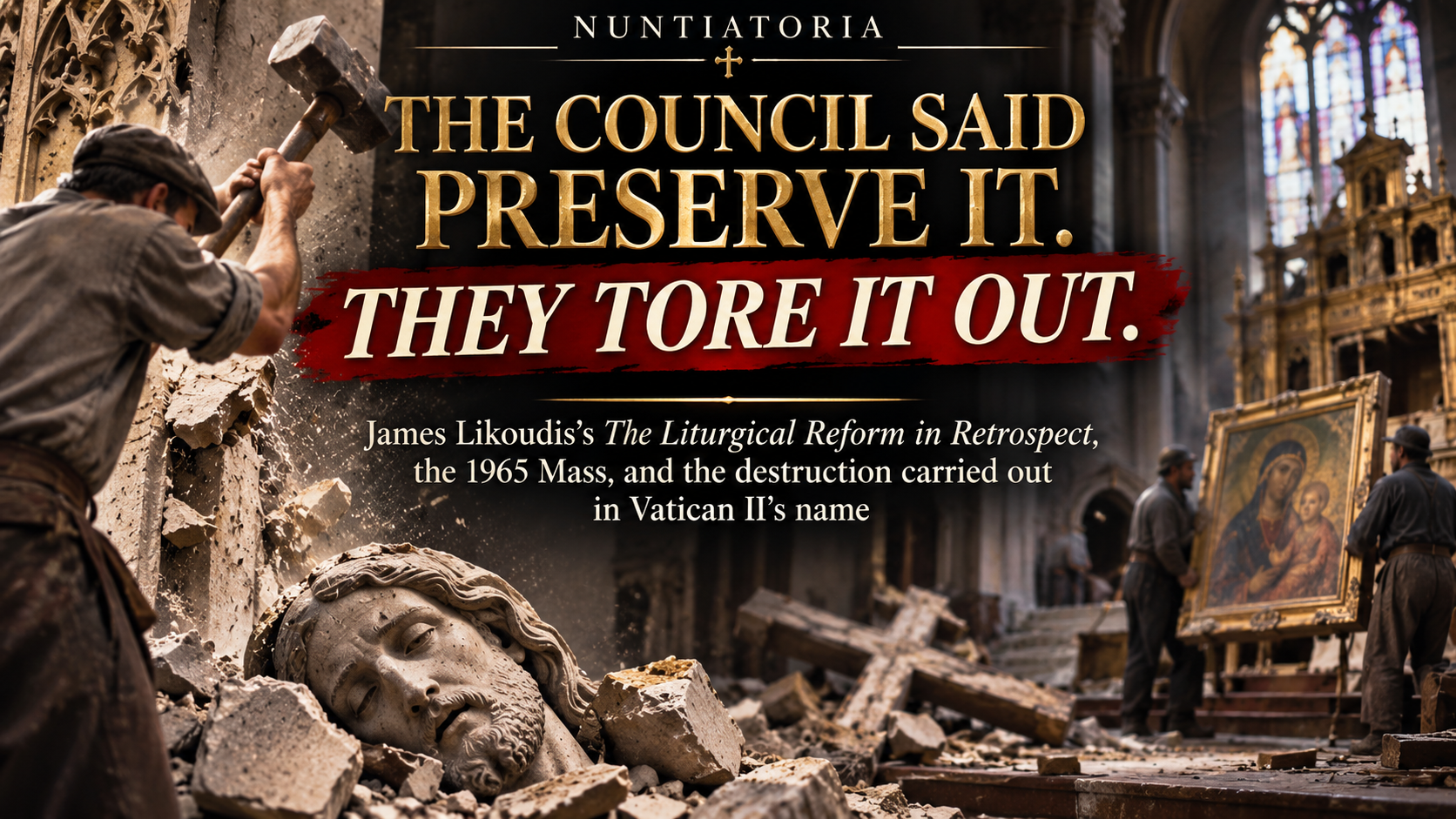
James Likoudis, the forgotten 1965 Mass, and the destruction carried out in Vatican II’s name
James Likoudis’s final defence of the postconciliar liturgical reform raises a question his appeal to papal authority cannot answer: why was so much changed, abandoned or destroyed in the name of a Council which had expressly ordered its preservation? The evidence extends far beyond the reconstructed Roman Missal. It includes stripped sanctuaries, discarded and sometimes burned sacred furnishings, the near-disappearance of Latin and Gregorian chant from ordinary worship, and the transformation of seminaries and religious life. The interim Mass of 1965 demonstrates that the Council’s pastoral objectives could be pursued without the reconstruction of 1969–70. More remarkably, Rome itself acknowledged that Vatican II was being invoked to justify practices contrary to its intentions. The resulting controversy concerns not simply the obedience of those who resisted the reforms, but the fidelity of those who implemented them.
James Likoudis spent much of his life defending the Second Vatican Council and the authority of the Catholic Church. His final essay, The Liturgical Reform in Retrospect, recently republished by his grandson Andrew Likoudis in Tradition & Renewal, represents the considered judgement of a man who had devoted decades to one of the most consequential controversies in modern Catholic history. Having entered the Church in 1952, he knew the Roman liturgy before the Council, witnessed its subsequent transformation, and was sufficiently concerned by the disorder which followed to co-author The Pope, the Council, and the Mass with Kenneth D. Whitehead in 1981. He deserves a serious answer, not least because his defence of ecclesiastical authority arose from a sincere commitment to Catholic unity. But there is a conspicuous weakness in his final argument. Likoudis acknowledges much of what went wrong after the Council, yet repeatedly directs his criticism towards those who resisted the changes rather than those who introduced them. He recognises the disappearance of inherited liturgical forms, the confusion experienced by the faithful, the disorderly experimentation and the loss of familiar patterns of worship. He even concedes that Sacrosanctum Concilium envisaged a more conservative approach than many of the measures subsequently undertaken. Having conceded so much, however, he returns to the obligation of Catholics to submit to legitimate ecclesiastical authority. He has identified the damage but has not adequately examined those responsible for it.¹
The Catholic Church undoubtedly possesses authority to regulate her public worship. The Roman Pontiff enjoys supreme jurisdiction in matters of ecclesiastical discipline, and the faithful owe obedience to legitimate government. But the possession of authority does not establish that every exercise of it is wise, necessary, pastorally beneficial or faithful to the fullness of the Church’s inheritance. A superior may have the power to command something and still exercise that power imprudently. His jurisdiction does not transform a mistaken decision into a sound one, nor does the lawfulness of an alteration demonstrate that what was removed had become spiritually worthless. Likoudis correctly distinguishes the unchangeable substance of the sacraments from the changeable elements of liturgical discipline. His difficulty is that he treats the changeable character of those elements as though their alteration carried comparatively little theological significance. Yet the Church’s prayers, ceremonies, sacred language and customary gestures are among the principal means by which the faithful learn, profess and transmit Catholic doctrine. A genuflection is not necessary for transubstantiation. Neither is a particular arrangement of candles, the traditional Offertory, the use of Latin or the orientation of the priest at the altar. None of this proves that their removal is inconsequential. The Church did not spend centuries developing a recognisable language of sacred worship merely to discover that much of it could be discarded without spiritual loss.
The distinction between authority and stewardship has already informed Nuntiatoria’s Authority Is Not Alchemy, Reverence Cannot Rewrite History, The Most Clerical Revolution in Modern Catholic History, and The Council, the Reform, and the Missing “Thus”. Those investigations demonstrated the importance of distinguishing four things which have too often been confused: what Vatican II expressly decreed, what the Consilium subsequently proposed, what Paul VI authorised, and what eventually became customary throughout much of the Church. These were not one and the same historical act. Yet they have repeatedly been defended as though the mere invocation of Vatican II settled every question about what followed. The problem is especially apparent in Likoudis’s essay because he recognises that the Council’s liturgical Constitution sought to preserve much of the inherited Roman Rite, while also acknowledging that the subsequent implementation removed many of its defining features. The discrepancy is visible in his own account, but its implications are never properly pursued. Instead, he treats the Church’s authority to regulate worship as the principal answer to difficulties created by the manner in which that authority was exercised.²
Likoudis even describes the near disappearance of the exclusively Latin Mass as a foreseeable consequence of the Council. That assertion deserves scrutiny because the Council actually said something rather different. Sacrosanctum Concilium, promulgated on 4 December 1963, instructed that Latin should be preserved in the Latin rites, envisaged the faithful continuing to recite or sing their proper parts of the Ordinary in Latin, and gave Gregorian chant pride of place in the Roman liturgy. It authorised a wider use of vernacular languages, particularly where pastoral advantage could be established, but did not command Latin’s effective disappearance from ordinary parish worship. Paragraph 23 established an even more fundamental rule: there must be “no innovations unless the good of the Church genuinely and certainly requires them”, and new forms should develop organically from those already existing. This was not a decorative introduction to the Constitution. It was a governing principle intended to regulate the entire undertaking. The Council required careful theological, historical and pastoral investigation, the preservation of sound tradition, and alterations justified by genuine ecclesiastical benefit. It did not present innovation as an achievement in itself or the inherited form as an obstacle whose removal required little explanation.³
That principle imposes a burden which Likoudis never satisfactorily discharges. What genuine and certain good required the removal of the traditional Offertory? What deficiency demanded the multiplication of Eucharistic Prayers in a rite whose defining feature had been the Roman Canon? Why was the inherited calendar so extensively reorganised? Why did Latin practically disappear from ordinary parish worship when the Council had expressly required its preservation? Why was Gregorian chant displaced when it had been accorded a privileged place? Why did historic sanctuaries need to be dismantled, religious habits abandoned and established forms of clerical formation reconsidered or discarded? These are not identical questions. Some concern official liturgical reform, others subsequent permissions, local decisions or unauthorised abuses. Their canonical status differs. But they share an important historical feature: they became associated with the implementation of Vatican II despite the absence of any general conciliar command requiring them. To answer that ecclesiastical authority possessed the power to introduce or permit particular changes does not explain why those changes were desirable. It merely identifies who possessed the power to authorise or prevent them.
St Thomas Aquinas had already recognised that alterations to established law require more than the discovery of a theoretically better arrangement. In the Summa Theologiae, I-II, q.97, a.2, he explained that even a change capable of producing some benefit may injure the common good by disturbing established custom. The stability of law is itself valuable, and the loss occasioned by change requires substantial justification. The principle is especially relevant to worship, where repeated actions and inherited forms shape the religious understanding of an entire community. A liturgical reform must therefore account not only for what it introduces but for what its introduction requires the faithful to surrender. The Roman Rite was not an unfinished project awaiting completion by twentieth-century experts. Its prayers, ceremonies, devotional customs and theological vocabulary embodied centuries of ecclesiastical worship, having been examined, corrected, enriched and transmitted by generations of popes, bishops, theologians, saints and ordinary Catholics. It remained capable of legitimate development, but its inheritance did not become expendable merely because legitimate authority had authorised a revision.⁴
The most revealing evidence that the comprehensive reconstruction of the Roman Mass was not the inevitable consequence of Vatican II is the interim rite introduced in 1965. Following the instruction Inter Oecumenici, a revised Ordo Missae came into use on 7 March of that year. It was a transitional arrangement rather than a wholly new typical edition of the Roman Missal, and it was never presented as the completed implementation of the Council. Nevertheless, it demonstrates how substantial elements of the conciliar programme could be applied while retaining the fundamental structure and sacrificial vocabulary of the inherited Roman Rite. The alterations were real. Certain repetitions were suppressed, the prayers at the foot of the altar were abbreviated, the Last Gospel was omitted, readings could be proclaimed in the vernacular, and provision was made for the Prayer of the Faithful. Congregational responses received greater emphasis, while the homily and the intelligibility of the liturgical action were given renewed attention. Catholics attached to the older rubrics may reasonably question some of these changes, particularly when judged against the Roman discipline which preceded the reforms of the 1950s. Yet the Mass remained immediately recognisable. The traditional Offertory was preserved, the Roman Canon remained the Eucharistic Prayer, and the celebrant continued the central sacrificial action according to the inherited ceremonial framework. Celebration facing the congregation was not made obligatory.⁵
The documentary evidence is direct. The Canadian Catholic Conference’s official publication of the revised Ordo Missae and Ritus Servandus in May 1965 retains Suscipe, sancte Pater, Offerimus tibi, Domine, In spiritu humilitatis, Veni, sanctificator and Suscipe, sancta Trinitas. It also preserves the Roman Canon beginning Te igitur. This is not a traditionalist reconstruction of what Vatican II might have intended; it is evidence of what the Church actually began to implement immediately after the Council. If the faithful needed to understand the Epistle and Gospel, those readings could be proclaimed in their own language. If congregational participation was insufficient, responses and chants could be encouraged. If Catholics needed to understand the ceremonies more thoroughly, instruction and preaching could be improved. If particular repetitions required simplification, they could be examined individually. None of these objectives inherently required the replacement of the traditional Offertory or the introduction of several additional Eucharistic Prayers. The Council had certainly anticipated further work, including a richer biblical lectionary and the revision of particular ceremonies, so it would be inaccurate to claim that every Council Father intended the 1965 settlement to remain definitive. But the existence of that settlement establishes an indispensable historical fact: the comprehensive reconstruction of 1969–70 was not the only conceivable way of fulfilling the Council’s pastoral objectives. A route already existed which preserved substantially more of the inherited Roman Mass while implementing many of the changes expressly envisaged by the Council. Why was it considered insufficient?⁶
The question becomes sharper when the further instruction Tres abhinc annos, issued in May 1967, is examined. Additional genuflections, kisses of the altar and signs of the cross were reduced. The Canon could be recited aloud, wider vernacular use was permitted under the applicable authorisations, and the maniple ceased to be required. The inherited ceremonial vocabulary was progressively simplified before the new Order of Mass had even been promulgated. Each alteration can be defended separately as leaving sacramental validity intact, but this does not answer the question of its cumulative significance. Catholics had learned reverence not only through spoken prayers but through what they saw the priest doing. He approached the altar in a particular manner, made repeated gestures of adoration, treated the sacred vessels with extraordinary care and surrounded the consecration with ceremonies expressing the holiness of the action taking place. If those ceremonies had become insufficiently understood, why was the preferred solution so frequently to remove them rather than explain them? The Council had explicitly demanded improved liturgical formation. It had not established that the faithful could participate properly only once inherited ceremonies had been simplified to the point of immediate intelligibility.⁷
Pius XII had addressed the underlying danger in Mediator Dei in 1947. He recognised the Church’s power to regulate the liturgy and rejected the reduction of worship to mere external ceremony, but he also warned against an exaggerated antiquarianism which treated earlier forms as necessarily superior to later developments. The fact that a ceremonial element had developed during the Middle Ages did not make it a corruption, nor did the identification of an earlier practice automatically justify removing what centuries of legitimate Catholic development had added. The Roman Rite was not an archaeological site from which subsequent centuries could simply be excavated and discarded. Its inherited prayers and ceremonies represented the cumulative religious life of the Roman Church. This does not mean that every addition was equally valuable or incapable of revision. It means that the value of a practice cannot be measured solely by its historical age or by its conformity to a scholar’s reconstruction of early Christian worship. The Church’s liturgical tradition had developed precisely because successive generations had contributed to it. An authentic restoration ought therefore to be able to explain why particular inherited elements were removed, not merely why different arrangements were possible.⁸
The traditional Offertory illustrates the problem particularly clearly. Its prayers anticipated the Eucharistic Sacrifice through an explicitly sacrificial vocabulary, situating the priest’s action within the worship of the whole Church and associating the offering with the salvation of souls. The revised preparation of the gifts employed different formulas blessing God for bread and wine received from His bounty. Those formulas are capable of entirely orthodox interpretation, and the revised Missal retains sacrificial language elsewhere, including in the Prayer over the Offerings, the invitation Orate, fratres, and the Eucharistic Prayers. It would therefore be incorrect to claim that the revised rite simply denies the sacrificial nature of the Mass. Nevertheless, the replacement altered the manner in which that doctrine was communicated at a particular moment of worship. The traditional prayers were neither invalid nor incapable of expressing the distinction between the unconsecrated gifts and the Eucharistic Victim. Their sacrificial language anticipated the consecration rather than suggesting that transubstantiation had already occurred. The Council did not expressly require their replacement. A preference among reformers for a different theological or ritual arrangement cannot, without further argument, establish the genuine and certain benefit which Sacrosanctum Concilium required.
The same question arises, with still greater force, concerning the Roman Canon. In Missale Romanum, his apostolic constitution of 3 April 1969, Paul VI himself acknowledged that “The major innovation concerns the Eucharistic Prayer.” He authorised three additional Eucharistic Prayers alongside the traditional Roman Canon, and approved corresponding changes to the institution narrative. The words Mysterium fidei were moved from their traditional position within the chalice formula to the introduction of the people’s acclamation. The historical importance is immense. The Roman Canon was not merely one prayer among several which happened to be available for use. It was a defining feature of the Roman Rite, substantially stable across many centuries and saturated with the language of sacrifice, intercession, saints, martyrs and heavenly worship. The introduction of alternatives changed its place within the ordinary liturgical life of the Church. What had been the fixed Eucharistic Prayer became one option among several. The Eastern Catholic Churches have long possessed a legitimate diversity of anaphoras, demonstrating that multiple Eucharistic Prayers are not intrinsically contrary to Catholic doctrine. But the existence of that diversity elsewhere does not establish that the Roman Rite needed to alter its own settled practice. Paul VI described this as the principal innovation, and it therefore deserves a substantial justification. Why was such a fundamental alteration required when the Council had not expressly commanded it?⁹
The reservations expressed by bishops before the final promulgation of the revised Missal further complicate Likoudis’s account. When the experimental Missa normativa was presented to the first Synod of Bishops in October 1967, the vote on its general structure produced 71 unqualified approvals, 62 approvals subject to modification, 43 negative votes and four abstentions. These figures are preserved in the Consilium’s own journal, Notitiae. The qualified approvals cannot fairly be counted as rejections, but neither can they be presented as unreserved endorsement. Only 71 bishops approved the proposed general structure without conditions. The report also records concerns about preserving inherited ceremonies, including signs of the cross, genuflections and other gestures which some bishops wished to retain. The Synod was not Vatican II, its consultation did not possess the authority of the Council, and the experimental rite differed in certain respects from the final Missal. Nevertheless, the episode establishes that substantial episcopal reservations existed before the reform was completed. It is historically misleading to speak as though every subsequent decision of the Consilium was simply the unquestioned expression of the mind of the Council Fathers. The reform involved choices, those choices were disputed, and some went significantly beyond what the Council had explicitly prescribed. Their eventual papal authorisation settled the matter of lawful promulgation. It did not retrospectively establish that every choice had been necessary or prudent.¹⁰
The reconstruction also extended beyond the Order of Mass itself. The calendar, lectionary, collects, proper prayers and other liturgical texts underwent substantial alteration. The expanded lectionary represented a serious attempt to fulfil the Council’s desire for a richer presentation of Scripture, placing a greater selection of biblical readings before the faithful, and that achievement should be acknowledged. But providing additional readings did not inherently require the extensive reassignment of ancient collects and other prayers. The Roman liturgical year had developed an internal coherence through centuries of use. Its prayers, Epistles, Gospels and chants formed part of an inherited spiritual pattern, their annual recurrence shaping the Catholic imagination and allowing generations of faithful to encounter the same doctrines and petitions at recognisable moments in the Church’s year. A collect was not merely a paragraph which could be moved elsewhere without consequence. Changes to individual texts may be defensible, but their collective reassignment requires a more substantial explanation than the assertion that the revised books provide greater variety. Enrichment does not necessarily require displacement, and the existence of additional material does not prove that the loss of an established relationship between prayers and seasons was beneficial.
This is one reason Likoudis’s comparison between Trent and Vatican II is historically unsatisfactory. The Missal promulgated by St Pius V in 1570 substantially codified and standardised an inherited Roman liturgical tradition. It did not invent the Roman Mass. Its sacrificial prayers, Canon and ceremonial structure had developed long before the Council of Trent, and Pius V’s legislation expressly protected other venerable liturgical usages. The reform of Paul VI was a substantially different undertaking, involving extensive textual reconstruction, the introduction of new Eucharistic Prayers and major alterations to the calendar, lectionary and ceremonial structure. Both reforms were undertaken through papal authority, but that does not make them historically equivalent. Nor should the intervening developments be overlooked. The Roman books had already undergone substantial changes before Vatican II, notably through the Holy Week reforms of the 1950s and the simplification of rubrics under Pius XII and John XXIII. These reforms also merit examination against the principles of continuity and necessity. There is no need to pretend that the liturgical inheritance remained entirely unchanged until 1969. The relevant question is whether the extent and character of each alteration can be justified, not whether any change had ever occurred.
The controversy would already be substantial if it concerned only the revised Missal. But the postconciliar transformation reached far beyond the texts placed upon the altar. It reached the altars themselves. Throughout much of the Western Church, sanctuaries were remodelled, high altars removed or displaced, Communion rails demolished, statues taken away and valuable furnishings discarded or dispersed. Traditional arrangements which had served Catholic worship for generations were treated as unsuitable for the new liturgical age. Not every alteration was unlawful. The Council permitted contemporary sacred art and called for appropriate adaptations to churches in order to facilitate legitimate liturgical needs. Some modifications were carefully undertaken and genuinely beneficial. Others were destructive, and Vatican II had not ordered that destruction. Sacrosanctum Concilium §123 required the Church’s artistic inheritance to be carefully preserved. Paragraph 125 maintained the veneration of sacred images, paragraph 126 instructed bishops to protect valuable works of art and sacred furnishings, and paragraph 129 required seminarians to be educated so that they might appreciate the Church’s venerable monuments. These were positive obligations. They cannot reasonably be reconciled with the indiscriminate stripping of sanctuaries or the treatment of historic ecclesiastical furnishings as rubbish.³
The evidence is not merely anecdotal. On 11 April 1971, the Sacred Congregation for the Clergy issued Opera Artis, a circular letter concerning the preservation of the Church’s historical and artistic inheritance. It complained that unwarranted changes had been made to places of worship under the pretext of carrying out liturgical reform, resulting in the “disfigurement or loss of priceless works of art.” This was not the accusation of a traditionalist polemicist. It was an official Roman admission, issued only a few years after the Council closed. The document insisted that inherited works of art should be preserved and continued to serve the Church wherever possible. It instructed bishops to protect historic churches and sacred objects, ensure that alterations were genuinely necessary, consult competent experts and preserve works which could no longer be employed in ordinary worship. The implications are unmistakable. Rome recognised that the language of liturgical reform had been used to justify the destruction of things which the Council itself had instructed ecclesiastical authorities to protect. The Congregation was obliged to remind bishops of responsibilities they already possessed.¹¹
A church building does not remodel itself. The removal of a historic altar, the demolition of a Communion rail, the dispersal of valuable furnishings and the transformation of a sanctuary required decisions by clergy, architects, commissions, religious superiors and diocesan authorities. Some acted from sincere conviction; others accepted contemporary theories with insufficient scrutiny. Some believed that removing visible signs of inherited Catholic worship would make churches more accessible to modern congregations. But good intentions do not restore a destroyed altar, nor does invoking Vatican II excuse conduct which Vatican II never commanded. Nothing in the Council required Catholics to be deprived of sacred beauty in order to participate more fully in the liturgy. A high altar could communicate the sacrificial character of the Mass. A sanctuary rail could teach reverence and distinguish sacred space. Sacred images could raise the mind towards heavenly realities. The presence of saints and martyrs in stone, wood or glass formed part of the devotional world in which generations of Catholics had learned their faith. These were not automatically obstacles to participation, and the assumption that they were ought never to have been treated as self-evident. The Church had not spent centuries developing an integrated sacred environment merely to discover that much of it impeded authentic Catholic worship.
The transformation was not restricted to architecture. The same mentality appeared in the treatment of older liturgical books and vestments. A Roman Missal does not become worthless because a subsequent edition has been promulgated. It remains a witness to the Church’s worship, a theological and historical document, and sometimes a work of considerable craftsmanship. A chasuble, cope or dalmatic does not cease to belong to the Church’s patrimony because its appearance has become unfashionable. Such vestments may embody centuries of craftsmanship, the donations of the faithful, the work of religious communities and the memory of generations of priests. Yet older liturgical furnishings and vestments were sometimes discarded, reworked or destroyed as newer forms came into use. There is documentary evidence of actual burning. In The Original Roman-Catholic Liturgical Clothing in the Czech Republic and Slovakia since 1989, Slovak scholar Pavla Lazárková Trizuljaková examined the transformation of vestments in former Czechoslovakia. Discussing changes undertaken during the 1970s, she recorded that surplus vestments were burned in some places, while elsewhere old embroideries were salvaged and incorporated into newly fashioned garments. These were sacred objects, some produced through the efforts of religious sisters working under Communist restrictions. Their destruction was not required by Sacrosanctum Concilium, nor was it an inevitable consequence of permitting different vestment designs.¹²
The same concern arises from a reported incident at the seminary in Nitra, Slovakia, during the 1990s, where an account describes the public burning of older liturgical books. The particular incident has not yet been independently corroborated by a contemporaneous record or identifiable eyewitness testimony, and responsibility cannot therefore be attributed to named individuals. The historical circumstances of the seminary, however, are established. Closed by the Communist authorities in 1950, it reopened in September 1990 following the restoration of religious freedom. The Slovak National Library has also documented the vulnerability of ecclesiastical books in post-Communist Slovakia. Its publication Zlatá niť records that historic parish libraries suffered not only through war and Communist confiscation but through subsequent neglect and disposal, including instances in which clergy undertaking renovations discarded older books considered obsolete. At Mojmírovce, a historic collection was rescued after being placed beside rubbish containers. These documented cases do not establish the specific Nitra allegation, nor should every instance of loss be attributed exclusively to postconciliar liturgical ideology. Communist persecution, institutional disruption and inadequate conservation resources all contributed to the problem. But the wider failure of custodianship is real. Books and vestments which had survived persecution could remain vulnerable to neglect or destruction when religious freedom returned. A Church emerging from decades of repression ought to have recognised its surviving liturgical inheritance as something to be recovered, protected and transmitted.¹³ ¹⁴
This failure to distinguish renewal from the abandonment of an inheritance becomes still more important when the subject changes from sacred objects to the formation of priests. The Council’s decree Optatam Totius, promulgated in October 1965, did not order the abandonment of traditional seminary discipline. It required sound spiritual, intellectual, pastoral and human formation, retaining what experience had demonstrated to be valuable while introducing improvements suited to contemporary circumstances. Paragraph 11 expressly recognised the necessity of discipline in priestly formation. Paragraph 13 required seminarians to acquire sufficient Latin to understand the Church’s documents and principal theological sources. The decree preserved the importance of philosophy, systematic theology, sound doctrine and the intellectual inheritance associated particularly with St Thomas Aquinas. These were not incidental remarks. They were part of the decree actually promulgated. Yet in the years following the Council, many seminaries reconsidered or weakened traditional patterns of common discipline, serious Latin instruction, ascetical observances and systematic philosophical formation. The extent and character of these changes varied between institutions, and it would be inaccurate to claim that every seminary adopted the same programme or experienced the same consequences. But wherever elements expressly maintained by the Council were abandoned, the invocation of Vatican II as their justification was inadequate. A seminary which ceased to teach Latin seriously could not claim that Optatam Totius required its disappearance. Nor could the weakening of common prayer, silence or priestly discipline be justified merely through a general appeal to pastoral adaptation.¹⁵
The contrast becomes sharper when John XXIII’s apostolic constitution Veterum Sapientia, issued in February 1962, is considered. Shortly before opening the Council, the Pope emphatically defended Latin as a common language of the Church and a vital instrument of ecclesiastical learning. The subsequent marginalisation of Latin in much clerical formation represented an extraordinary reversal of expectations. A Church which entered the Council insisting upon the importance of Latin emerged, in many places, with priests increasingly dependent upon translations to encounter their own liturgical and theological inheritance. That is not a trivial loss. A priest need not possess the qualifications of a classical scholar, but the Church’s liturgical language gives direct access to her documents, prayers, theology and intellectual history. To surrender that competence is to weaken an important means of continuity between generations. The same principle applies to seminary discipline. The purpose of a seminary is not merely to train religious professionals for parish administration. It is to form priests capable of offering the Holy Sacrifice, preaching Catholic doctrine, administering the sacraments, practising the virtues and guiding souls towards eternal salvation. Common prayer, silence, ascetical discipline, clerical dress, intellectual study and ordered community life serve that supernatural purpose. They are not guarantees of holiness, but neither are they useless merely because they have become familiar. Those responsible for removing or diminishing them bear the burden of explaining how the same formation will otherwise be secured.¹⁶
The treatment of religious life presents an even clearer contradiction. The decree Perfectae Caritatis certainly called for renewal and adaptation, but it began by requiring fidelity to the Gospel, the intentions of founders, the distinctive character of religious institutes and their sound traditions. Paragraph 9 required the preservation of the authentic nature of monastic life. Paragraph 16 maintained enclosure for contemplative nuns while permitting appropriate adaptation. Paragraph 17 recognised the religious habit as a sign of consecration, allowing changes in simplicity, suitability and practical design without commanding its disappearance. Yet the decades following the Council witnessed extensive transformations in religious institutes. Habits were modified or discarded, constitutions were rewritten, communal observances were revised, and established patterns of prayer, silence, enclosure and ascetical discipline were reconsidered. Some adaptations were legitimate and necessary. Others weakened the distinctive identities of the communities concerned. The habit is an instructive example because its significance is readily understood. It publicly signifies consecration, identifies the wearer as belonging to a particular form of life and makes that vocation visible to the world. It may be modified for genuine practical reasons, but its abandonment cannot be presented as an explicit requirement of a Council which continued to recognise its importance. The same is true of enclosure, common observance, silence and fidelity to a founder’s spirituality. Renewal is not synonymous with abandoning what makes a religious institute recognisably itself.¹⁷
This was not merely the complaint of traditionalist Catholics. On 29 June 1971, Paul VI issued Evangelica Testificatio, addressing the renewal of religious life following Vatican II. He warned against arbitrary transformations, excessive distrust of the past and an eagerness to conform religious life too readily to contemporary society. Then came the remarkable question: “Has not appeal even unjustly been made to the Council to cast doubt on the very principle of religious life?” The importance of that admission is considerable. Paul VI explicitly recognised that Vatican II was being invoked to justify developments which threatened the nature of religious life itself. He recognised that adaptation could become abandonment, that distrust of inherited religious forms could undermine authentic consecration, and that conformity to contemporary society could be mistaken for renewal inspired by the Holy Ghost. This was the Pope who had presided over the Council’s completion and was supervising its implementation. His warning demonstrates that fidelity to Vatican II could sometimes require opposition to what was being done in Vatican II’s name. A religious who protested the abandonment of his institute’s founding discipline was not necessarily opposing the Council; he might have been defending precisely what Perfectae Caritatis required. A seminarian who wished to retain Latin and traditional spiritual formation was not necessarily rejecting Optatam Totius; he might have been insisting upon its observance. A parishioner who objected to the destruction of a historic sanctuary was not necessarily opposing Sacrosanctum Concilium; he might have been invoking its explicit protection of sacred art.¹⁸
The question of obedience therefore looks rather different from the way Likoudis presents it. He repeatedly invokes Hebrews 13:17 and the obligation of the faithful to obey their ecclesiastical superiors. The obligation is genuine, but those exercising authority also possess obligations. Bishops were required to protect sacred buildings and furnishings. Seminary rectors were responsible for providing sound formation. Religious superiors were obliged to preserve the authentic charisms of their institutes. Liturgical authorities were required to respect the principles established by the Council. They were not exempt from responsibility because they occupied positions of government. Indeed, the duties of stewardship become more demanding as the authority entrusted to a person increases. One of the most troubling features of the postconciliar period was the tendency to describe resistance to changes as disobedience while failing to examine whether those changes respected the governing instructions from which their legitimacy was supposedly derived.
The distinction between official reform and unauthorised abuse must nevertheless be maintained. The destruction of a sanctuary contrary to ecclesiastical regulations is not the same kind of act as the promulgation of a revised Missal by the Pope. A priest inventing his own Eucharistic Prayer is not exercising the same authority as Paul VI when he promulgated additional authorised Eucharistic Prayers. A religious superior who abandons the charism of an institute without legitimate permission is not performing the same act as one who secures approval for a carefully considered revision of its constitutions. These distinctions matter, but they do not exhaust the problem. The traditional Offertory was officially replaced. The Roman Canon’s position within the rite was officially altered. The revised calendar and lectionary were officially promulgated. The use of the vernacular was substantially extended through legitimate authorisation. Many changes in religious constitutions and seminary programmes received ecclesiastical approval. Those decisions cannot be attributed entirely to irresponsible local clergy. The central question concerns the wisdom and consequences of official reform as well as the failure to prevent abuses.
John Paul II acknowledged the latter in Vicesimus Quintus Annus, issued in 1988, distinguishing authentic liturgical renewal from illicit omissions, invented rites, unauthorised Eucharistic Prayers and practices which weakened the sense of the sacred. That distinction was justified, but it was only the beginning of an examination of responsibility. If abuses became widespread, their causes require investigation. Were the implementing instructions sufficiently clear? Did the pace and scale of change encourage the impression that further improvisation was permissible? Were bishops sufficiently vigilant? Did the rhetoric of liberation from inherited forms sometimes weaken respect for liturgical law itself? The authorities responsible for reform were not answerable for every act of individual disobedience, but they did possess responsibility for the programme they administered, the regulations they issued and failures of oversight which permitted abuses to become established. Likoudis’s own quotation from Monsignor Ferdinando Antonelli is therefore more damaging to his argument than he appears to recognise. Antonelli, who had participated in the work of the Consilium, complained about the instability created by repeated alterations and the assumption that experimentation gave priests permission to introduce their own innovations. These observations arose from direct involvement with the reforming process. A serious retrospective ought to ask what they reveal about the manner in which the reform was governed. Instead, Likoudis largely treats them as regrettable circumstances surrounding an otherwise legitimate exercise of authority.¹⁹
There is another irony worth considering. The reform was frequently defended in the name of greater participation by the faithful, yet much of the reconstruction was undertaken through an intensely clerical and bureaucratic process. Committees revised the texts, ecclesiastical authorities approved the alterations, liturgical commissions advised on the reconstruction of sanctuaries, seminary rectors changed programmes of formation, religious superiors revised constitutions, and clergy introduced new ceremonial arrangements. The ordinary faithful were generally expected to receive the results. They had not collectively requested that the Roman Canon become one Eucharistic Prayer among several, nor had they necessarily asked for the removal of their historic altars, the abandonment of their accustomed chants or the disappearance of the traditional liturgical calendar. When they objected, their concerns could be dismissed as nostalgia, ignorance or disobedience. This was a remarkable exercise of clerical power for a reform so frequently associated with overcoming clericalism. The faithful were told that their participation was essential while being given comparatively little influence over changes which would shape their spiritual lives for generations. The point is not that every liturgical decision should be determined by popular vote. The Catholic Church is not constituted in that manner, and regulation of worship belongs to legitimate ecclesiastical authority. It is that authority exists for the spiritual welfare of the faithful, not merely for the execution of administrative programmes.
The Church’s own law recognises the faithful as subjects of rights as well as obligations. The 1983 Code permits them, within the conditions established by canon 212 §3, to make their concerns known to ecclesiastical authority. Canon 213 recognises their right to assistance from the Church’s spiritual goods, while canon 214 protects legitimate forms of worship and spiritual life consonant with Catholic doctrine. These provisions do not establish an unconditional entitlement to every historical edition of a liturgical book, nor do they authorise Catholics to disregard binding ecclesiastical regulations whenever they disagree with them. They do demonstrate that obedience and responsible criticism are not mutually exclusive. The faithful may be bound to observe a law while legitimately questioning whether it should have been enacted. There is a difference between rejecting the Pope’s jurisdiction and asking whether a particular papal decision has served the Church well. That distinction also bears upon Likoudis’s treatment of Archbishop Marcel Lefebvre and the Society of St Pius X. Likoudis suggests that Lefebvre’s opposition arose from a belief that Vatican II was invalid, but this is not an adequate summary of his position. Lefebvre criticised particular conciliar teachings and postconciliar reforms which he regarded as difficult to reconcile with earlier Catholic doctrine. His objections were not reducible to the assertion that the Council had never possessed legitimate ecclesiastical standing. On 5 May 1988 he signed a doctrinal protocol negotiated with Cardinal Joseph Ratzinger which accepted the teaching of Lumen Gentium §25 concerning the Magisterium, recognised the validity of the revised sacramental rites when properly celebrated, and proposed continued study of disputed questions.²⁰
His subsequent rejection of the proposed settlement and decision to consecrate bishops without a papal mandate raised grave questions of canonical obedience and ecclesiastical communion. Rome judged those consecrations to be schismatic acts. But the canonical question surrounding the consecrations cannot simply be substituted for an examination of the theological and historical criticisms of the liturgical reform. Nor should schism, heresy, disobedience and excommunication be treated as interchangeable concepts, since each has a distinct meaning within Catholic doctrine and canon law. The Church’s penal legislation recognises the importance of imputability, necessity and circumstances affecting culpability. Whether particular provisions can be successfully invoked in an individual case requires careful examination; they do not automatically vindicate every appeal to necessity. Nevertheless, the actual canonical arguments must be addressed rather than dismissed through a general accusation of disobedience. Likoudis’s treatment of Campos in Brazil presents a similar difficulty. The traditionalist community associated with Bishop Antônio de Castro Mayer did not simply continue unchanged within the ordinary diocesan structure until Rome recognised its preferences. Its history included prolonged conflict, episcopal consecrations without the required mandate, and eventual reconciliation through the establishment of the Personal Apostolic Administration of St John Mary Vianney in 2002. That settlement demonstrated the Holy See’s capacity to accommodate an established traditionalist community without requiring the abandonment of its inherited liturgical identity. It also showed that canonical reconciliation could be pursued through doctrinal agreement, pastoral provision and institutional generosity.
The differing approaches of Benedict XVI and Francis towards the older Roman liturgy cannot be adequately explained simply by observing that both possessed authority to legislate. Benedict XVI’s Summorum Pontificum was accompanied by a theological argument concerning the continuity of the Church’s worship. His principle was memorably expressed in the words: “What earlier generations held as sacred, remains sacred and great for us too.” The significance of that statement extends beyond a particular edition of the Roman Missal. It recognises that the sacredness of an inherited liturgical tradition does not depend wholly upon the administrative preferences of a reigning pontiff. Francis subsequently restricted the older liturgy through Traditionis Custodes, advancing a different judgement about the requirements of ecclesiastical unity and the relationship between the older books and the postconciliar settlement. Both decisions were exercises of papal government, but that does not establish that both were equally wise, proportionate or beneficial. If one Pope believes generous liturgical provision can encourage reconciliation while another believes restrictions are necessary to preserve unity, the disagreement raises legitimate questions about pastoral judgement. Those restrictions require evidence of their necessity and an explanation of their proportionate benefit, particularly where they affect communities which accept Catholic doctrine and papal primacy. Likoudis suggests that the danger of further schism may justify the restrictions. But measures which alienate Catholics who have remained in communion with the Holy See require especially careful justification. It is not enough to invoke unity; one must establish that the measures actually serve it.²¹
The question of the reform’s pastoral results also remains unanswered. The Council sought fuller participation, improved liturgical formation, greater familiarity with Scripture and a deepening of the spiritual life of the faithful. These were serious objectives, but a reform introduced with pastoral intentions must eventually be examined in the light of pastoral outcomes. Did the changes improve Catholics’ understanding of the Eucharistic Sacrifice, strengthen belief in the Real Presence, encourage vocations and sacramental practice, deepen reverence and help transmit Catholic doctrine to subsequent generations? No responsible historian should attribute every decline in religious practice to the liturgical reform. Secularisation, social upheaval, demographic changes, failures of catechesis and many other factors influenced Catholic life during the same decades. Equally, it would be irresponsible to exempt the reform from scrutiny merely because it was undertaken with good intentions or under legitimate authority. A claim of pastoral improvement is not established by the fact that reformers intended improvement, nor is a claim of organic continuity proved by the existence of earlier legitimate reforms. The historical evidence must be examined. This is where Likoudis’s final essay is most disappointing. He recognises the losses and the disorder, acknowledges that the implementation went substantially beyond the immediate wording of the Council’s Constitution, and yet directs his principal concern towards the obedience of those who objected. He demands scrutiny of traditionalists without applying equally searching scrutiny to the decisions of the reformers.
The imbalance is not corrected by asserting that the liturgy exists for the worship of God rather than factional conflict. It certainly does. But precisely because the liturgy exists for divine worship and the sanctification of souls, those responsible for altering it bear a grave responsibility for the consequences. The restoration of Latin, chant and reverent ceremonial within celebrations of the Missal of Paul VI may improve those celebrations enormously. It cannot settle the historical question of whether the reconstruction itself was required by Vatican II or organically developed from the inherited Roman Rite. A beautifully celebrated new Mass remains a celebration of the new Mass. Its beauty does not restore the traditional Offertory, make the Roman Canon obligatory or reverse every alteration to the inherited prayers and calendar. Reverence is desirable in every legitimate Catholic rite, but it is not a substitute for historical examination. Nor is it satisfactory to claim that the Council’s implementation was successful while attributing every adverse consequence to the disobedience of those responsible for its local application. Some damage arose from unauthorised experimentation, some from negligence or institutional incompetence, but some of the most substantial changes were official decisions, introduced deliberately and defended by those exercising authority. Responsibility for those decisions cannot be placed entirely upon others.
The Council’s own documents remain the best starting point for examining what happened. They required the preservation of Latin, gave Gregorian chant pride of place, ordered the careful protection of sacred art, maintained the importance of the religious habit, the founders’ charisms and the discipline of consecrated life, and required serious priestly formation, including Latin and the Church’s perennial intellectual inheritance. They demanded that liturgical innovation be justified by genuine ecclesiastical benefit and grow organically from existing forms. Those provisions have not disappeared. The fact that subsequent competent authorities could revise disciplinary arrangements does not mean that the Council itself had commanded their revision. An official permission issued after Vatican II is not an instruction issued by Vatican II. A custom which became widespread after Vatican II is not necessarily something ordered by Vatican II. And a decision taken by the Consilium or approved by Paul VI cannot retrospectively be presented as though every Council Father had specifically authorised its content. This is the historical distinction which Likoudis’s account repeatedly obscures. It is also what makes the testimony of Paul VI so consequential. In 1971 the Congregation for the Clergy warned against the destruction of sacred patrimony undertaken under the pretext of liturgical reform. That same year Paul VI warned that the Council was being invoked unjustly to undermine the very nature of religious life. These were not hostile traditionalist accusations. They were admissions from the authorities responsible for governing the Church during the period of implementation.
The irony is considerable. A Catholic could object to the removal of a historic altar and be told that he was resisting the Council which had ordered the preservation of sacred art. He could ask for the continuation of Gregorian chant and be accused of opposing the Council which had given it pride of place. He could defend the religious habit and be accused of obstructing the Council which had recognised it as a sign of consecration. He could insist upon the study of Latin in seminaries and find himself treated as an opponent of the Council which had expressly required it. He could ask why the traditional Offertory and Roman Canon had been so substantially displaced and be told that Vatican II had demanded the new liturgy, although the Council’s own Constitution contained no specific command to make those alterations. What, precisely, was disobedient about asking that the Council’s actual provisions be respected? This is not to claim that every traditionalist response was wise, charitable or canonically justified. Some responses were intemperate, some involved serious disobedience, some confused disciplinary regulations with immutable doctrine, and others developed an ecclesiology difficult to reconcile with the Church’s visible unity and indefectibility. Those failings deserve criticism. But they cannot excuse the errors of the reformers, nor can they retrospectively justify the destruction of sacred patrimony, the abandonment of sound religious discipline or the marginalisation of traditions the Council had expressly protected.
The Catholic Church possesses the authority to develop her liturgy. She also possesses the duty to preserve it. The two obligations are not opposed but complementary, and both arise from her responsibility to transmit the faith. This is why the older Roman Rite cannot simply be treated as ecclesiastical property whose value rises or falls according to the permissions of successive pontificates. It belongs to a living inheritance. Particular rubrics and editions can be altered, and laws governing its use can be revised, but its historical and theological significance is not abolished merely because another liturgical arrangement has received official approval. The Council of Trent did not invent the Roman Mass. The Missal of St Pius V was not its beginning. Nor did the Roman Rite become disposable material in 1969. Its prayers and ceremonies embodied centuries of Catholic faith, sacrifice and devotion. The faithful who received that inheritance were entitled to expect that it would be transmitted faithfully, and those charged with preserving it were answerable for what they did with it. Likoudis ends his essay with an appeal to charity, unity and the worship of God. Those are worthy concerns, but charity does not require the suppression of historical truth, and unity cannot be reduced to unquestioning approval of every ecclesiastical policy.
The Pope is the guardian of the Church’s liturgy, not its proprietor. The bishops are its stewards, not its owners. The liturgical, artistic and spiritual inheritance of the Church is not the disposable property of whichever generation happens to administer it. There is nothing Catholic about treating centuries of sacred worship as an embarrassment to be overcome, nor anything disloyal about asking why so much was discarded when the Council had repeatedly instructed that what was sound should be preserved. A serious retrospective upon the liturgical reform must therefore begin not merely with the obedience demanded of those who resisted, but with the fidelity required of those who governed. It must examine whether the innovations genuinely and certainly served the Church’s good, whether the new forms grew organically from the inherited rite, whether the Church’s artistic and liturgical treasures were protected, whether seminarians and religious were formed according to the provisions actually promulgated, and whether the faithful were treated as sons and daughters entitled to pastoral care rather than obstacles to a programme whose wisdom they were forbidden to question.
The scandal of the postconciliar period was not simply that the Church changed. It was that so much was changed in the name of a Council which had not ordered it; that some of what was done directly contradicted the Council’s instructions; and that those who protested could find themselves accused of disobedience while the failures of those responsible for implementation went largely unexamined. A Missal was reconstructed, sanctuaries were stripped, sacred objects were dispersed and some vestments burned. Seminary disciplines were altered, religious institutes transformed, an ancient language of worship surrendered in ordinary practice, and much of the Church’s inherited ceremonial vocabulary disappeared. Some changes were legitimate, some defensible but disputable, and others abuses. None should be condemned or defended merely because it occurred after the Council. Each must be judged according to the Church’s doctrine, her law, her actual conciliar instructions and the evidence of its consequences. The final question is therefore not whether the Pope possessed authority to reform the liturgy. He did. It is whether those entrusted with that authority faithfully guarded what they had received, and whether the extent of what was altered, discarded or destroyed can be justified according to the very Council whose name was invoked to authorise it. Likoudis asks traditional Catholics to examine their obedience, and rightly so. But those who governed the reform must also be asked to examine their stewardship. The Council said preserve it. In too many places, what followed was the opposite.
¹ James Likoudis, The Liturgical Reform in Retrospect, in Faith in Crisis: Critical Dialogues in Catholic Traditionalism, Church Authority, and Reform, ed. Andrew Likoudis (En Route Books, 2025), 743–755.
² Nuntiatoria, Authority Is Not Alchemy, 14 August 2026; The Most Clerical Revolution in Modern Catholic History, 21 August 2026; The Council, the Reform, and the Missing “Thus”, 28 August 2026.
³ Second Vatican Council, Sacrosanctum Concilium, 4 December 1963, §§22–23, 36, 54, 116, 123–129.
⁴ St Thomas Aquinas, Summa Theologiae, I-II, q.97, a.2.
⁵ Sacred Congregation of Rites, Inter Oecumenici, 26 September 1964.
⁶ Canadian Catholic Conference, The Rites of Mass: Ordo Missae and Ritus Servandus, Bulletin of the National Commission on Liturgy, no. 4 (May 1965).
⁷ Sacred Congregation of Rites, Tres abhinc annos, 4 May 1967.
⁸ Pius XII, Mediator Dei, 20 November 1947, §§56–64.
⁹ Paul VI, Missale Romanum, 3 April 1969.
¹⁰ Consilium ad Exsequendam Constitutionem de Sacra Liturgia, De Liturgia in Prima Synodo Episcoporum, Notitiae 3, no. 8 (November 1967), 353–370, especially 357–358.
¹¹ Sacred Congregation for the Clergy, Opera Artis: Circular Letter on the Care of the Church’s Historical and Artistic Heritage, 11 April 1971.
¹² Pavla Lazárková Trizuljaková, The Original Roman-Catholic Liturgical Clothing in the Czech Republic and Slovakia since 1989, Ars Liturgica, 2011.
¹³ Diocese of Nitra, Tri storočia Kňazského seminára v Nitre, 9 November 2015.
¹⁴ Slovak National Library, Zlatá niť, no. 1, 2018, 28–31.
¹⁵ Second Vatican Council, Optatam Totius, 28 October 1965, §§8–16.
¹⁶ John XXIII, Veterum Sapientia, 22 February 1962.
¹⁷ Second Vatican Council, Perfectae Caritatis, 28 October 1965, §§2, 9, 16–17.
¹⁸ Paul VI, Evangelica Testificatio, 29 June 1971, §§2, 11, 33–37, 51.
¹⁹ John Paul II, Vicesimus Quintus Annus, 4 December 1988, §§11–13; Nicola Giampietro, The Development of the Liturgical Reform: As Seen by Cardinal Ferdinando Antonelli from 1948 to 1970 (Roman Catholic Books, 2009), 174–175.
²⁰ Code of Canon Law, 1983, canons 212–214; Joseph Cardinal Ratzinger and Archbishop Marcel Lefebvre, Protocol of Agreement, 5 May 1988.
²¹ Benedict XVI, Letter to the Bishops Accompanying Summorum Pontificum, 7 July 2007; Francis, Traditionis Custodes, 16 July 2021; Letter to the Bishops Accompanying Traditionis Custodes, 16 July 2021.



Leave a Reply