
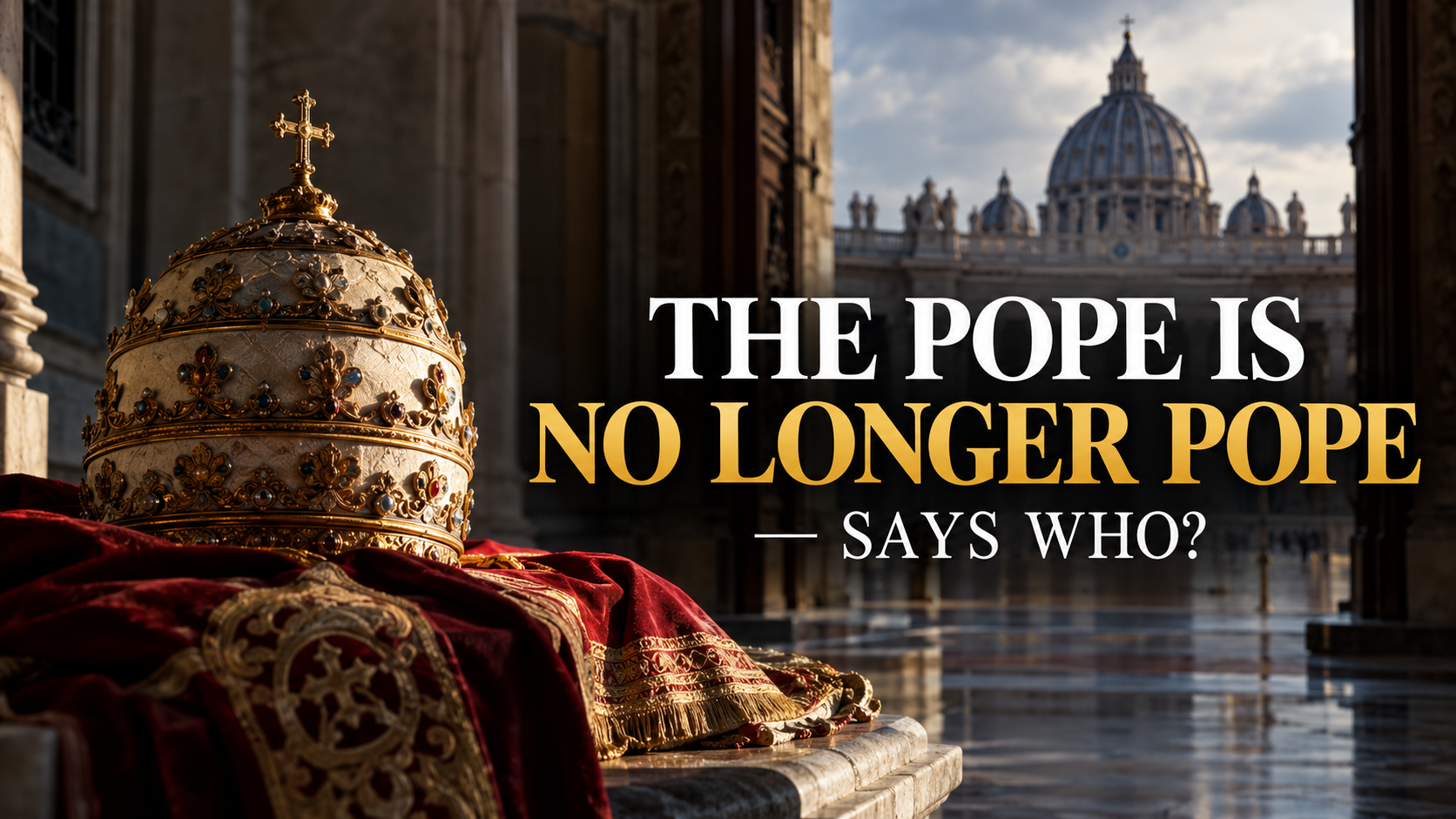
Papal heresy, private judgement, and what the canonists before Vatican II actually taught about the vacancy of the Apostolic See
A Catholic may recognise doctrinal error, challenge the Roman Pontiff and resist an unlawful command. But by what authority may a cleric or layman determine that the Pope is a pertinacious heretic, conclude that he has forfeited his office, and act upon that conclusion without any authoritative determination by the Church? The pre-conciliar canonists distinguished with considerable precision between automatic legal consequences, the facts necessary to establish them, and their recognition in the Church’s public order. Their disagreements deserve to be understood, not selectively quoted.
Who gave you the authority to declare that the Pope is no longer Pope?
Not to criticise him, challenge an erroneous proposition, expose a contradiction with Catholic doctrine, or refuse a command contrary to divine law. Catholics may do these things and, in certain circumstances, are obliged to do them. The question is considerably more serious. By what authority may an individual priest, bishop or layman determine that the reigning Roman Pontiff has become a pertinacious heretic, conclude that he has consequently forfeited his office, and proceed as though that conclusion were an established ecclesiastical fact governing the communion and jurisdiction of the universal Church?
The question is frequently answered by addressing something else. St Robert Bellarmine is cited, the incompatibility of manifest heresy with membership of the Church is rehearsed, and examples of supposedly heterodox papal statements are produced. Some of those criticisms may be justified. Others may depend upon questionable interpretations. But even supposing that a doctrinal accusation is entirely correct, a further difficulty remains. Who authorised the critic to convert his theological conclusion into a determination concerning the occupancy of the Apostolic See?
The matter was not neglected before the Second Vatican Council. Catholic theologians and canonists examined the exceptional possibility of a heretical Pope, the conditions of formal heresy, the distinction between public and notorious offences, and the operation of law where an ecclesiastical office becomes vacant without a constitutive judicial sentence. Their conclusions concerning the papacy were not unanimous. Their careful distinctions nevertheless expose a weakness in much contemporary argument: the assumption that a theological explanation of how an office might be lost also establishes the authority of an individual to determine that the loss has occurred.
The first distinction concerns private judgement itself.
In the present controversy, private judgement does not mean the ordinary exercise of reason, conscience or theological discernment by which a Catholic recognises doctrine and identifies what appears contrary to it. Such discernment is indispensable to the responsible exercise of faith. Rather, it means the unilateral determination, by a person possessing no recognised ecclesiastical competence to establish the matter for the Church, that the reigning Roman Pontiff has incurred formal and pertinacious heresy and consequently forfeited, or must be treated as having forfeited, his office. The difficulty becomes particularly acute when that individual treats his conclusion as sufficiently authoritative to regulate ecclesiastical communion, deny the Pontiff’s jurisdiction, or require others to regard the Apostolic See as vacant.
The judgement is private not because it is concealed, nor because its author is necessarily a layman, but because the authority claimed for its ecclesiastical consequences derives from the individual’s own assessment. Publication does not change its character. Neither does episcopal consecration, theological learning, or the agreement of an entire religious community. Nevertheless, forming a theological opinion, acting personally upon that opinion, and issuing a purportedly authoritative determination for the Church are not identical acts. The distinction must be preserved because the strongest objection to the present argument rests precisely upon it.
Nuntiatoria examined the larger theological question in When the See Is Said to Be Vacant, distinguishing the hypothetical loss of papal office from the public certainty necessary to establish its alleged occurrence.¹ The present argument concerns particularly the canonical principles which illuminate that distinction.
The First Vatican Council taught that the Holy Ghost was promised to Peter’s successors not so that they might reveal new doctrine, but so that they might preserve and faithfully expound the revelation handed down by the Apostles. Papal authority is therefore bound to the Deposit of Faith. Yet Pastor Aeternus also defines the Roman Pontiff’s supreme jurisdiction and teaches the perpetuity of the Petrine primacy instituted as the visible foundation of ecclesiastical unity.² These doctrines belong together. Those who insist, rightly, that the Pope cannot alter divine revelation must be equally careful not to reconstruct the constitution of his office upon their own authority.
The canonical principle is equally familiar: Prima Sedes a nemine iudicatur — the First See is judged by no one. It appears in Canon 1556 of the 1917 Code and is repeated in Canon 1404 of the 1983 Code.³ This does not make the Pope personally impeccable, every papal utterance infallible, or every disciplinary act irreformable. Nor does it dispose automatically of the exceptional hypothesis of papal heresy. It does, however, establish that the reigning Roman Pontiff possesses no earthly superior exercising ordinary judicial jurisdiction over him. The question of a heretical Pope must consequently be examined without inventing such jurisdiction in those who do not possess it.
St Robert Bellarmine famously defended the position that a Pope who becomes a manifest heretic ceases of himself to be Pope and head of the Church. In De Romano Pontifice, Book II, Chapter 30, he considered five opinions and rejected Cardinal Cajetan’s explanation, under which ecclesiastical intervention was required to effect the loss of office. Bellarmine instead located the consequence in the manifest heretic’s separation from the Church.⁴ His conclusion is a serious theological opinion advanced by a Doctor of the Church. It cannot responsibly be dismissed by pretending that no Catholic theologian ever contemplated the automatic loss of papal office through heresy.
But Bellarmine’s decisive qualification was manifest. His argument concerned a heresy sufficiently manifested to sustain the extraordinary consequence alleged. It did not establish that every individual who considers a papal statement heretical thereby acquires the authority to determine that the papacy has been forfeited. The distinction becomes clearer when Bellarmine is read alongside the later canonists.
Franz Xaver Wernz and Pietro Vidal, in Ius Canonicum, Volume II, no. 453, defended a position substantially agreeing with Bellarmine. Their text states that through heresy which is notorious and openly divulged, a Roman Pontiff would be deprived of his jurisdiction ipso facto, even before any declaratory sentence of the Church.⁵ The meaning is unmistakable. Wernz–Vidal did not regard an ecclesiastical declaration as the constitutive cause of the loss they contemplated. Those who claim that the pre-conciliar authorities unanimously required such a sentence misrepresent the evidence.
Yet Wernz–Vidal also recognised a declaratory role for the Church. Their explanation distinguishes a sentence which would purport to deprive a reigning Pope of jurisdiction from one declaring the fact through which, according to their theory, he had already separated himself from the Church. In the formulation preserved in the 1943 edition revised by Philippe Aguirre, a general council would declare the fact of the offence rather than exercise superior jurisdiction to deprive the Pope of his office. The distinction is between making a Pope lose his jurisdiction and publicly establishing that the alleged loss has already occurred.
This is a substantial point which contemporary disputants should not evade. Even among those defending automatic loss, a public ecclesiastical declaration could have significance without being the cause of the vacancy. The question of what happened and the question of how its occurrence becomes publicly established are different.
Here the expression ipso facto requires careful definition.
Literally, ipso facto means “by the fact itself”. In canonical usage it signifies that a specified consequence follows from the occurrence of the legally relevant fact, without requiring a further constitutive act to bring that consequence into existence. Ipso iure means “by the law itself”, or by operation of law. The expressions are closely related, although the former emphasises the triggering fact and the latter the juridical rule attaching a consequence to it. Where the law adds sine ulla declaratione, it expressly excludes the necessity of a declaration to constitute the consequence.
These expressions must be given their proper force. An automatic consequence is not merely a possibility awaiting an ecclesiastical superior’s subsequent decision to impose it. But neither does its automatic operation establish that the relevant fact has occurred in a disputed case. The law may make a consequence automatic; it does not thereby make the existence of its conditions automatically certain to every observer.
Canon 188 of the 1917 Code provides a particularly important example. It recognised renuntiatio tacita, or tacit resignation, and identified circumstances in which an ecclesiastical office became vacant ipso facto et sine ulla declaratione. Section 4 concerned a cleric who a fide catholica publice defecerit — had publicly defected from the Catholic Faith.⁶ Once the conditions were fulfilled, the vacancy contemplated by the provision arose without a further declaration constituting it.
The pre-conciliar canonist Gerald Vincent McDevitt examined the provision in The Renunciation of an Ecclesiastical Office, completed as a doctoral dissertation in 1945 and published in 1946. McDevitt rejected the proposition that the Code merely presumed an intention to resign. Tacit resignation, he argued, was a genuine juridical consequence attached by law to specified acts, even where the cleric personally intended to retain his office. He also distinguished tacit resignation from a canonical penalty. Some acts producing resignation were themselves delicts, but the effect of resignation belonged to a distinct juridical category.⁷
McDevitt’s analysis is important precisely because it prevents a false argument against automatic loss of office. It would be incorrect to claim that Canon 188 merely contemplated a vacancy which an ecclesiastical superior might subsequently choose to impose. The law attached an actual consequence to the specified fact. Nevertheless, McDevitt’s conclusion did not eliminate the necessity of establishing that the fact had occurred. The distinction between the operation of law and the determination of the legally relevant circumstances remains.
McDevitt also rejected an unduly restrictive interpretation of public defection. Formal enrolment in a non-Catholic sect was not indispensable. A defection could be public by reason of its actual dissemination or circumstances making its dissemination sufficiently likely. He further distinguished the possible application of Canon 188 to public heresy or apostasy from the disputed inclusion of pure schism, considering the latter insufficiently certain to justify forfeiture under that provision.
Here was a pre-conciliar canonist carefully examining the conditions under which an admittedly automatic loss of office occurred. The formula ipso facto did not relieve him of the need to define the act to which the law attached its consequence. Nor did his treatment of cardinals as subject to Canon 188 amount to the establishment of a settled procedure for determining the disputed status of a reigning Pope. An ordinary provision concerning clerical offices cannot simply be made to answer every exceptional constitutional question concerning the Apostolic See.
The distinction becomes sharper still when one considers what the 1917 Code meant by public and notorious.
Canon 2197 distinguished a public delict from one notorious in law, one notorious in fact, and one occult. A delict was publicum if it had already been divulged or occurred in circumstances where divulgation could prudently be judged likely. It was notorium notorietate iuris after a definitive judicial sentence or a qualifying judicial confession. It was notorium notorietate facti where the offence was publicly known and committed under circumstances excluding concealment by evasion or a valid legal excuse. An occultum delict was one not public, whether because the act itself was hidden or because its imputability remained concealed.⁸
These classifications are not interchangeable. An act can be publicly known while its canonical character remains disputed. Dom Charles Augustine, commenting upon the Pio-Benedictine Code, explained that notoriety of fact involved not simply publicity but also the absence of circumstances capable of excusing the offence. He also recognised the practical difficulty of drawing an absolutely sharp boundary between certain degrees of publicity and notoriety. The importance of his discussion lies not in an artificial mathematical threshold of notoriety, but in the requirement to consider the established character of the act and its imputability.⁹
This has immediate relevance to accusations of papal heresy. A statement may be reproduced throughout the Catholic world, examined by theologians, criticised by bishops and discussed in countless publications. Its publicity is beyond dispute. But publicity does not of itself establish that the speaker has knowingly and obstinately rejected a truth proposed by the Church as divinely revealed. Nor should the technical categories of Canon 2197, which concern canonical delicts, be imposed mechanically upon every earlier theological use of manifest heresy. Bellarmine wrote centuries before the 1917 Code. His terminology must be interpreted within his own argument, although the later canonical distinctions remain instructive.
Canon 1325 §2 of the 1917 Code defined a heretic as a baptised person retaining the Christian name who pertinaciously denies or doubts a truth requiring divine and Catholic faith. The word pertinaciter is decisive. An objectively heretical proposition and the formal heresy of the person expressing it are not identical. The particular dogma must be identified, the alleged contradiction established, and the obstinacy necessary to sustain the accusation demonstrated.¹⁰
Yet canonical precision also requires acknowledging Canon 2200 §2. Under the 1917 Code, once an external violation of law had been established, deliberate wrongdoing was presumed in the external forum until the contrary was proved. The law therefore recognised rebuttable presumptions concerning imputability. It would be inaccurate to claim that canonical guilt could never be presumed under any circumstances. But a presumption operating under a defined penal norm is not a general authorisation for individuals to presume all the conditions necessary to conclude that a reigning Pope has incurred formal heresy and forfeited his office. One must first establish that the relevant norm and its prerequisites apply.
The distinction between latae sententiae and ferendae sententiae is equally important. Under Canon 2217, a latae sententiae penalty was one incurred through the commission of the delict itself, provided the legal requirements were satisfied. A ferendae sententiae penalty required imposition by a judge or superior.¹¹ The Dominican moral theologian Benedict Henry Merkelbach, writing in his Summa Theologiae Moralis before Vatican II, made the same distinction when explaining the obligation arising from penal laws. Automatic penalties are genuinely incurred upon commission of the relevant offence; penalties requiring a sentence are not.
But a penalty already incurred and the public enforcement of that penalty are not necessarily the same juridical matter.
Canon 2232 of the 1917 Code provides a particularly instructive example. A person conscious of having incurred a latae sententiae penalty was bound ipso facto in utroque foro — by the fact itself in both fora. Yet before a declaratory sentence, the canon also regulated the duty of observing the penalty and the circumstances in which its observance could be demanded externally. It excused observance where compliance would cause infamy and restricted demands made in the external forum, subject to the exceptions expressly provided for notorious delicts and other applicable legislation. A declaratory sentence related the penalty back to the moment of the offence.¹²
The distinction between the internal and external fora is therefore essential.
The forum internum concerns matters of conscience and those subjected to the Church’s internal jurisdiction, whether sacramental or non-sacramental. It is not simply another expression for whatever an individual privately believes. The forum externum concerns the Church’s publicly cognisable juridical order: ecclesiastical rights, obligations, offices, discipline and government. Both fora possess their proper significance in Catholic canon law. A matter binding in conscience does not necessarily follow the same procedural rules concerning its establishment and enforcement in the external forum.¹³
Canon 2232 illustrates how the law could recognise an automatic penalty while regulating its public effects. It does not follow that its provisions may be transferred wholesale to tacit resignation under Canon 188, still less to the exceptional case of papal heresy. McDevitt expressly distinguished tacit resignation from punishment. But the legislation demonstrates that the pre-conciliar canonical order did not confuse the occurrence of a juridical consequence with every question concerning its recognition and enforcement.
This also explains the distinction between a sententia declaratoria and a sententia condemnatoria. A declaratory sentence establishes that a juridically relevant condition or consequence already exists; a condemnatory sentence imposes the penalty or consequence concerned. A declaration need not cause the underlying fact in order to have real significance for the Church’s public order. To confuse declaration with constitution is to misunderstand the debate surrounding an allegedly heretical Pope.
John of St Thomas confronted this difficulty directly. In On the Deposition of a Pope, he argued that the relevant admonitions and determination of heresy must proceed juridically and by the Church’s authority, rather than according to private judgement. Otherwise, the faithful could be expected to avoid a Pope merely because individuals reported him heretical, while others denied that the offence had been established. He therefore defended the necessity of a public ecclesiastical declaration, distinguishing the Church’s ministerial role in establishing the relevant fact from the divine authority by which, according to his explanation, the loss of office would occur.¹⁴
John of St Thomas did not simply repeat Bellarmine. Their disagreement concerned the relationship between manifest heresy, ecclesiastical declaration and the actual loss of the pontificate. Bellarmine and Wernz–Vidal maintained that the consequence occurred automatically before declaration. John of St Thomas assigned a necessary preparatory role to the Church’s determination. These are different theological explanations, not alternative expressions of an identical doctrine.
The nineteenth-century canonist Dominique Bouix advanced a further objection. In Tractatus de Papa, he favoured the opinion that divine providence would preserve the Pope from falling into personal heresy. Considering the exceptional hypothesis nonetheless, he rejected both automatic deposition and the proposed conciliar remedy. He asked what degree of notoriety would suffice for the Pope to be considered deprived of his office, and what would follow if some regarded his heresy as notorious while others denied that it had been established. The danger, Bouix argued, was not merely theoretical uncertainty but schism and confusion concerning the acts of a man continuing to exercise the papal office.¹⁵
Bouix’s preferred conclusions were disputed, but the difficulty he identified deserves attention. If the fact upon which automatic loss supposedly depends is itself contested, by what publicly recognisable authority is the controversy resolved? The confidence of one party does not make its conclusion authoritative for the whole Church. Neither does the absence of an agreed procedure entitle individuals to provide their own and treat its results as binding.
Other pre-conciliar writers approached the hypothesis with similar caution. Vermeersch–Creusen considered the possibility of a Pope becoming a heretic highly improbable in view of the divine protection enjoyed by the Church. Felix Cappello expressed an even stronger confidence that public papal heresy would be prevented by providence. Ulrich Beste observed that history supplied no established example of the supposed case. Their opinions were not definitions of doctrine, but they demonstrate that pre-conciliar canonical scholarship did not treat the heretical Pope as an ordinary disciplinary problem awaiting resolution by private individuals.¹⁶
The disagreement among these authorities is substantial. Some defended automatic loss, others the necessity of ecclesiastical declaration, and others rejected or regarded the exceptional hypothesis itself as highly improbable. It would be intellectually dishonest to construct an artificial consensus among them. Equally, it would be dishonest to treat their disagreement as though it authorised any individual to select the opinion he finds most persuasive and elevate its disputed application into a binding ecclesiastical determination.
The strongest objection must therefore be faced on its own terms. Those invoking Bellarmine may insist that they claim no jurisdiction whatever. They are not deposing the Pope, issuing a judicial sentence, or exercising coercive authority. They are merely recognising what, under Bellarmine’s account, divine law has already accomplished. A Catholic can recognise a manifest fact, they argue, without waiting for an ecclesiastical tribunal to tell him that it exists.
That distinction is genuine. Recognition is not necessarily jurisdiction. But it does not abolish the necessity of proof or settle the authority of the consequences drawn from a contested conclusion. If a Pope publicly repudiated the divinity of Christ, expressly acknowledged that the Church teaches it as divinely revealed, and declared his conscious refusal to believe it, the circumstances would be radically different from an allegation derived from disputed interpretations of statements which their author continues to profess as consistent with Catholic doctrine.
The latter circumstances may disclose grave material error, theological confusion or even deliberate ambiguity. They may warrant public correction. But where the conclusion depends upon establishing personal pertinacity, one must consider the accused person’s actual profession, explanation and response. Those may be unconvincing or evasive. They cannot simply be excluded because the accusation has already been pronounced certain.
This is where direct confrontation becomes particularly significant. Where is the disputed proposition placed before the Holy Father, the contradictory dogma identified, clarification or retraction demanded, and the response examined? Direct personal admonition is not an inflexible prerequisite without which heresy could never conceivably become manifest. But where pertinacity is disputed, confrontation offers an obvious means of testing what has otherwise been inferred. The answer an accuser imagines the Pope would give is not evidence that he has actually given it.
St Paul confronted St Peter to his face when Peter’s conduct endangered the truth of the Gospel. St Thomas Aquinas invoked that example when explaining the right and duty of fraternal correction, including public correction of a superior where the Faith is endangered. But Aquinas distinguished such correction from coercive correction exercised through jurisdiction.¹⁷ The Apostle resisted Peter’s conduct; he did not declare Peter’s apostolic office vacant.
The distinction is indispensable to traditional Catholic ecclesiology. Nuntiatoria previously examined Francisco Suárez’s account of resistance in The False Choice: Obey Everything or Vacate the See. Suárez recognised the possibility of resisting grave abuses of papal authority without conferring coercive jurisdiction upon those resisting.¹⁸ An unlawful command may require refusal without its author ceasing to hold office. A false doctrinal proposition may require correction without the speaker thereby being proved a formal heretic.
There is a form of absolutism in private certainty no less dangerous than papal maximalism. It emerges when an individual’s interpretation of Tradition becomes the final measure not merely of a particular proposition’s orthodoxy, but of the legitimacy of the Church’s visible government. The individual then acknowledges ecclesiastical authority only to the extent that he judges its holder to satisfy conditions of legitimacy which he himself determines and applies. What began as an appeal to objective Tradition risks becoming dependence upon the subjective certainty of its interpreter.
This is not an accusation that everyone who questions the legitimacy of a Pope consciously claims supreme jurisdiction. Many would expressly deny doing so. The difficulty is more precise. Where the practical consequences of a private conclusion extend to withholding recognition, rejecting the acts of papal government, disputing episcopal appointments, or declaring subsequent papal elections illegitimate, the question of public ecclesiastical certainty becomes unavoidable. Such consequences concern more than the internal convictions of an individual.
The Church is a visible and hierarchical society. Pius XII, in Mystici Corporis Christi, insisted upon her visible constitution and Christ’s ordinary government of His Mystical Body through His Vicar on earth.¹⁹ This does not exclude ordinary vacancies or settle the exceptional hypothesis of papal heresy. It does mean that theories concerning disputed vacancies must account for the visible continuity of the Church’s government. If successive Pontiffs have been declared illegitimate, who determines the legitimacy of subsequent electors and elections? If groups of Catholics identify different moments at which the See allegedly became vacant, by what authority are their competing conclusions resolved? These questions concern the constitution of the Church, not merely the administrative inconvenience of prolonged uncertainty.
The crisis of ecclesiastical government cannot itself supply the missing competence. Traditional Catholics have ample grounds to question post-conciliar theological, liturgical and disciplinary developments. The Deposit of Faith must be preserved, doctrinal ambiguity challenged, and unlawful commands resisted. No Pope can make heresy orthodox or require assent to what contradicts divine revelation. Yet necessity does not manufacture jurisdiction. Those who rightly insist that the Pope may not alter the divine constitution of the Church must be equally careful not to reconstruct that constitution themselves.
The distinction survives in the present canonical order. Canon 194 of the 1983 Code recognises removal from certain ecclesiastical offices by operation of law, while §2 requires a declaration by competent authority before specified removals can be enforced.²⁰ This provision does not establish a procedure for the exceptional case of the papacy. Its relevance is the continuing juridical distinction between the legal occurrence of a consequence and the conditions governing its public enforcement.
The governing principles should therefore be stated without equivocation. Ipso facto identifies an automatic consequence; it does not supply proof that its triggering fact has occurred. Publicum and notorium are not interchangeable juridical categories. Material doctrinal error is not identical to formal and pertinacious heresy. A sententia declaratoria need not constitute the consequence it recognises, but it may establish that consequence authoritatively for ecclesiastical purposes. The internal and external fora are distinct, and tacit resignation is not simply another name for a latae sententiae penalty.
None of these distinctions requires denying Bellarmine’s opinion. None permits the pretence that all approved canonists required a constitutive sentence before a Pope could lose office. They require something more exacting: that theological possibility, factual proof, canonical effect and ecclesiastical competence be distinguished rather than compressed into a single assertion.
And so the original question returns, now sharpened by the very authorities so frequently invoked against it.
Where in Sacred Tradition, canon law, or the teaching of any Doctor of the Church is an individual cleric or layman authorised to treat his own disputed assessment of papal pertinacity as sufficient to establish, with binding public consequences, that the reigning Roman Pontiff has forfeited his office? Where is the recognised process by which that assessment acquires the authority of an ecclesiastical determination? Who has conferred upon him competence to settle the disputed status of the Apostolic See independently of the Church herself?
It will not do to reply that Bellarmine considered automatic loss of office possible. That has already been acknowledged. Nor is it enough to invoke Canon 188, whose application depends upon the actual occurrence of public defection and whose relevance to the papacy cannot simply be presumed. The question is not whether automatic juridical consequences exist. They do. It is whether the necessary facts have been established and what authority is possessed for the public consequences claimed.
If papal heresy is alleged, demonstrate the heresy. If pertinacity is asserted, establish it rather than presume it. If an automatic vacancy is invoked, distinguish its supposed occurrence from the proof that it has occurred. And if the conclusion is to govern the communion and jurisdiction of the universal Church, identify the authority by which it becomes binding.
The pre-conciliar canonists did not settle every aspect of the hypothetical heretical Pope. Their differences are substantial and must be respected. But no disagreement among theologians, and no automatic consequence recognised by law, of itself authorises an individual to transform his disputed theological assessment into an authoritative determination of the Church’s public order.
A theological possibility is not an established ecclesiastical fact. A private conviction is not a canonical determination. And the automatic operation of a legal consequence does not make every person who invokes it an authoritative judge of whether its conditions have been fulfilled.
The Catholic Faith requires resistance to error. It does not authorise the invention of ecclesiastical competence.
The Pope cannot invent a new Faith. Neither can his critics invent a new source of ecclesiastical authority.
For the claimed competence to convert a disputed private judgement concerning papal heresy into a binding determination that the Apostolic See is vacant, no sufficient warrant has been demonstrated.
None. Nowhere. Nada. Nihil.
- Nuntiatoria, When the See Is Said to Be Vacant: Papal Heresy, Pertinacity, Jurisdiction and the Limits of Private Certainty, 14 August 2026.
- First Vatican Council, Pastor Aeternus, 18 July 1870, chapters II–IV.
- Codex Iuris Canonici (1917), Canon 1556; Codex Iuris Canonici (1983), Canon 1404.
- St Robert Bellarmine, De Romano Pontifice, Book II, Chapter 30, English translation by Ryan Grant.
- F. X. Wernz, P. Vidal and Ph. Aguirre, Ius Canonicum, Vol. II, De Personis, no. 453; third edition, Rome, 1943, pp. 517–518.
- Codex Iuris Canonici (1917), Canon 188, especially no. 4.
- Gerald V. McDevitt, The Renunciation of an Ecclesiastical Office, Catholic University of America, 1946, chapters X and XII, pp. 112–117 and 136–140.
- Codex Iuris Canonici (1917), Canon 2197.
- Charles Augustine, A Commentary on the New Code of Canon Law, Vol. VIII, commentary on Canon 2197; T. Lincoln Bouscaren and Adam C. Ellis, Canon Law: A Text and Commentary, commentary on Canon 2197.
- Codex Iuris Canonici (1917), Canons 1325 §2 and 2200 §2.
- Codex Iuris Canonici (1917), Canon 2217; Benedict Henry Merkelbach, Summa Theologiae Moralis, Vol. I, no. 348, Paris, 1935.
- Codex Iuris Canonici (1917), Canon 2232, §§1–2.
- William H. W. Fanning, Ecclesiastical Forum, The Catholic Encyclopedia, Vol. VI, 1909.
- John of St Thomas, On the Deposition of the Pope, Cursus Theologicus, II–II, q. 1, disp. 2, art. 3.
- Dominique Bouix, Tractatus de Papa, ubi et de Concilio Oecumenico, Vol. II, Part III, chapter III, 1869, pp. 653 ff.
- Vermeersch–Creusen, Epitome Iuris Canonici, Vol. I, no. 340; Felix Cappello, Summa Iuris Canonici, Vol. I, no. 309; Ulrich Beste, Introductio in Codicem, p. 242; Edward N. Peters, A Canonical Primer on Popes and Heresy, 16 December 2016.
- St Thomas Aquinas, Summa Theologiae, II–II, q. 33, aa. 3–4.
- Nuntiatoria, The False Choice: Obey Everything or Vacate the See — What Suárez Actually Says About Resisting a Pope, 21 August 2026.
- Pope Pius XII, Mystici Corporis Christi, 29 June 1943, especially §§40–41.
- Code of Canon Law (1983), Canon 194, §§1–2.



Leave a Reply