

WHEN THE SEE IS SAID TO BE VACANT: Papal heresy, pertinacity, jurisdiction and the limits of private certainty
By HE ✠Jerome Lloyd

There are periods in the life of the Church when obedience is comparatively uncomplicated because authority speaks recognisably with the voice of what has been handed down. There are other periods in which Catholics find themselves confronted by something immeasurably more painful: men who possess the offices, titles and instruments of ecclesiastical government while appearing to contradict, obscure or practically undermine what their predecessors taught. The post-conciliar crisis has forced questions upon priests and faithful which, in happier centuries, belonged principally to the speculative disputations of theologians. Can a Pope become a heretic? If he did, would he thereby cease to be Pope? Does Canon 188 §4 of the 1917 Code settle the matter? Is a priest obliged to name such a man una cum in the Canon of the Mass? If ordinary jurisdiction has become hostile to Tradition, when and how does the Church supply what is lacking?
These are serious questions. Those who ask them should not be dismissed merely because some of the answers proposed are mistaken. The instinct beneath them can be entirely Catholic: truth cannot contradict truth, papal authority cannot make falsehood true, and the Deposit of Faith is not the personal property of whichever ecclesiastic happens to occupy the highest office at a particular moment. Vatican I states the principle with admirable precision. The Holy Ghost was not promised to Peter’s successors so that by His revelation they might disclose new doctrine, but so that with His assistance they might guard sacredly and expound faithfully the Revelation transmitted through the Apostles.¹ The papacy exists in service of Revelation. Revelation does not exist in service of the papacy.
Yet the gravity of the crisis imposes obligations upon those who resist it as surely as upon those exercising authority. One error is not corrected by embracing its opposite. Neo-ultramontanism cannot safely be answered by making private judgement sovereign. Ecclesiastical confusion does not entitle us to manufacture juridical certainty. Above all, we must preserve a distinction without which much contemporary argument becomes circular: the distinction between what Catholic theology says could occur and what has actually been established as an ecclesiastical fact.
That distinction is the real heart of the sedevacantist question.
It is sometimes proposed that the Catholic position should be understood as a kind of theological mean. Modernism subtracts from the Faith; radicalism adds conclusions which Revelation does not require; therefore the truth must lie somewhere between them. As a rough illustration such language can occasionally be useful. As an argument it proves nothing. St Thomas does not teach that speculative or theological truth is discovered by locating two extremes and choosing their midpoint. Intellectual truth consists in conformity with its proper measure; faith is measured ultimately by God and Divine Truth. Aquinas even observes that while faith can in a secondary sense appear between opposite heresies, the theological virtues considered in themselves do not possess their mean in this manner, because their rule is God Himself.²
Catholic Christology is not true because Nestorius stands on one side and Eutyches on the other. Rather, because the revealed truth concerning the one divine Person and two natures of Christ is antecedently true, the contrary departures of Nestorianism and Eutychianism can afterwards be identified. Truth identifies the extremes; the extremes do not manufacture the truth.
St Vincent of Lérins offers another way of expressing the same principle. His famous criterion concerns universality, antiquity and consent—what has been believed everywhere, always and by all—not the discovery of a convenient centre between rival factions.³ The Catholic rule is Tradition received and transmitted, not intellectual triangulation.
This matters because the same logical danger recurs when Canon 188 §4 is invoked. The canon itself should be quoted without dilution. Under the 1917 Code, ecclesiastical offices become vacant ipso facto et sine ulla declaratione by tacit resignation admitted by law if a cleric a fide catholica publice defecerit—has publicly defected from the Catholic Faith.⁴ Where the juridically relevant fact has truly occurred, a subsequent declaration need not cause the vacancy. The law attaches the consequence to the fact.
But this settles one question and leaves another untouched.
An automatic legal consequence is not the same thing as automatic certainty that the condition triggering it has occurred. Ipso facto describes what the law does when the relevant factum exists; it does not make every observer infallible in determining whether that factum exists. A marriage may be invalid from the outset because an indispensable condition was absent, without every spouse thereby becoming his own marriage tribunal. A canonical consequence may follow automatically from an objectively existing circumstance while serious questions remain concerning whether the circumstance has been proved in the particular case.
The distinction between the effect of law and the establishment of fact is not a Modernist evasion. It is indispensable to the very operation of law.
The difficulty becomes acute when the office in question is the Roman Pontificate. One may construct a superficially impeccable syllogism: a cleric who publicly defects from the Catholic Faith loses office; this Pope has publicly defected from the Catholic Faith; therefore this Pope has lost office. The problem is that the second proposition contains almost the whole controversy. It cannot simply be announced as the minor premise and then returned as the conclusion.
Which Pope publicly defected? By which proposition or act? What precisely was denied? Was it a truth of divine and Catholic faith, a doctrine definitively to be held, a theological conclusion, or a matter belonging to some lesser degree of authority? Was the offending formulation formally heretical, materially heretical, erroneous, ambiguous, scandalous or capable—however implausibly—of an orthodox distinction? If formal heresy is alleged, by what evidence has pertinacity been established? At what identifiable point did the man cease to hold office? At the first erroneous statement? At its repetition? After correction? After an explicit refusal to retract? If separate sedevacantist schools identify different propositions, different Popes and different moments of vacancy, by what ecclesial principle does one private conclusion acquire public certainty for the universal Church?
The words sine ulla declaratione do not answer any of these questions. They establish that a declaration need not be constitutive of loss of office. They do not establish that the antecedent fact requires no public establishment before the Church can safely regulate her government, sacraments, elections and visible communion according to its supposed consequence.
Here St Robert Bellarmine enters the controversy, and rightly so. His authority cannot responsibly be waved away. In De Romano Pontifice he considers several opinions concerning a heretical Pope. He rejects Cajetan’s view that a manifestly heretical Pope remains in office until deposed through the Church, and advances his celebrated fifth opinion: a Pope who becomes manifestly a heretic ceases of himself to be Pope and head of the Church, just as he ceases to be a Christian and member of the Church. Bellarmine grounds his argument partly in St Paul’s instruction concerning the heretic who is to be avoided after admonition because he has shown himself obstinate.⁵
The operative word is manifest.
Bellarmine is not discussing a Pope whose words can be shown by a theological essay to be susceptible of a heretical interpretation. Nor does his proposition amount to “a Pope whom I judge to have taught heresy is therefore no Pope”. He is describing a heretic whose rupture with the Faith has become externally manifest to the point that the ecclesial consequence can follow from that manifest separation.
The distinction between material and formal heresy therefore cannot be dismissed as scholastic embroidery. A proposition may be objectively contrary to revelation while the subjective element required for formal heresy remains unproved. Formal heresy involves pertinacity: the obstinate rejection of a truth which the person knows the Church proposes as revealed. Misunderstanding, ambiguity, contradictory statements, defective theology, deliberate equivocation and even obstinate maintenance of an objectively erroneous formula are not necessarily identical to a knowingly pertinacious denial of dogma. None makes the objective error harmless. But the distinction becomes decisive if the conclusion being drawn is nothing less than the disappearance of the supreme ecclesiastical office.
Consider an uncomplicated hypothetical case. A Pope announces publicly that Jesus Christ is not God. He acknowledges that Nicaea and the Catholic Church infallibly teach Christ’s divinity. He states that he understands the doctrine, knows that the Church requires its acceptance, and rejects it precisely because he considers it false. He is corrected. He refuses correction and repeats his denial. In such circumstances the difficulty of establishing manifest formal heresy would be very small.
The post-conciliar crisis has generally presented something different and, juridically, far more troublesome. John Paul II could convene the religious gathering at Assisi in 1986 while simultaneously professing before its participants his conviction that Jesus Christ is the Saviour of all and explicitly denying that the different religions were being reduced to a common denominator.⁶ Francis could sign the Abu Dhabi declaration stating that religious pluralism and diversity were “willed by God” and subsequently explain the multiplicity of religions by reference to God’s permissive will.⁷ Fiducia supplicans could introduce the blessing of same-sex “couples” while simultaneously insisting that marriage remained exclusively the stable and indissoluble union of a man and woman and that the blessing neither legitimised the union nor altered perennial doctrine.⁸
Those qualifications do not dispose of the objective theological objections. They may be contradictory. They may be evasive. They may make the scandal worse by combining innovation with assertions of continuity. But they demonstrate why the juridical question cannot be reduced to taking an objectionable phrase, writing heresy beneath it, and moving immediately to vacancy of the Roman See.
The distinction becomes sharper still when the question of pertinacity is examined. It is often said that repeated maintenance of an alleged heresy makes the pertinacity obvious. But repetition demonstrates persistence in words; it does not invariably demonstrate the specifically theological pertinacity necessary for formal heresy. If the person accused says that he accepts the Catholic dogma, denies that his formulation contradicts it, supplies a theological distinction or claims that the interpretation attributed to him is not his own, then those answers form part of the evidence. They may prove unsatisfactory. They cannot simply be wished out of existence if one’s proposed conclusion depends upon the man’s subjective obstinacy against a known article of Faith.
Bellarmine’s own appeal to Titus therefore creates a question that deserves far greater attention than it generally receives. Where has the alleged pertinacity actually been tested?
John of St Thomas makes the problem explicit. In his treatment of a heretical Pope he argues that the admonitions envisaged in the Pauline text must be made legally and with the authority of the Church, rather than according to the judgement of private individuals. His concern is profoundly ecclesiological: otherwise confusion would follow, with individual Catholics claiming that the Pope is publicly heretical while the fact has never been established in a manner capable of binding the Church.⁹ One need not adopt John of St Thomas against Bellarmine in order to recognise the strength of the evidentiary point. Even under Bellarmine’s theory, the heresy must be manifest. Where manifestation is disputed, admonition and confrontation are among the natural means by which obstinacy is established rather than merely presumed.
This introduces one of the strangest features of contemporary sedevacantism. For decades its bishops, clergy and writers have produced an extensive literature announcing that successive occupants of the Roman See are manifest and pertinacious heretics. Yet no comparable public record has been produced of a major organised sedevacantist episcopate or clerical society formally approaching Rome with a precise theological indictment: identifying the particular propositions alleged to be heretical, stating the dogmas they contradict, demanding an orthodox profession or retraction, receiving the response and then adducing an explicit refusal as evidence of pertinacity.
It would be imprudent to assert that no individual sedevacantist has ever written privately to a Roman office. Historical negatives of that kind are almost impossible to prove exhaustively. The important point is narrower and much more significant: there is no publicly documented sedevacantist process remotely comparable with the prolonged institutional doctrinal confrontation undertaken by the Society of St Pius X.
Whatever judgement is made about the SSPX’s canonical circumstances, this contrast cannot simply be ignored. The only major organised traditionalist clerical body for which a sustained public record exists of placing the alleged post-conciliar errors directly before Roman authority, demanding answers, negotiating over them, and submitting them to formal theological discussion is the SSPX. ✠Marcel Lefebvre did not merely denounce Rome from Écône and declare that the men in Rome had thereby ceased to possess authority. His resistance unfolded through correspondence, appeals, canonical procedures, meetings and negotiations. On 5 May 1988, after direct negotiations with Cardinal Joseph Ratzinger, ✠Lefebvre signed a Protocol of Agreement with the Holy See—a fact subsequently recorded by John Paul II himself.¹⁰
Nor did the doctrinal engagement disappear with ✠Lefebvre. Benedict XVI stated explicitly in 2009 that the outstanding difficulties concerning the SSPX were “essentially doctrinal in nature”, concerning principally the acceptance of the Second Vatican Council and the post-conciliar Magisterium.¹¹ A joint commission of theologians representing the Congregation for the Doctrine of the Faith and the Society subsequently met in Rome on eight occasions between October 2009 and April 2011 in order to identify and study the essential doctrinal difficulties dividing the parties.¹² In 2011 Rome presented a formal Doctrinal Preamble; the Society responded; the Congregation examined its answer; and in June 2012 Cardinal William Levada met ✠Bernard Fellay specifically to communicate the Holy See’s evaluation and pursue further clarification.¹³
The significance of this record should not be underestimated. Whatever one thinks of the positions adopted on either side, this is what an actual doctrinal confrontation with ecclesiastical authority looks like. Objections are identified. The accused authority knows what is alleged against its teaching. Representatives argue the propositions. Distinctions are offered and tested. Answers are demanded. The parties discover whether a contradiction can be resolved or remains irreducible. The evidentiary record moves beyond one side simply declaring the other guilty.
The irony is considerable. The SSPX, which continues to recognise the Roman Pontiff, has repeatedly taken its allegations of doctrinal rupture to Rome. It has confronted Roman representatives over religious liberty, ecumenism, collegiality, the liturgical reform and the interpretation of Vatican II. Sedevacantism, which requires the incomparably more drastic conclusion that the Roman claimant is formally outside the Catholic Church and therefore incapable of possessing the papacy, ordinarily begins where one might have expected the ecclesiastical process to end: the verdict is announced, the name is omitted from the Canon, and pertinacity is treated as already demonstrated.
One might reasonably have expected the reverse.
If one genuinely believed that the man accepted throughout the Catholic world as Vicar of Christ was unknowingly maintaining a heresy, charity itself would suggest placing the Catholic doctrine before him in unmistakable terms. If one believed that he was knowingly rejecting it, the obvious evidentiary means would be to confront him with the dogma and the alleged contradiction and require him to choose. If he replied, “I know what the Church has defined and I reject it,” the evidence would become formidable. If he refused serious correction while consciously maintaining the contradiction, the case for pertinacity would become correspondingly stronger. But if no serious attempt is made to elicit such an answer, the answer one imagines he would give cannot simply be entered into evidence as though he had given it.
This is not to claim that formal admonition operates as a sacramental formula without which heresy is metaphysically impossible. A man’s pertinacity may conceivably become manifest through his own sufficiently explicit public acts. Bellarmine’s position must not be surreptitiously replaced by John of St Thomas’s. The point is evidentiary. Where the pertinacity is not self-evident, confrontation, admonition and response are obvious means of converting suspicion into demonstrable fact. The more disputed the alleged heresy, the more important those means become.
Without them a circular method readily develops. The Pope is declared pertinacious because he repeatedly uses an objectionable formula. His attempts to distinguish or explain the formula are dismissed because he has already been judged pertinacious. No answer from him can alter the conclusion because his supposed loss of office has already been assumed. No ecclesiastical examination is required because those announcing the vacancy have themselves declared the heresy manifest. The conclusion supplies the proof which is then invoked to justify the conclusion.
This is precisely why the disagreement between Bellarmine, Cajetan and John of St Thomas matters. Bellarmine himself records Cajetan’s contrary theory before rejecting it. John of St Thomas later develops a more explicitly juridical account, requiring public and notorious heresy, incorrigibility and a declaratory role for the Church.⁹ One may prefer Bellarmine’s solution; indeed, it has formidable arguments in its favour. What cannot accurately be said is that the exact mechanism was unanimously defined by the Church and therefore possesses the force of dogma.
A theological opinion does not become an article of Faith because circumstances make its consequences attractive.
Paul IV’s Cum ex Apostolatus Officio is sometimes treated as supplying the missing certainty, but here too distinctions are necessary. Section 6 addresses the case of one found to have deviated from the Catholic Faith or fallen into heresy before his promotion or elevation, including before assumption of the Roman Pontificate, and declares such an election or promotion null.¹⁴ The underlying Catholic principle is obvious enough: one who is already outside the Church cannot simply acquire supreme ecclesiastical headship through an electoral act. Yet pre-election incapacity and post-election loss of an office validly acquired are related but distinct juridical questions.
One cannot use a provision addressing the first as though it mechanically settled the second.
Neither is the canonical status of Cum ex after 1917 solved by the assertion that the bull was never revoked. Canon 6 of the 1917 Code explicitly regulates the relationship between the codification and earlier disciplinary legislation. It preserves earlier law where incorporated, gives previous law interpretative significance where the Code reproduces it, abolishes penalties omitted from the Code, and provides rules concerning earlier disciplinary provisions not retained in the codification.¹⁵ The serious canonical question is therefore which provisions of Cum ex expressed divine law, which were positive ecclesiastical discipline, and how their substance was received into the Code. The adjective “perpetual” is not a substitute for that analysis.
Canon 188 itself must also be read within the wider canonical constitution of the Church. The 1917 Code states succinctly: Prima Sedes a nemine iudicatur—the First See is judged by no one.¹⁶ Bellarmine’s argument attempts to reconcile this principle with the hypothetical heretical Pope precisely by saying that the man ceases to be Pope before the Church can judge him. But that does not amount to a grant of competence to every Catholic to determine for the universal Church that the antecedent loss has occurred.
The larger problem is ecclesiological. Vatican I teaches not simply that Christ once gave Peter an office, but that the primacy instituted for the perpetual welfare of the Church must endure continually in Peter’s successors, and that Peter was established as a permanent principle and visible foundation of ecclesial unity.¹⁷ A vacancy between the death of one Pope and the election of another presents no difficulty whatever. The Church has experienced many. During an ordinary interregnum the papal office remains part of the visible constitution of the Church, the vacancy is publicly known, and the juridical mechanism by which the vacancy is to be ended remains identifiable.
A theory of a vacancy extending through generations presents a qualitatively different problem.
Pius XII gives the traditional ecclesiology in particularly stark language in Mystici Corporis Christi. Christ, he teaches, does not govern His Mystical Body only invisibly or extraordinarily; He governs it “in a visible and normal way through His Vicar on earth”. Pius adds that Christ could not leave the Church He founded as a human society without a visible head and describes the Roman Pontiff as the visible foundation through whom Christ exercises the visible government of the Christian community.¹⁸ The same encyclical insists upon the juridical and social constitution of the Church and upon visible bonds of unity.¹⁹
Again, none of this proves that the See can never be vacant. Pius XII himself lived through papal interregna. Nor does it automatically disprove every conceivable case of papal heresy. What it does is impose a formidable burden upon a theory maintaining that practically the entire visible Catholic Church has recognised a sequence of false Popes for more than half a century while the authentic Petrine office has remained without a publicly recognisable occupant.
The questions multiply. If John XXIII was never Pope, by what publicly certain impediment? If Paul VI lost office, at what point? If John Paul I never obtained the papacy, why? If John Paul II, Benedict XVI, Francis and now Leo XIV are not Roman Pontiffs, what became of the authority by which cardinals were created and papal elections regulated? At what point did the College of Cardinals cease to possess legitimate electors? By what identifiable juridical mechanism could a true Pope now be elected and recognised? What distinguishes the certainty of such a future claimant from the universal recognition which the theory has already declared incapable of establishing the legitimacy of his predecessors?
Merely saying that valid Orders have survived cannot answer these questions. Orders and jurisdiction are not interchangeable. A bishop can possess the sacramental character of episcopacy without possessing ordinary jurisdiction over a diocese. The Church is not merely a collection of validly ordained men administering valid sacraments. She is a visible, hierarchical society with a divinely constituted principle of universal government. Pius XII’s insistence that the Church cannot be conceived as an invisible or merely spiritual association strikes directly at any ecclesiology in which sacramental succession is allowed to substitute indefinitely for publicly recognisable apostolic government.¹⁸
Prophecy cannot be inserted where the ecclesiological explanation becomes difficult. St Paul’s warning concerning apostasy and the man of sin in 2 Thessalonians is grave and mysterious. The Church unquestionably expects severe trials. But the Apostle does not say that a succession of false Roman Pontiffs will be universally recognised for generations while the true papacy becomes juridically indiscernible. That conclusion must be proved independently. It cannot be smuggled into Scripture and then brought back out as evidence.
The same requirement for precision applies to jurisdiction.
Canon 209 of the 1917 Code states the conditions under which the Church supplies jurisdiction under that canon: in errore communi aut in dubio positivo et probabili sive iuris sive facti—in common error or in positive and probable doubt of law or fact.²⁰ The canon does not contain an additional unlimited category reading “whenever necessity exists”. Necessity may create circumstances in which a recognised canonical principle applies; danger of death, for example, causes the law itself to provide extraordinary faculties. But Canon 209 cannot simply be rewritten.
This is particularly important for those of us who defend the reality of supplied jurisdiction in genuinely extraordinary circumstances. The Church supplies jurisdiction; necessity does not magically manufacture it. If that distinction disappears, supplied jurisdiction quietly becomes self-supplied jurisdiction.
There is, however, a broader traditional argument from necessity and epikeia, and it deserves a better answer than dismissal. Aquinas treats epikeia as a virtue because human legislators frame laws according to what ordinarily occurs; exceptional cases can arise in which observing the letter would frustrate the very good intended by the legislator. In such circumstances equity can require acting according to the legislator’s true intention rather than mechanically following words fashioned for ordinary cases.²¹ There is nothing Modernist about this. It belongs to classical moral theology.
But epikeia has limits. It can excuse from the observance of a merely human law in an exceptional situation. It does not allow the subject to create a power which, by its nature, must be received from another. Where sacramental jurisdiction is required for validity, equity cannot turn the priest himself into the source of that jurisdiction. It can explain why the Church’s own extraordinary provisions ought to be construed according to their salvific purpose; it cannot replace the supplying Church with the individual minister who requires what she supplies.
The sacrament of Penance makes the point especially clearly. Canon 872 of the 1917 Code states that besides the power of Orders, jurisdiction over the penitent is required for valid absolution.²² Valid Orders alone are therefore not a universal answer to questions of sacramental validity. A priest may possess the indelible sacerdotal character and yet lack what is juridically necessary for validly absolving a particular penitent, unless ordinary, delegated or supplied jurisdiction is present.
Canon 2252 is also sometimes assigned a meaning it does not possess. It concerns persons who have received absolution from certain censures in danger of death and the obligation of recourse if they recover.²³ It does not establish a general rule that outside danger of death the Church automatically supplies whenever no other minister is available. Canon 2261 does permit the faithful, for a just cause and especially where other ministers are lacking, to request sacraments and sacramentals from certain excommunicated clerics, while imposing stricter limitations upon those subject to a condemnatory or declaratory sentence.²⁴ That is important evidence that the Church’s discipline takes spiritual necessity seriously. It is not evidence that necessity abolishes jurisdictional order.
The maxim salus animarum suprema lex belongs here. The familiar formulation as Canon 1752 is found in the 1983 Code, not the 1917 Code, although the principle itself is ancient and wholly traditional. The salvation of souls is indeed the supreme law because it is the end towards which ecclesiastical government and discipline are ordered. But a maxim describing the purpose of law cannot legitimately be turned into a formula by which every individual may suspend the law whenever he judges his action spiritually beneficial. The salvation of souls is the reason the Church possesses a juridical order; it is not the reason juridical order becomes optional.
Nor does any of this entail servile obedience to ecclesiastical superiors. St Thomas is perfectly clear that a subject is not obliged to obey a superior in a matter contrary to God. He invokes the apostolic principle: “We ought to obey God rather than men.”²⁵ Catholic obedience has never meant surrendering reason, conscience or the Faith.
But resistance and deposition are different acts because they answer different questions.
St Paul resisted St Peter “to the face” when Peter’s conduct endangered the truth of the Gospel. He did not first declare that Peter had ceased to be Peter. A priest ordered to commit sacrilege refuses the sacrilegious command; he need not establish that the bishop giving it has thereby lost his see. A Catholic confronted by a proposition irreconcilable with a previous dogmatic definition must hold the dogma; he is not consequently endowed with jurisdiction to pronounce the Apostolic See vacant.
This distinction is the basis of serious Catholic resistance. The Roman Pontiff is not guaranteed personal wisdom, prudence, theological clarity, good appointments, liturgical judgement or impeccability. Vatican I defined infallibility under specified conditions; it did not make every papal utterance irreformable.¹ The refusal of neo-ultramontanism therefore does not entail sedevacantism. There is a large and recognisably Catholic space between pretending that whatever Rome does must be traditional and pretending that an authority acting against Tradition has necessarily ceased to possess authority.
The una cum brings this theoretical discussion into the sanctuary. In the traditional Roman Canon the Church prays for herself throughout the world una cum famulo tuo Papa nostro N. et Antistite nostro N. Naming the Roman Pontiff is not an affirmation that every act of his pontificate is prudent, orthodox or worthy of imitation. It identifies the man acknowledged as occupying the Roman See within the Church’s visible communion. Conversely, omitting his name because one has concluded that he is not Pope is more than resistance to a particular teaching. It embodies in the public worship of the Church a judgement that the Apostolic See is objectively vacant.
Such a judgement surely demands a proportionate certainty.
One often hears that nobody is “judging the Pope”; Catholics are merely recognising the effect which divine or ecclesiastical law has already produced. There is an important truth in the distinction: according to Bellarmine, the Church does not make the heretic cease to be Pope; his manifest heresy has already produced the consequence. But the distinction does not abolish the epistemological problem. To recognise that the juridically decisive fact has occurred is itself to make a judgement about the existence of that fact.
If Bellarmine requires manifest heresy, manifestation must be established. If Canon 188 requires public defection from the Catholic Faith, public defection must be established in the sense relevant to that canon. If formal heresy requires pertinacity, pertinacity must be established rather than assumed. And if the consequences of the judgement extend beyond one man’s office to subsequent conclaves, episcopal appointments, jurisdiction throughout the Church and the very means of restoring the papacy, the required degree of public certainty increases rather than diminishes.
This is where the absence of a sustained sedevacantist confrontation with Rome becomes more than a curious historical footnote. Those claiming the most radical juridical consequence have generally not undertaken the most obvious means of testing the fact upon which that consequence rests. By contrast, the SSPX—while refusing to declare the papal office vacant—has repeatedly brought its accusations to the very authority it believes has erred. Benedict XVI himself acknowledged that the resulting dispute was doctrinal.¹¹ Rome and the Society placed theologians opposite one another and argued the contested propositions.¹² There is an ecclesial seriousness in that procedure which deserves recognition even from those who criticise the Society on other grounds.
It is not enough to say that Rome would never listen. Sometimes it did not; sometimes it did. What matters is that the allegation was carried to the accused authority. ✠Lefebvre remonstrated, negotiated and appealed. His successors continued doctrinal engagement. The record shows an attempt to force Rome to answer the accusation of rupture rather than allowing the accusation to prove itself in the minds of those making it.
There is something deeply Catholic about that instinct. The Church’s history is full of remonstrance, appeal, correction, theological controversy and even saints confronting Popes. St Paul went to Peter. St Catherine of Siena wrote to Gregory XI. Theologians submitted propositions for judgement. Bishops protested policies. Councils investigated claims. The Catholic instinct is not to abandon the visible Church at the first discovery of error but to bring the controversy back to the place where the responsibility for the Church’s unity lies.
That does not mean Rome always answers adequately. Silence itself may become significant evidence. Evasive answers may deepen a crisis. Repeated refusal to clarify a proposition can become morally grave. Yet there is an immense difference between having confronted authority and received an inadequate answer, and never having sought the answer because one has already concluded that the authority no longer exists.
The sedevacantist difficulty is therefore not that its foundational theological proposition is absurd. It is not. Bellarmine’s opinion is respectable, classical and formidable: a manifest heretic cannot remain Pope. The difficulty lies in moving from that theological proposition to the assertion that a particular man has fulfilled its factual conditions, that the fact is publicly certain, and that private clergy may therefore regulate the Church’s visible communion as though the universal vacancy were an established juridical reality.
That burden is substantial because the conclusion is substantial.
Anyone asserting a prolonged vacancy must do more than identify scandal, contradiction or objective error. He must establish formal defection, the pertinacity constitutive of formal heresy, and the manifestation necessary for Bellarmine’s consequence; he must explain why the disputed mechanism he adopts among the classical theological schools possesses sufficient certainty to bind ecclesial action; he must account for the subsequent papal elections, the status of electors and the visible perpetuity of the Petrine office; and, where extraordinary jurisdiction is claimed in consequence, he must demonstrate the actual title by which the Church supplies it rather than merely appeal to necessity as though necessity itself conferred jurisdiction. None of these questions is answered simply by repeating ipso facto.
The distinction with which we began therefore remains decisive: a theological possibility is not yet an established ecclesiastical fact.
One may concede Bellarmine’s proposition without conceding that it has been proved of John XXIII, Paul VI, John Paul I, John Paul II, Benedict XVI, Francis or Leo XIV. One may accept that office can under certain conditions be lost ipso facto without accepting that every individual Catholic possesses the competence to determine for the universal Church that those conditions have occurred. One may resist an ecclesiastical superior gravely while continuing to acknowledge his office. One may appeal to necessity and epikeia while remembering that neither transforms the individual priest into the source of his own jurisdiction. One may name the recognised Roman Pontiff una cum without thereby endorsing his errors or pretending that papal recognition is equivalent to theological approval.
This position does not make the crisis smaller. In one respect it makes it harder to bear. It requires Catholics to endure the spectacle of authority exercised badly without seeking refuge in either of two consoling simplifications: that whatever authority does must somehow be right, or that an authority which does wrong must somehow have ceased to exist.
The Cross may lie precisely there.
The history of the Church contains Popes whose conduct scandalised Christendom, bishops who compromised with political power, periods of doctrinal confusion, disputed elections, rival claimants and moments when the human appearance of ecclesiastical government sat painfully beside Christ’s promises. The Church survived those crises not because Catholics reinvented her constitution whenever its visible operation became difficult to understand, but because the constitution given by Christ endured through the failures of the men entrusted with it.
Traditional resistance must therefore itself remain traditional. It can refuse falsehood. It can reject an unlawful command. It can preserve the immemorial liturgy against unjust prohibition. It can appeal from novelty to what the Church has always taught. It can invoke the Church’s own provisions where extraordinary necessity requires them. It can confront Popes and bishops with contradictions and demand answers. Indeed, the SSPX record demonstrates that such confrontation is entirely compatible with refusing post-conciliar errors.
What resistance cannot safely do is convert its own theological judgement into an ecclesiastical fact without establishing the bridge between the two.
If a Pope is said to be a formal heretic, establish the formal rejection. If pertinacity is asserted, show how it has become manifest rather than merely inferred. If Canon 188 is invoked, demonstrate the public defection required by the canon. If Bellarmine is invoked, retain his word manifest. If the See is declared vacant, explain how that judgement acquires the public ecclesial certainty proportionate to its consequences. If the vacancy is said to have lasted generations, explain how the visible Petrine constitution and the means of legitimate succession have endured. And before pronouncing a man pertinacious beyond correction, there is surely an obvious ecclesiastical question which ought first to have been asked: where is the correction which was actually put to him, and what did he answer?
That question is particularly difficult to evade when the historical record shows that those traditionalists who did not declare Rome vacant were the ones who repeatedly went to Rome and placed their accusations on the table.
Res sunt quod sunt. Things are what they are. The maxim rebukes the Modernist who converts contradiction into development. It rebukes the ultramontanist who converts prudence into infallibility. But it must also rebuke the traditionalist who converts theological inference into juridical fact, persistence into pertinacity, necessity into jurisdiction, and private certainty into the certainty of the Church.
Truth requires more of us than choosing the error we find easiest to live with. It requires us to preserve the Faith whole while respecting the constitution Christ Himself gave to the society in which that Faith is professed.
That is harder than either capitulation or vacancy.
It is also more Catholic.
¹ First Vatican Council, Dogmatic Constitution Pastor Aeternus, ch. IV, on the purpose of the assistance of the Holy Ghost and the conditions of papal infallibility; the same conciliar formulation is reproduced by Pius XII in Munificentissimus Deus.
² St Thomas Aquinas, Summa Theologiae, I–II, q.64, aa.3–4, on intellectual truth, the mean, and the theological virtues.
³ St Vincent of Lérins, Commonitorium, chs. 2–3, on universality, antiquity and consent.
⁴ Codex Iuris Canonici (1917), can. 188 §4: a fide catholica publice defecerit; official promulgation in Acta Apostolicae Sedis, vol. IX, pars II (1917).
⁵ St Robert Bellarmine SJ, De Romano Pontifice, II, ch. 30. Bellarmine records Cajetan’s contrary position before defending the fifth opinion that the manifest heretic ceases ipso facto to be Pope; his argument appeals to Titus 3:10–11 and the manifestly obstinate heretic.
⁶ John Paul II, addresses at Assisi, 27 October 1986. In concluding the World Day of Prayer he expressly professed Jesus Christ as “Saviour of all” and stated that the differing prayers could not be reduced to a common denominator.
⁷ Francis and Ahmad Al-Tayyeb, Document on Human Fraternity for World Peace and Living Together, Abu Dhabi, 4 February 2019; Francis, General Audience, 3 April 2019, subsequently explaining the existence of many religions through the scholastic category of God’s permissive will.
⁸ Dicastery for the Doctrine of the Faith, Declaration Fiducia supplicans, 18 December 2023, especially nn. 4 and 31, simultaneously affirming the perennial doctrine of marriage and permitting non-ritual blessings of same-sex couples.
⁹ John of St Thomas OP, Cursus Theologicus, II–II, q.1, disp. 2, art. 3. In answering Bellarmine he insists that admonitions be legally made with the Church’s authority rather than according to private judgement and argues from the ecclesial confusion which would otherwise result.
¹⁰ John Paul II, Apostolic Letter Ecclesia Dei, 2 July 1988, expressly referring to the Protocol signed on 5 May 1988 by Cardinal Joseph Ratzinger and ✠Marcel Lefebvre.
¹¹ Benedict XVI, Letter to the Bishops of the Catholic Church concerning the remission of the excommunication of the four bishops consecrated by ✠Lefebvre, 10 March 2009: the outstanding problems were “essentially doctrinal in nature” and concerned principally Vatican II and the post-conciliar Magisterium.
¹² Vatican communiqué reproduced by the SSPX concerning the joint CDF–SSPX theological commission, which met in Rome eight times between October 2009 and April 2011 to identify and study the essential doctrinal difficulties between the parties.
¹³ Holy See Press Office, communiqué of 14 June 2012, recording the SSPX response to the Doctrinal Preamble presented by the Congregation for the Doctrine of the Faith on 14 September 2011 and the subsequent meeting between Cardinal William Levada and ✠Bernard Fellay for evaluation and clarification.
¹⁴ Paul IV, Cum ex Apostolatus Officio, §6, 15 February 1559: ante eius promotionem … seu Romanum Pontificem assumptionem, concerning deviation from the Faith preceding promotion or assumption of the Roman Pontificate.
¹⁵ Codex Iuris Canonici (1917), can. 6, governing the relation of the Code to earlier disciplinary legislation.
¹⁶ Codex Iuris Canonici (1917), can. 1556: Prima Sedes a nemine iudicatur.
¹⁷ First Vatican Council, Dogmatic Constitution Pastor Aeternus, prologue and chs. I–II, on the perpetual endurance of the Petrine primacy and Peter as the visible principle and foundation of ecclesiastical unity.
¹⁸ Pius XII, Encyclical Mystici Corporis Christi, nn. 40–41, teaching that Christ rules the Mystical Body visibly and ordinarily through His Vicar on earth and that the Church founded as a human society could not be left without a visible head.
¹⁹ Ibid., especially the treatment of the visible bonds of ecclesiastical unity and the Church’s juridical and social constitution.
²⁰ Codex Iuris Canonici (1917), can. 209: In errore communi aut in dubio positivo et probabili sive iuris sive facti, iurisdictionem supplet Ecclesia pro foro tum externo tum interno.
²¹ St Thomas Aquinas, Summa Theologiae, II–II, q.120, a.1, on epikeia or equity and exceptional cases falling outside the ordinary intention of the human legislator.
²² Codex Iuris Canonici (1917), can. 872, requiring jurisdiction in addition to the power of Orders for valid sacramental absolution.
²³ Codex Iuris Canonici (1917), can. 2252, concerning recourse after absolution from certain reserved censures received in danger of death.
²⁴ Codex Iuris Canonici (1917), can. 2261 §§1–3, on requests for sacraments and sacramentals from excommunicated ministers and the stricter conditions attaching to those subject to condemnatory or declaratory sentence.
²⁵ St Thomas Aquinas, Summa Theologiae, II–II, q.104, a.5, on the limits of obedience and Acts 5:29.
RELATED ARTiCLES


LATEST ARTICLES
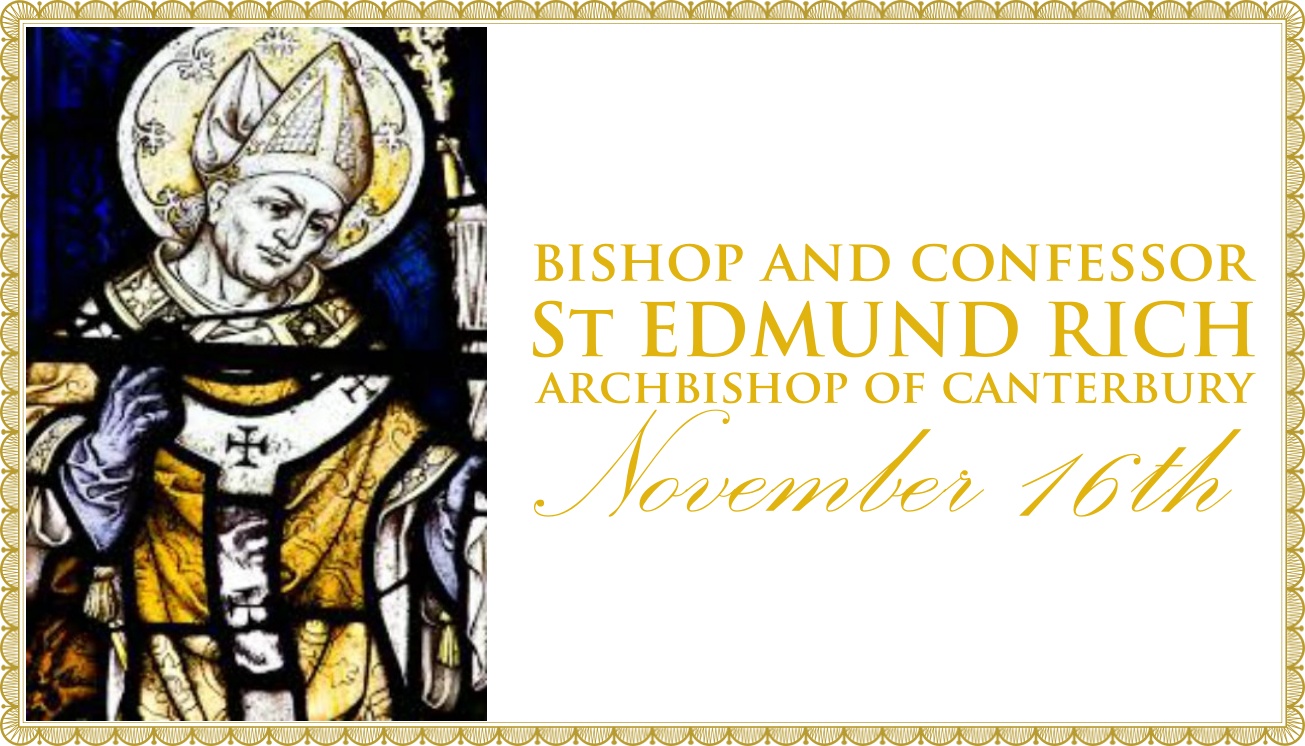
- Today’s homily: Feast of St Edmund Rich of AbingdonSt Edmund Rich’s defence of the Church’s liberty and the Gospel of the talents remind us that God asks fidelity to the graces and duties entrusted to us, even when our efforts seem unsuccessful.
- Today’s Mass: November 16 St Edmund Rich of AbingdonSt. Edmund Rich, a prominent Archbishop of Canterbury born in 1180, championed discipline and justice. Educated at Oxford and Paris, he became known for his eloquence and service to King Henry III. Resigning in 1240, he later joined the Cistercians and was canonized in 1246-47, with a college in Oxford named after him.
- Sermon for St. Edmund of AbingdonSt Edmund of Abingdon, scholar, preacher and Archbishop of Canterbury, courageously opposed abuses of power while remaining gentle and faithful. Despite fierce resistance from King Henry III and church authorities, he upheld reform and principle until his death in 1240. His life encourages us to use our gifts faithfully, speak truth in love and remain steadfast.
- The Catholic Girl’s Guide, II: Keep the FaithChapter II of the 1906 Catholic Girl’s Guide: religious instruction, Christian conduct, avoidance of sin and prayer, with a contemporary Catholic reflection.
- The Young Man’s Guide, II: The Creature and the CreatorChapter II of the 1910 Young Man’s Guide: the obligations of the creature to the Creator, human freedom and the virtue of religion, with a contemporary Catholic reflection.
CURRENT EDITION


Today’s Mass Propers
- Today’s Mass: November 16 St Edmund Rich of Abingdon
 St. Edmund Rich, a prominent Archbishop of Canterbury born in 1180, championed discipline and justice. Educated at Oxford and Paris, he became known for his eloquence and service to King Henry III. Resigning in 1240, he later joined the Cistercians and was canonized in 1246-47, with a college in Oxford named after him.



Leave a Reply