

When the Devil Becomes “Imaginary”: Bishop Ferreira, St Michael and the Exorcism of the Supernatural
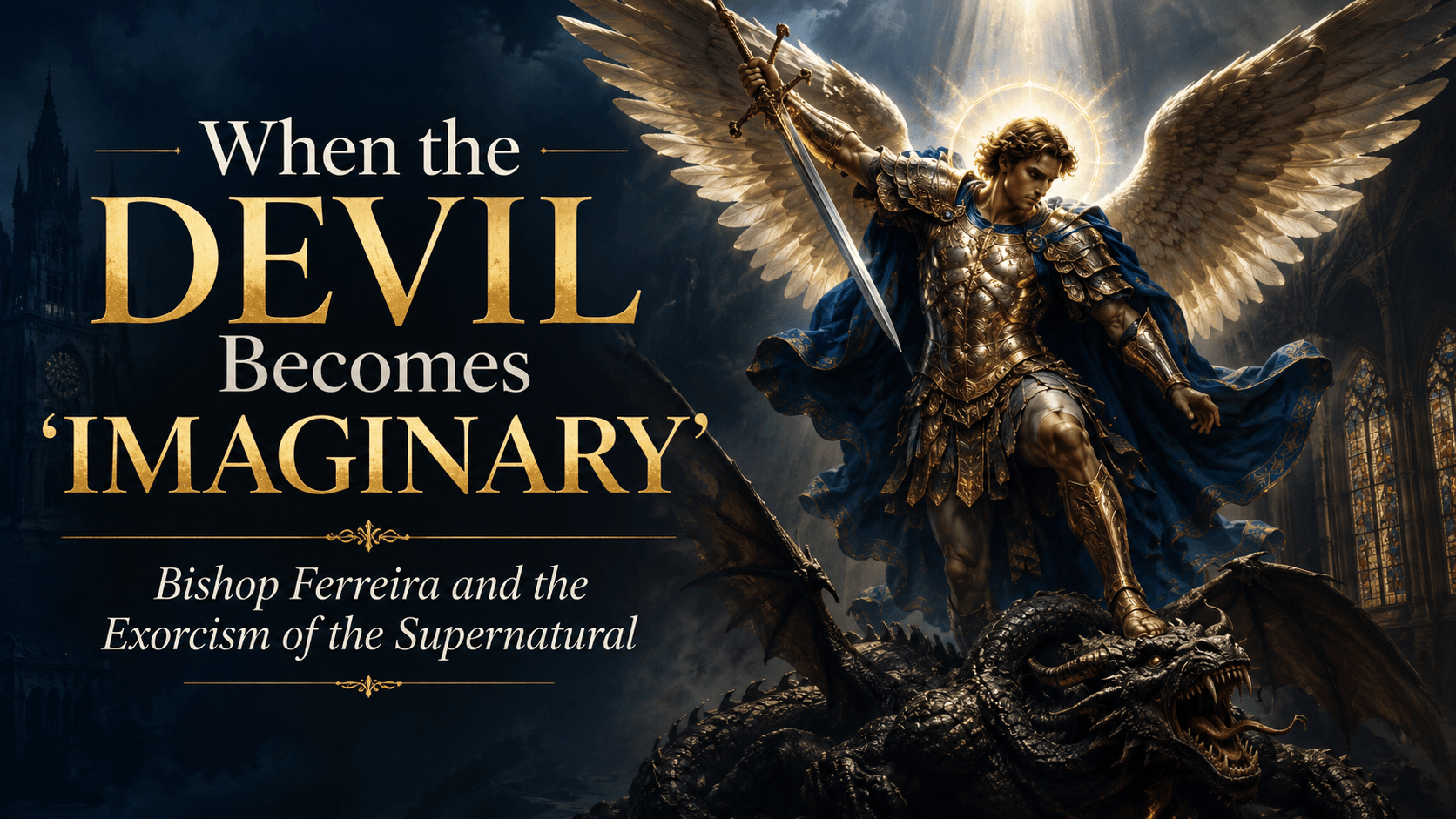
There is no need to exaggerate what Bishop Vicente de Paula Ferreira of Livramento de Nossa Senhora wrote on 8 August. Indeed, the controversy becomes more serious when his actual words are allowed to stand. Ferreira did not issue the formal proposition, “the devil does not exist”. He asked instead: “Are there theological justifications for consecration to St Michael? One consecrates oneself to God the Father, Son and Holy Spirit.” Then came the revealing question: “Is not the devil being fought rather imaginary?” His proposed alternative was what he called a “greater exorcism”: of homophobia, femicide, racism and crimes against indigenous peoples, “this legion of evils”.¹ The distinction is important. Catholics do themselves no service by turning a rhetorical question into a quotation which the bishop did not make. But neither should the rhetorical form obscure what happened. A Catholic bishop questioned an increasingly popular devotion to St Michael by casting doubt upon the reality of the enemy against whom the Archangel is traditionally invoked, and then transferred the language of exorcism from the supernatural order to a catalogue of contemporary social evils.
The first part of Ferreira’s objection contains a point which deserves to be treated seriously. In strict theological language, consecration has God as its proper object. Even the contemporary Directory on Popular Piety and the Liturgy, while acknowledging the long Catholic practice of speaking about “consecration” to Our Lady, explains that the term is being used analogically and that entrustment or dedication may sometimes express the devotional reality more precisely.² There is therefore nothing unreasonable in asking whether “entrustment to St Michael” might be the more exact expression. Catholic theology has always been capable of distinguishing the worship owed to God alone from the veneration of His saints, and of distinguishing both from the invocation of angelic protection.
What cannot reasonably follow from that distinction is the suggestion that placing a diocese, city or nation beneath St Michael’s patronage is somehow theologically suspect. There is a remarkably awkward witness against Ferreira on precisely this point. On 5 July 2013, in the presence of Benedict XVI, Pope Francis inaugurated a statue of St Michael in the Vatican Gardens. The official Holy See calendar described the ceremony as an “Act of consecration of the Vatican City State to St Joseph and St Michael the Archangel.” Francis himself said: “In consecrating the Vatican City State to St Michael the Archangel, let us ask him to defend us from the Evil One and cast him out.” He had just described Michael as the defender of the People of God against “the arch-enemy par excellence, the devil”.³ It is difficult to imagine a more exact answer to Ferreira’s question. One may argue for terminological refinement if one wishes; what one cannot plausibly maintain is that the devotional act itself stands outside recognisable Catholic theology. Pope Francis did exactly what Ferreira has now questioned, and described exactly the spiritual enemy whose reality Ferreira’s words appeared to place at a distance.
That brings us to the real issue. Satan is not the Catholic name for racism. He is not an ancient symbol which may now be translated into the categories of political sociology, nor a dramatic personification of the worst things human beings do to one another. He is not the collective unconscious, a literary device, an oppressive structure or a convenient theological synonym for whatever social programme happens to be condemned in a particular decade. The Church teaches that Satan is a created spiritual intelligence, originally good, who freely rebelled against God; that other angels fell with him; that he tempted our first parents; that he continues to tempt mankind; that his power is real but strictly limited by divine providence; and that his definitive defeat belongs to the victory of Jesus Christ.⁴ This is not folklore appended to Christianity. It belongs to the architecture of Revelation.
The Gospels leave very little room for the theory that the devil is an imaginative personification of human wickedness. Our Lord’s forty days in the wilderness are not presented as an interior dialogue with social injustice. The tempter approaches Christ, speaks to Him, proposes particular temptations and receives answers. “Begone, Satan,” Our Lord tells him. Christ later says that He saw Satan falling like lightning from heaven; warns Peter that Satan has sought to sift the Apostles as wheat; calls the devil a liar and murderer; and repeatedly confronts demons who recognise Him, speak and are commanded to depart.⁵ If this personal agency is removed from the Gospel, one does not merely discard a piece of medieval demonology. One begins rewriting the ministry of Christ.
The Apostles understood their Master perfectly well. St Peter warns the faithful that their adversary, the devil, “as a roaring lion, goeth about seeking whom he may devour”. St Paul tells the Ephesians that the Christian struggle is “not against flesh and blood” but against principalities, powers and “the spirits of wickedness in the high places”. The Apocalypse gives the conflict its great liturgical image: “Michael and his angels fought with the dragon”, and St John identifies that dragon as “that old serpent, who is called the devil and Satan, who seduceth the whole world”.⁶ The very St Michael whose patronage Ferreira questions enters Scripture precisely within a supernatural warfare which cannot be reduced to the contest between just and unjust social arrangements.
The Fathers inherited the same doctrine without confusion. St Cyril of Jerusalem taught his catechumens that the devil had been created good and had become evil through his own free choice. Yet Cyril was equally emphatic that the devil does not abolish human freedom: temptation proposes; man consents or refuses. St Irenaeus described the devil as the apostate angel whose assault upon mankind Christ recapitulated and defeated. St Augustine placed the rebellion of the fallen angels at the beginning of that conflict between the two cities which unfolds through human history, while St Gregory the Great continued the same tradition in his Moralia in Job. The 1975 study Christian Faith and Demonology issued by the Congregation for the Doctrine of the Faith made the historical point with unusual force: it would be difficult, it observed, to find a single Father who was silent about the reality and activity of the devil.⁷
That same document also supplies perhaps the most useful sentence for the present controversy: **“Paul never identifies sin with Satan.”**⁸ This is the distinction Ferreira’s rhetoric threatens to blur from the opposite direction. Catholic doctrine does not require a demon whenever a man sins, nor does it permit a man to transfer responsibility for his own wickedness to a demon. Satan tempts; man sins. Demonic activity and human evil may be intimately related, but they are not identical. The distinction becomes especially important when the word exorcism is introduced, because Catholicism means something definite by that word.
St Thomas Aquinas gives this doctrine its characteristic intellectual sobriety. The devil may tempt by presenting objects to the imagination and by working indirectly upon the passions. He cannot directly seize the rational will and compel it to consent. Nor does every sin require a particular diabolical suggestion. Human concupiscence, bad habits, disordered passions and deliberate choices account for plenty of evil without our inventing demonic interventions for each occasion.⁹ There is nothing credulous about this account. It avoids precisely the sort of indiscriminate demonology which gives modern scepticism its easiest target. Yet St Thomas does not solve superstition by secularising the universe. The devil is real; temptation is real; free will is real; and moral responsibility remains real.
The Roman Church’s understanding of exorcism is equally exact. The Rituale Romanum requires prudence before a solemn exorcism and warns against confusing genuine demonic activity with natural illness or deception. The current Catechism, despite all the intervening liturgical changes, still gives essentially the same definition: an exorcism occurs when the Church asks publicly and authoritatively in the name of Jesus Christ that a person or object be protected from the power of the Evil One and withdrawn from his dominion. It distinguishes the exorcisms associated with Baptism from the solemn or major exorcism reserved to a priest authorised by his bishop and specifically warns that psychological illness is another matter.¹⁰ An exorcism, therefore, is not simply an emphatic Catholic word meaning “opposition to something bad”. It has a supernatural referent.
Ferreira is perfectly free to employ exorcism metaphorically. Christians have always used religious language by analogy. One might speak rhetorically about exorcising corruption from public life or hatred from a community without imagining that corruption is a possessing spirit. But Ferreira did something more pointed. Having asked whether the devil against whom St Michael is invoked might be “rather imaginary”, he immediately proposed social evils as the proper object of a “greater exorcism”.¹¹ In that juxtaposition the metaphor ceases to be innocent. The actual demonic order becomes questionable while the sociological analogue becomes concrete. It is precisely the direction in which much modern theology has travelled: supernatural realities are not always explicitly denied; they are more often retained as vocabulary while being quietly supplied with new referents.
Nor does one need to deny any genuine social evil in order to recognise the problem. Murder is gravely sinful. Racial hatred is sinful. The exploitation of the poor can be sinful. Crimes committed against indigenous communities demand justice. If by “homophobia” one means hatred of persons or genuine unjust discrimination, Catholic moral theology has no difficulty condemning that either, though Catholics are under no obligation to accept every ideological meaning now loaded into an elastic political term. Traditional Catholic social doctrine has never taught that one may exploit workers, despise racial groups, murder women or mistreat the vulnerable so long as one says the Rosary afterwards. The caricature becomes possible only by forgetting Leo XIII, St Pius X, Pius XI and Pius XII, and the enormous corpus of Catholic moral teaching on justice, wages, property, political authority, the common good and the obligations of charity.
The error comes when those evils are made substitutes for the supernatural realities which explain the deepest disorder in man. Racism is not Satan. Murder is not Satan. An unjust economic system is not Satan. Even a “structure of sin” is not Satan. These things arise through human acts and human choices; they can become socially entrenched and may furnish further occasions of sin. They may also be exploited by the tempter. But the sinner, the sin, the structure created by accumulated sins, the temptation to sin and the tempter himself remain distinguishable realities. The CDF’s 1975 study was explicit: Satan leads men towards sin but “is distinct from the evil which he causes to be committed”.¹² The distinction is not hairsplitting. Without it, responsibility, temptation, sin and demonic agency collapse into one another and Catholic moral theology loses its shape.
This is where Ferreira’s publicly avowed sympathy for liberation theology becomes relevant, though it should not be used as a label in place of an argument. He wrote in May that he was not afraid to call himself a “theologian of liberation”; in December 2024 he had written that liberation theology had taught him to pray “in the way of Jesus”, and in July this year he described it as a theology which thinks about God from the “wounded bodies of the earth and the poor”.¹³ He has for years worked closely with communities affected by mining, including those harmed by the 2019 Brumadinho disaster, and he has held responsibility within the Brazilian episcopate’s Commission for Integral Ecology and Mining.¹⁴ None of this, in itself, is discreditable. A bishop should care about victims of injustice. The Church does not become less supernatural by feeding a hungry man, defending a family whose home has been destroyed, or demanding accountability from powerful economic interests.
Indeed, the Church herself made precisely this distinction when she examined liberation theology in the 1980s. The Congregation for the Doctrine of the Faith did not say that every theology of liberation was Marxist, still less that concern for the poor was suspect. Its 1984 Instruction begins by calling the Gospel “a message of freedom and a force for liberation” and explicitly refuses to provide an excuse for indifference towards misery and injustice. But it then establishes the order which a Catholic theology cannot reverse: “Liberation is first and foremost liberation from the radical slavery of sin.” From that fundamental liberation follow consequences in the cultural, economic, social and political spheres. The danger arises when temporal liberation is made primary and liberation from sin is displaced into the background, or when analytical categories borrowed from Marxism begin determining how Revelation itself is read.¹⁵
The second Instruction, Libertatis Conscientia, published in 1986, makes the connection with social structures more precise. Fallen man, turning from God towards created goods, disorders his pursuit of wealth, pleasure and power; through these sins he contributes to structures of exploitation and servitude. The structures are real, and Catholics may have a duty to reform them, but their moral genealogy still leads back to sinful persons.¹⁶ The Catholic solution is therefore richer than either the individualistic caricature or the political reduction. Grace heals persons, converted persons act justly, just action affects institutions, and institutions in turn can assist or impede virtuous life. The supernatural and temporal orders are related without being confused.
One curious feature of the Brazilian controversy illustrates the false choice particularly well. Supporters of Ferreira denounced what they called an “empty and individualistic devotionalism” surrounding St Michael and portrayed criticism of the bishop as the work of a Catholic “far right”. Yet the Instituto Hesed, which promotes the Grande Reconquista and the St Michael pilgrimage, does not appear to fit the convenient opposition between supernatural devotion and concern for bodily needs. As well as its large prayer apostolate, it reports a social project assisting some 2,500 families each month, distributing thousands of food parcels, carrying out weekly prison visits and providing community meals and activities for children and the elderly.¹⁷ One may scrutinise any popular movement prudently; the Church has always done so. But it is difficult to dismiss this particular devotion as intrinsically “individualistic” when the people praying to St Michael are simultaneously feeding people.
That is Catholicism behaving normally. The same religion which puts bread into a hungry man’s hand tells him that he has an immortal soul. The same Church which builds hospitals blesses the dying. The same priest who condemns an employer for defrauding labourers hears Confessions and absolves sins. The same Christian who fights an injustice asks his Guardian Angel for protection and invokes St Michael against Satan. There is no contradiction unless Christianity is first forced into a political theory which can make sense of the horizontal but has become embarrassed by the vertical.
The scale of the St Michael revival in Brazil makes Ferreira’s intervention more significant than an isolated argument about devotional terminology. The Grande Reconquista began with the arrival of a pilgrim image associated with the Sanctuary of Monte Gargano, the ancient Italian centre of Michaelic devotion. By 11 August thirty-four Brazilian dioceses had reportedly undergone acts of consecration to St Michael through the initiative; by 13 August the image itself had travelled roughly 150,000 kilometres, passing through thirty-five dioceses in sixteen states and the Federal District. The movement now coincides with the Brazilian observance of the Quaresma de São Miguel, beginning on 15 August and continuing until 29 September with prayer, fasting and penance.¹⁸ Whatever one thinks of every feature of the contemporary campaign, there is plainly a popular hunger here for something which much official ecclesiastical discourse has neglected: spiritual combat, penance, angelic intercession, the seriousness of sin and the reality of evil as more than a social malfunction.
For Catholics formed by the traditional Roman Rite, the destination of that forty-day devotion carries its own resonance. The old Roman calendar names 29 September as the Dedication of St Michael the Archangel. Pius XI could still date an encyclical on that day simply by referring to the feast under that title.¹⁹ The Roman liturgical tradition did not regard Michael as an embarrassing survival from a pre-scientific imagination. He belonged to the public worship and consciousness of the Church because the world revealed by Christianity includes the angelic creation.
The irony is that one does not have to appeal exclusively to the traditional liturgy, the medieval Schoolmen or the Fathers to answer Ferreira. One can remain entirely within the post-conciliar authorities which a bishop of his theological instincts would presumably find difficult to dismiss. Paul VI declared in 1972 that evil includes “a living spiritual being, perverted and perverting” and warned that those who reduce the devil to a conceptual or imaginative personification no longer remain within biblical and ecclesiastical teaching. The CDF produced Christian Faith and Demonology three years later in response to exactly such demythologising tendencies. Pope Francis then repeated Paul VI’s warning in Gaudete et Exsultate and added his own strikingly unambiguous sentence: **“Hence, we should not think of the devil as a myth, a representation, a symbol, a figure of speech or an idea.”**²⁰
It is hard to devise a more precise answer to the suggestion that the devil whom Catholics combat may be “rather imaginary”.
Francis did not stop with theological assertion. In September 2018 he asked Catholics throughout the world to conclude their Rosary during October with the invocation Sub tuum praesidium and the familiar prayer to St Michael: “defend us in battle” against the “wickedness and snares of the devil”, and cast Satan and the evil spirits into hell.²¹ Five years earlier he had consecrated Vatican City itself to St Michael while explicitly asking the Archangel to defend it against the Evil One. One might therefore say, without irony, that Ferreira’s dispute is not really with a traditionalist interpretation of Francis. On this particular question it is with Francis himself.
The supporters who answered Ferreira’s critics by reaching immediately for the description “far right” therefore avoided the essential point. Whether a Catholic critic votes on the right, left or not at all has no bearing upon whether Satan is a personal fallen angel. “Far right” is not a category in demonology. Nor can the Church’s doctrine of the angels be made politically disreputable by associating it with people whom one dislikes. Either Christ confronted a personal tempter in the desert or He did not. Either Lateran IV taught that the devil and demons were created good and became evil through their own choice or it did not. Either the Church understands exorcism as an exercise of Christ’s authority against the Evil One or she does not. Political labelling answers none of these questions.
There is also something pastorally revealing in the direction of the suspicion. Ferreira looked at a large popular movement drawing Catholics towards prayer, fasting, penance, the Sacraments and devotion to St Michael, and his instinct was to ask whether the devil being opposed was “rather imaginary”. Yet even the post-conciliar Directory on Popular Piety warns against the “manifest and hasty abandonment of inherited forms of popular piety” and against unjustified criticism of the piety of ordinary Catholics in the name of a supposedly purer faith. It describes authentic popular piety as capable of preserving the Faith where pastoral provision is weak and even as an antidote to secularised ideologies.²² Discernment is necessary; contempt is not.
None of this means that every claimed demonic manifestation should be believed, every private devotion encouraged without qualification, or every social ill explained by invoking Satan. The Catholic position is more demanding because it refuses both easy extremes. A man who blames the devil for every temptation may be avoiding responsibility for his passions; a man who denies the devil because modernity finds him embarrassing is refusing Revelation. The Church has never required us to choose between credulity and unbelief. Her doctrine, at its best, is marked by the same realism we find in Aquinas: Satan is real, Satan tempts, Satan cannot compel the will, not every sin arises from a particular demonic suggestion, and man remains morally responsible for what he freely chooses.
What is at stake in Ferreira’s comment, then, is larger than a Brazilian devotional controversy. It is the persistent temptation to horizontalise Christianity: not necessarily by publicly denying its supernatural vocabulary, but by translating that vocabulary into something which secular modernity already understands. Sin becomes chiefly oppression; salvation becomes liberation; mission becomes social advocacy; conversion becomes institutional transformation; exorcism becomes political struggle. Each word can still be printed on a diocesan poster. What gradually disappears is the supernatural thing to which the word originally pointed.
A fully Catholic account has no need of this reduction. It can speak about oppression because it first knows what sin is. It can work for justice because it knows that justice answers to a law higher than the State. It can care for creation because creation has a Creator. It can defend the poor because each poor man possesses an immortal soul redeemed by Christ. It can reform institutions because men acting together can embody either virtue or vice in institutions. And it can do all this while still believing that “our wrestling is not against flesh and blood” alone.
That little word alone matters. The Catholic does not escape responsibility for earthly injustice by staring upwards at angels. Neither does he become mature by closing Heaven and restricting reality to what sociology can measure. The supernatural does not abolish nature. Grace does not make justice unnecessary. St Michael does not excuse us from feeding the hungry. But feeding the hungry does not make St Michael imaginary.
This is why the Archangel is such an uncomfortable figure for a thoroughly horizontal Christianity. His very name is an act of adoration: Quis ut Deus? — Who is like unto God? The answer destroys every attempt to make man, class, race, nation, state, market, ideology or even ecclesiastical institution absolute. Michael represents the creature standing rightly beneath the Creator. His warfare is not autonomous violence but obedience. As Francis himself said in the Vatican Gardens, Michael triumphs because God acts in him.²³
The Church needs that reminder because the great Christian drama is finally not the construction of a satisfactory society. Every just society will pass away. The poor whom we feed will still die. Every political settlement will eventually be replaced by another. Christianity certainly demands works of mercy and justice in this world, but it does so because human beings are travelling towards another. The ultimate catastrophe is not poverty but damnation; the ultimate liberation is not political emancipation but redemption from sin; the ultimate victory is not the triumph of a social programme but the triumph of the Lamb.
That is why Our Lord entered the wilderness and resisted Satan. It is why the Apostles cast out demons. It is why catechumens renounced Satan before Baptism. It is why the Fathers preached about the fallen angels, why Lateran IV defined their created goodness and subsequent fall, why Aquinas analysed their capacity to tempt, why the Roman Ritual contains exorcisms, why Leo XIII gave Catholics his prayer to St Michael, why Paul VI warned against demythologising the devil, why the CDF revisited the doctrine in 1975, why Francis insisted that Satan is neither myth nor symbol, and why the same Francis consecrated Vatican City to the Archangel.
The continuity is rather difficult to miss.
There are evils in Brazil which cry out for justice, as there are in Britain, Europe and everywhere else fallen men organise their common life. Catholics should confront them. But the Church will not become more compassionate by becoming less Catholic, and she will not serve the oppressed by reducing Revelation to the language of oppression. The man whose body is wounded needs justice; the man whose soul is wounded needs grace. Very often he needs both.
St Michael does not stand in the way of that work. He reminds us what world we are actually living in.
It is a world in which men sin freely and can repent; in which social injustice is real and must be corrected; in which grace is more powerful than sin; in which angels minister; in which demons tempt; in which Christ has conquered; in which judgement awaits us; and in which the final victory belongs not to the politics of left or right, but to God.
The remedy for an excessive interest in demons is Catholic sobriety. The remedy for superstition is sound doctrine. The remedy for injustice is justice and conversion. The remedy for sin is repentance and grace.
The remedy for the devil is not to imagine him away.
Sancte Michael Archangele, defende nos in proelio.
¹ Natalia Zimbrão, “Bispo critica consagração a São Miguel e diz que exorcismo deve ser contra homofobia, feminicídio e racismo,” ACI Digital, 11 August 2026, reporting and reproducing Bishop Vicente de Paula Ferreira’s social-media comments of 8 August 2026.
² Congregation for Divine Worship and the Discipline of the Sacraments, Directory on Popular Piety and the Liturgy: Principles and Guidelines (Vatican City, 2001), no. 204; cf. nos. 213–217.
³ Francis, Address at the Blessing of the New Statue of St Michael the Archangel, Vatican Gardens, 5 July 2013; Office for the Liturgical Celebrations of the Supreme Pontiff, Calendar of Celebrations, July 2013, entry for 5 July.
⁴ Fourth Lateran Council, Constitution Firmiter credimus (1215), DS 800; Catechism of the Catholic Church, nos. 391–395, 414.
⁵ Matthew 4:1–11; Luke 10:18; 22:31–32; John 8:44; Mark 1:23–27; 5:1–13. Scriptural citations follow the Douay-Rheims Bible.
⁶ Ephesians 6:12; 1 Peter 5:8–9; Apocalypse 12:7–9. Scriptural citations follow the Douay-Rheims Bible.
⁷ St Cyril of Jerusalem, Catechetical Lectures, II.4; St Irenaeus of Lyons, Adversus Haereses, principally V.21; St Augustine, De Civitate Dei, XI–XIV; St Gregory the Great, Moralia in Job; Sacred Congregation for the Doctrine of the Faith, Christian Faith and Demonology, 26 June 1975.
⁸ Sacred Congregation for the Doctrine of the Faith, Christian Faith and Demonology, 26 June 1975, section treating the Pauline distinction between Satan and the sin which he incites.
⁹ St Thomas Aquinas, Summa Theologiae, I–II, q. 80, aa. 1–4, De causa peccati quantum ad diabolum.
¹⁰ Rituale Romanum, Tit. XII, cc. I–II, De exorcizandis obsessis a daemonio and Ritus exorcizandi obsessos a daemonio; Catechism of the Catholic Church, no. 1673.
¹¹ Zimbrão, “Bispo critica consagração a São Miguel,” ACI Digital, 11 August 2026.
¹² Sacred Congregation for the Doctrine of the Faith, Christian Faith and Demonology, 26 June 1975.
¹³ Vicente de Paula Ferreira, social-media statements of 16 December 2024, 14 May 2026 and 21 July 2026, cited in Zimbrão, “Bispo critica consagração a São Miguel,” ACI Digital, 11 August 2026.
¹⁴ Apostolic Nunciature in Brazil, “Papa Francisco nomeia Dom Vicente de Paula Ferreira para a Diocese de Livramento de Nossa Senhora (BA),” 1 February 2023; Conferência Nacional dos Bispos do Brasil, Comissão Episcopal Especial para a Ecologia Integral e Mineração, biographical and institutional materials concerning Dom Vicente de Paula Ferreira.
¹⁵ Congregation for the Doctrine of the Faith, Libertatis Nuntius: Instruction on Certain Aspects of the “Theology of Liberation”, 6 August 1984, Introduction and parts VI–X.
¹⁶ Congregation for the Doctrine of the Faith, Libertatis Conscientia: Instruction on Christian Freedom and Liberation, 22 March 1986, nos. 37–43.
¹⁷ Natalia Zimbrão, “Instituto Hesed apresenta três propostas de Quaresma de São Miguel,” ACI Digital, 13 August 2026, reporting the charitable and apostolic activities associated with Instituto Hesed.
¹⁸ Ibid.; Zimbrão, “Bispo critica consagração a São Miguel,” ACI Digital, 11 August 2026.
¹⁹ Missale Romanum, Proprium Sanctorum, 29 September, In Dedicatione S. Michaelis Archangeli; Pius XI, Encyclical Ingravescentibus Malis, 29 September 1937.
²⁰ Paul VI, General Audience, 15 November 1972; Sacred Congregation for the Doctrine of the Faith, Christian Faith and Demonology, 26 June 1975; Francis, Apostolic Exhortation Gaudete et Exsultate, 19 March 2018, nos. 160–161 and n. 121.
²¹ Holy See Press Office, Communiqué, 29 September 2018, concerning Pope Francis’s request for the daily recitation during October of the Rosary, the Sub tuum praesidium and the Prayer to St Michael the Archangel.
²² Congregation for Divine Worship and the Discipline of the Sacraments, Directory on Popular Piety and the Liturgy, nos. 48–65.
²³ Francis, Address at the Blessing of the New Statue of St Michael the Archangel, Vatican Gardens, 5 July 2013.
RELATED ARTICLES


LATEST ARTICLES
- Today’s Mass: September 30 St Jerome of BethlehemSaint Jerome, born in Dalmatia in 329, was a prominent Doctor of the Church, known for his scripture translations and contributions to Catholic teachings. He emphasised monastic life and the Divine Office. Jerome died in Bethlehem on 30 September 420. Today also marks the name day of His Grace, Jerome OSJV of Selsey.
- Sermon for St. JeromeSt. Jerome, born around 342, was a pivotal biblical scholar and translator whose work established the Vulgate as the standard Latin Bible. His life reflected the tensions of early Christianity, as he struggled with controversies while advocating for orthodoxy. Jerome’s rich education and transformation from a pagan scholar to a Christian hermit marked his enduring legacy in the Church. He died in 420.
- Veritas non mutatur consensu ~ Truth is not altered by agreement: Spiritual Conference for Nuntiatoria CXXVThe text explores the theme of enduring truth amidst changing societal values, particularly within the Catholic faith. It emphasises that truth remains unchanged irrespective of popular opinion or individual feelings, urging believers to receive and embody divine teachings faithfully. The article concludes with a call to act upon this truth in daily life and relationships.
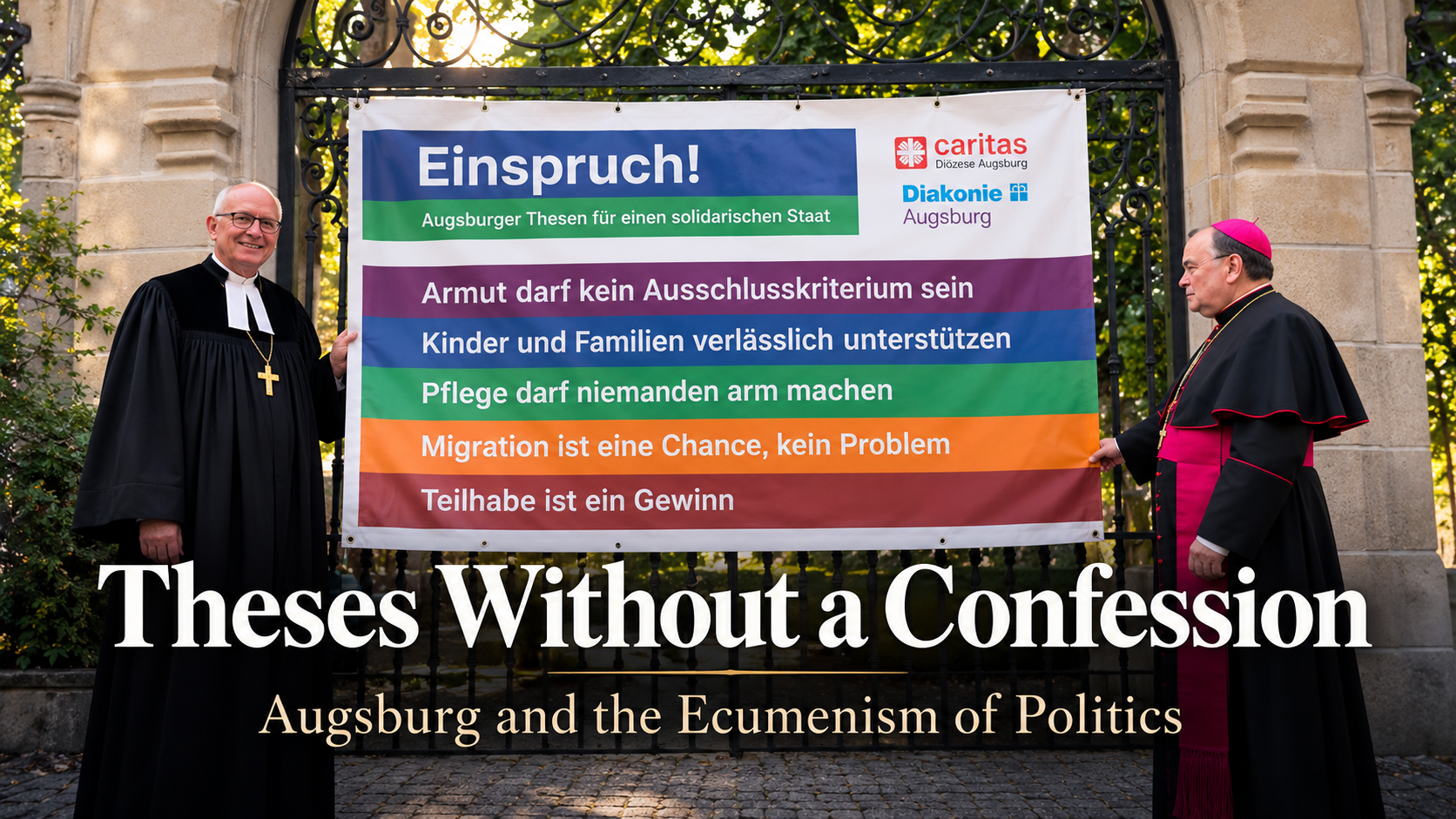
- Theses Without a Confession: Augsburg and the Ecumenism of PoliticsIn Augsburg, Catholic and Lutheran leaders have symbolically reposted theses on social issues like poverty and migration, reflecting Christian social teaching. This event highlights a growing divide where churches confidently address social policies while unresolved doctrinal differences remain. Cooperation on such issues is valuable but should not replace the pursuit of true Christian unity.
- Quis ut Deus? Michaelmas and the Order of HeavenThe Dedication of Saint Michael, celebrated on 29 September, highlights the Archangel’s role within divine order, illustrating humility and obedience before God. Rooted in ancient Roman traditions, the feast contrasts human pride with the recognition of God’s sovereignty. It underlines the importance of worship that connects earthly life to heavenly realities, centering around God’s presence.


Leave a Reply