
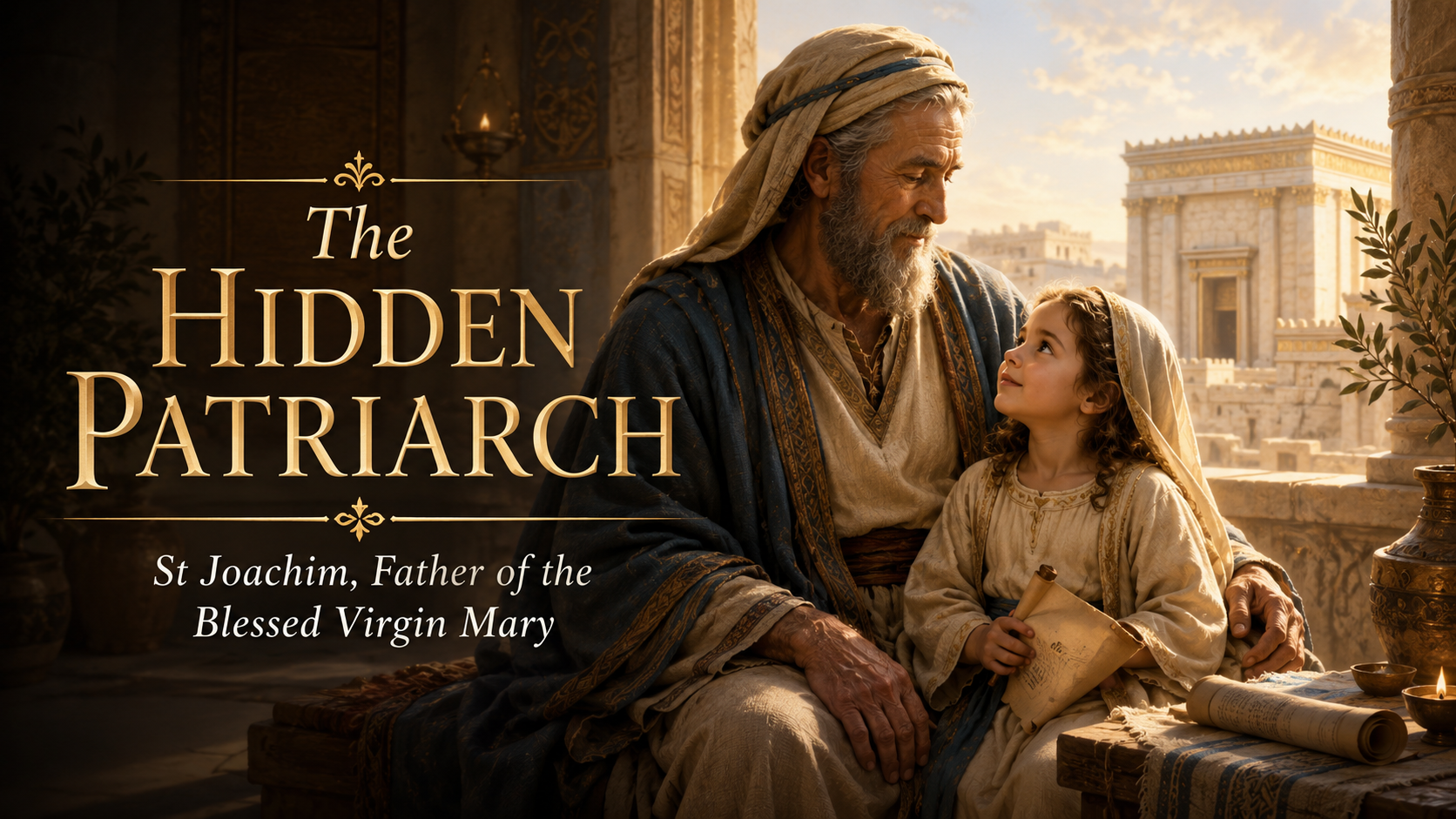
The Hidden Patriarch: St Joachim, Father of the Blessed Virgin Mary, August 16

There is something peculiarly beautiful about the place St Joachim occupies in the traditional Roman calendar. The Church has scarcely finished celebrating the bodily Assumption of the Blessed Virgin when she turns to the father who once held that same Virgin as a child. In the older arrangement of the Roman calendar St Joachim was kept on the Sunday following the Assumption; under St Pius X the feast was fixed to 16 August. In 2026 the two arrangements providentially coincide: 16 August is itself the Sunday after the Assumption. The ancient liturgical instinct is therefore unusually visible. Yesterday the Church contemplated Mary already glorified in heaven; today she looks backwards towards the obscure father into whose keeping God first entrusted her on earth.¹
Strictly speaking, St Joachim’s feast was not part of the calendar promulgated with the Missal of St Pius V in 1570. Its history is more complicated, and more revealing. Devotion to the parents of Our Lady was ancient in the East, where Joachim was particularly associated with the Nativity of Mary. Western observance developed later and on several dates. About 1510 Julius II introduced Joachim into the Roman calendar on 20 March, immediately after St Joseph. The feast disappeared during the Pian reform, was restored by Gregory XV in 1622, and in 1738 Clement XII transferred it to the Sunday after the Assumption. Leo XIII, whose baptismal name was Gioacchino, raised the feasts of both Joachim and Anne to Double of the Second Class in 1879. Finally the Pian reform of the calendar placed Joachim on 16 August.² The saint has therefore wandered through the calendar almost as a patriarch of old wandered through the land of promise, yet the Roman Church repeatedly returned him to the neighbourhood of his Daughter. That liturgical instinct matters. Joachim is known through Mary; Mary exists for Christ.
This is precisely how the Collect presents him:
Deus, qui prae omnibus Sanctis tuis beatum Joachim Genitricis Filii tui patrem esse voluisti…
God chose Joachim, above His other saints, to be father of the Mother of His Son. The prayer says almost nothing about Joachim’s deeds. It does not praise a martyrdom, a theological work, an apostolate or a miracle. His singular dignity is expressed through fatherhood. Blessed Ildefonso Schuster saw in this the echo of St John Damascene’s manner of praising Joachim and Anne: they are known by the incomparable fruit whom God caused to spring from them.³
That is the key to the whole feast. Joachim is a saint whose greatest achievement is another person.
There is a salutary lesson even in the silence surrounding him. The canonical Gospels never name the parents of the Blessed Virgin. The names Joachim and Anne, together with the familiar account of their childlessness, prayers, angelic announcement and Mary’s presentation in the Temple, first appear in the second-century Protoevangelium of James. Later apocryphal works developed the narrative. These texts are not inspired Scripture, and the Church has never required Catholics to believe every detail contained in them. Yet neither did the ancient Church simply discard the tradition. Its central elements passed into Christian memory extraordinarily early and were received by Fathers including St Andrew of Crete and St John Damascene. Catholic sobriety therefore requires two things at once: we must not elevate apocryphal narrative into revelation, but neither need we pretend that a tradition is worthless merely because the canonical Evangelists had another purpose and left it unrecorded.⁴
St Andrew of Crete gives us one of the earliest and most attractive portraits. In his homily on the Nativity of the Blessed Virgin he describes Mary as sprung from David and from Joachim, and Joachim himself as gentle, devout and formed by the Law of God, growing old without offspring.⁵ The emphasis is recognisably biblical. Joachim belongs to the long succession of righteous men whose hopes seem contradicted by barrenness: Abraham before Isaac, Manue before Samson, Elcana and Anna before Samuel, Zachary and Elizabeth before John the Baptist. Again and again Sacred History allows nature to reach an apparent impasse before grace shows that the fulfilment of God’s promise is His gift.
St John Damascene goes further. Preaching on the Nativity of Our Lady, he addresses the holy couple directly and rejoices in Joachim because from his daughter comes the Child Who is “mighty God”.⁶ This is patristic theology at its most concentrated. Joachim’s importance cannot terminate in Mary because Mary’s importance does not terminate in herself. From Joachim comes Mary according to natural generation; from Mary comes Jesus Christ according to His human nature; and the Child born of Mary is God. Joachim thus belongs, remotely but really, to the human ancestry through which the Eternal Word chose to enter His creation.
The traditional Roman Mass understands this perfectly. Its Gospel is not a picturesque episode taken from Joachim’s legendary life. It is Matthew 1:1–16, the genealogy of Jesus Christ: Liber generationis Jesu Christi, filii David, filii Abraham. At first the choice is surprising. Joachim does not appear by name. Yet no Gospel could better disclose the Church’s reason for honouring him. The feast places him inside the history of the Incarnation.
St Thomas Aquinas, treating the ancestry of Christ, insists on the significance of Our Lord’s descent from Abraham and David. The promises converge upon Christ: the blessing promised through Abraham’s seed and the kingdom promised to David reach their fulfilment in Him. Aquinas also argues that Mary’s Davidic descent is implicit in the Scriptural witness to Christ as being “of the seed of David according to the flesh”.⁷ Joachim therefore belongs to a genealogy whose ultimate subject is not genealogy at all, but promise. Generations of Israel come and go; kingdoms rise and collapse; the Davidic monarchy disappears from sight; the chosen people endure exile and foreign domination. Yet God’s word has not failed. At the appointed hour there stands a Jewish maiden of David’s house, and the angel says to her that her Son shall receive “the throne of David his father” and reign for ever.
This explains why Joachim’s fatherhood has a theological importance altogether disproportionate to the small amount we know about his biography. Christianity is not a religion in which salvation means escape from created nature. The Word truly became flesh. He entered a family, a people and a history. As Aquinas states elsewhere in the celebrated scholastic principle, grace does not destroy nature but perfects it. Joachim’s natural fatherhood is therefore not an accidental shell around the supernatural mysteries associated with Mary. Providence takes that fatherhood up and gives it a place in the economy of salvation. God could have created a human nature for Christ without ancestry. He chose not to do so. He could have formed Mary independently of ordinary human generation. He chose instead that she should be truly the daughter of Joachim and Anne.
Here the Immaculate Conception makes Joachim’s dignity more wonderful, not less. Joachim did not make Mary immaculate. Neither did Anne. They gave their daughter the human nature which every child receives from human parents; the singular privilege of preservation from original sin was the work of God alone, granted in view of the foreseen merits of Jesus Christ. Blessed John Duns Scotus supplied the decisive scholastic insight by which the perfection of Mary’s redemption could be understood precisely as preservation: Christ is not less her Redeemer because He prevents her fall; He is more perfectly her Redeemer.⁸ Joachim therefore stands at a precise frontier between nature and grace. He gives what a father can give; God gives what only God can give. The supernatural does not make Joachim’s paternity unreal. It crowns it.
The Mass begins by presenting the moral character of such a father. Its Introit is taken from Psalm 111: Dispersit, dedit pauperibus: justitia ejus manet in saeculum saeculi — he distributed, he gave to the poor; his justice remaineth for ever. The Epistle, Ecclesiasticus 31:8–11, begins Beatus vir and praises the man who possessed wealth without becoming enslaved by it, who might have transgressed and did not, who might have done evil and refused. The ancient account of Joachim describes precisely such a man, generous in his offerings to God and liberal towards the poor. The Church does not require us to certify the arithmetic of the Protoevangelium’s description of his almsgiving before allowing the inspired portrait of the just man to illuminate the saint whom tradition remembers. The liturgy takes what is morally intelligible in the tradition and places it within the surer language of Scripture.⁹
Then comes one of the most remarkable verses of the feast. The Gradual returns to Psalm 111:
Potens in terra erit semen ejus: generatio rectorum benedicetur.
“His seed shall be mighty upon earth: the generation of the righteous shall be blessed.”
Applied to most saints, the verse is praise. Applied to Joachim it becomes almost a prophecy. His offspring is Mary. From Mary comes Christ. What Psalm 111 says generally of the posterity of the righteous acquires, on Joachim’s lips, an extraordinary density. The seed of this just man does indeed become mighty upon earth, because through his daughter the promised Seed of Abraham enters the world.
The Alleluia makes the family relation still more explicit: O Joachim, sancte conjug Anne, pater almae Virginis… Joachim is invoked as the holy spouse of Anne and father of the Virgin. The order is important. He is husband before he is father. The traditional liturgy instinctively refuses to isolate Mary’s birth from marriage. Joachim and Anne are not two devotional accessories attached separately to the Blessed Virgin. They are spouses. The child entrusted to them is the fruit of their marriage. The supernatural history of the Incarnation passes through the ordinary natural institution by which mankind continues from generation to generation.
There is something urgently corrective here for the modern world. Christianity does not regard fatherhood and motherhood as interchangeable functions which happen to be performed by adults surrounding a child. The Incarnation itself comes surrounded by distinctions of relationship. Joachim is father; Anne is mother; Mary is daughter; Joseph will become Mary’s true husband and Christ’s virginal, legal and foster father. None is interchangeable with another. Grace works through those relations rather than obliterating them.
The Secret of the Mass takes the thought still further. The priest offers the Sacrifice in honour of the holy Patriarch Joachim and asks that, through the intercession of Joachim, his spouse and their most blessed Child, the faithful may obtain remission of sins and everlasting glory.¹⁰ Few prayers in the Missal display a family so compactly. Joachim, Anne and Mary are named around the altar; but the Victim upon the altar is Mary’s Son.
This is Catholic family theology in miniature. The family does not close upon itself. Its supernatural end lies beyond itself. Joachim’s household is holy because it is ordered towards Christ. Mary is not the private possession of her parents, and their greatest glory is that the child God entrusted to their care was prepared for the vocation He intended for her. Christian parenthood reaches its perfection not by retaining the child but by returning the child to God.
The Communion antiphon makes that doctrine explicit through the words of Our Lord: Fidelis servus et prudens, quem constituit Dominus super familiam suam — the faithful and prudent servant whom his lord has placed over his household.¹¹ The Church applies the image of the steward to Joachim.
That single antiphon may say more about Christian fatherhood than many books.
A father possesses genuine authority, but it is delegated authority. The household is “his”, yet ultimately it belongs to another. The child is truly his child, yet more fundamentally the child belongs to God. He is therefore not owner but steward. He must feed, teach, protect, correct, preserve and finally prepare the soul entrusted to him for an end which he did not invent. The father who understands this does not ask first what his child can become for his own satisfaction, prestige or continuation. He asks what God intends for this soul.
If we receive the ancient tradition of Mary’s presentation in the Temple as pious Christian memory rather than as an article of faith, it becomes an almost perfect icon of Joachim’s vocation. The child for whom he has waited is precisely the child he must surrender. What appears to natural affection as possession becomes, under grace, oblation. Joachim receives Mary from God and gives Mary to God.
The mystical writers seized upon this hidden drama. Venerable Mary of Jesus of Ágreda, in the Mystical City of God, expands the lives of Joachim and Anne into a long meditation upon prayer, purification of intention and the providential preparation of Our Lady. Blessed Anne Catherine Emmerich likewise gives extensive visionary descriptions of their marriage, sorrow at childlessness, prayer, the meeting at the Golden Gate and the childhood of Mary.¹² Such writings must be kept in their proper place. Private revelation neither completes Scripture nor supplies historical certainty where the sources do not. Indeed, the literary history of Emmerich’s visions, transmitted through Clemens Brentano, requires particular prudence. But the spiritual intuition underlying both authors accords strikingly with the liturgy: some of God’s greatest works mature for years in places which attract no notice from the world.
Joachim is therefore a saint of hidden causality.
No sentence of his survives. No apostolate carries his name from antiquity. No book establishes his reputation. The canonical Scriptures pass over him in silence. Even the authentic details of his life are mostly beyond recovery. Yet from his household came the Blessed Virgin Mary.
Modernity finds this difficult because modernity instinctively equates significance with visibility. A man matters if he projects himself, builds a reputation, leaves records, commands attention or can point to achievements bearing his name. Joachim represents almost the exact opposite. His greatness is visible only by looking beyond him. He is glorious because he was faithful to something whose fulfilment belonged to another generation.
Dom Prosper Guéranger understood why the feast belongs beside the Assumption. East and West repeatedly placed Joachim near one of Mary’s own festivals because his holiness is illuminated by hers.¹³ But the relationship works in both directions. Mary’s glory does not eclipse her father; it reveals what his obscure fidelity was serving. The Assumption shows us the completion of a work whose human beginnings lay partly in the household of Joachim and Anne.
Consider the distance between those two scenes. At one end stands a Jewish father with a little girl. He cannot see Bethlehem. He cannot see Nazareth. He cannot see the miracle at Cana, the hostility of the Sanhedrin, the darkness of Calvary, the empty tomb or the descent of the Holy Ghost. He cannot see his Daughter standing beneath the Cross while the sword foretold by Simeon passes through her soul. Still less can he see her assumed body and soul into heaven and crowned above the angelic choirs.
He does not need to see it.
He needs to be faithful to the portion of Providence entrusted to him.
Here lies perhaps the deepest spirituality of St Joachim. We commonly want God to show us the result before we consent to the duty. We want assurance that sacrifice will bear visible fruit, that fidelity will be vindicated, that children will remain faithful, that institutions will survive, that prayers will be answered in the manner we expect. Joachim belongs instead to the biblical company of those who obey within the partial knowledge permitted to creatures. He does not possess the plan. He receives a vocation.
That is why the Communion’s description is so exact: fidelis servus et prudens. Not brilliant servant. Not successful servant. Not celebrated servant. Faithful servant.
The traditional feast therefore has something quite severe to say to fathers. Fatherhood is not validated by domination, indulgence, biological fact alone, financial provision alone, or the production of children who reproduce their father’s opinions and ambitions. A Christian father is a custodian of souls. His authority must ultimately make possible another person’s obedience to God. He teaches so that another may know God; disciplines so that another may acquire virtue; protects so that another may become strong; provides so that another may fulfil a vocation; and, eventually, relinquishes what was never absolutely his.
Joachim succeeds so completely that he almost disappears.
There is no humiliation in this. It is the peculiar glory of fatherhood. The father decreases in the foreground of his child’s life precisely when he has accomplished his work well. Joachim’s child becomes greater than he could naturally have imagined: Immaculate Virgin, Mother of God, Queen of Heaven. Christian devotion does not therefore need to invent achievements for Joachim in order to make him important. Mary is the monument of his fatherhood.
And Mary herself points beyond Joachim and beyond herself to Christ.
Thus the feast finally becomes Christological. The Collect calls Joachim father of the Mother of the Son. The Gospel gives the genealogy of Jesus Christ. The Secret gathers Joachim, Anne and Mary around the Sacrifice of Christ. The Postcommunion asks through Joachim’s intercession that those who have received the sacred Mysteries may attain grace here and glory hereafter through Jesus Christ.¹⁴ The saint’s entire liturgical identity is relational, and every relation converges upon the Incarnate Word.
This is why St John Damascene can praise Joachim by speaking immediately of Mary’s Son. From Joachim’s daughter comes the Child Who is God. The movement is irresistible: Joachim to Mary, Mary to Christ, Christ to the Father. Catholic devotion to the saints, when it is healthy, always has this architecture. It never gets trapped at the creature. The creature becomes transparent to the work of God.
On 15 August, therefore, we lift our eyes to the Queen assumed into heaven. On 16 August the Roman Church lowers them again for a moment to the earth from which that Queen came: to ancestry, marriage, household, prayer, disappointment, parenthood and quiet fidelity.
And there she finds Joachim.
A man almost entirely hidden from history, but not hidden from God.
A father whose Daughter became the Mother of God.
A steward who guarded another’s treasure.
A patriarch who did not live to see the whole harvest.
A fidelis servus et prudens who performed the duty given him and left the consequences to Providence.
The world asks a man what he has made of himself. The feast of St Joachim asks the more Christian question: what did he faithfully prepare for God?
¹ Breviarium Romanum and Missale Romanum, traditional calendar; Dom Prosper Guéranger, The Liturgical Year, August, feast of St Joachim.
² Dom Prosper Guéranger, The Liturgical Year, feast of St Joachim; cf. the historical notices on the institution, suppression, restoration and transfer of the feast under Julius II, Gregory XV, Clement XII, Leo XIII and St Pius X.
³ Missale Romanum, Collect for St Joachim; Blessed Ildefonso Schuster, Liber Sacramentorum [The Sacramentary], treatment of the feast of St Joachim; St John Damascene, homily on the Nativity of the Blessed Virgin Mary.
⁴ Protoevangelium of James, cc. 1–8; The Catholic Encyclopedia, s.v. “The Blessed Virgin Mary” and “St Joachim”; cf. the early Eastern reception of the Joachim-and-Anne tradition.
⁵ St Andrew of Crete, Homily on the Nativity of the Blessed Virgin Mary.
⁶ St John Damascene, Homily on the Nativity of the Blessed Virgin Mary; cf. De Fide Orthodoxa, IV, 14.
⁷ St Thomas Aquinas, Summa Theologiae, III, q.31, a.2; I, q.1, a.8, ad 2.
⁸ Blessed John Duns Scotus, Ordinatio, III, d.3, q.1, on the preservative redemption of the Blessed Virgin.
⁹ Missale Romanum, Mass of St Joachim: Introit, Psalm 111; Epistle, Ecclesiasticus 31:8–11; Gradual, Psalm 111.
¹⁰ Missale Romanum, Secret of the Mass of St Joachim.
¹¹ Missale Romanum, Communion of the Mass of St Joachim, Luke 12:42.
¹² Venerable Mary of Jesus of Ágreda, Mystical City of God, Part I, sections concerning Joachim and Anne; Blessed Anne Catherine Emmerich, The Life of the Blessed Virgin Mary, sections concerning Joachim, Anne and the childhood of Mary.
¹³ Dom Prosper Guéranger, The Liturgical Year, feast of St Joachim.
¹⁴ Missale Romanum, Collect, Gospel, Secret, Communion and Postcommunion of the Mass of St Joachim.
related articles


Latest articles
- October Beneath Our Lady’s StandardThe Feast of the Most Holy Rosary commemorates the 1571 victory at Lepanto and evolved through papal endorsements, especially under Pope Leo XIII in the late 19th century. October, dedicated to the Rosary, serves as a reminder of prayer’s significance during trials, fostering both personal and communal spiritual resilience in Catholic life.
- Marriage Endures as Britain’s Common Christian Framework RecedesRecent ONS data indicates that 83.7 per cent of couples married in 2015 remained together by their tenth anniversary. However, Britain faces declining fertility rates, increasing abortion statistics, an ageing Christian demographic, and a reliance on migration for population growth. The critical challenge lies in transmitting family, faith, and culture across generations.
- Vatican III by Stealth? When “Reception” Becomes RevisionArchbishop Anthony Randazzo warns against the misuse of synodality as a means to eliminate perceived “dead wood” from the Church, stressing the importance of faithfully interpreting Vatican II. He argues that authentic renewal relies on the continuity of the Church’s doctrine, warning that unchecked synodality may lead to revisions of established teachings rather than genuine reception.
- Today’s homily: St Jerome of BethlehemThe homily reflects on St Jerome’s profound transformation from a scholar enamoured with classical literature to a devoted servant of Christ. It highlights the necessity of allowing faith to permeate one’s life, emphasising that merely possessing knowledge of doctrine is insufficient without a corresponding internal change. Jerome’s legacy urges believers to let Scripture guide their lives authentically.
- Today’s Mass: September 30 St Jerome of BethlehemSaint Jerome, born in Dalmatia in 329, was a prominent Doctor of the Church, known for his scripture translations and contributions to Catholic teachings. He emphasised monastic life and the Divine Office. Jerome died in Bethlehem on 30 September 420. Today also marks the name day of His Grace, Jerome OSJV of Selsey.




Leave a Reply