
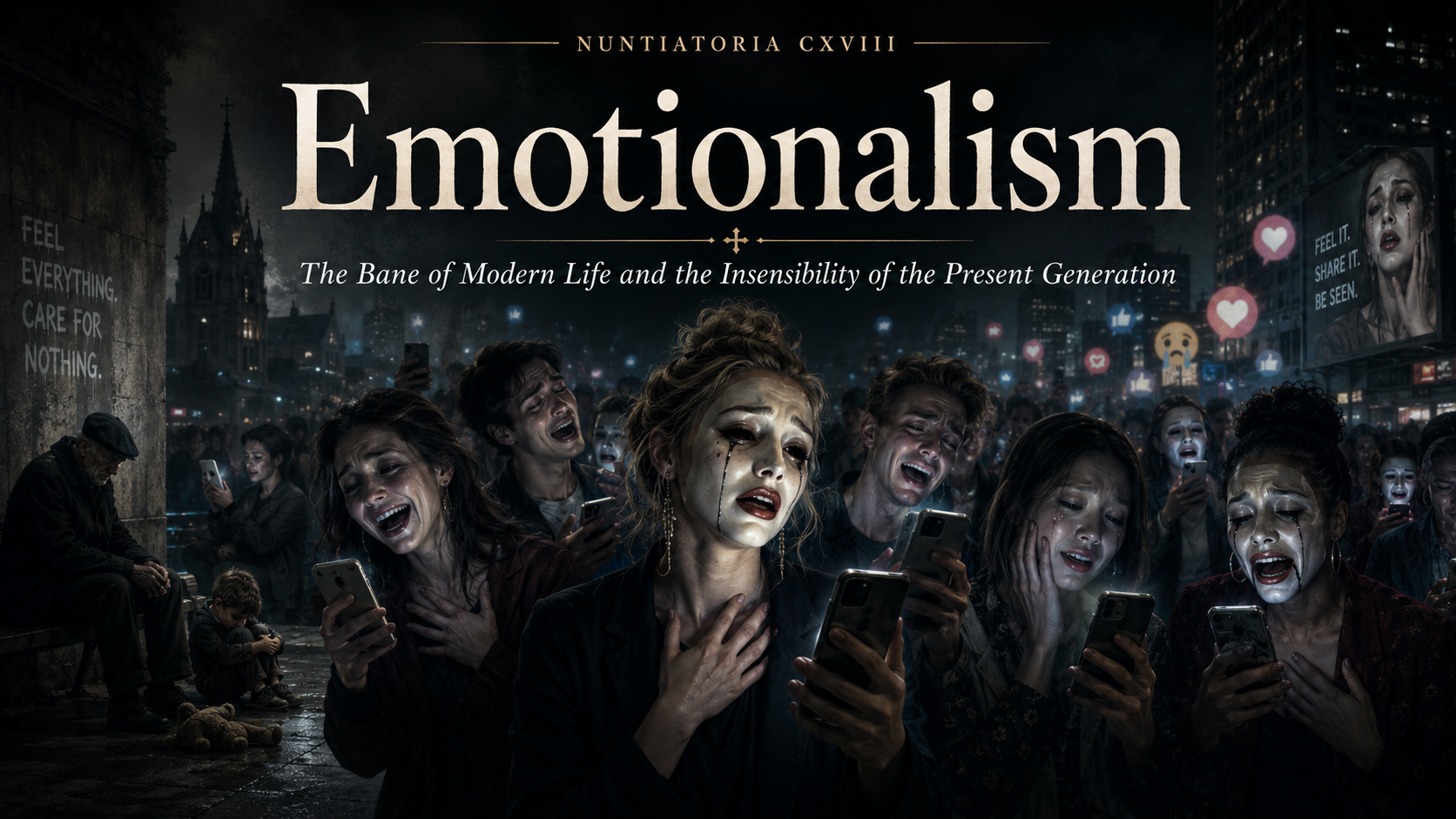
Emotionalism: The Bane of Modern Life and the Insensibility of the Present Generation

Modern society congratulates itself upon its sensitivity. Never, perhaps, have we possessed so extensive a vocabulary for describing feelings. We speak incessantly of empathy, trauma, vulnerability, affirmation, validation, emotional safety, lived experience and the necessity of being heard. Schools teach emotional literacy; corporations advertise compassion; politicians compete to display empathy; public institutions increasingly interpret disagreement through therapeutic categories. Even within the Church, the vocabulary of listening, accompaniment, inclusion and experience has come to occupy a strikingly prominent place in pastoral discourse. Yet the civilisation produced by all this advertised sensitivity is not conspicuously gentler. On the contrary, ours is an age of remarkable emotional agitation combined with an equally remarkable capacity for moral insensibility.
That paradox is the essence of emotionalism. Emotionalism is not the possession of strong feelings, nor is its opposite coldness, repression or indifference. Catholicism has never taught that holiness consists in becoming unfeeling. The passions belong to human nature. Love, desire, hope, fear, sorrow, joy and anger are capable of entering into a genuinely virtuous life. Saint Thomas Aquinas does not propose their destruction but their ordering beneath reason, while the Church expressly teaches that passions become morally good insofar as they contribute to good action.¹ Strong feeling is therefore neither a vice nor a virtue merely because it is strong.
The modern error lies elsewhere. It consists in allowing feeling to cease being a response to reality and to become instead the measure of reality. “I feel this” becomes “therefore it is true.” “This distresses me” becomes “therefore it is wrong.” “This contradicts my understanding of myself” becomes “therefore I have been harmed.” “This makes me uncomfortable” becomes “therefore you ought not to say it.” Emotion, which ought to inform human experience, begins to usurp the office of reason. A feeling becomes an argument.
But emotions are not arguments. A frightened man may fear something harmless. An angry man may be unjust. A jealous man may sincerely imagine betrayal where none exists. A resentful person may genuinely feel injured by someone who has done him no wrong. A man consumed by appetite may experience his desire with overwhelming intensity. The reality of a feeling proves that the feeling exists. It does not prove that the judgment accompanying it is true, that the desire producing it is good, or that the action proposed in consequence is morally lawful. As the Catechism puts it with admirable economy, “strong feelings are not decisive for the morality or the holiness of persons.”²
This distinction was once elementary to the formation of character. The child naturally experiences his emotional world as absolute. Hunger, disappointment, fear and anger occupy his entire horizon because he has not yet acquired proportion. One of the purposes of upbringing is to teach him that the world is larger than his immediate interior state. Wanting something does not create a right to possess it. Anger does not prove another person guilty. Fear does not prove danger. Disappointment does not establish injustice. Desire does not establish identity.
Maturity consists, in part, in learning to place some distance between feeling and judgment. The adult ought to be capable of saying, “I feel this profoundly, but I may nevertheless be mistaken.” Few sentences are more hostile to the spirit of the present age.
For contemporary culture increasingly reverses the traditional process of formation. Rather than teaching the individual to govern his interior world, it seeks to rearrange the exterior world around it. Discomfort must be removed. Contradiction must be softened. Language must be regulated. Other people must be taught not merely to behave courteously but to validate the individual’s preferred interpretation of himself. The result is one of the strangest products of modernity: the emotionally fragile authoritarian, too vulnerable to endure contradiction yet sufficiently imperious to demand that contradiction be forbidden.
Once disagreement is described as harm, censorship may be presented as protection. Once contradiction is called violence, silencing an opponent becomes self-defence. Once affirmation is equated with compassion, refusal to affirm becomes cruelty. What begins as a reasonable demand to be treated civilly gradually becomes an unreasonable demand that other people participate in maintaining one’s psychological equilibrium.
This is not freedom. It is dependence. A person whose peace requires universal affirmation possesses very little interior liberty. His tranquillity depends continually upon the speech and conduct of others. An unwelcome fact can destabilise him; a contrary opinion can threaten him; refusal to validate him can assume the proportions of an existential injury. Far from possessing himself, he becomes hostage to everyone around him.
Traditional Christian formation sought precisely the opposite: a person capable of self-possession. Its language was the language of virtue. Prudence teaches us to discern the true good rather than the merely attractive. Justice gives to God and neighbour what is actually due rather than what present sentiment prefers. Fortitude enables us to pursue the good despite fear, pain or difficulty. Temperance restrains appetite so that desire remains a servant rather than becoming a master. The human virtues, the Catechism teaches, “govern our actions, order our passions, and guide our conduct according to reason and faith.”³ In that single sentence stands an entire anthropology against the emotionalism of the age.
For emotionalism instinctively distrusts the qualities upon which mature character depends. Restraint becomes repression. Fortitude becomes emotional unavailability. Judgment becomes intolerance. Duty becomes oppression. Renunciation becomes psychological harm. Obedience becomes inauthenticity. Sacrifice becomes suspicious. The sovereign self must never hear the word no.
Yet the person who cannot hear no is not free. He is ruled by whichever appetite presently speaks the loudest.
This explains why the ascetical disciplines of Christianity appear increasingly incomprehensible to modernity. Fasting tells appetite that it is not sovereign. Silence refuses the demand that every thought be expressed. Mortification teaches that discomfort need not immediately be escaped. Examination of conscience teaches that sincerity is not innocence. Obedience teaches that goodness may require submission. Prayer teaches the creature that he is not God. These are not exercises in self-hatred. They are exercises in freedom.
The contrast with digital culture could hardly be greater. Social media rewards emotional immediacy. Anger, outrage, fear and indignation travel rapidly; qualification and reflection do not. Grief becomes performance, sympathy display, indignation social currency. One must not simply care; one must be seen to care. One must not merely object; one must exhibit outrage. Even silence can become morally suspicious when public conformity requires everyone to display the approved emotion.
The World Health Organisation reported in 2024 that problematic social-media use among adolescents across the countries surveyed had risen from seven per cent in 2018 to eleven per cent in 2022, defining problematic use in terms of addiction-like symptoms, impaired control and negative consequences in ordinary life.⁴ The significance is not that digital media alone explains the emotional pathologies of the present generation, but that an entire generation is being formed within an environment whose commercial architecture rewards reaction, stimulation and continual self-display.
Constant stimulation, however, eventually produces desensitisation. This is emotionalism’s great paradox. A culture obsessively devoted to sensitivity becomes incapable of proportion. Ordinary embarrassment becomes trauma, criticism harm, disagreement danger, disappointment oppression. Language once reserved for grave suffering is expanded until the ordinary abrasions of human existence require the terminology of catastrophe. And when everything becomes catastrophic, catastrophe itself becomes increasingly difficult to perceive.
Thus we encounter the peculiar insensibility of the present generation. It can be exquisitely sensitive to a badly chosen word while astonishingly indifferent to an unborn child. It can tremble at an unwelcome opinion while discussing the intentional ending of life in the language of dignity. It can condemn moral disapproval as psychologically harmful while accepting profoundly consequential interventions upon healthy bodies in order to relieve immediate distress. Emotionalism does not abolish feeling. It determines selectively what we are permitted to feel about.
The person who can articulate distress most effectively acquires the strongest claim upon public sympathy. The invisible, the inconvenient and the inarticulate consequently disappear. This is nowhere more obvious than in abortion. The woman in crisis can describe fear, poverty, abandonment, shame or desperation, each of which may be tragically real and deserving of genuine compassion. The unborn child, however, cannot speak. He cannot explain that he wishes to live. He cannot campaign, give an interview, describe his pain or demand recognition. Once morality is organised chiefly around visible subjective distress, the voiceless become remarkably easy to exclude.
Catholic moral reasoning begins elsewhere. It asks first what the being before us actually is. If the answer is an innocent human life, his inability to express his interests does not diminish our responsibility towards him but increases it. Hence the Church’s uncompromising insistence that human life “must be respected and protected absolutely from the moment of conception.”⁵ This does not negate compassion for the mother. It refuses to define compassion so narrowly that one human being must disappear before another can be seen.
Saint John Paul II recognised in the acceptance of abortion something deeper than an isolated moral error. He identified a crisis of the moral sense itself: an obscuring of the capacity to distinguish good from evil where human life is concerned.⁶ The diagnosis is especially disturbing precisely because ours is a culture which prides itself upon moral sensitivity. We have learnt to feel intensely while becoming capable, in some circumstances, of failing to see what stands immediately before us.
The same inversion appears in assisted suicide and euthanasia. Suffering is real. Fear is real. Terminal illness may involve terrible pain, dependence and humiliation. Christianity does not romanticise agony. Catholic teaching permits the refusal of disproportionate treatment and the proper relief of pain. What it refuses is the deliberate causing of death as the means by which suffering is removed.⁷
The distinction is urgently relevant in Britain. On 17 June 2026 the Terminally Ill Adults (End of Life) Bill was introduced again in the House of Commons, its stated purpose being to allow eligible terminally ill adults, subject to safeguards, to request assistance to end their lives. Its Second Reading is scheduled for 11 September 2026.⁸ Once again the political vocabulary is that of dignity, autonomy, protection and compassion.
Yet notice what sentimental reasoning does. The suffering person gradually becomes difficult to distinguish from the suffering itself. If suffering is treated as the supreme evil, then eliminating the sufferer may eventually present itself psychologically as eliminating suffering. Saint John Paul II called euthanasia “false mercy”, insisting that true compassion shares another’s pain rather than killing the person whose suffering we cannot bear.⁹
That phrase — whose suffering we cannot bear — exposes something rarely admitted. There is a counterfeit compassion concerned as much with the discomfort of the observer as with the good of the sufferer. Watching another decline is painful. Caring for the chronically ill may be exhausting. Dementia is distressing. Disability may place immense demands upon families and public services. A civilisation which has forgotten the nobility of sacrifice will therefore become increasingly susceptible to the temptation to rename elimination as mercy.
The gravest question is not simply whether an individual may one day be legally permitted to request death. It is what kind of culture may eventually teach the elderly, disabled, lonely or dependent to wonder whether continuing to live constitutes selfishness towards those obliged to care for them. Autonomy can become remarkably coercive once dependence itself is treated as indignity.
The same failure of moral proportion was exposed by the controversy surrounding paediatric gender medicine. For years, serious questions about rapid affirmation and medical intervention were often interpreted not simply as competing clinical judgments but as evidence of cruelty. The distress of the child appeared increasingly capable of supplying both diagnosis and prescription. Again, the intensity of present feeling was permitted to outrun prudence.
The Cass Review called for a markedly more cautious and holistic approach, highlighting the weakness of the evidence base in significant areas of care. The subsequent advice of the Commission on Human Medicines led the British Government to make restrictions upon the private prescribing of puberty blockers for gender incongruence or dysphoria to under-eighteens indefinite.¹⁰ Whatever disputes continue concerning the broader subject, one lesson should now be obvious: present distress cannot by itself determine long-term good.
Children deserve compassion precisely because they are children. Sometimes compassion reassures; sometimes it waits; sometimes it investigates; sometimes it refuses. A parent who never says no is not necessarily loving. A physician who immediately provides whatever a distressed patient requests is not necessarily compassionate. A priest who validates every moral inclination is not necessarily merciful. Love differs from sentimentality because love can see beyond the present emotion towards the whole good of the person.
The same principle governs family life. Marriage survives because fidelity is greater than emotion. Parenthood survives because duty is greater than convenience. Friendship survives because loyalty is greater than enjoyment. Religious vocation survives because commitment is greater than consolation. The language of duty sounds severe only because we have forgotten what duty protects. Duty is what makes another person secure when our feelings change.
A husband remains a husband when enthusiasm fades. A wife remains a wife when romance becomes difficult. A mother remains responsible when she is exhausted. A father remains a father when sacrifice becomes inconvenient. A priest remains a priest when prayer becomes dry. A Christian remains bound to charity even when the person before him is profoundly difficult to love. Feeling may begin an attachment; virtue makes it dependable.
Our culture instead repeatedly tells people to “be true to themselves” without asking the more important question: what kind of self ought one to become? Christianity proposes something immeasurably more demanding. The self is not merely discovered; it must be converted. Desire must be educated. Appetite must be disciplined. Conscience must be formed. Reason must submit to truth. The will must acquire virtue. Grace must heal what sin has wounded. Otherwise authenticity becomes little more than concupiscence supplied with flattering publicity.
Education also suffers when this anthropology disappears. Genuine education necessarily contains discomfort. The pupil discovers that he is wrong. His work is corrected. His prejudices are challenged. He encounters arguments he cannot immediately answer, historical facts indifferent to his feelings and authors who did not share the assumptions of his own age. None of this is violence. It is education. No mind can mature until it discovers that reality is under no obligation to flatter it.
Politics becomes similarly irrational when emotional testimony substitutes for argument. A moving story may demonstrate that suffering exists; it cannot by itself determine which law is just. Tears may establish sincerity; they cannot settle questions of justice, rights, consequences or the common good. Yet sentimental politics increasingly seeks to show not merely that an opponent is mistaken, but that disagreement itself reveals a moral defect. He does not merely oppose a policy: he lacks compassion. He does not merely dispute a premise: he is hateful. He does not merely dissent: his presence is unsafe. Once one side has monopolised kindness, the other need scarcely be answered.
Here the danger reaches directly into ecclesial life. The problem is not listening; Christians ought to listen. The problem is not accompaniment; the shepherd accompanies his sheep. The problem is not pastoral sensitivity; a pastor incapable of tenderness is a poor representation of Christ. The danger begins when experience ceases to be something illuminated and judged by Revelation and becomes instead something before which Revelation itself is expected to bend.
The synodal process has repeatedly emphasised listening, dialogue and the interpretation of lived experience.¹¹ Properly understood, such listening can expose pastoral failures, clerical arrogance, hypocrisy, injustice and needless harshness. It cannot create truth. No accumulation of experiences can make contradiction non-contradictory. No consultation can transform adultery into fidelity, sexual acts contrary to the moral law into chastity, falsehood into truth or error into doctrine. The Church listens in order to discern how eternal truth is to be faithfully applied; she does not listen in order to discover whether eternal truth remains true.
This is precisely where emotionalism can corrupt pastoral practice. The pastoral is rhetorically separated from the doctrinal, as though an action could leave doctrine formally untouched while conveying an entirely different moral intuition. The controversy following Fiducia Supplicans demonstrated the instability of this distinction. The Declaration insisted that Catholic teaching on marriage remained unchanged while authorising non-ritual blessings of couples in irregular situations and couples of the same sex.¹² Whatever intention was supplied by the explanatory text, the ensuing controversy revealed an elementary fact that sentimental pastoralism too easily forgets: actions communicate as surely as propositions do.
Pastoral gestures communicate. Symbols communicate. Blessings communicate. Ceremonial proximity communicates. The question cannot therefore be reduced to whether somebody intends to be welcoming. Catholic realism asks what an action objectively signifies, what understanding it reasonably creates and towards what moral end it directs those involved. Benevolent intention cannot make an ambiguous sign clear merely by declaring it benevolent.
The Church cannot compete with secular therapeutic culture by becoming its supernatural department. Christianity is not principally the reassurance that God understands how we feel. It is the proclamation that God has acted in Jesus Christ to deliver us from sin and death. Its first evangelical word is not affirm yourself but do penance. The Gospel does not canonise the wounded self. It heals it.
Our Lord is therefore the perfect refutation of sentimental religion. Jesus wept at Lazarus’s grave. He had compassion upon the multitudes. He welcomed children. He allowed the penitent woman to wash His feet with her tears. Christianity can never despise tenderness after contemplating the Sacred Heart. Yet no sentimentalist could have invented the Christ of the Gospels, because the same Jesus speaks of judgment, commands repentance, warns of hell, demands renunciation and permits men to depart rather than falsify the conditions of discipleship.
Saint Mark tells us that Christ looked upon the rich young man and loved him. That detail matters enormously. It is precisely the man whom Christ loves whom He asks to surrender what possesses his heart. The young man departs sorrowful, but Our Lord does not run after him to renegotiate the truth.¹³ Love does not remove the demand. Love explains the demand.
The woman taken in adultery encounters the same indivisible mercy: “Neither will I condemn thee. Go, and now sin no more.”¹⁴ The sentimental Christianity of the present age is perpetually tempted to retain the first sentence while suppressing the second. But remove sin no more and neither will I condemn thee gradually ceases to mean mercy. It becomes permission. Mercy can exist only where there is something from which man needs to be saved.
Nowhere, however, is the Christian ordering of emotion revealed more perfectly than in Gethsemane. Christ does not pretend that suffering is pleasant. He does not repress anguish. “Father, if thou wilt, remove this chalice from me.” The feeling is real. The fear is real. The desire is real. Yet none becomes sovereign. “Nevertheless not my will, but thine be done.”¹⁵
There is the Christian answer to emotionalism in a single scene. Feeling is neither denied nor enthroned. It is acknowledged and then ordered to truth, obedience and love.
After Gethsemane comes Calvary, and Calvary exposes the final poverty of sentimentalism. The Cross reveals love not principally as emotional intensity but as sacrificial fidelity. Christ remains when remaining costs everything. He loves when love wounds. He gives when nothing can be returned. He does not make suffering an excuse for ceasing to love; He makes suffering the place in which love reaches its supreme expression.
Christianity and emotionalism therefore proceed from radically different questions. Emotionalism asks how suffering may be avoided; Christianity asks what love requires. Emotionalism asks what feels authentic; Christianity asks what is true. Emotionalism asks how others must change so that the self need not experience discomfort; Christianity asks how the self must be converted.
None of this excuses callousness. The answer to sentimentality is not cruelty. Mockery of genuine distress is not fortitude. Inability to express affection is not masculine strength. Coldness is not orthodoxy. A priest who never comforts the suffering is not made a good pastor merely because his propositions are correct. Catholicism demands not diminished sensitivity but properly ordered sensitivity.
The Christian ought to feel more truthfully. He should grieve over what actually destroys men rather than merely what disturbs him. He should become angry at genuine injustice rather than personal contradiction. He should fear sin more than social disapproval. He should rejoice in goodness even when goodness is unfashionable. He should pity suffering without allowing pity to become an accomplice of falsehood.
For compassion requires truth precisely because compassion concerns another person’s good. Sentimentality asks chiefly how the other person feels at this moment. Charity asks what will actually make him whole. Sentimentality seeks immediate relief from distress. Charity considers the whole person, his duties, his relationships, the truth of his nature and, finally, the salvation of his soul.
That is why emotionalism can end in cruelty while continuing to speak the language of kindness. It will affirm a destructive choice rather than endure the discomfort of questioning it. It will leave a sinner in sin rather than risk appearing judgmental. It will tell the adulterer to “follow his heart” rather than acknowledge the wife, husband or children broken by betrayal. It will describe death as autonomy rather than ask why the elderly or terminally ill have come to regard their continued existence as burdensome. It will mistake the immediate relief of psychological distress for proof that the action producing relief is good.
Sentimentalism wishes to feel merciful without bearing the cost of mercy.
Real charity is more expensive. It remains beside the suffering person. It performs the tedious work of care. It bears another’s burdens. It tells difficult truths without hatred. It protects the vulnerable when doing so is inconvenient. It forgives. It admonishes. It waits. It refuses when refusal is necessary. It comforts without lying. It understands that sometimes the most loving word is yes, sometimes no, sometimes repent, and sometimes simply I will remain with you.
The present generation therefore does not need less compassion. It needs adult compassion. It does not need fewer feelings. It needs feelings educated by truth. It does not need indifference to suffering. It needs sufficient moral intelligence to distinguish suffering from evil.
That distinction is indispensable. Sometimes suffering accompanies evil and should be relieved. Sometimes suffering accompanies the rejection of evil and must be endured. Sometimes suffering is itself the cost of fidelity. The surgeon causes pain in order to heal. The parent causes disappointment by refusing what would harm the child. The teacher wounds vanity by correcting error. The confessor disturbs the conscience so that grace may restore it. A civilisation unable to understand such distinctions will eventually call healing cruel and destruction compassionate.
That danger is no longer theoretical.
The recovery must begin with an older and far more humane proposition: the heart is a noble servant but a terrible sovereign. Reason must recover its office. Conscience must be formed rather than merely consulted. Fortitude must again be taught. Temperance must cease to sound oppressive. Duty must recover its dignity. Sacrifice must once again be understood as one of the ordinary languages of love.
Christians, above all, must recover confidence in ascetical formation. Fasting, mortification, silence, examination of conscience, obedience, patience and prayer are profoundly countercultural because each teaches the self that it is not sovereign. They train appetite to hear no. They teach emotion that it need not immediately become action. They strengthen the will to persevere after enthusiasm has vanished. They deliver man from slavery to his own impulses.
They make him free.
The alternative is increasingly visible: men and women possessing innumerable choices while remaining inwardly governed by appetites which commerce exploits, emotions which politics manipulates, fears which institutions administer and grievances which digital platforms monetise. Never has man been offered so many opportunities to express himself; seldom has he been encouraged so little to govern himself.
That is the deepest insensibility of the present generation. It is not that people have ceased to feel. Their feelings have become curved inward. They are acutely sensitive to the self and increasingly insensitive to realities which make claims upon the self. They perceive the insult but overlook the obligation; detect the microaggression but miss the abandoned neighbour; condemn the unwelcome word while ignoring the broken family; profess compassion for distant abstractions while resenting the inconvenient person immediately before them.
There is nothing compassionate about this. It is narcissism equipped with an ethical vocabulary.
A genuinely sensitive civilisation would be sensitive first to reality. It would see the child in the womb even when seeing him imposes obligations. It would see dignity in the dying person even when caring for him is exhausting. It would recognise that a distressed child deserves something more substantial than ideological slogans. It would understand that children need stable adults rather than adults frightened to contradict them. It would recognise that truth spoken gently may be infinitely more loving than a consoling lie.
Above all, it would understand that the purpose of moral formation is not to prevent the heart from feeling, but to teach it what is worthy of love, sorrow, anger, fear and joy.
For sentimentality asks remarkably little that is heroic of us. It asks us to experience the approved feeling and, increasingly, to display it publicly. Charity demands immeasurably more. Charity asks us to tell the truth when truth costs affection; to remain faithful when affection grows cold; to care for those whose care is burdensome; to protect those who cannot repay us; to forgive when resentment feels justified; to correct without hatred; to persevere without applause; and, if necessary, to lay down our lives for those whom we love.
That is why the saints appear incomprehensible to an emotionalist age. Their emotions were often immense. Saint Peter wept bitterly. Saint Augustine burned with longing. Saint Teresa knew ecstasy and anguish. Saint Thérèse suffered darkness. Our Lady stood beneath the Cross. Christianity has never lacked feeling.
But the saints’ feelings were not their masters.
They possessed something modern man increasingly lacks: the liberty of the rightly ordered soul.
That is the liberty our civilisation desperately needs to rediscover — not freedom from feeling, but freedom from enslavement to feeling; not hardness of heart, but purification of heart; not indifference, but proportion; not the abolition of compassion, but its rescue from sentimentality.
For the ultimate fruit of emotionalism is not tenderness but insensibility. The heart which requires continual stimulation eventually becomes numb. The person who interprets every discomfort as catastrophe loses the ability to recognise tragedy. The civilisation which concludes that suffering is the supreme evil will eventually become willing to destroy the sufferer in order to destroy suffering.
Christianity offers something infinitely greater: truth in the intellect, virtue in the will, discipline in the passions, charity in the heart, and grace ordering the whole person towards God. Only then can sorrow become compassion rather than self-pity; anger become courage rather than rage; desire become love rather than appetite; fear become reverence rather than panic; and suffering become sacrifice rather than despair.
The present generation does not need its feelings endlessly affirmed. It needs its heart converted.
For the heart is indeed a noble servant but a terrible sovereign. Governed by reason, purified by virtue and sanctified by grace, it becomes capable of fidelity, sacrifice and mercy. Enthroned as the measure of truth, it becomes first demanding, then tyrannical, then cruel — and finally so absorbed in feeling itself that it loses the capacity to love.
¹ St Thomas Aquinas, Summa Theologiae, I–II, qq. 22–48, 59; Catechism of the Catholic Church, §§1762–1770.
² Catechism of the Catholic Church, §1768.
³ Catechism of the Catholic Church, §§1804–1809.
⁴ World Health Organisation Regional Office for Europe, “Teens, Screens and Mental Health,” 25 September 2024.
⁵ Catechism of the Catholic Church, §§2270–2275.
⁶ John Paul II, Encyclical Evangelium Vitae, 25 March 1995, nos. 58, 61–62.
⁷ Catechism of the Catholic Church, §§2276–2279.
⁸ House of Commons Library, “Terminally Ill Adults (End of Life) Bills”; UK Parliament, Terminally Ill Adults (End of Life) Bill, Bill 14, 2026–27.
⁹ John Paul II, Evangelium Vitae, nos. 64–66.
¹⁰ Hilary Cass, Independent Review of Gender Identity Services for Children and Young People: Final Report, April 2024; Department of Health and Social Care, “Ban on Puberty Blockers to Be Made Indefinite on Experts’ Advice,” 11 December 2024.
¹¹ XVI Ordinary General Assembly of the Synod of Bishops, For a Synodal Church: Communion, Participation, Mission — Final Document, 26 October 2024.
¹² Dicastery for the Doctrine of the Faith, Declaration Fiducia Supplicans: On the Pastoral Meaning of Blessings, 18 December 2023, nos. 31, 38–41.
¹³ Mark 10:17–22, Douay-Rheims.
¹⁴ John 8:11, Douay-Rheims.
¹⁵ Luke 22:42, Douay-Rheims.
RELATED ARTICLES


Latest ARTICLES
- Quod accepimus, custodimus et tradimus ~ What we have received, we guard and hand on: Spiritual Conference for Nuntiatoria CXXIVThe Catholic Faith has reached us at a time when parts of its doctrinal, moral and liturgical inheritance are contested, obscured or neglected even within the Church. This spiritual conference asks what happened, why it happened and, above all, what Catholics can do despite it. Fidelity in a crisis requires more than private endurance: Catholics must know the Faith, defend it, resist what would corrupt it, restore what has been damaged, build where institutions have failed and hand the inheritance whole to those who come after them. We are not called merely to outlast the crisis, but to fight for the Faith through it.
- Archbishop Viganò’s “Schism of the Head”: A True Diagnosis That Risks a False EcclesiologyArchbishop ✠Carlo Maria Viganò correctly identifies the limits of papal authority and the modernist practice of eroding doctrine through pastoral processes. His theory of a “schism of the head”, however, risks replacing papal maximalism with a private judgement that makes each resister the judge of whether the Pope remains united to the Church.
- MOUNT MELLERAY REOPENS: People Before Profit’s “MAGA beachhead” meets Catholic realityPeople Before Profit warned that Ave Maria University’s arrival at Mount Melleray would create a “MAGA beachhead” and has now demanded confiscatory taxation of Catholic property transactions. Yet the abbey has reopened with students, prayer, education and public worship. Behind the political rhetoric lies a more important question: when Ireland’s old religious communities can no longer sustain their foundations, must their patrimony inevitably be secularised?
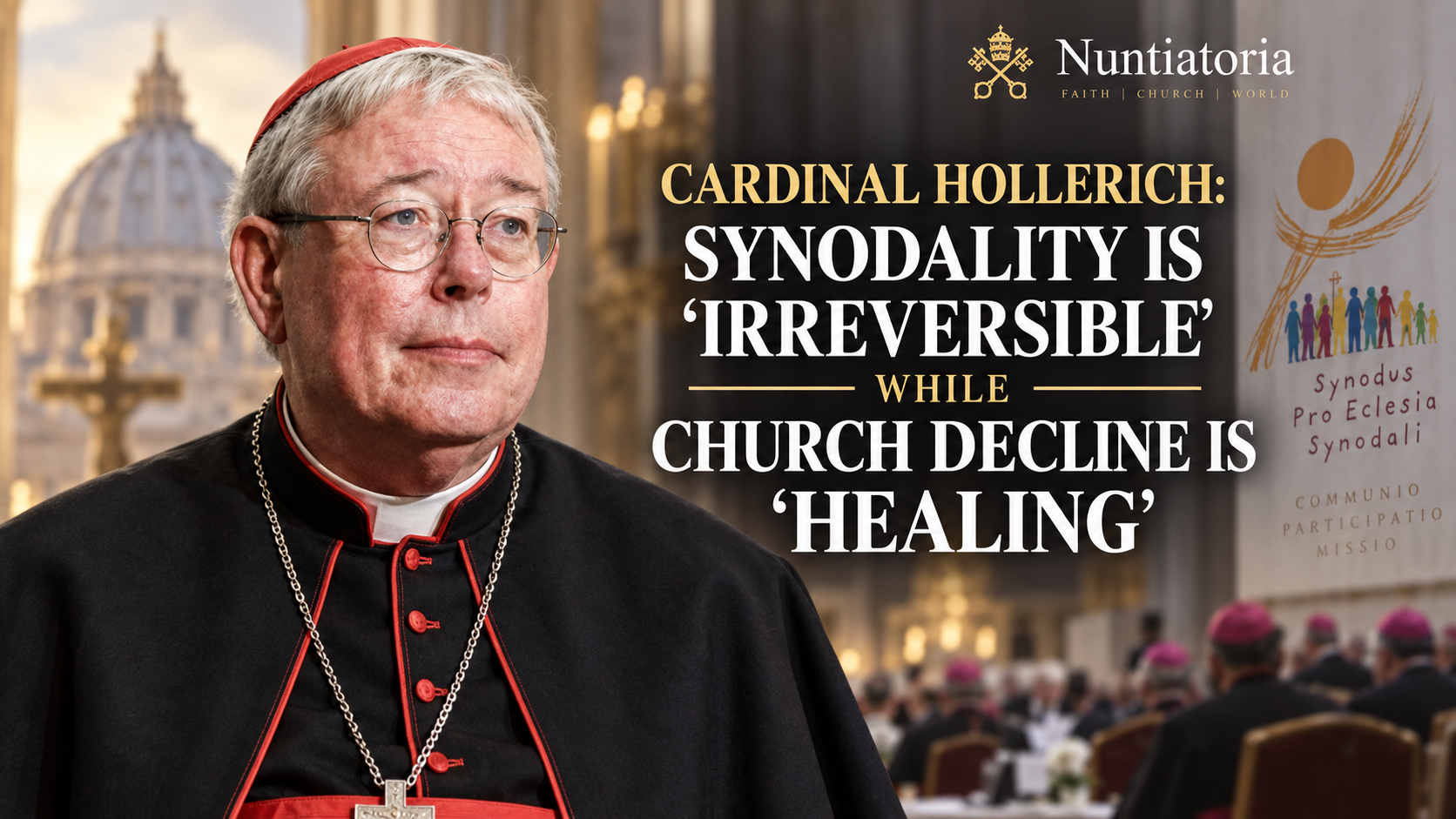
- Cardinal Hollerich: Synodality is “irreversible” while Church decline is “healing”Cardinal Jean-Claude Hollerich asserts that the synodal process initiated by Pope Francis is “irreversible”, viewing the decline in Catholic practice as a potential healing process. However, he warns against equating decline with justification. Evidence from France and Germany highlights the significant downturn in sacramental practice, urging a need for genuine evaluation of pastoral methods to ensure faithful transmission of the Faith.
- Cardinal Arborelius Faces New Evidence of Failure to Implement Vatican DecreeNew documentary evidence intensifies questions over the Diocese of Stockholm’s response to a Vatican decree declaring Fr Tobias Unnerstål’s suspension invalid. The affair has become a test not simply of one priest’s treatment, but of a more fundamental Catholic principle: whether canon law binds those exercising ecclesiastical authority as surely as those subject to it.




Leave a Reply