
Watching the Watchers: Facial Recognition, Policing, and the Quiet End of Privacy in Britain
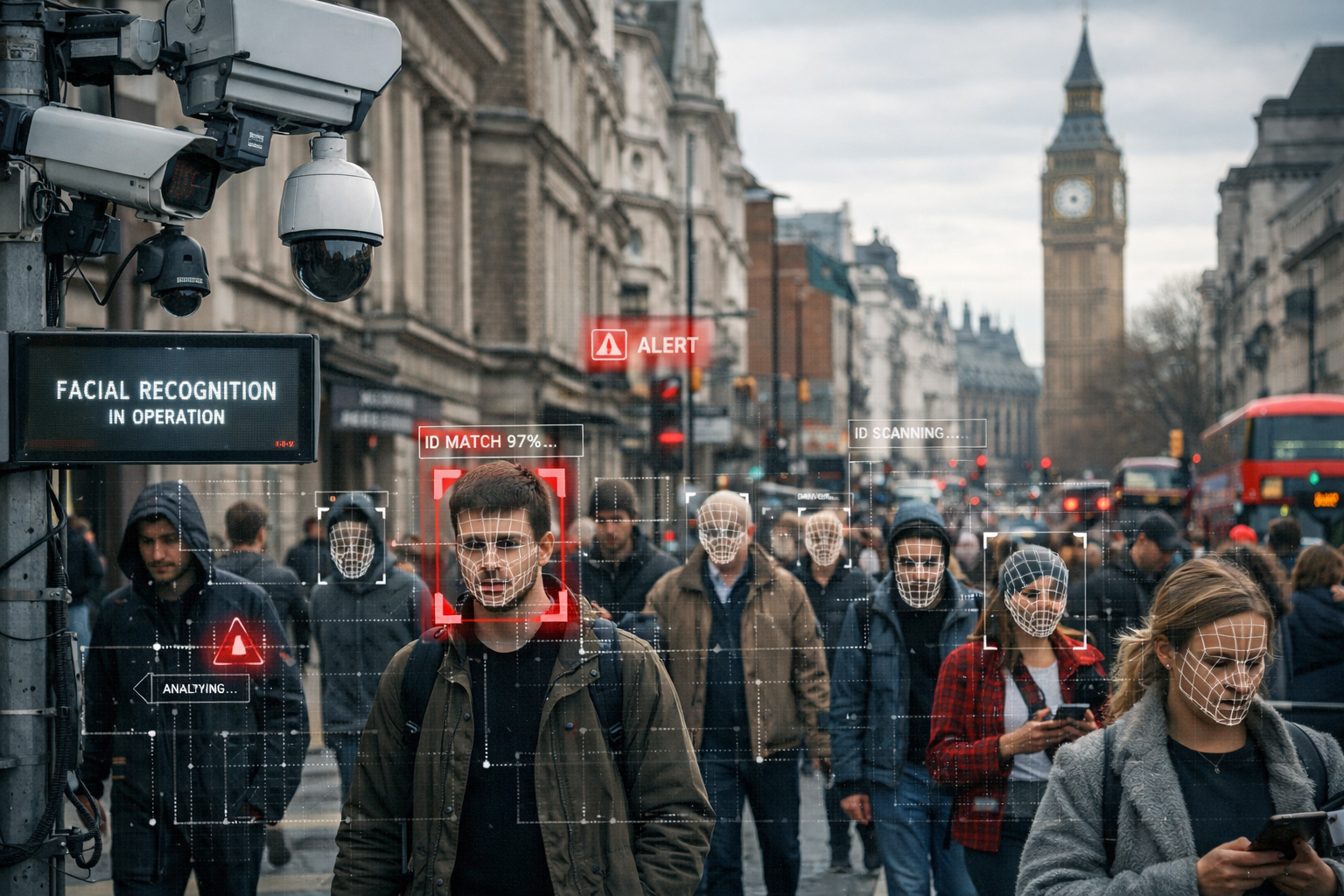
Britain is entering a new phase of surveillance. In January 2026 the UK Government confirmed plans for the largest expansion of live facial recognition (LFR) technology in the country’s history, as part of a package of policing reforms across England and Wales. These reforms include a substantial increase in the number of police vehicles equipped with live facial recognition cameras, wider deployment across forces, and the establishment of a national body to coordinate the use of artificial intelligence in policing.¹
Live facial recognition allows police cameras to scan the faces of all individuals within range and compare those images in real time against predefined watchlists. According to official government documentation, the technology operates by capturing facial images of passers-by and automatically assessing them for potential matches, with a human officer reviewing any alerts generated.² The process applies indiscriminately to the public present in the surveillance area, rather than to individuals already suspected of wrongdoing.
The Government has presented this expansion as a means of improving efficiency, accelerating investigations, locating wanted or missing persons, and reducing administrative burdens on police officers.¹ However, the scale and routine nature of the proposed deployment mark a significant shift from earlier, time-limited trials at specific events.
Legal framework and judicial scrutiny
There is currently no single, dedicated statutory regime governing the use of live facial recognition by police forces in the United Kingdom. Instead, its use is regulated through a combination of data protection law, human rights legislation, common-law policing powers, and non-binding oversight codes.³ This fragmented framework has been repeatedly criticised by legal scholars and regulatory bodies for lacking clarity, precision, and democratic accountability.
Judicial concerns are not theoretical. In 2020, the Court of Appeal ruled that earlier deployments of live facial recognition by South Wales Police were unlawful, citing inadequate safeguards, excessive discretion in watchlist creation, and failures to properly assess privacy impacts.⁴ More recently, a fresh legal challenge has been brought before the High Court against the Metropolitan Police’s current use of live facial recognition, arguing that the technology continues to operate without sufficiently clear legal limits on where, when, and how it may be deployed.⁵
These cases do not dispute that the technology functions as designed. Rather, they raise the question of whether its routine use in public spaces is compatible with existing legal protections for privacy, proportionality, and freedom of association.
From targeted tools to ambient surveillance
What distinguishes the current phase of facial recognition from earlier policing technologies is not merely accuracy or speed, but permanence and scope. Traditional stop-and-search powers require officer initiation, observable suspicion, and post-hoc accountability. Live facial recognition, by contrast, operates continuously and invisibly, subjecting all individuals in a given space to biometric analysis without notice or consent.
Official government materials confirm that the system is designed to scan all faces captured by the camera feed, regardless of whether any individual is suspected of an offence.² As deployments expand from isolated trials to routine use in town centres and transport hubs, facial recognition increasingly resembles ambient infrastructure rather than an exceptional investigative tool.
International comparison and surveillance architecture
The UK Government rejects comparisons with the People’s Republic of China, where facial recognition is embedded within a comprehensive system of population monitoring and behavioural enforcement. That distinction is valid at the level of political system. However, the comparison often made by civil-liberties scholars concerns infrastructure rather than ideology.
China’s surveillance model relies on the integration of ubiquitous cameras, biometric identification, centralised databases, and automated decision-making. Public reporting confirms that facial recognition plays a core role in systems used to monitor movement, identify individuals, and enforce compliance with both criminal and administrative regulations.⁶
The relevance of this comparison lies not in equating political intent, but in recognising how surveillance capacity, once established, creates long-term structural possibilities that extend beyond its original justification.
The erosion of public anonymity
One immediate consequence of live facial recognition is the effective removal of anonymity from public space. Individuals attending demonstrations, religious services, political meetings, or other lawful gatherings may be scanned, assessed, and logged without their knowledge. While no claim is made that such data is currently used for ideological enforcement, the capability itself alters the relationship between citizen and state.
Regulatory bodies have repeatedly warned that biometric surveillance raises unique risks because facial data is permanent, cannot be changed, and can be repurposed across systems.³ Once biometric identification becomes normalised, the threshold for further expansion is lowered.
A threshold quietly crossed
The expansion of live facial recognition has proceeded faster than public understanding or parliamentary scrutiny. Infrastructure is being deployed while consultations and legal challenges follow behind. As with many technological shifts, the decisive change is not announced with fanfare but embedded incrementally.
The question now facing Britain is not whether facial recognition can assist policing in limited circumstances, but whether a society committed to ordered liberty can accept continuous biometric monitoring of the general population as a normal condition of public life.
China did not become a surveillance state overnight. It became one camera at a time.
Britain would be wise to reflect on that lesson before the architecture is complete.
¹ Sky News, “Facial recognition technology to be rolled out nationally and police to also get AI support”, January 2026.
² UK Government, Police use of facial recognition: factsheet, Home Office publication.
³ Ada Lovelace Institute, “The legal framework for police use of facial recognition”, briefing paper on regulatory gaps and oversight.
⁴ Court of Appeal (Civil Division), R (Bridges) v Chief Constable of South Wales Police [2020] EWCA Civ 1058.
⁵ The Register, “High Court to grill London cops over live facial recognition creep”, January 2026.
⁶ Human Rights Watch, “China’s Algorithms of Repression”, documentation of facial recognition and population surveillance systems.
RELATED ARTICLES


Latest ARTICLES
- Today’s Mass: September 19 St. Januarius, Bishop and Companion MartyrsSt. Januarius and companion martyrs were martyred during the persecution under Diocletian. St. Januarius, patron of the city of Naples and bishop of Beneventum, was beheaded with his deacons and some others.
- Sermon for St. Januarius and his CompanionsToday we celebrate the feast of St. Januarius and his companions. About St. Januarius little is known except that he was among the many martyrs during the great persecution under the Emperor Diocletian.
- 20.09.26 Nuntiatoria CXXIV: QUOD ACCEPIMUS, CUSTODIMUS ET TRADIMUSThe editorial emphasises the importance of understanding our inheritance as custodians rather than owners. It highlights the obligation to preserve and transmit the Christian Faith, sacraments, and traditions to future generations. Through gratitude and fidelity, those who receive must ensure that what has been entrusted does not end with them.
- ONE LORD, ONE FAITH, ONE BAPTISM: The Seventeenth Sunday after PentecostThe Seventeenth Sunday after Pentecost emphasises the love of God and neighbour, rooted in divine justice. The Mass articulates the necessity of one faith and baptism, ensuring charity is not sentimental but deeply theological. The Gospel challenges believers to recognise Christ’s dual nature as both David’s son and Lord, reinforcing true Christian charity.
- AN AWARD IS NOT A MEETINGLambeth Palace has withdrawn the Hubert Walter Award given to Hafiz Tahir Ashrafi for reconciliation, citing previously unknown controversial comments. This raised questions about the vetting process prior to the award. While Ashrafi has defended his record of protecting minority rights, the Palace must clarify why such issues were overlooked initially.





Leave a Reply