
The Apostolic Altar: Reclaiming the Sacrificial Reality of the Early Church
Christian worship did not emerge from a vacuum, nor was it invented ex nihilo by a group of Galilean fishermen experimenting with new religious forms. It arose within a precise religious world in which sacrifice was the definition of religion itself. For the Apostles—men formed by the Temple, the Psalms, and the liturgical calendar of Israel—the idea of a non-sacrificial faith would have been unintelligible. To suggest that they proclaimed a Christianity without offering is as historically incoherent as suggesting they abandoned prayer, fasting, or covenantal law.¹
The modern claim that Christian sacrifice represents a later “pagan” corruption depends entirely upon an anachronistic reading of the first century. In Second Temple Judaism, Temple worship was not one devotional option among many but the axis around which all religious life revolved. Even synagogue prayer presupposed the altar in Jerusalem and oriented itself toward it.² Any movement claiming continuity with Israel’s God while rejecting sacrifice would have been instantly recognisable as apostate. No such rejection appears in the apostolic record.
Fulfilment, Not Abolition: Christ and the New Sacrifice
The Apostolic preaching proclaimed fulfilment, not negation. This is stated with particular clarity in the Epistle to the Hebrews, which presents Christ’s sacrifice not as the abolition of cult, but as its perfection.³ The once-for-all character of Christ’s offering refers to the historical immolation of Calvary, not to the exclusion of liturgical participation in that sacrifice.
This distinction is decisive for understanding the Last Supper. Christ does not speak in vague or poetic terms, but in the technical language of sacrifice: blood poured out, covenant ratified, memorial commanded. In Jewish liturgical usage, anamnesis does not denote subjective recollection but cultic re-presentation—the making present of a saving act through ritual obedience.⁴ As both Joachim Jeremias and Louis Bouyer demonstrated in detail, the Passover context renders any purely symbolic interpretation historically indefensible.⁵
What Christ institutes at the Supper is therefore not a fellowship meal detached from worship, but the sacramental form of His one sacrifice—unbloody, yet truly sacrificial; distinct from Calvary in mode, yet identical in substance.⁶

The Forty Days and the Formation of Apostolic Liturgy
After the Resurrection, Christ spends forty days instructing the Apostles concerning the Kingdom of God.⁷ In Jewish theology, the Kingdom is inseparable from divinely ordered worship. The Fathers consistently understood these post-Resurrection instructions to include the form of Eucharistic celebration itself, not merely doctrinal abstractions.⁸
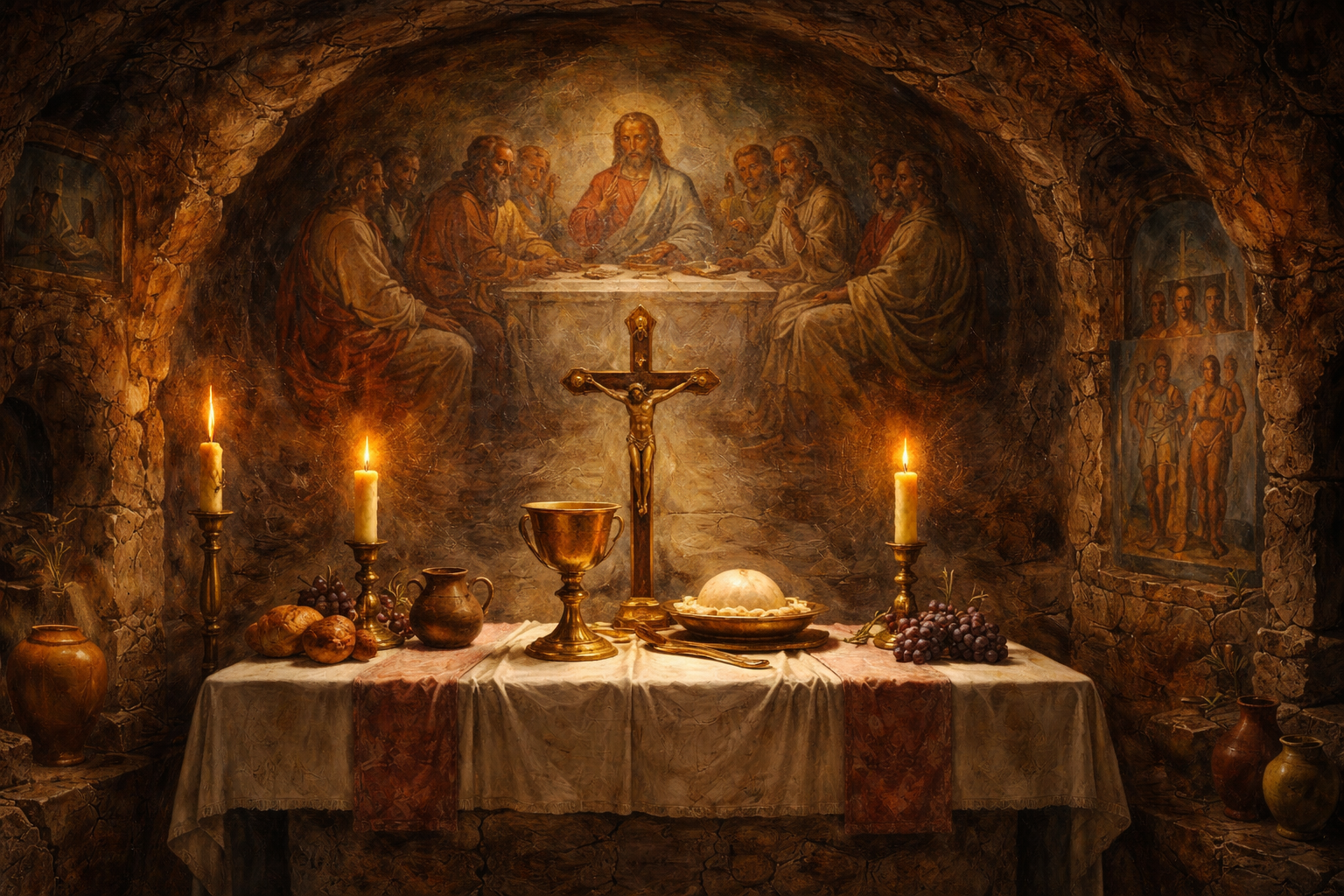
This explains the striking historical reality that the earliest Christian communities—meeting in private homes under conditions of persecution—nonetheless establish fixed liturgical structures, designated ministers, and sacrificial terminology from the outset. Archaeological evidence from early house churches confirms the presence of permanent altars rather than temporary dining arrangements.⁹ The Apostles were not improvising devotional gatherings; they were enacting a cultus received from Christ Himself.
Altar and Priesthood in the Earliest Church
The earliest Christian texts outside the New Testament confirm this sacrificial self-understanding. The Didache explicitly speaks of a “pure sacrifice” offered among the nations, invoking the prophecy of Malachi as already fulfilled in the Eucharist.¹⁰ This is covenantal language, not metaphorical ornamentation.
From the beginning, sacrifice and priesthood are inseparable. An altar presupposes an offering; an offering presupposes one authorised to offer. This logic was axiomatic in the ancient world, but in the Church it was decisively shaped by apostolic authority rather than borrowed from surrounding religions.¹¹ The Christian priesthood is not a pagan survival, but the necessary form taken by Christ’s own priesthood as it is sacramentally extended through time.
Clement of Rome and Apostolic Order
The most decisive first-century witness is Saint Clement of Rome, writing to the Corinthians around A.D. 96. Clement was a direct contemporary of the Apostles and, according to consistent tradition, ordained by Saint Peter himself.¹² His letter presupposes living memory of apostolic norms.
Responding to a rebellion against legitimate ministers, Clement grounds ecclesial order explicitly in sacrificial ministry:
“Our sin will not be small, if we eject from the episcopate those who have blamelessly and holily offered the sacrifices.”¹³
This statement is decisive. The offering of sacrifice is presented as the defining act of the episcopal office. Clement further insists that these offerings are commanded by God to be carried out at fixed times and in proper order, drawing a direct parallel between the liturgical hierarchy of the Old Covenant and that of the Church.¹⁴ The language is not spiritualised or allegorical. It is cultic, concrete, and juridical.
Counter-Arguments Examined and Disproved
Several recurring objections are often raised against the sacrificial understanding of the early Church. Each collapses under historical and textual scrutiny.
The first claim is that the Eucharist was originally a communal meal and only later became a sacrifice under Greco-Roman influence. This assertion is contradicted by the earliest sources themselves. The Didache, Clement, Ignatius, and Irenaeus all pre-date Constantine and yet speak unambiguously of sacrifice and altar.¹⁰ ¹³ ¹⁵ ¹⁶ No textual stratum exists in which the Eucharist is non-sacrificial and then later “evolves.” The sacrificial understanding is original, not developmental.
A second objection appeals to Hebrews, arguing that Christ’s “once for all” sacrifice excludes any ongoing sacrificial action. This reading confuses historical immolation with liturgical participation. Hebrews explicitly contrasts repeated bloody sacrifices with Christ’s single bloody offering, not with its sacramental re-presentation.³ The same epistle presupposes an altar and priestly action when it speaks of Christians having “an altar from which those who serve the tent have no right to eat” (Heb 13:10). The text itself refutes the objection.
A third claim asserts that priesthood contradicts the “priesthood of all believers.” This argument collapses once its anachronism is exposed. The New Testament affirms a universal priesthood precisely by analogy with Israel, where a royal priesthood coexisted with a ministerial priesthood. Exodus 19:6 did not abolish the Aaronic priesthood; neither does 1 Peter 2 abolish apostolic ministry. Clement’s language makes this continuity explicit.¹³ ¹⁴
Finally, it is often alleged that altars are pagan intrusions and that early Christians used ordinary tables. Archaeology directly contradicts this claim. Early Christian worship spaces show fixed cultic focal points oriented toward offering, not domestic dining.⁹ Moreover, the consistent patristic distinction between altar and table demonstrates that Christians themselves did not regard the Eucharistic altar as a piece of furniture but as a sacred locus of sacrifice.¹¹
In every case, the counter-arguments depend not on evidence but on later theological presuppositions projected backwards onto the apostolic age.
Patristic Consensus and Magisterial Continuity
Clement stands within a unanimous patristic tradition. Ignatius of Antioch insists upon unity around the bishop precisely because only the bishop—or one authorised by him—may validly offer the Eucharist, which he identifies as the flesh of Christ Himself.¹⁵ Irenaeus of Lyons explicitly identifies the Eucharist as the New Covenant sacrifice foretold by the prophets and offered throughout the world.¹⁶
The Church’s magisterium later gives dogmatic precision to this inherited faith. The Council of Trent teaches that in the Mass “that same Christ is contained and immolated in an unbloody manner who once offered Himself in a bloody manner on the altar of the Cross.”¹⁷ Trent does not innovate; it defends apostolic doctrine against recurrent denials.
Conclusion
The cumulative evidence—Scriptural, patristic, liturgical, and archaeological—admits of only one conclusion. The early Church understood herself as a sacrificial body, ordered around altar and priesthood, precisely because she understood herself as apostolic.
To dismiss this reality as “pagan” is not merely theologically erroneous; it is historically indefensible. The altar and the priest were not foreign accretions imposed upon Christianity. They were the divinely ordained instruments by which those who had known Christ ensured that His one sacrifice would remain sacramentally present until the end of time.
Standing at the threshold between apostolic memory and post-apostolic history, Clement of Rome leaves no ambiguity. The Church was never conceived as a disembodied fellowship of believers, but as a liturgical organism—structured, sacrificial, and obedient to the form of worship handed down by the Lord Himself during those final days of instruction.
¹ G. von Rad, Old Testament Theology, vol. I (Edinburgh: Oliver & Boyd, 1962), 250–268.
² A. Edersheim, The Temple: Its Ministry and Services (Peabody: Hendrickson, 1994), 19–45.
³ Hebrews 9–10.
⁴ Exodus 12; Leviticus 24; cf. J. Ratzinger, The Spirit of the Liturgy (San Francisco: Ignatius Press, 2000), 50–56.
⁵ J. Jeremias, The Eucharistic Words of Jesus (London: SCM Press, 1966), 222–247; L. Bouyer, Eucharist (Notre Dame: University of Notre Dame Press, 1968), 90–104.
⁶ Catechism of the Council of Trent, II.4.
⁷ Acts 1:3.
⁸ Hippolytus, Apostolic Tradition, 3–4.
⁹ L. Michael White, The Social Origins of Christian Architecture, vol. I (Valley Forge: Trinity Press, 1990), 47–78.
¹⁰ Didache 14; Malachi 1:11.
¹¹ J. Jungmann, The Mass of the Roman Rite, vol. I (New York: Benziger, 1951), 15–32.
¹² Irenaeus, Adversus Haereses, III.3.3.
¹³ Clement of Rome, Epistle to the Corinthians, 44.
¹⁴ Ibid., 40–41.
¹⁵ Ignatius of Antioch, Smyrnaeans, 7–8.
¹⁶ Irenaeus, Adversus Haereses, IV.17–18.
¹⁷ Council of Trent, Session XXII, Doctrine on the Sacrifice of the Mass, ch. 2.
related articles


Latest articles
- Today’s Mass: October 24 St Raphael the ArchangelThe Feast of Saint Raphael the Archangel highlights his healing powers as depicted in the Book of Tobit, where he aids Tobit and his son, Tobiah. Venerated as a protector of travellers and the blind, Raphael is celebrated for his miraculous interventions. His legacy includes support for nurses, matchmakers, and Catholic studies.
- 25.10.26 Nuntiatoria CXXIX: CHRISTUS REXThe text discusses the relationship between Christ’s kingship and authority within the Church amidst contemporary challenges. It contrasts ecclesiastical power with genuine faith, emphasising that authority must protect divine truth rather than alter it. The witness of imprisoned priests illustrates the enduring significance of fidelity to Christ over institutional conformity.
- THE DOMESTIC CHURCH: 25 October – 2 November 2026 A Home with Room for Heaven: Preparing for All Saints and All SoulsThe content outlines a week’s plan for traditional Catholic families to prepare for the feasts of All Saints and All Souls. Emphasising daily prayers, remembrance of the deceased, and engagement with children’s activities, it aims to integrate Catholic customs into family life, enriching spiritual practices and fostering a shared faith experience.
- ORDO w/c 25.10.26The text outlines the liturgical calendar for the last week of October and the beginning of November, highlighting key celebrations. Notable events include the Feast of Christ the King, St Evaristus, the Vigil of Saints Simon and Jude, and the Feast of All Saints, emphasising themes of holiness, unity in faith, and the Church’s teachings.
- Christ the King: The Sovereignty of the Crucified RedeemerThe Mass of Christ the King articulates core Catholic beliefs about Jesus’ divine authority, redemptive sacrifice, and the essence of His Kingdom. It emphasises Christ as Prophet, Priest, and King, whose sovereignty is inseparable from His mission of reconciliation, calling the faithful to acknowledge His authority and embrace moral duties rooted in divine truth.




Leave a Reply