
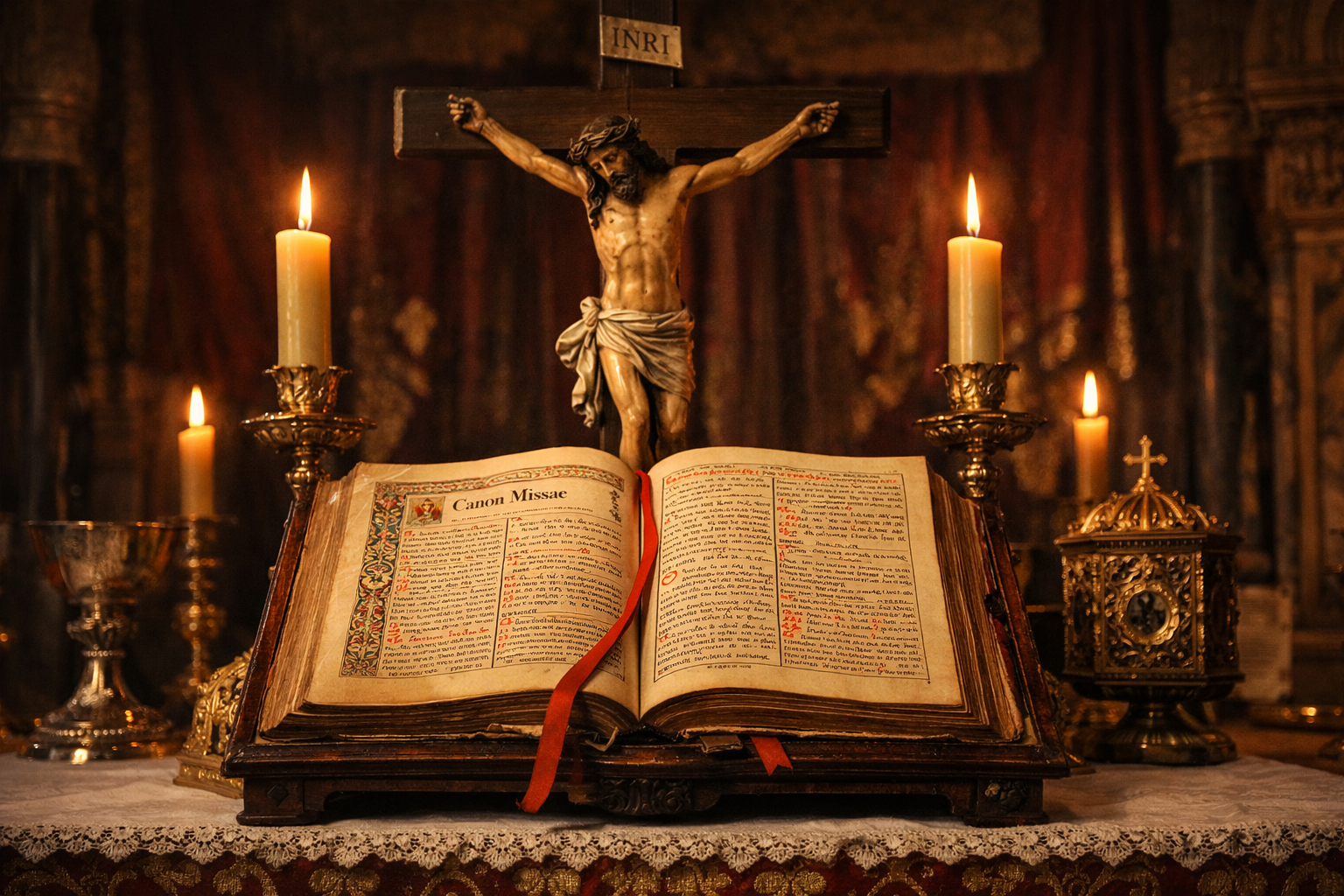
Cardinals Roche and Cupich vs Quo Primum: Unity, Authority, and the Misuse of History
Recent public comments by Cardinal Arthur Roche, Prefect of the Dicastery for Divine Worship and the Discipline of the Sacraments, echoed and publicly reinforced by Cardinal Blase Cupich, have renewed the claim that liturgical unity in the Latin Church requires the effective suppression of the traditional Roman Rite. Both cardinals have appealed—explicitly or implicitly—to St Pius V’s 1570 apostolic constitution Quo Primum as historical precedent for enforcing a single liturgical form.¹ This appeal, circulating widely following the January 2026 extraordinary consistory, demands careful historical, juridical, and theological scrutiny.
The argument advanced is superficially simple: St Pius V imposed unity after Trent; therefore contemporary authorities may do likewise. The difficulty is that this reading depends upon a partial and selective use of Quo Primum—one that stresses unity while ignoring both its explicit protection of ancient rites and its stringent restrictions on future alteration of the Roman Missal itself.
St Pius V Codified the Roman Rite—He Did Not Impose Absolute Uniformity
St Pius V did not impose a single rite upon the universal Church, nor did he abolish all liturgical diversity within the Latin Church. Quo Primum codified the Roman Rite and made it normative only where no other rite or use of at least two hundred years’ continuous standing existed.² This was not an incidental concession but a governing principle. The Ambrosian Rite of Milan, the Mozarabic Rite of Toledo, and the proper rites of several religious orders were explicitly safeguarded.
Even diocesan uses of the Roman Rite itself—such as the Sarum Use in England—were not abolished by papal decree. Their later disappearance resulted largely from episcopal choice and pastoral consolidation, not juridical suppression.³ To portray Quo Primum as mandating absolute liturgical uniformity is therefore historically inaccurate.
This alone weakens contemporary appeals to St Pius V as justification for suppressing the traditional Roman Rite. But the internal incoherence of the argument becomes clearer still when the full juridical language of Quo Primum is considered.
The Quicumque Pastorum Clause: What Quo Primum Explicitly Restrains
Beyond its provisions concerning antiquity and unity, Quo Primum contains a prohibition of exceptional clarity and force. St Pius V decrees that no one whatsoever (quicumque) among the pastors of the Church may add to, subtract from, or alter the Missal he promulgates, reinforcing this prohibition with solemn sanctional language characteristic of papal legislation of the period.⁴
The clause does not claim to bind future popes simpliciter in the exercise of supreme authority, but it does establish a principle of restraint: the Roman Rite is not to be treated as a malleable administrative construct subject to discretionary revision by pastors of the Church.
Fr Gregor Hesse on Quo Primum and Liturgical Stability
This stabilising intent has been emphasised in traditional Catholic commentary, notably by Fr Gregor Hesse (1953–2006) in recorded lectures explaining Quo Primum. In the lecture cited here, Hesse argues that the unusually strong prohibitory language of the constitution reflects a deliberate papal intent to secure the permanence of the Tridentine Missal against arbitrary alteration by ecclesiastical authorities, treating the Roman Rite as a received inheritance rather than a revisable policy instrument.⁵
Hesse’s position does not constitute magisterial teaching, nor does it resolve all canonical questions surrounding later papal authority. It is, however, a historically grounded interpretation of the text’s rhetoric and intent, and it underscores the tension between Quo Primum’s stabilising purpose and modern claims that appeal to it in support of sweeping liturgical reconstruction.
Continuous Reform Is Not Organic Development
Cardinal Roche’s appeal to “continuous reform” as intrinsic to liturgical history must be attributed directly to his memorandum “Liturgy,” dated 7–8 January 2026, circulated to members of the College of Cardinals in advance of the extraordinary consistory.⁶ In that text, Roche argues that the history of the liturgy is best understood as a process of continual reform, which he presents as equivalent to organic development.
As already demonstrated in a prior Nuntiatoria editorial, this argument conflates two distinct realities: organic development within tradition, and administrative reconstruction imposed by authority.⁷ Authentic organic development presupposes continuity of structure, theological emphasis, and ritual grammar. The Roman Rite matured slowly over centuries through usage, reception, and limited adjustment. By contrast, the post-conciliar reform involved the construction of a new order of Mass through scholarly committees, the introduction of new Eucharistic prayers without organic connection to the Roman Canon, and a reconfiguration of the rite’s orientation and textual architecture.
The distinction matters because it exposes the weakness of the Roche–Cupich analogy. Quo Primum codified and stabilised a received rite; it did not inaugurate a paradigm of perpetual liturgical revision.
The Irony at the Heart of the Roche–Cupich Appeal
Here the central irony becomes unavoidable. Quo Primum is invoked—by Roche in his memorandum and by Cupich in public commentary—to justify uniformity against the traditional Roman Rite, while the same document’s strongest cautionary clause—the quicumque pastorum restriction—is quietly ignored.
If Quo Primum is authoritative precedent for restricting ancient forms in the name of unity, then it must also be relevant when considering the limits of authority to alter the Roman Missal itself. To invoke St Pius V selectively—affirming what supports a contemporary policy while disregarding what constrains it—is not historical argument but instrumentalisation.
Unity Recast as Compliance Rather Than Continuity
The position advanced by Cardinals Roche and Cupich ultimately redefines unity not as communion in faith and sacramental life, but as compliance with the most recent juridical form. This redefinition departs both from historical Catholic practice—where multiple rites co-existed in full communion—and from the internal logic of Quo Primum itself. St Pius V tolerated diversity rooted in tradition while restraining novelty imposed by authority. The modern inversion tolerates novelty imposed by authority while restraining tradition received by inheritance.
Conclusion: Authority Requires Coherence
The present controversy is not merely about rubrics or pastoral policy. It concerns whether authority in the Church is exercised as stewardship of a received inheritance or as managerial control over a revisable system.
If Quo Primum is to be cited, it must be cited whole. When read whole, it does not support enforced uniformity through suppression. It stands instead as a warning—addressed to quicumque pastorum, whomsoever among the pastors of the Church—against treating the Roman Rite as malleable policy rather than sacred trust.
Unity severed from continuity persuades no one.
¹ Cardinal Blase J. Cupich, weekly column “Tradition, Reform, Unity,” Chicago Catholic, 21 January 2026.
² St Pius V, Quo Primum (Apostolic Constitution, 14 July 1570), in Bullarium Romanum, vol. VII; see also Papal Encyclicals Online and New Advent for accessible texts.
³ J. Wickham Legg, The Sarum Missal (Oxford: Clarendon Press, 1916), Introduction.
⁴ Quo Primum, concluding prohibition clause (nulli ergo omnino hominum liceat…).
⁵ Fr Gregor Hesse, lecture on Quo Primum and the permanence of the Tridentine Missal, recorded commentary (YouTube: https://www.youtube.com/watch?v=No4Nj8duyRY).
⁶ Cardinal Arthur Roche, memorandum “Liturgy,” 7–8 January 2026, circulated to members of the College of Cardinals.
⁷ “Why ‘Continuous Reform’ Is Not Organic Development,” Nuntiatoria, 16 January 2026.
related articles


Latest articles
- Today’s Mass: September 18 St. Joseph of CupertinoSt. Joseph of Cupertino, born in 1603, was a devoted Franciscan known for mystical experiences and levitations during prayer. Despite early struggles with learning and rejection, he found his path to holiness through humility and devotion, attracting many followers. Canonised in 1767, he is the patron saint of air travellers and those with learning disabilities.
- Sermon for St. Joseph of CupertinoToday marks the feast of St. Joseph of Cupertino, a humble priest known for his unusual ecstatic levitations. Born into poverty, he struggled for acceptance within religious orders. His sanctity was recognised by the public despite being seen as a nuisance by his order, highlighting the tensions between genuine spirituality and societal norms.
- QUI BENE DISTINGUIT, BENE DOCET ~ He who distinguishes well, teaches well: Spiritual Conference for Nuntiatoria CXXIIIIn a series of Tuesday conferences, the speaker explores themes about recognising reality, receiving divine gifts, and understanding spiritual truths. He highlights the importance of making careful distinctions to maintain sound judgment, especially in an age consumed by distractions and superficial assessments. True wisdom lies in distinguishing truth from perception and nurturing an authentic inner life centred on Christ.
- Today’s homily: Impression of the Stigmata upon St FrancisFrom serving the lepers he once shunned to receiving Christ’s wounds upon Mount Alvernia, Saint Francis shows how grace transforms a soul through obedient love. His stigmata call us to let the Cross shape our lives, beginning with the particular act of mercy or sacrifice we have been reluctant to offer.
- Today’s Mass: September 17 Impression of the Stigmata of St Francis of AssisiSaint Francis received the stigmata because he had first allowed the Cross to transform his soul. His wounds were not a spectacle, but God’s answer to a world growing cold: the visible sign of a life consumed by crucified love. We may never bear Christ’s wounds in our flesh, but we must bear their likeness through penance, fidelity, patience, mercy and sacrificial love.



Leave a Reply