
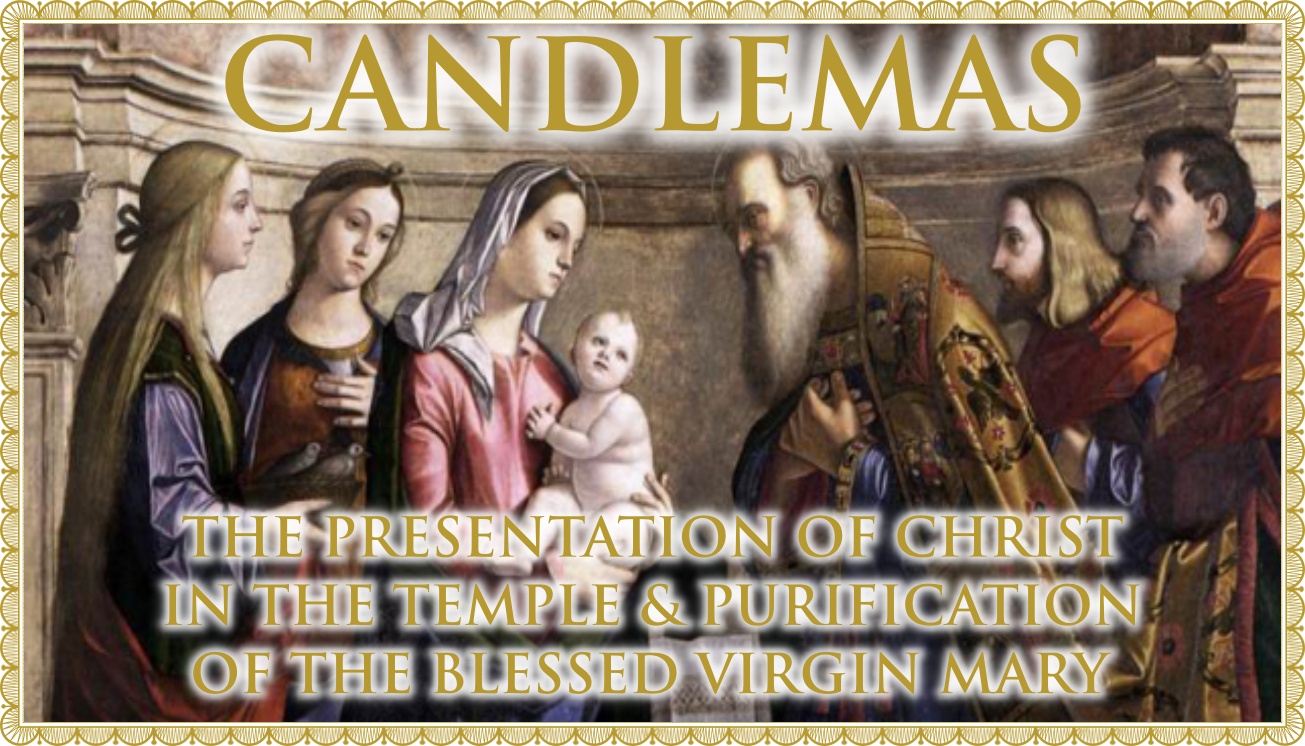
CANDLEMAS BEFORE THE REFORMS:
LIGHT, FULFILMENT, AND THE GRAMMAR OF REDEMPTION
(The Purification of the Blessed Virgin Mary in the Tridentine Rite, pre-1955)
The Feast of the Purification of the Blessed Virgin Mary—commonly known as Candlemas—occupies a unique and luminous place within the traditional Roman liturgical year. Celebrated forty days after the Nativity, it gathers together the mysteries of the Incarnation and quietly turns them toward sacrifice, prophecy, and fulfilment. In its pre-1955 Tridentine form, Candlemas is not merely a commemorative feast but a fully integrated liturgical action in which doctrine is communicated through gesture, colour, movement, posture, and prayer. The rite does not explain itself discursively; it forms the faithful by drawing them into the drama of salvation.
At the heart of the day stands Simeon’s canticle, the Nunc Dimittis, framed by its antiphon Lumen ad revelationem gentium. This text is not incidental ornamentation but the structural and theological backbone of the entire ceremony. Simeon appears at the precise moment when promise yields to fulfilment. He belongs to the old order, yet beholds the new. He does not preach, organise, or reform; he receives, blesses, and prophesies. The Church deliberately places his words upon her own lips, confessing that salvation is not seized but given, not engineered but received.
Violet Before White: Awaiting Redemption
One of the most striking—and most theologically articulate—features of the pre-1955 rite is the deliberate alternation of liturgical colour. The blessing of candles and the procession are conducted in violet, while the Mass itself is sung in white. This is not aesthetic flourish but doctrinal grammar. In the Roman rite, violet signifies not only penance but incompleteness: the state of humanity before the work of redemption is consummated. It is the colour of Advent and Lent, seasons that speak of waiting, restraint, and expectation.
Accordingly, before the ceremony begins, the altar is veiled in violet and left unadorned. The credence table, the Mass vestments laid upon the sedilia, and even the candles themselves are hidden beneath violet coverings. The sanctuary appears deliberately muted. The sacred ministers enter in penitential array: the celebrant in a violet cope, the deacon and subdeacon in folded chasubles, a vesture associated from antiquity with penitential processions. The folded chasuble, retained on Ember Days and Candlemas, silently proclaims that something is awaited, something not yet fully revealed.
Only after the procession does the visual language resolve. The altar is unveiled and clothed in white. The ministers change vestments. The tunicle and dalmatic reappear. The movement from violet to white is the movement from promise to manifestation, from prophecy to presence. The Church has gone out to meet her Lord; now she receives Him.
The Blessing of Candles: Creation Drawn into Redemption
The blessing of the candles itself is a dense theological act, composed of five prayers whose scope is both cosmic and intimate. They begin by recalling God’s self-revelation through light: the fire seen by Moses, the pillar that guided Israel, the light ordained by God to banish darkness. These prayers deliberately include references to the labour of bees and the purity of the wax, reminding the faithful that creation itself is not neutral or disposable, but capable of being sanctified and elevated for divine worship.¹
As the rite progresses, the focus narrows. Christ is named explicitly as the true Light; Simeon’s petition and prophetic insight are recalled; and finally the prayers turn inward, asking that this outward light may correspond to an interior purification of the soul. The candles are censed and lustrated while the celebrant chants Asperges me without the psalm, reinforcing the connection between light and cleansing.
The structure of these prayers is deliberate and catechetical. They move from Christ as Light, to peoples and nations, to Simeon holding the Child in his arms, and finally to the individual believer who must be illumined, purified, and made ready to meet the Lord. What is enacted externally is ordered toward interior transformation.
Distribution, Posture, and Procession
The distribution of candles takes place during the chanting of the Nunc Dimittis. Each member of the faithful receives light directly from the Church’s ministers, often kneeling, in a posture that recalls Simeon himself receiving Christ from the hands of the Virgin. The symbolism is immediately intelligible, yet inexhaustible in depth. The faithful receive Christ’s light not privately or abstractly, but ecclesially, through the mediation of the Church.
Before the final collect of the blessing, the deacon and subdeacon chant Flectamus genua and Levate, commanding the faithful to kneel and then rise. These ancient instructions—also found in the pre-1955 Good Friday liturgy and the Ember Days—teach through the body what words alone cannot convey. Kneeling expresses dependence and supplication; rising expresses hope and readiness. Their later suppression removed not redundancy, but embodied theology.²
The procession is the ritual summit of Candlemas. Led by the subdeacon bearing the processional cross—Christ Himself—the Church goes forth singing Adorna thalamum tuum, Sion, a text by St John of Damascus, one of the rare Greek elements adopted into the Roman rite. The procession is not a pious embellishment but the liturgical re-enactment of the Presentation itself.
As the Catholic Encyclopaedia observes, it represents the entry of Christ, the Light of the World, into the Temple of Jerusalem, and is an essential part of the day’s worship wherever ministers are available.³ The presence of the cross renders the meaning unmistakable: Christ enters His Temple borne by His Church.
The Mass of the Purification: Sacramental Fulfilment
The Mass of the Purification of the Blessed Virgin Mary is not an appendix to the blessing and procession but their sacramental consummation. What has been enacted ritually before Mass—light borne, Christ received, the Temple entered—is now proclaimed, offered, and made present upon the altar. The Mass propers complete the theological arc of the day by interpreting the Presentation not merely as an event in salvation history, but as a mystery perpetually present in the Church’s worship.
Introit — Suscepimus, Deus, misericordiam tuam
The Introit places on the lips of the Church the very words that interpret the procession just completed. Christ has been carried into the Temple, and the Church now confesses that she has received mercy there. The emphasis is not on human offering alone, but on divine gift. Salvation is received before it is acted upon.
Collect — Omnipotens sempiterne Deus
The Collect gathers the entire feast into a single petition. God is asked to grant that those who celebrate the mystery outwardly may be presented inwardly to Him with purified minds. Exterior devotion must correspond to interior transformation.
Epistle — Malachi 3:1–4
The Epistle introduces a note of holy severity. The Lord who enters His Temple is not merely a consolation but a judge and purifier. Divine nearness refines before it consoles, preparing an acceptable sacrifice.
Gospel — Luke 2:22–32
The Gospel recounts the event already ritualised before Mass and interpreted by the chants. Christ is revealed as Light to the Gentiles and glory of Israel, uniting universality and election in a single Person. Simeon’s canticle, already sung, is now proclaimed as Gospel truth.
Offertory, Secret, Communion, Postcommunion
The Offertory quietly turns attention to the Blessed Virgin Mary, upon whose lips grace is poured. The Secret presents Christ sacrificially, anticipating Calvary. The Communion antiphon places the faithful mystically in Simeon’s arms, while the Postcommunion prays that those nourished by heavenly food may be brought safely to eternal life. The faithful, having received Christ, are taught how to depart this world in peace.
Conclusion
The unreformed rites of Candlemas reveal a liturgical language alive and articulate, capable of forming souls without simplification or reduction. They do not obscure the Gospel; they proclaim it through a grammar of light, colour, posture, and procession. Redemption is shown as something awaited, revealed, and finally received.
Celebrated according to the pre-1955 Tridentine rubrics, Candlemas stands as a quiet yet powerful testimony that the Light of Christ is neither obscure nor elitist—only profound. Like Simeon, the Church need not invent novelty. She need only receive, bless, and proclaim.
- Roman Missal, Benedictio Candelarum, prayers 1–3 (pre-1955).
- Roman Missal, Good Friday Solemn Prayers and Ember Day liturgies (pre-1955).
- Catholic Encyclopaedia, “Candlemas,” section on the Procession of February 2.
- Catholic Encyclopaedia, “Mass,” historical notes on Reformation-era persecution
related articles


Latest articles
- Today’s Mass: September 18 St. Joseph of CupertinoSt. Joseph of Cupertino, born in 1603, was a devoted Franciscan known for mystical experiences and levitations during prayer. Despite early struggles with learning and rejection, he found his path to holiness through humility and devotion, attracting many followers. Canonised in 1767, he is the patron saint of air travellers and those with learning disabilities.
- Sermon for St. Joseph of CupertinoToday marks the feast of St. Joseph of Cupertino, a humble priest known for his unusual ecstatic levitations. Born into poverty, he struggled for acceptance within religious orders. His sanctity was recognised by the public despite being seen as a nuisance by his order, highlighting the tensions between genuine spirituality and societal norms.
- QUI BENE DISTINGUIT, BENE DOCET ~ He who distinguishes well, teaches well: Spiritual Conference for Nuntiatoria CXXIIIIn a series of Tuesday conferences, the speaker explores themes about recognising reality, receiving divine gifts, and understanding spiritual truths. He highlights the importance of making careful distinctions to maintain sound judgment, especially in an age consumed by distractions and superficial assessments. True wisdom lies in distinguishing truth from perception and nurturing an authentic inner life centred on Christ.
- Today’s homily: Impression of the Stigmata upon St FrancisFrom serving the lepers he once shunned to receiving Christ’s wounds upon Mount Alvernia, Saint Francis shows how grace transforms a soul through obedient love. His stigmata call us to let the Cross shape our lives, beginning with the particular act of mercy or sacrifice we have been reluctant to offer.
- Today’s Mass: September 17 Impression of the Stigmata of St Francis of AssisiSaint Francis received the stigmata because he had first allowed the Cross to transform his soul. His wounds were not a spectacle, but God’s answer to a world growing cold: the visible sign of a life consumed by crucified love. We may never bear Christ’s wounds in our flesh, but we must bear their likeness through penance, fidelity, patience, mercy and sacrificial love.



Leave a Reply