
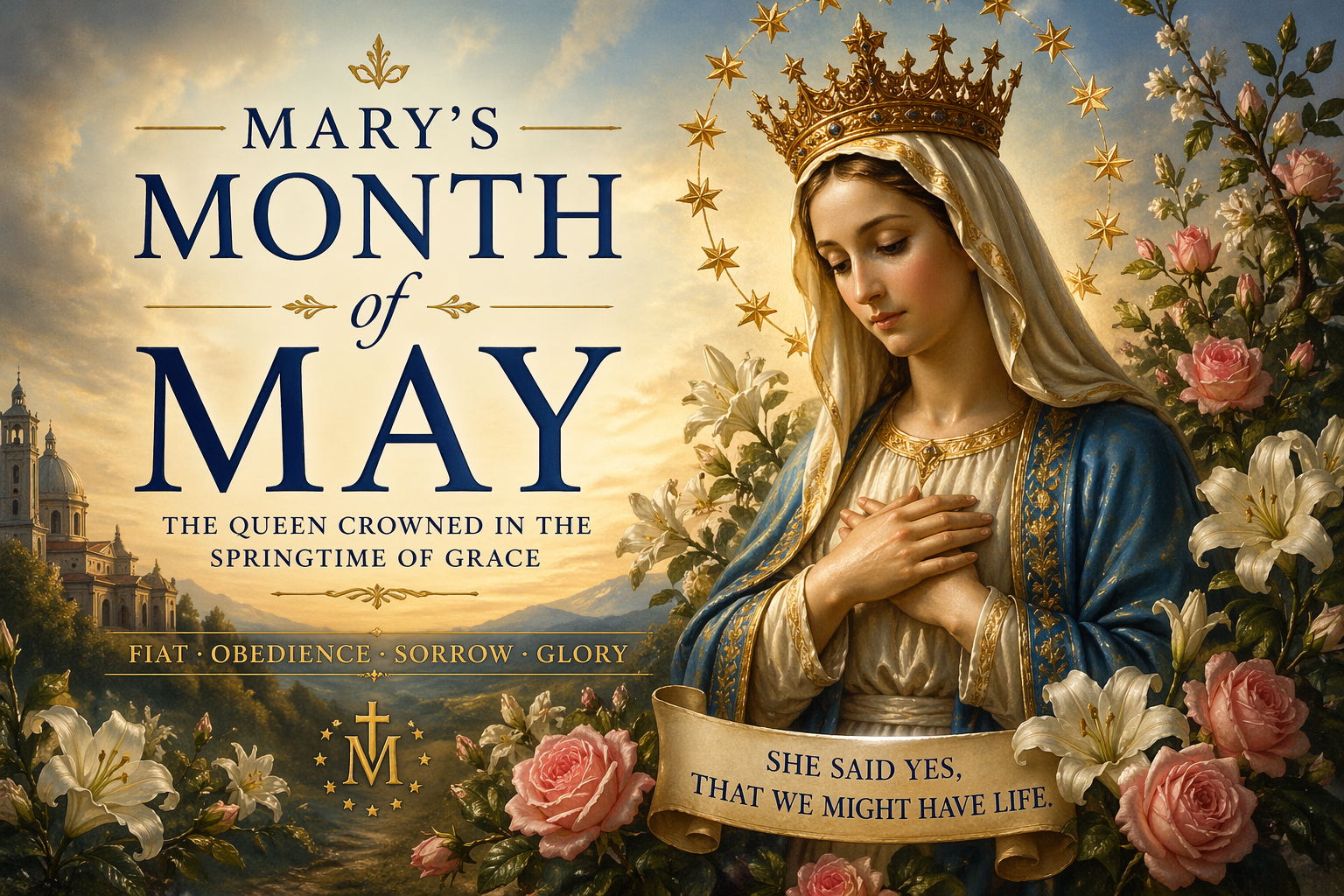
Mary’s Month of May: The Queen Crowned in the Springtime of Grace

From garden to throne: the theology of May as formation, not sentiment
The dedication of the month of May to the Blessed Virgin Mary is not an ornamental survival of Catholic culture, nor a devotional instinct attached to the pleasant accident of spring. It is a theological act grounded in revelation, articulated by the Fathers, confirmed by the magisterium, and enacted in the Church’s ascetical life. To understand May is to enter the logic of the Incarnation itself; for Mary is not peripheral to that mystery, but its chosen threshold.
The Church’s proclamation of Mary as Theotokos at the Council of Ephesus establishes the first principle. This title does not magnify Mary apart from Christ; it secures the unity of His Person. The one whom she bore is not divided: He is God in the flesh. Thus Marian doctrine is not devotional excess but doctrinal necessity. To diminish Mary is, inevitably, to distort Christ. Every authentic Marian devotion—including the observance of May—therefore belongs not to the margins, but to the centre of Catholic faith.
From this Christological foundation emerges the patristic synthesis. St Irenaeus of Lyons articulates the decisive parallel: “the knot of Eve’s disobedience was loosed by the obedience of Mary.”¹ The Fathers do not present this as analogy but as structure. Humanity fell through a woman’s disobedience; it is restored through a woman’s obedience. St Ephrem the Syrian deepens the insight, describing Mary as the “new earth” from which the Second Adam is formed.² St Ambrose of Milan, in turn, presents her as the archetype of the Church herself: virgin, fruitful, and wholly receptive to the Word.³ The Marian mystery is thus not isolated; it is ecclesial, anthropological, and redemptive.
Sacred Scripture confirms this architecture with precision. At the Annunciation (Luke 1:38), Mary’s fiat is the hinge of history: divine initiative meets human consent. At Cana (John 2:1–11), her intercession reveals a maternal mediation that operates not in competition with Christ, but in perfect dependence upon Him: “Do whatever He tells you.” At Calvary (John 19:26–27), the words Ecce mater tua establish her maternity over the Church. And in Apocalypse 12:1, the woman crowned with twelve stars appears as both Mary and the Church—type and fulfilment united in a single image. Scripture does not treat Mary as incidental; it places her at decisive moments where salvation is effected and revealed.
It is within this revealed order that the Month of May assumes its full intelligibility.
The Church reads creation sacramentally. The blossoming of May is not mere ornament, but sign. After the barrenness of winter, life returns with abundance: hidden vitality becomes visible. The tradition recognises in this a fitting analogue to Mary, the hortus conclusus of the Song of Songs (4:12)—the enclosed garden in which divine life takes root without corruption. St Bernard of Clairvaux contemplates this mystery by seeing in Mary the place where “the flower of the field” blossoms for the salvation of the world.⁴ The lily signifies her purity; the rose her charity; the enclosed garden her inviolate integrity. These are not decorative associations but theological disclosures.
Historically, the dedication of May to Mary emerges organically from this symbolic vision. While Marian devotion is as ancient as the Church herself, the structured observance of May developed in the Latin West and was widely consolidated by the early modern period. The daily Rosary, the Litany of Loreto, acts of consecration, and public devotions formed a coherent ascetical programme. The May Crowning, in particular, became a visible synthesis of doctrine and devotion.
For the crowning of Mary is not theatrical sentiment—it is doctrinal expression.
As taught authoritatively in Ad Caeli Reginam, “Mary is Queen more by divine relationship than by any other right.”⁵ Her queenship derives from her divine maternity, her intimate cooperation in the redemptive work of her Son, and her continuing intercession. In the Davidic order, the queen is the king’s mother—the Gebirah. Thus, the crowning enacted in May is not imaginative embellishment but theological precision: it renders visible the exaltation of the one who first received the Word in humility.
Yet if doctrine is affirmed without transformation, devotion becomes a contradiction.
The observance of May is inherently ascetical. It demands not only honour but imitation. The Rosary disciplines the intellect and memory; Marian litanies purify the affections; voluntary sacrifices reorder the will. Mary’s fiat is not merely admired—it is to be reproduced in the soul. St Louis de Montfort insists that true devotion to Mary consists in total consecration, a complete handing over of oneself to Christ through her maternal mediation.⁶
Here the confrontation with modernity becomes unavoidable. The contemporary world is structured upon autonomy, self-assertion, and the primacy of desire. Mary reveals the falsity of this anthropology. She does not construct her identity; she receives it. She does not seek self-expression; she becomes the instrument of divine expression. She does not grasp; she consents. In her, freedom is revealed not as independence from God, but as perfect conformity to His will.
The implications are moral and immediate. Purity is not optional; it is the condition for divine indwelling. Silence is not absence; it is readiness. Obedience is not diminishment; it is participation in divine wisdom. The Month of May, therefore, is not devotional excess—it is spiritual correction. It exposes the disordered loves of the age and proposes their reordering in the Marian pattern.
Mary’s role is also constitutive of the Church. At Pentecost (Acts 1:14), she is present among the Apostles, persevering in prayer as the Holy Ghost descends. The Church is born in a Marian context—not merely historically, but structurally. St Augustine of Hippo teaches that Mary first conceived Christ in her heart before she conceived Him in her womb.⁷ This interior receptivity becomes the pattern of ecclesial life: the Church must receive before she can proclaim.
Finally, Mary stands as an eschatological sign. Assumed into Heaven, she reveals the destiny of redeemed humanity. Her queenship is not an isolated privilege but the anticipation of a promise: that those who are united to Christ will share in His glory. The crown of May, therefore, is prophetic. It points beyond itself to the final consummation, where grace reaches its perfection.
The recovery of the Month of May demands more than nostalgia. It requires restoration of discipline, doctrine, and devotion in their unity. The Rosary must return to the home. Public devotions must be restored with clarity and reverence. Marian doctrine must be preached without dilution. Without this, the observance of May dissolves into sentimentality—flowers without fruit, honour without obedience.
For Mary is not an accessory to Christianity.
She is its pattern in creaturely form.
And thus the final truth must be stated without qualification.
To crown Mary is to accept her path. Her crown is inseparable from her Cross. The obedience that began at Nazareth reaches its consummation at Calvary. There is no Marian glory without Marian suffering; no queenship without surrender.
The modern world crowns itself and calls this autonomy. It enthrones the self and names it freedom.
The Church crowns Mary—and learns, once again, how to obey.
Only one crown endures.
¹ St Irenaeus of Lyons, Adversus Haereses, III.22.4.
² St Ephrem the Syrian, Hymns on the Nativity, 11.6.
³ St Ambrose of Milan, De Virginibus, II.2.
⁴ St Bernard of Clairvaux, Sermones super Missus Est, II.
⁵ Ad Caeli Reginam, §34.
⁶ St Louis de Montfort, True Devotion to Mary, §120.
⁷ St Augustine of Hippo, Sermo 215, 4.
related articles


Latest articles
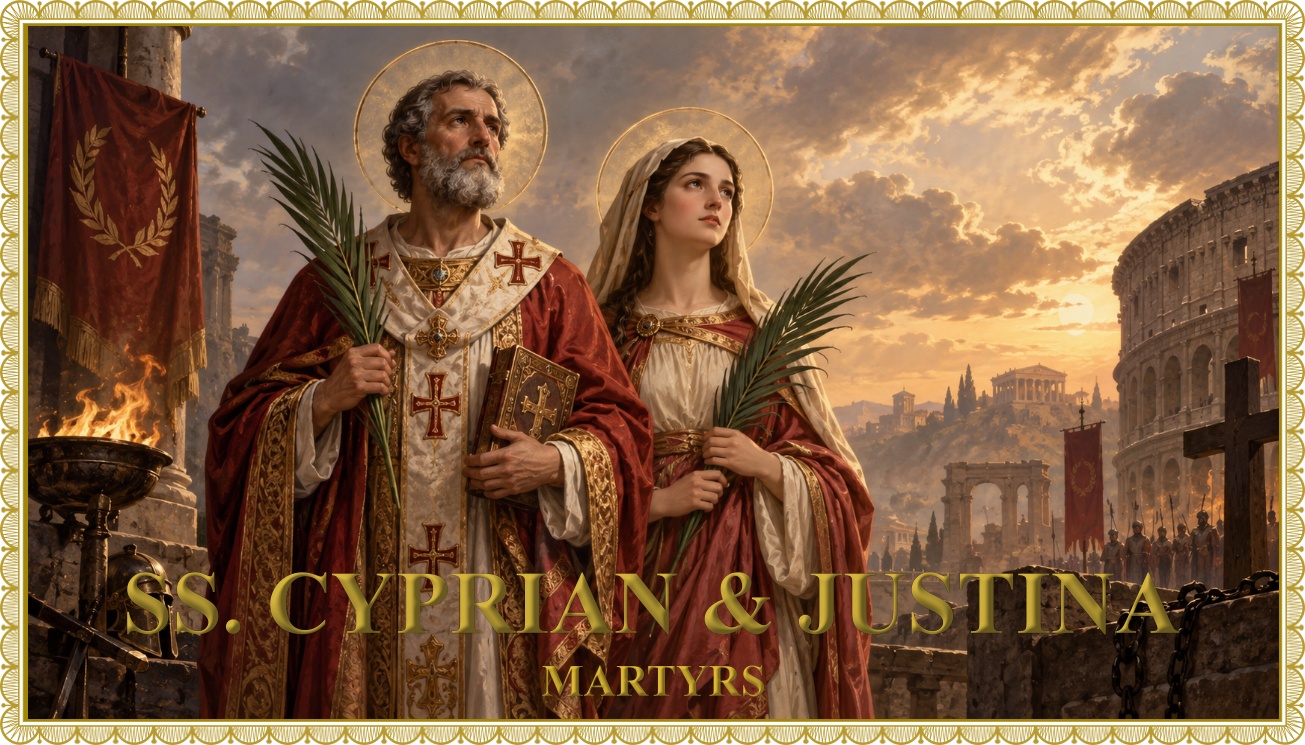
- Today’s Mass: September 26 SS. Cyprian and Justina, MartyrsThe persecution of Diocletian broke out at that time, and Cyprian and Justina were seized and presented to Diocletian himself, who judged them. Justina was scourged and Cyprian was torn with iron hooks. After this they were both sent back to Diocletian in chains. He commanded that their heads be cut off, and they died; martyrs for the Faith!
- 27.09.26 Nuntiatoria CXXV: VERITAS NON MUTATUR CONSENSUThis edition emphasises that truth remains constant, regardless of institutional consensus. It explores how authority should serve existing realities rather than define them, stressing the importance of preserving the Church’s traditions and teachings. The Church’s role is to guard and transmit truth, not to create it through agreement or procedure.
- ORDO w/c 27.09.26The week begins with the Eighteenth Sunday after Pentecost, honouring various saints, culminating in the feast of St Francis of Assisi. Key celebrations include St Wenceslaus, St Michael the Archangel, St Jerome, and St Thérèse of the Child Jesus. The period highlights the call to surrender worldly attachments in devotion to God.
- Rupnik’s accusers appeal to Leo XIV: the women are still outside the doorThe text explores the concept of “spiritual denial” within the Catholic Church regarding serious allegations against church leaders. It argues that this denial, often perceived as loyalty, leads to evasion of uncomfortable truths. The piece emphasises that acknowledging these failures does not undermine the Church’s integrity, urging faithful confrontation of wrongdoing while maintaining justice for all involved.
- TRADITIONIS CUSTODES BY THE NUMBERS: WHAT ROME’S 2025 DECREE REGISTER ACTUALLY SHOWSThe Vatican’s 2025 decree register clarifies the status of the Traditional Roman Mass, detailing 34 decrees concerning 33 jurisdictions and 55 parish churches. While 41 locations have renewed permissions, this system requires repeated authorisation from Rome, indicating administrative dependency on continuous approval for traditional practices rather than expanding opportunities.




Leave a Reply