
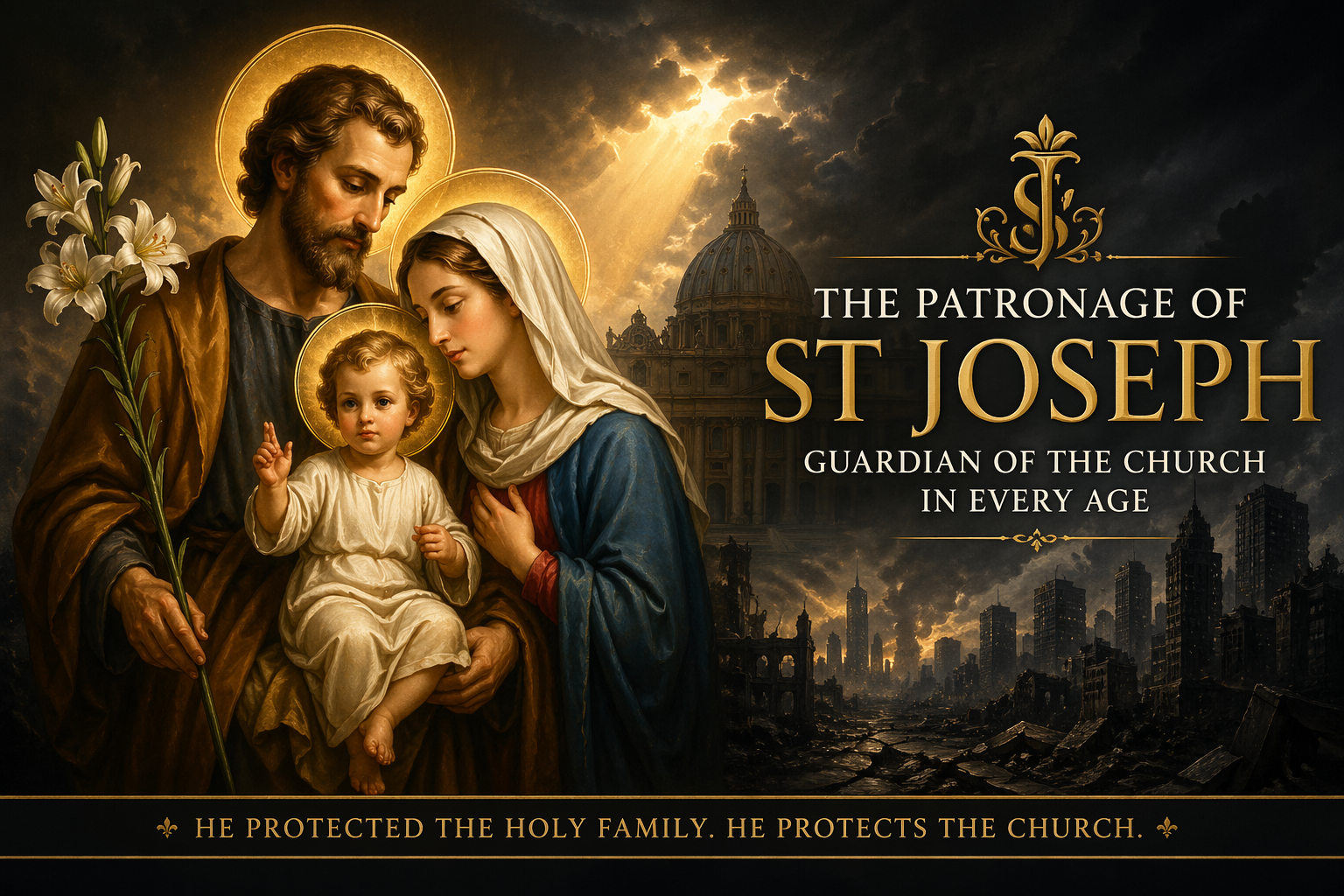
The Patronage of St Joseph: Guardian of the Church in an Age of Crisis

The Feast of the Patronage of Saint Joseph, traditionally observed in the pre-1955 Roman Rite on the Third Sunday after Easter (and later fixed to the Wednesday after the Second Sunday after Easter), emerges not as a sentimental addition to the calendar but as a doctrinal affirmation forged in crisis. In 1870, amid the collapse of the Papal States and the intensifying pressures of secular modernity, Pope Pius IX solemnly declared St Joseph Patron of the Universal Church. This act was not merely devotional; it was ecclesiological, recognising that the visible Church, assailed by political and ideological forces, remained under divine guardianship exercised through the silent authority of Joseph.¹
Theological Foundation
The Church’s veneration of Joseph rests upon his unique role within the economy of salvation. As the foster-father of Jesus Christ and the spouse of the Blessed Virgin, he was constituted the head of the Holy Family—that primordial society in which the Incarnate Word was protected, nourished, and concealed from the designs of Herod the Great. This historical mission does not terminate in the past; rather, it extends mystically into the life of the Church, which is the continuation of Christ’s presence in the world.
Pope Leo XIII articulates this continuity with precision in Quamquam Pluries (1889), teaching that as Joseph once safeguarded the physical Body of Christ, so he now guards His Mystical Body.² The analogy is not poetic but theological: the same divine providence that entrusted Christ to Joseph in time entrusts the Church to him in history.
This patronage must be understood correctly. Joseph exercises no jurisdiction within the hierarchical constitution of the Church; his authority is not magisterial but moral, not legislative but protective. Yet precisely for this reason it is universal in scope and constant in efficacy: a paternal guardianship that operates under divine providence across all ages.
Scholastic Witness and the Fittingness of Joseph’s Role
The theological tradition confirms the fittingness of this doctrine. St Thomas Aquinas teaches that Joseph was chosen by God to stand in a true relation of authority within the Holy Family, not by nature but by divine ordination, so that he might faithfully provide, govern, and protect the Incarnate Word in His earthly life.³ This principle—authority conferred for the sake of service to the divine plan—extends analogically to Joseph’s patronage of the Church. What was exercised visibly in Nazareth is now exercised invisibly in the Mystical Body.
Patronage and Fatherhood
The Patronage of St Joseph reveals the nature of authority as understood within the Catholic tradition. Joseph’s fatherhood, though not biological, is real, juridical in its historical context, and efficacious in its salvific role. It is exercised not through domination but through obedience, sacrifice, and fidelity to the will of God. In this, he stands as the definitive corrective to modern distortions of authority, wherein power is detached from responsibility and identity from duty.
His silence in Sacred Scripture is not an absence but a manifestation of perfected obedience. He speaks not in words but in action: rising at the command of the angel, fleeing into Egypt, labouring in obscurity, and returning at the appointed time. This pattern of hidden fidelity becomes the template for his ongoing patronage—unseen yet decisive.
Ecclesial Significance in the Present Age
The contemporary Church finds herself in a condition not unlike that which occasioned the formal proclamation of Joseph’s patronage: doctrinal ambiguity, institutional fragility, and external hostility converge to produce a crisis that is at once visible and spiritual. In such a moment, recourse to St Joseph is not optional but necessary.
His patronage affirms that the Church is not sustained by human ingenuity alone. Structures may falter, leadership may waver, and cultural support may evaporate, yet the divine order remains intact. God, who entrusted His Son to Joseph, has not withdrawn that trust. The Church, though beset, is not abandoned. Where paternal authority collapses, where leadership becomes uncertain, and where the guardians of the sacred hesitate, Joseph remains—steady, obedient, and divinely appointed.
Contemporary Relevance: Fatherhood, Authority, and the Crisis of Guardianship
The modern West presents a landscape in which the very principles embodied by St Joseph are not merely neglected but actively inverted. Fatherhood is no longer understood as a stable vocation ordered toward protection and provision, but increasingly as a negotiable or even dispensable social role. Authority, likewise, is frequently redefined as a function of consensus or self-expression rather than as a duty grounded in truth and ordered toward the good of others.
Within the Church, parallel distortions appear. The language of accompaniment risks displacing the language of guardianship; the imperative to affirm can eclipse the obligation to protect. Yet Joseph’s example admits no such confusion. He does not negotiate with danger, nor does he reinterpret his duty in light of circumstance. When commanded, he rises; when threatened, he acts; when entrusted, he guards. His authority is exercised precisely in his readiness to act decisively for the sake of those placed under his care.
This has profound implications. A Church that forgets how to guard will not long preserve what has been entrusted to her. A society that dissolves fatherhood will not sustain the conditions necessary for human flourishing. And a culture that replaces responsibility with autonomy will inevitably produce instability—moral, social, and spiritual.
Against this, the Patronage of St Joseph stands as both rebuke and remedy. It recalls that authority is not self-generated but received; that responsibility is not optional but binding; and that protection—of the innocent, of truth, of the sacred—is not an outdated instinct but a permanent obligation.
Liturgical Expression
The traditional liturgy of this feast emphasises protection, guardianship, and confidence in divine providence. The prayers of the Mass invoke Joseph as a powerful intercessor whose care extends to all the faithful. The Church does not merely recall his past role; she actively places herself under his present protection, confident that the providence which governed Nazareth governs still.
Conclusion
The Feast of the Patronage of St Joseph stands as a declaration of supernatural realism. It rejects the illusion that the Church’s survival depends solely upon visible means and recalls the faithful to a deeper confidence in divine governance. Joseph, once the guardian of the Hidden Life, remains the guardian of the Mystical Body.
In an age marked by the collapse of fatherhood, the weakening of authority, and the disorientation of institutions, his silent authority endures as both rebuke and remedy. He does not contend for attention, yet he governs by obedience; he does not assert power, yet he exercises it by divine commission. To place the Church under his patronage is not pious ornament—it is a recognition of the order God Himself has established. And where that order is honoured, protection is not hoped for—it is given.
¹ Pope Pius IX, Decree Quemadmodum Deus (8 December 1870).
² Pope Leo XIII, Encyclical Quamquam Pluries (15 August 1889), §§2–3.
³ St Thomas Aquinas, Summa Theologiae, III, q.29, a.1–2.
⁴ Pope Benedict XV, Motu Proprio Bonum Sane (25 July 1920).
related articles


Latest articles
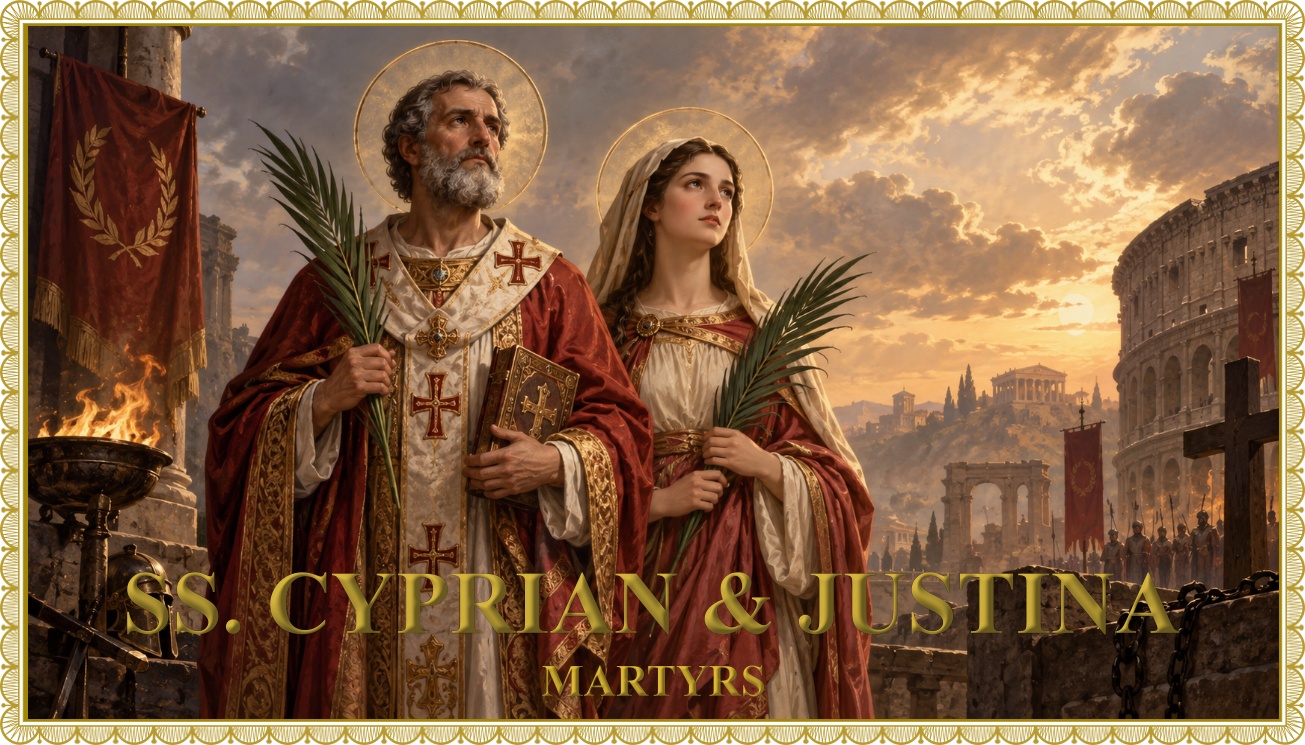
- Today’s Mass: September 26 SS. Cyprian and Justina, MartyrsThe persecution of Diocletian broke out at that time, and Cyprian and Justina were seized and presented to Diocletian himself, who judged them. Justina was scourged and Cyprian was torn with iron hooks. After this they were both sent back to Diocletian in chains. He commanded that their heads be cut off, and they died; martyrs for the Faith!
- 27.09.26 Nuntiatoria CXXV: VERITAS NON MUTATUR CONSENSUThis edition emphasises that truth remains constant, regardless of institutional consensus. It explores how authority should serve existing realities rather than define them, stressing the importance of preserving the Church’s traditions and teachings. The Church’s role is to guard and transmit truth, not to create it through agreement or procedure.
- ORDO w/c 27.09.26The week begins with the Eighteenth Sunday after Pentecost, honouring various saints, culminating in the feast of St Francis of Assisi. Key celebrations include St Wenceslaus, St Michael the Archangel, St Jerome, and St Thérèse of the Child Jesus. The period highlights the call to surrender worldly attachments in devotion to God.
- Rupnik’s accusers appeal to Leo XIV: the women are still outside the doorThe text explores the concept of “spiritual denial” within the Catholic Church regarding serious allegations against church leaders. It argues that this denial, often perceived as loyalty, leads to evasion of uncomfortable truths. The piece emphasises that acknowledging these failures does not undermine the Church’s integrity, urging faithful confrontation of wrongdoing while maintaining justice for all involved.
- TRADITIONIS CUSTODES BY THE NUMBERS: WHAT ROME’S 2025 DECREE REGISTER ACTUALLY SHOWSThe Vatican’s 2025 decree register clarifies the status of the Traditional Roman Mass, detailing 34 decrees concerning 33 jurisdictions and 55 parish churches. While 41 locations have renewed permissions, this system requires repeated authorisation from Rome, indicating administrative dependency on continuous approval for traditional practices rather than expanding opportunities.





Leave a Reply