
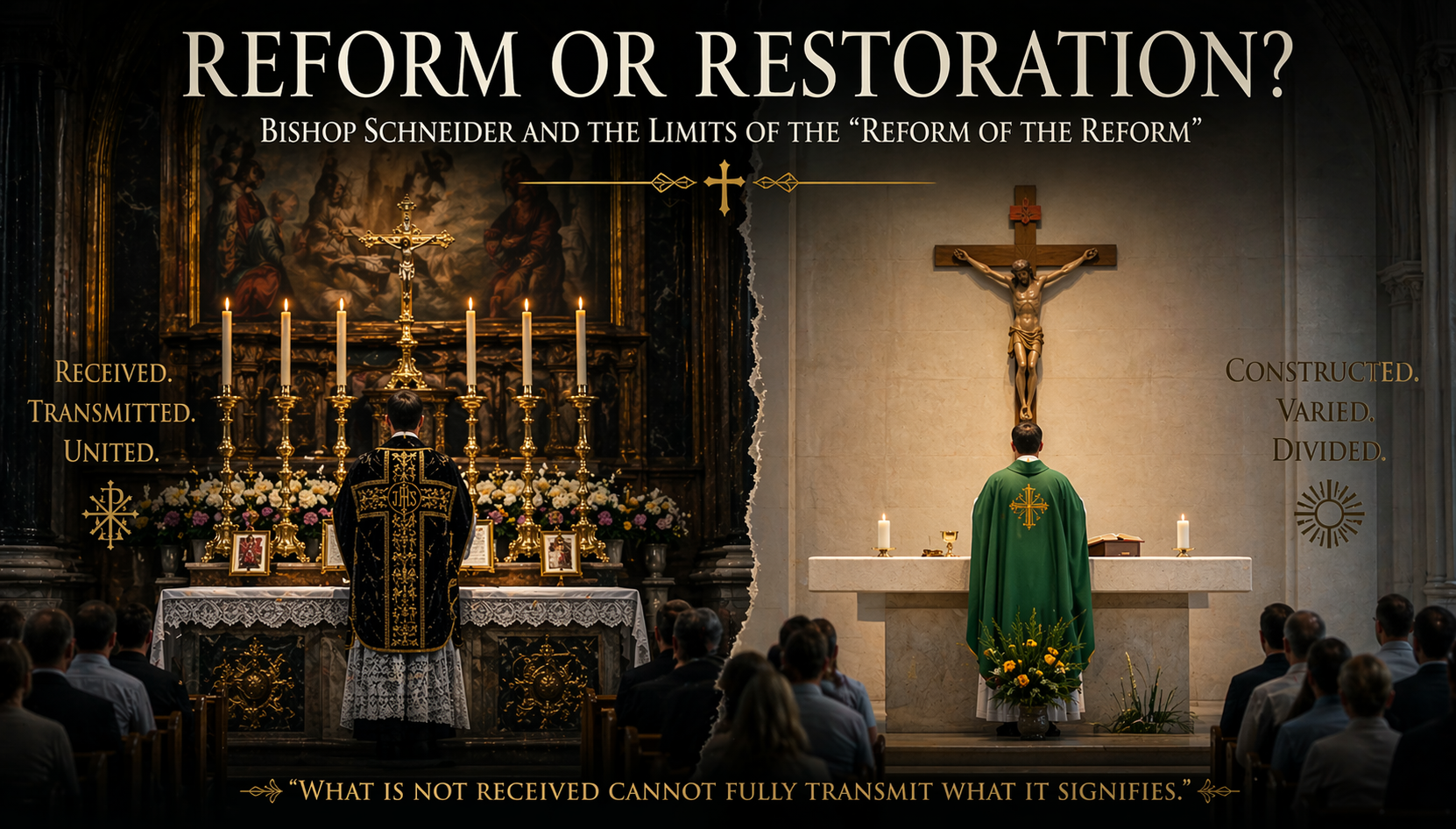
Reform or Restoration? Bishop Schneider and the Limits of the “Reform of the Reform”

The postconciliar Roman Rite stands not merely in need of reform, but under judgment as to its continuity with what preceded it. In an intervention of unusual clarity, Athanasius Schneider has argued that the present form of the Novus Ordo “cannot continue as it is,” having diverged from both the text and the intention of the Second Vatican Council.¹ The stakes are not local or theoretical. Across the Latin Church, from cathedral to parish, the ordinary form of the Mass shapes the faith, devotion, and doctrinal perception of millions of Catholics. The question, therefore, is not whether the liturgy may be improved, but whether it remains organically continuous with the Roman Rite as received.
Schneider’s argument is anchored in the Council’s own constitution on the sacred liturgy, Sacrosanctum Concilium, which lays down a principle often cited and seldom obeyed: “there must be no innovations unless the good of the Church genuinely and certainly requires them,” and any new forms must “grow organically from forms already existing.”² This is not a peripheral guideline but a governing norm. It defines the manner in which liturgical authority is to be exercised—conservatively, developmentally, and in continuity with what has been handed down.
Yet the historical implementation of the Missal promulgated by Paul VI in 1969 presents a difficulty that cannot be resolved by intention alone. Within a remarkably short period, the liturgical forms that had shaped Catholic worship for centuries were displaced in ordinary parish life.³ Clergy and laity alike experienced not a gradual organic development, but an abrupt transition. The Roman Rite, once transmitted as a living inheritance, appeared suddenly as subject to comprehensive revision. Whatever the canonical legitimacy of papal promulgation, the experiential reality was one of rupture—not merely in text, but in memory.
It is precisely this rupture that Schneider seeks to address through a programme of reform. His proposals are concrete and ordered: the universal restoration of ad orientem worship, the recovery of kneeling Communion on the tongue, the exclusion of women from liturgical functions within the sanctuary, the re-establishment of sacred music in continuity with tradition, and the renewed use of Latin as a sacral language. Each of these touches a decisive theological axis. Orientation determines whether worship is directed towards God or towards the assembly; the manner of Communion expresses belief in the Real Presence; the sanctuary reflects the hierarchy of orders; music mediates the sacred; language stabilises doctrine across time and place. In this respect, Schneider’s programme is not cosmetic. It seeks to reconfigure the phenomenology of the Novus Ordo—how it is experienced, and therefore how it is believed.
And yet the question persists: can the rite be restored by modifying its expression, if its structure itself has shifted? The Offertory provides the clearest test. In the traditional Roman Rite, the priest offers the host pro innumerabilibus peccatis, offensionibus et negligentiis—for sins, offences, and negligences—explicitly anticipating the propitiatory sacrifice.⁴ The language is sacerdotal, sacrificial, and unambiguous. In the reformed rite, this is replaced by a formula of blessing: “Benedictus es, Domine Deus universi…”⁵ The emphasis moves from sacrifice anticipated to gifts prepared. This is not a question of tone, but of theological register. No adjustment of posture or music can entirely compensate for such a shift at the level of the rite’s internal logic.
A similar difficulty arises in the multiplication of Eucharistic Prayers. The traditional Roman Rite knows only the Roman Canon—stable, fixed, and transmitted across centuries as a doctrinal constant. The Novus Ordo introduces multiple anaphoras, varying in length and theological density. While all are valid, their plurality introduces variability into the very heart of the liturgy. What was once received becomes chosen; what was once fixed becomes optional. The principle of stability yields to a principle of selection.
The expansion of the lectionary presents a further ambiguity. The traditional one-year cycle, precisely through repetition, inscribed the mysteries of salvation into the memory of the faithful. The multi-year system of the reformed rite increases the quantity of Scripture proclaimed, but fragments its liturgical integration. The faithful hear more, but remember less. The coherence of the liturgical year is diffused, its doctrinal emphases less sharply impressed.
A further consequence, rarely stated with sufficient clarity, is the effect of the reformed rite upon the visible unity of the Church. Under the traditional Roman Rite, a Catholic could enter a church in Rome, Paris, London, or Manila and encounter substantially the same Mass: the same language, the same Canon, the same cycle of readings and orations, differing only in the proper calendar of local saints. This was not incidental. It was the concrete expression of catholicity—unity not merely in doctrine, but in worship. The rite itself embodied the universality of the Church, forming a common liturgical identity that transcended nation, culture, and epoch. By contrast, the widespread adoption of the vernacular, combined with the multiplication of options within the Novus Ordo, has introduced a degree of variation previously unknown in the Roman Rite. The faithful no longer encounter a single, stable form, but a spectrum of localised expressions—differing in language, music, ceremonial, and even in the selection of texts. What was once recognisably the same act of worship across the world now appears contingent upon place and preference. The result is not simply diversity, but disparity: a weakening of the shared liturgical identity that once bound Catholics together, and an environment in which divergence—sometimes doctrinally and symbolically significant—can take root under the cover of legitimate variation. In place of a unifying liturgical culture, there emerges a patchwork of expressions, not all of which equally reflect the mind of the Church.
These features are not incidental. They arise not from abuse, but from design. They reflect a different method of liturgical formation—one that is, in a precise sense, constructed rather than received. Here the analysis of Joseph Ratzinger is decisive. Reflecting on the postconciliar reform, he warned that “in the place of liturgy as the fruit of development came fabricated liturgy,” produced not by organic growth but by committee.⁶ As Alcuin Reid has observed in his study of liturgical development, authentic reform proceeds by “organic growth,” not by “a priori reconstruction,” lest continuity be replaced by abstraction.⁷ The distinction is not rhetorical. A liturgy that develops unconsciously over centuries carries within it the sedimented faith of generations; a liturgy that is constructed risks appearing as an artefact, however well intentioned its authors.
Schneider’s proposal must be understood within this tension. It represents the most serious attempt within the present ecclesial framework to restore continuity without precipitating further rupture. It acknowledges the depth of the crisis and rejects the complacency that would deny it. Yet it remains fundamentally reformist. It presupposes that the Novus Ordo, though deformed, is structurally capable of being realigned with tradition through incremental correction.
The stricter Tridentine analysis reaches a more radical conclusion. It does not deny the value of Schneider’s reforms; indeed, it affirms them as necessary. But it questions whether they are sufficient. For if the rupture lies not only in practice but in principle—not only in how the rite is celebrated but in how it was formed—then reform alone cannot fully resolve it. What is required is not merely adjustment, but restoration: the recognition that the Roman Rite, as sanctified by centuries of use, does not require reconstruction, but recovery.
The distinction is decisive. Reform seeks to improve what exists; restoration seeks to return to what endures. Schneider stands at the threshold between the two, his instincts aligned with tradition, his method constrained by the present order. Yet the Church cannot remain indefinitely upon a threshold. A liturgy that can be remade at will cannot convincingly claim to be received—and what is not received cannot fully transmit what it signifies. The question before us is therefore not one of preference, nor even of prudence, but of fidelity to what has been handed down. For the Roman Rite is not ours to construct, but ours to guard; not ours to refashion, but ours to receive and to hand on intact. If the Church is to speak again with one voice in her worship, she must recover the form in which that voice was forged—lest, in multiplying expressions, she lose the unity they were meant to serve, and in seeking adaptation, forget the inheritance that alone can endure.
- Athanasius Schneider, interview with John-Henry Westen, LSNTV, “Bishop Schneider’s WARNING: ‘Novus Ordo CANNOT Continue As Is’,” 14 January 2026.
- Sacrosanctum Concilium (1963), §23: “Ne introducantur innovationes nisi vera et certa utilitas Ecclesiae id exigat… formae novae ex formis iam exstantibus organice quodammodo crescant.”
- Paul VI, Apostolic Constitution Missale Romanum (3 April 1969); Annibale Bugnini, The Reform of the Liturgy 1948–1975 (Collegeville, MN: Liturgical Press, 1990), pp. 108–135.
- Missale Romanum (1962), Offertory prayer Suscipe, sancte Pater: “pro innumerabilibus peccatis, offensionibus et negligentiis.”
- Missale Romanum (1970), Order of Mass, Preparation of the Gifts: “Benedictus es, Domine Deus universi…”
- Joseph Ratzinger, The Spirit of the Liturgy (San Francisco: Ignatius Press, 2000), p. 165.
- Alcuin Reid, The Organic Development of the Liturgy (San Francisco: Ignatius Press, 2005), pp. 172–175.
RELATED ARTICLES


Latest
- Today’s Mass: September 18 St. Joseph of CupertinoSt. Joseph of Cupertino, born in 1603, was a devoted Franciscan known for mystical experiences and levitations during prayer. Despite early struggles with learning and rejection, he found his path to holiness through humility and devotion, attracting many followers. Canonised in 1767, he is the patron saint of air travellers and those with learning disabilities.
- Sermon for St. Joseph of CupertinoToday marks the feast of St. Joseph of Cupertino, a humble priest known for his unusual ecstatic levitations. Born into poverty, he struggled for acceptance within religious orders. His sanctity was recognised by the public despite being seen as a nuisance by his order, highlighting the tensions between genuine spirituality and societal norms.
- QUI BENE DISTINGUIT, BENE DOCET ~ He who distinguishes well, teaches well: Spiritual Conference for Nuntiatoria CXXIIIIn a series of Tuesday conferences, the speaker explores themes about recognising reality, receiving divine gifts, and understanding spiritual truths. He highlights the importance of making careful distinctions to maintain sound judgment, especially in an age consumed by distractions and superficial assessments. True wisdom lies in distinguishing truth from perception and nurturing an authentic inner life centred on Christ.
- Today’s homily: Impression of the Stigmata upon St FrancisFrom serving the lepers he once shunned to receiving Christ’s wounds upon Mount Alvernia, Saint Francis shows how grace transforms a soul through obedient love. His stigmata call us to let the Cross shape our lives, beginning with the particular act of mercy or sacrifice we have been reluctant to offer.
- Today’s Mass: September 17 Impression of the Stigmata of St Francis of AssisiSaint Francis received the stigmata because he had first allowed the Cross to transform his soul. His wounds were not a spectacle, but God’s answer to a world growing cold: the visible sign of a life consumed by crucified love. We may never bear Christ’s wounds in our flesh, but we must bear their likeness through penance, fidelity, patience, mercy and sacrificial love.



Leave a Reply