
Authority Without Example: The Silent Crisis of the Modern Episcopate
Ratzinger, Eijk, and the Silence that Sustains the Crisis
A Gesture in Context.
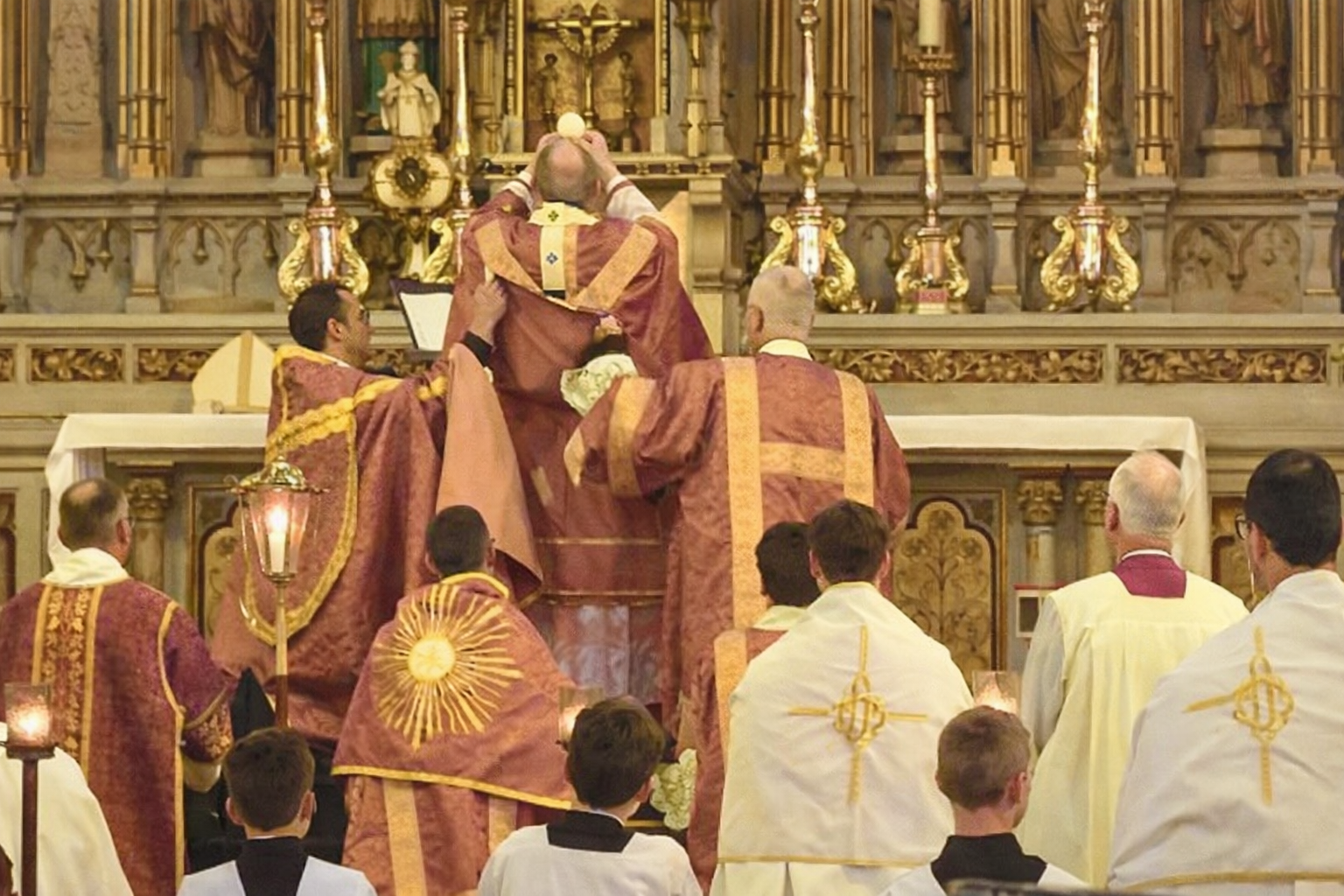
The recent offering of the Traditional Latin Mass by Willem Jacobus Eijk on Laetare Sunday has been received with cautious interest, even quiet enthusiasm, in certain quarters. In a climate shaped by restriction and suspicion following Traditionis Custodes, such a moment cannot be dismissed as insignificant.² Yet its meaning must be carefully delimited. The circumstances point not to a shift in episcopal policy, but to a pastoral accommodation, most likely connected to an already established traditional community in Oss.¹ It is an act of presence rather than programme, concession rather than commitment. And it is precisely this distinction—between gesture and governance—that proves decisive. For in the present crisis, the Church is not lacking in gestures; she is lacking in coherent, embodied direction.
Ratzinger and the Clarity of Diagnosis.
Among the contemporary episcopate, Joseph Ratzinger stands as a rare figure of intellectual and theological clarity. He did not merely acknowledge confusion within the Church; he diagnosed its causes. He identified relativism as a governing principle of modern thought, warned of a rupture in the reception of the Second Vatican Council, and recognised that the crisis extended beyond pastoral practice into the very structures of theology and liturgy.³ His analysis was not managerial but civilisational. He perceived that the Church was not simply navigating difficulty, but confronting a profound internal dislocation in her understanding of truth, worship, and authority.³
The Asymmetry of His Pontificate.
Yet this clarity did not culminate in full enactment. As Pope, Ratzinger issued Summorum Pontificum, restoring juridical freedom to the ancient Roman Rite and affirming its perennial legitimacy.⁴ This act remains one of the most significant liturgical interventions of the modern period. But it remained, in a crucial respect, incomplete. For the one action that would have rendered this restoration unmistakable—the public offering of the Traditional Latin Mass by the Roman Pontiff himself—never took place.⁵ This absence is not incidental. Papal liturgy is itself a form of governance; it teaches by enactment. Without such an example, the older rite remained, in practice, exceptional. Its legitimacy was affirmed, but its centrality was not restored. Thus the paradox emerges with clarity: he authorised continuity, but did not fully embody it.
Eijk and the Silence of Non-Diagnosis.
If Ratzinger represents diagnosis without decisive enactment, Cardinal Eijk represents a different limitation: orthodoxy without structural analysis. His record in moral theology is clear and commendable.⁶ He has resisted the reduction of Catholic teaching to pastoral subjectivism and has maintained fidelity to doctrinal truth in a deeply secularised context.⁶ Yet he does not articulate the crisis in terms of rupture, nor does he engage its roots in postconciliar developments. His silence regarding the Society of Saint Pius X is instructive. It is neither condemnatory nor supportive, but deliberately non-committal—reflecting an ecclesiology of institutional deference.⁷ It is reasonable to conclude that, were Rome to regularise or further restrict the SSPX, he would support such a decision without public reservation. His Laetare Mass must therefore be read within this framework: a gesture conditioned by circumstance, not a signal of reorientation; a pastoral act, not a programme of restoration.
The Crisis of Example.
What unites these two figures, despite their differences, is a deeper and more consequential reality: the absence of authoritative example at the highest levels of the Church’s life. Ratzinger perceived the crisis but did not enact its full correction. Eijk preserves orthodoxy but does not diagnose its causes. In both cases, the result is structurally similar. The existing framework remains intact, the tensions unresolved, and the faithful are left navigating a Church in which continuity is asserted but not consistently embodied. For the life of the Church is not governed by documents alone, nor sustained by isolated gestures, but shaped by visible and authoritative action—by what is done, publicly and unmistakably, by those entrusted with her care.⁸
Conclusion: The Limits of Gesture—and the Necessity of Witness.
The offering of the Traditional Latin Mass by a cardinal, like the promulgation of a motu proprio, is not without value. But neither is sufficient to effect restoration. Without a willingness to name the roots of the crisis, to address its structural causes, and above all to embody continuity in the Church’s highest acts of worship, such moments remain fragmentary. They console, but they do not correct. This pattern is not confined to a single figure. Even those most frequently associated with traditional liturgical sensibilities—such as Raymond Leo Burke, Robert Sarah, Francis Arinze, and Joseph Zen—have likewise offered the Traditional Latin Mass, spoken of crisis in varying degrees, and yet continued to celebrate the reformed liturgy and operate within the prevailing structures without fundamentally altering them.⁹
It is precisely here that the continued existence and activity of bodies such as the Society of Saint Pius X, the Old Roman Apostolate, and other traditional apostolates assume their full significance. Whatever one’s canonical evaluation, they represent an attempt—however contested—to resolve the disjunction between affirmation and enactment by living, rather than merely permitting, the Church’s liturgical and doctrinal inheritance.¹⁰ In a context where authority often hesitates to embody what it affirms, such witness emerges not as an optional eccentricity, but as a perceived necessity.
The lesson, then, is one of sober realism: permission without example cannot restore what has been displaced. Until authority is matched by enactment—until what is affirmed is also lived at the highest and most visible levels—the crisis will not merely endure; it will stabilise.
¹ Catholic Herald, report on Cardinal Eijk’s first public celebration of the Traditional Latin Mass in Oss (2026).
² Traditionis Custodes, Pope Francis, 16 July 2021.
³ Joseph Ratzinger, Homily at Mass Pro Eligendo Romano Pontifice (18 April 2005); Address to the Roman Curia (22 December 2005).
⁴ Summorum Pontificum, Pope Benedict XVI, 7 July 2007.
⁵ U.M. Lang, Turning Towards the Lord (Ignatius Press); Vatican liturgical records (2005–2013).
⁶ College of Cardinals Report; public interventions of Willem Jacobus Eijk (2014–2023).
⁷ College of Cardinals Report profile (absence of SSPX commentary).
⁸ A. Reid, The Organic Development of the Liturgy; J. Ratzinger, The Spirit of the Liturgy.
⁹ Public liturgical records and statements of Raymond Leo Burke, Robert Sarah, Francis Arinze, Joseph Zen.
¹⁰ Society of Saint Pius X official publications; Old Roman Apostolate mission materials.
Related Articles


Latest Articles
- Today’s Mass: October 09 St Dennis, Bishop with Rusticus & Eleutherius, MartyrsGregory of Tours states that Denis was bishop of the Parisii and was martyred by being beheaded by a sword. The earliest document giving an account of his life and martyrdom, the “Passio SS. Dionysii Rustici et Eleutherii” dates from c. 600, is mistakenly attributed to the poet Venantius Fortunatus, and is legendary.
- Today’s Mass: October 08 St Bridget of SwedenSaint Bridget of Sweden, born around 1302, was a noblewoman renowned for her piety and prophetic revelations. After marrying Prince Ulpho and raising eight children, she led a life of austerity and charity, founding the Order of the Holy Saviour. She died in Rome in 1373 and was canonised in 1391.
- Today’s Mass: October 07 Pope St Mark, ConfessorSt Mark’s brief pontificate teaches that God measures fidelity, not duration or worldly achievement. Christ alone possesses the everlasting priesthood; His servants are stewards of what they have received. With the commemorated martyrs, St Mark reminds us to persevere faithfully, so that when the Lord comes, He finds us “so doing.”
- Omnia autem probate: quod bonum est tenete ~ Prove all things; hold fast that which is good: Spiritual Conference for Nuntiatoria CXXVIThe conference reflects on St Paul’s assertion to “prove all things” in relation to self-judgement and the Church. It explores themes of synodality, ecumenism, and the importance of discernment, emphasising the need for humility in understanding truth and the challenge of maintaining genuine holiness in the midst of contemporary ecclesiastical crises.
- FROM PERMISSION TO PRESUMPTION: Fort Worth and the Chalice Vatican II never made the NormBishop Michael Olson has implemented strict limitations on the distribution of Communion under both species in the Diocese of Fort Worth, prompting a discussion on the historical evolution of liturgical practices following Vatican II. This decision aims to reaffirm the doctrine of the Eucharist, emphasising that Christ is fully present under either species, while addressing misconceptions surrounding modern practices.



Leave a Reply