
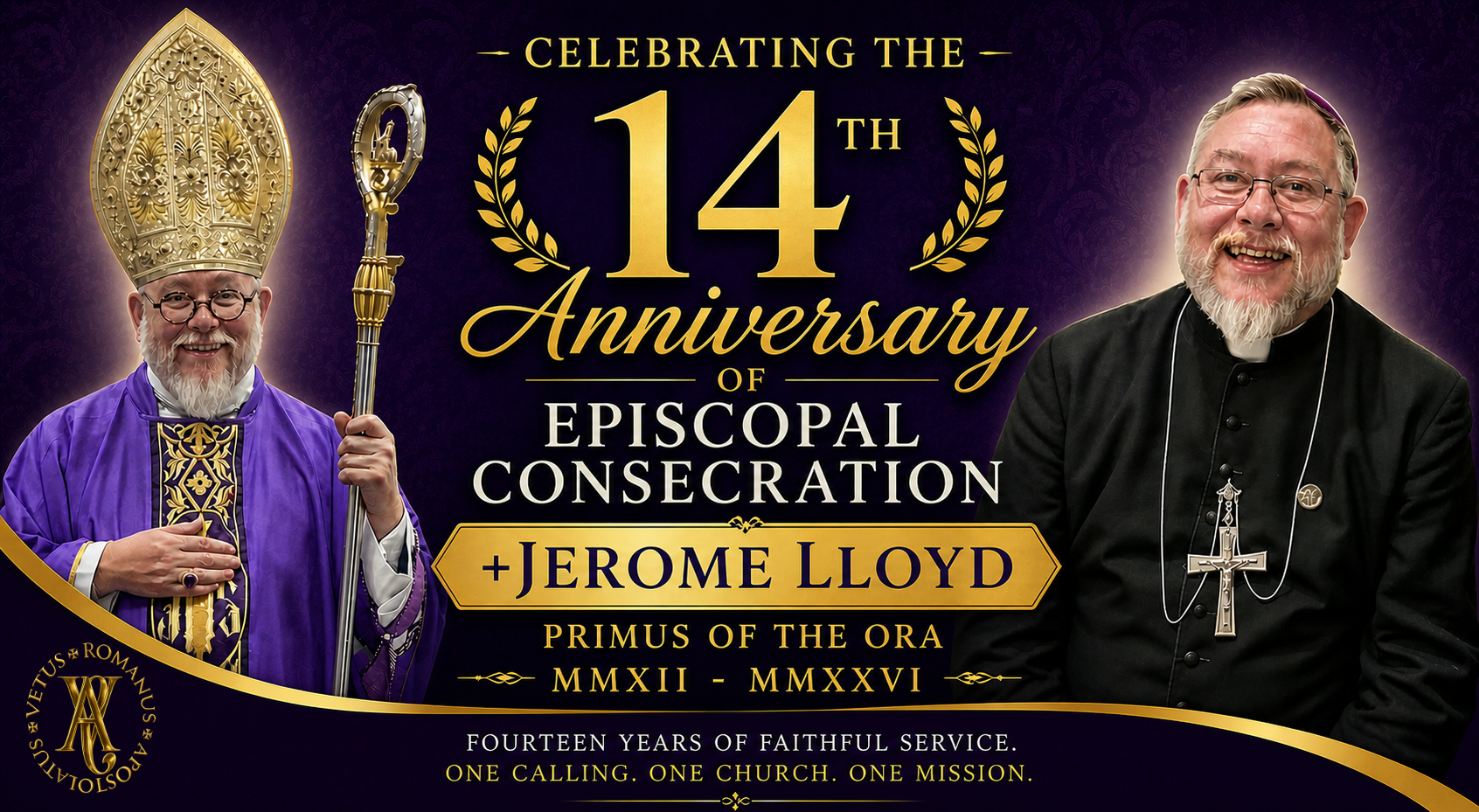
Fourteen Years of Apostolic Labour: The Ministry of ✠Jerome Lloyd and the Living Work of the Old Roman Apostolate

There are episcopal anniversaries that invite reflection upon a rite; there are others that compel attention to a life. The fourteenth anniversary of the episcopal consecration of ✠Jerome Lloyd belongs unmistakably to the latter. For what marks these years is not merely that a consecration took place in 2012, but that a ministry has been exercised—consistently, concretely, and across borders—in the service of souls.
The episcopate is not fulfilled in the moment of consecration but in the years that follow. It is proven not in ceremony, but in labour. And it is precisely here that the significance of these fourteen years must be located: in the visible, sustained, and often demanding work of the Old Roman Apostolate.
From the outset, the ministry of ✠Jerome has been marked by breadth, adaptability, and practical realism. As Primus of the Old Roman Apostolate—elected by his fellow bishops and clergy—he has exercised a form of governance that is both collegial and apostolic, coordinating missions across Europe with a growing presence in Africa and Asia.¹ His work has not been that of a distant prelate, but of an active missionary bishop: ordaining clergy, confirming the faithful, visiting dispersed communities, and sustaining sacramental life in places where it might otherwise lapse.²
This is not administrative oversight. It is apostolic governance in conditions that demand initiative, resilience, and personal sacrifice.
Yet the distinctiveness of this ministry lies not merely in its reach, but in its integration of doctrine, charity, and public witness—each flowing from a single theological vision.
Nowhere is this more concretely embodied than in Brighton.
Arriving in the city in 2007 to establish the Brighton Oratory, ✠Jerome entered a context marked by both cultural vitality and acute social need.¹ Rather than maintaining a purely liturgical presence, he embedded the Apostolate within the lived realities of the city. His early work among the homeless developed not only into direct provision but into structured initiatives that sought long-term restoration.
Most notably, Cherubs Kitchen, founded in 2013, exemplified this approach. It provided NVQ-accredited catering training, work placements, and practical pathways back into employment for those emerging from homelessness or instability.³ Participants were not treated as passive recipients, but as persons capable of recovery, formation, and reintegration. The initiative combined professional training with pastoral care—uniting practical skill with human dignity. Its eventual closure during the COVID lockdowns underscores not its failure, but the scale of disruption imposed upon precisely such grassroots works.³
Alongside this, ✠Jerome’s civic engagement extended into structural collaboration. As Chair of Brighton & Hove Faith in Action, Chair of the city’s Faith Council, and a contributor to multiple advisory bodies—including the Faith Covenant with the City Council, the Standing Advisory Council for Religious Education (SACRE), and interfaith and community cohesion initiatives—he has played a role in shaping how faith communities interact with public institutions.¹ His work as a Faith Adviser to Sussex Police and participation in local networks addressing social cohesion further demonstrate a consistent effort to ensure that religious voice remains both present and principled within civic life.¹
This engagement, however, has never been one of accommodation.
It is governed by the principles articulated in the Old Roman Apostolate itself: that the Church’s primary purpose is not temporal welfare, however necessary, but the salvation of souls, and that engagement with society must always be ordered by fidelity to the Apostolic Faith.⁴ The Church enters the world not to mirror it, but to transform it.
This theological clarity becomes especially visible in the Archbishop’s public interventions.
His address to the Free Speech Union in Brighton in 2023 articulated concerns about the expansion of the Public Sector Equality Duty beyond its statutory remit into the enforcement of contested ideological frameworks, particularly within education.⁵ He argued that public bodies were increasingly conflating legal obligations with advocacy positions, thereby undermining institutional neutrality and placing pressure upon conscience.
This was not an isolated intervention. His earlier critique of the “Trans Toolkit” used in local schools demonstrated the same method: careful textual analysis, attention to legal distinctions, and resistance to the presentation of contested claims as settled fact.⁵ These contributions form part of a broader body of work concerned with the preservation of lawful expression, the integrity of public discourse, and the protection of dissenting viewpoints in an increasingly constrained environment.⁶
At a deeper level, these interventions are grounded in a wider cultural diagnosis.
In his 2026 essay, Can You Build a Future on Borrowed Faith? Civilisational Exhaustion and the Moral Credit of Britain, ✠Jerome argues that Britain continues to rely upon moral concepts derived from Christianity—dignity, equality, rights—while increasingly abandoning the theological foundations that give those concepts coherence.⁷ The result is what he terms a depletion of “moral credit”: a civilisation living on inherited ethical capital without replenishing its source.
The consequence is not stability, but exhaustion.
A society that retains moral language while severing it from its metaphysical roots cannot sustain its own claims. Law becomes a substitute for consensus; ideology fills the vacuum left by doctrine. It is within this context that his civic engagement must be understood—not as political activism, but as an attempt to preserve the conditions under which truth can still be meaningfully articulated.
This integration of sacramental life and social engagement is further reinforced by his long-standing use of media.
As early as 2008, ✠Jerome established what has become one of the earliest and longest-running online apostolates dedicated to the Traditional Latin Mass. Through Old Roman TV, the Holy Sacrifice has been broadcast daily since the Feast of the Assumption, 15 August 2008—accompanied over time by devotions, catechesis, conferences, and spiritual reflections. This initiative, initially modest in scope, assumed decisive importance during the COVID period, when access to churches was restricted. What had been an apostolate became a lifeline: a daily participation in the liturgical life of the Church for the faithful unable to attend in person.¹
At a time when access to the sacraments was widely curtailed—and in many places entirely withdrawn—✠Jerome maintained their availability. The Mass continued—both in person and through the already-established daily broadcast of Old Roman TV. The faithful were not deprived of sacramental grace, whether locally present or spiritually united through the liturgy. This was not a matter of preference, but of principle: that the sacraments are essential, not optional; necessary, not incidental.²
In parallel, he provided concrete pastoral support to those facing moral dilemmas under public policy, issuing letters for conscientious objectors and affirming the Church’s duty to form and defend conscience under pressure.² Here again, the episcopal office is seen in its fullness: not merely administering rites, but guiding souls in moments of real moral consequence.
Alongside these works stands a sustained commitment to formation and teaching. Through pastoral epistles, catechetical initiatives, conferences, digital broadcasting, and the ongoing publication of Nuntiatoria, ✠Jerome has sought to articulate the faith with clarity in a time marked by confusion—addressing both internal ecclesial questions and broader cultural challenges.²
Thus, the ministry of these fourteen years unfolds across multiple, interlocking domains: sacramental provision, charitable action, civic engagement, intellectual formation, and public witness. Each is grounded in the same theological conviction. Each reinforces the others.
Fourteen years—MMXII – MMXXVI—therefore represent not simply endurance, but coherence: a ministry in which doctrine is not abstract, charity is not detached, and public witness is not compromised.
In an age inclined to fragmentation—of belief from practice, of charity from truth, of religion from public life—such integration is itself a sign.
Not a spectacle, but a substance.
Not a claim, but a work.
Ad multos annos.
¹ “Biography / Résumé,” Selsey.org
² “Apostolate,” Selsey.org
³ “Ministry: Homelessness,” Selsey.org
⁴ “Old Roman Catholicism,” Selsey.org
⁵ “Address to Free Speech Union, Brighton” (2023) and “Trans Toolkit Feedback” (2020), Selsey.org
⁶ “Free Speech,” Journal Category, Selsey.org
⁷ “Can You Build a Future on Borrowed Faith? Civilisational Exhaustion and the Moral Credit of Britain,” Selsey.org (13 February 2026)
related articles


Latest articles
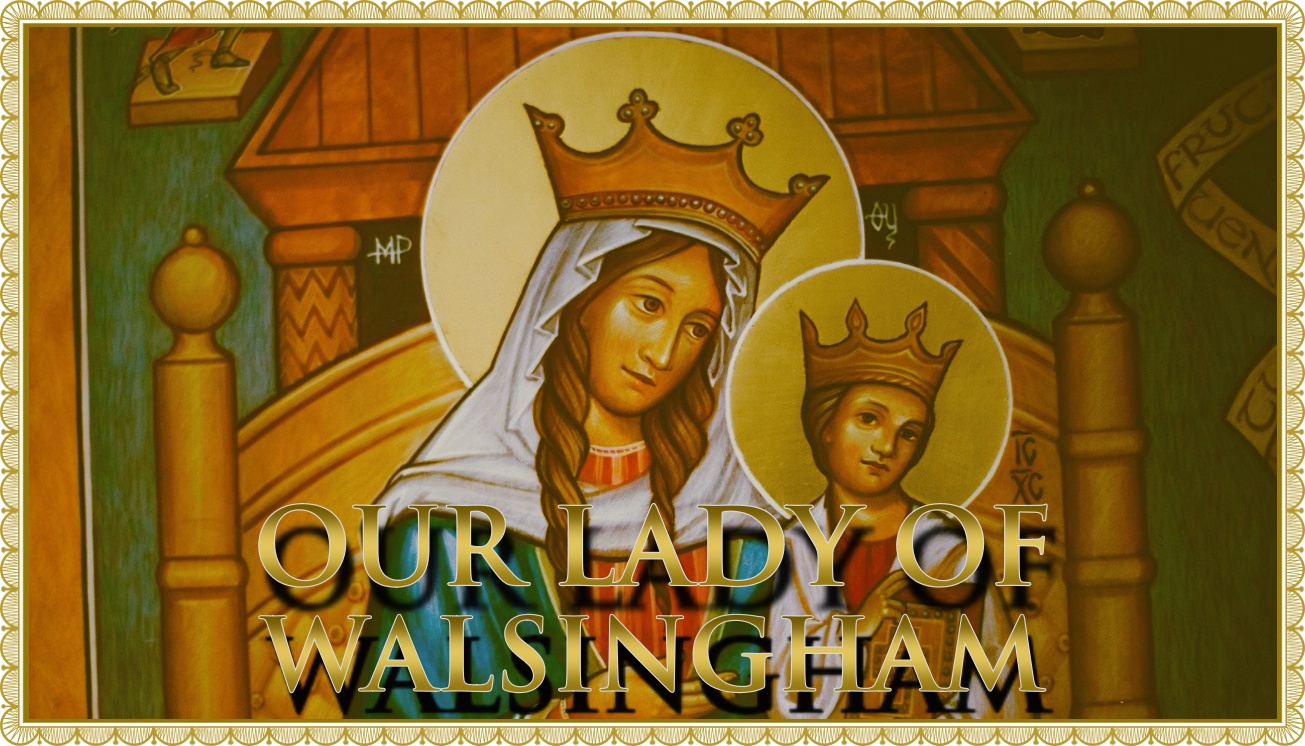
- Today’s homily: Our Lady of WalsinghamThe Mass reflects on the significance of Walsingham, Loreto, and the Christian soul as “Holy Houses” that embody the connection between heaven and earth. It highlights Mary’s central role in the Incarnation and emphasises the importance of inner conversion by inviting believers to reflect on their own hearts as dwelling places for God.
- Today’s Mass: September 24 Our Lady of WalsinghamThe Feast of Our Lady of Walsingham commemorates the vision of Mary that inspired Richeldis de Faverches to build a replica of her house in Nazareth in 1061. This shrine became a significant pilgrimage site, attracting royal visits until its destruction in 1538. The revival of pilgrimage in the 20th century reaffirmed its spiritual importance.
- Sermon for Blessed Virgin Mary of RansomToday, we commemorate the feast of the Blessed Virgin Mary of Ransom, which honours the Mercedarians, a religious order founded in 1218 to free Christian captives from the Moors in Spain. Their mission persists today, highlighting the ongoing relevance of ransoming captives amidst contemporary persecution, combining spiritual redemption with social responsibility.
- OUR LADY OF RANSOM: THE MOTHER OF THE REDEEMER AND THE BREAKING OF CHAINSThe Feast of Our Lady of Ransom, celebrated on 24 September, commemorates the Mercedarian Order’s mission to redeem Christian captives, embodying the concept of liberation from sin through Christ’s sacrifice. This day’s significance links historical devotion with England’s Catholic restoration, connecting the feast to both the Incarnation and personal spiritual freedom.
- Today’s Mass: September 23 Pope Saint Linus, MartyrPope Saint Linus, a nobleman from Tuscany, became an early Christian leader, first in Gaul and then as the Pope after Saint Peter. He was martyred for his faith, noted for his role in baptising and appointing bishops. Saint Thecla, inspired by Saint Paul, chose virginity and endured persecution, ultimately receiving martyrdom.





Leave a Reply