
The Mass That Built Filipino Faith — But History Rarely Shows It
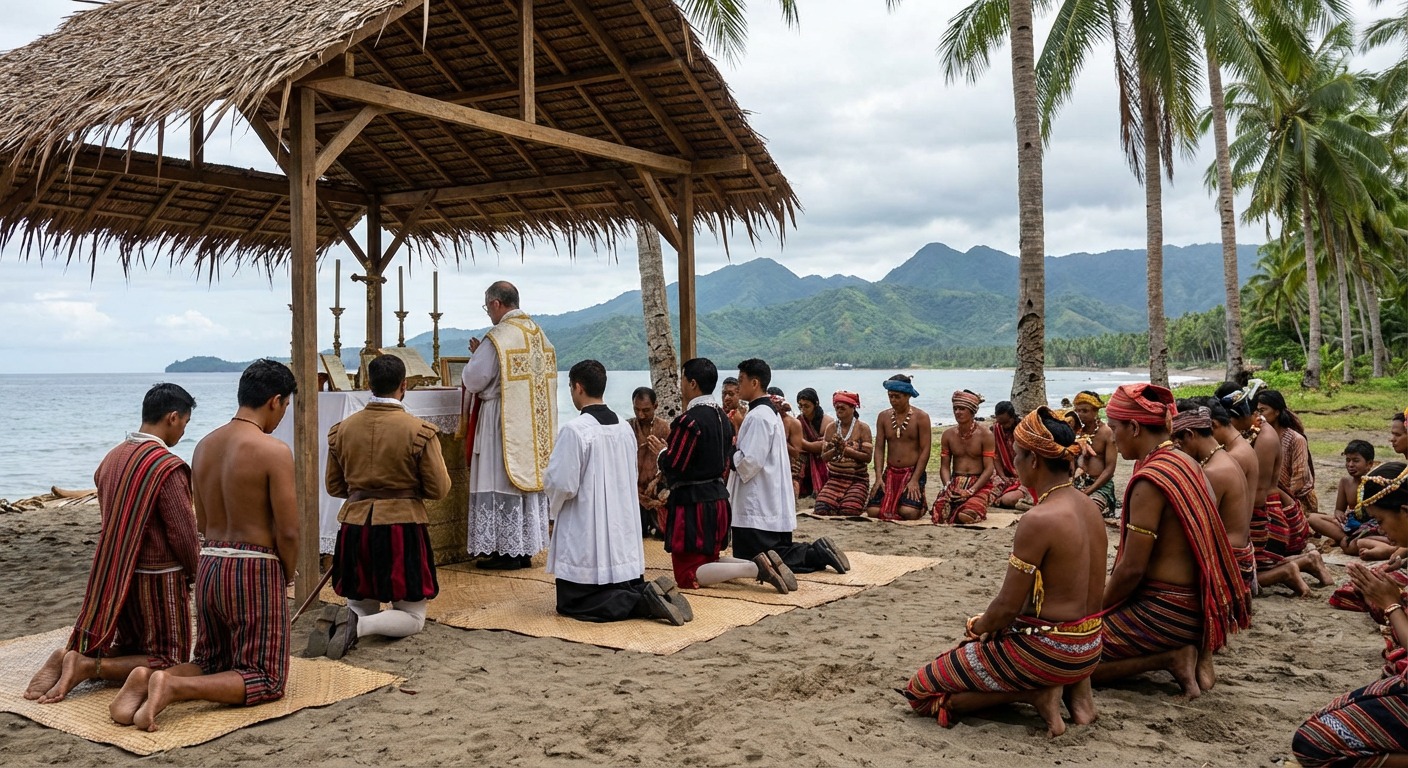
On 31 March 1521, on the shores of what is now Limasawa Island, the Holy Sacrifice of the Mass was offered for the first time in the Philippine archipelago. The principal celebrant was Fr. Pedro de Valderrama, chaplain to the expedition of Ferdinand Magellan. The scene, described in careful detail by Antonio Pigafetta, is not merely devotional memory but documentary history—one of the earliest firmly attested moments in the religious formation of the Filipino people.¹
And yet, the way in which this moment is remembered reveals a deeper problem. For while the fact of the Mass is commemorated, the form of that Mass—its structure, its symbolism, its theological language enacted in ritual—is almost entirely absent from modern consciousness. It is as though the foundation stone of a great cathedral were preserved, but the architecture it supports were forgotten.
This absence is not trivial. It is interpretive. For to remove the form of the Mass from history is to render unintelligible the very process by which the Philippines became Catholic.
The Mass that was offered at Limasawa was not a rudimentary or evolving liturgy. It was already ancient, already the fruit of a long and organic development within the Latin Church. As Josef A. Jungmann demonstrates, the Roman Mass had achieved substantial structural stability by late antiquity, with the Canon, Offertory, and sacrificial theology firmly established centuries before the Council of Trent.² The reforms of Pope Pius V did not create a new liturgy; they codified and standardised what had already been received.³
Thus, what arrived in the Philippines was not a provisional missionary adaptation, but a mature, universal rite—one that had already shaped Western Christendom across generations.
To grasp this is to begin to understand what the missionaries actually brought. They did not merely teach doctrines or impose structures. They introduced a sacred order—a way of encountering reality itself through ritual. The Mass was not explanatory but formative; not didactic but transformative. It did not primarily instruct the intellect; it oriented the soul.
This is why its characteristics matter.
The use of Latin, far from being an obstacle, marked the action as sacred—set apart from ordinary speech.⁴ The orientation of the priest ad orientem expressed a theological truth: that both priest and people are turned together toward God, not toward one another.⁵ The silence of the Canon conveyed the ineffable nature of the sacrifice being offered.⁶ Every gesture, every movement, every repetition reinforced a single, central reality: that the Mass is the re-presentation of the Sacrifice of Calvary.
Such a liturgy does not simply communicate belief. It creates a world in which belief becomes intelligible.
The historical record confirms that this world took root with remarkable depth. The missionary orders that followed—Augustinians (1565), Franciscans (1578), Jesuits (1581), Dominicans (1587)—did not diverge in liturgical practice but maintained continuity with the Roman Rite as standardised in the post-Tridentine period.⁷ Synodal decrees in Manila mandated conformity to the Roman Missal and Breviary, ensuring a unity of worship across the archipelago.⁸
And this unity bore fruit—not merely in ecclesiastical structures, but in culture itself.
Anthropological and historical studies consistently demonstrate that Catholicism in the Philippines became a total social reality. As John Leddy Phelan shows, the Spanish missionary project integrated liturgical life into governance, education, and communal identity.⁹ Towns were organised around the parish church; time was structured by the liturgical calendar; identity was marked by sacramental participation.
Similarly, John N. Schumacher argues that Catholicism did not remain an external imposition but became internalised precisely because it was lived—embodied in ritual, repeated in practice, reinforced through communal participation.¹⁰
Anthropologist Fenella Cannell further observes that Filipino Catholicism is characterised by an intensely embodied devotional life, in which ritual action—processions, devotions, sacramentals—serves as the primary medium of religious meaning.¹¹
This is crucial. For such a culture does not arise from abstract instruction. It arises from sustained immersion in a liturgical environment.
In other words: the Philippines did not become Catholic because it was taught the Faith. It became Catholic because it was formed by the Mass.
Even the enduring features of Filipino Catholicism today—the Santo Niño devotion, the Black Nazarene processions, Marian piety, penitential practices—bear the unmistakable imprint of a sacrificial and incarnational worldview.¹² These are not random cultural expressions. They are the visible outgrowth of a liturgical root.
And yet, in modern representations of Philippine history, this root is obscured.
The Mass is either omitted entirely or presented in forms that bear little resemblance to its historical reality. Silence is replaced with dialogue. Orientation is reversed. Ritual density is flattened. The result is not merely simplification, but distortion—a projection of contemporary assumptions onto a past that operated according to very different principles.
This distortion has consequences.
For when a people loses sight of the form that shaped it, it loses the ability to understand itself. The continuity between past and present becomes abstract rather than lived. Identity becomes detached from its source.
The ancient principle lex orandi, lex credendi, articulated by Prosper of Aquitaine, expresses this with clarity: the law of prayer is the law of belief.¹³ Worship is not secondary to doctrine; it is its embodiment, its transmission across time.
If the form of worship changes, the perception of belief changes with it.
This is why the current moment is not without significance.
Across the Philippines, there is a growing movement—quiet but unmistakable—toward rediscovery. The work of the Society of St. Pius X has reintroduced the Traditional Latin Mass to communities that had never encountered it in its fullness. Likewise, the Old Roman Apostolate has undertaken efforts to reconnect Filipino faithful with their liturgical inheritance through catechesis, mission work, and the restoration of traditional worship.
What is striking is not merely the existence of these efforts, but the response they evoke.
Many who encounter the traditional Roman Rite for the first time describe a sense of recognition—an awareness that this form of worship corresponds more closely to the devotional instincts already present within Filipino Catholic culture. It is not experienced as foreign, but as familiar in a deeper, almost intuitive sense.
This is not nostalgia. It is continuity.
It suggests that the imprint of the traditional liturgy has not been erased, but remains embedded within the cultural and spiritual memory of the people—waiting, as it were, to be rearticulated.
And this brings us to the central claim.
The Catholic faith in the Philippines was not built upon abstraction, nor sustained by adaptation alone. It was built, patiently and deliberately, upon the repeated offering of the Holy Sacrifice of the Mass as it had been handed down through the centuries.
To recover that Mass is not to retreat into history. It is to recover coherence—to reconnect belief with its expression, identity with its source, memory with reality.
On this 505th anniversary of the First Mass in the Philippines, the question is therefore not simply whether we remember that it happened.
The question is whether we are willing to see what it was—and what it made possible.
For until we do, the Mass that built Filipino faith will remain what it has become in modern consciousness:
Present in history.
But hidden from sight.
¹ Antonio Pigafetta, The First Voyage Around the World (1519–1522), trans. J. A. Robertson (Cleveland: Arthur H. Clark Company, 1906), pp. 120–123.
² Josef A. Jungmann, The Mass of the Roman Rite, vol. 1 (New York: Benziger, 1951), pp. 135–165.
³ Missale Romanum (1570), Apostolic Constitution Quo Primum, Pope Pius V.
⁴ Adrian Fortescue, The Mass: A Study of the Roman Liturgy (London: Longmans, 1912), pp. 213–220.
⁵ Joseph Ratzinger, The Spirit of the Liturgy (San Francisco: Ignatius Press, 2000), pp. 74–84.
⁶ Jungmann, Mass of the Roman Rite, vol. 2, pp. 379–400.
⁷ John Leddy Phelan, The Hispanization of the Philippines (Madison: University of Wisconsin Press, 1959), pp. 24–45.
⁸ Synod of Manila (1582–1586), decrees on liturgical conformity; cf. Phelan, pp. 92–95.
⁹ Phelan, pp. 97–120.
¹⁰ John N. Schumacher, Readings in Philippine Church History (Quezon City: Ateneo de Manila University Press, 1987), pp. 15–30.
¹¹ Fenella Cannell, Power and Intimacy in the Christian Philippines (Cambridge: CUP, 1999), pp. 3–28.
¹² Fernando Zialcita, Authentic Though Not Exotic: Essays on Filipino Identity (Quezon City: Ateneo, 2005), pp. 45–78.¹³ Prosper of Aquitaine, Epistula 217, PL 51, cols. 209–210.
Related Articles


Latest Articles
- Today’s Mass: September 04 Feria of Sunday XIV Post PentecostThe Fourteenth Sunday After Pentecost emphasises the importance of serving one master—God—over the flesh. It urges Christians to focus on spiritual over temporal concerns, warning against anxiety. The readings highlight the contrast between the fruit of the spirit and the works of the flesh, encouraging a pursuit of divine life.
- Today’s homily: St Pius X, PopeThe text reflects on the life and legacy of Pope St Pius X, who was chosen from humble beginnings to reform the Church. His pontificate focused on defending the Catholic Faith, restoring liturgical sanctity, and fostering deeper connections between believers and Christ. Pius X exemplified a balance of truth and pastoral charity.
- Today’s Mass: September 03 Pope St Pius X,Pope St Pius X, born Giuseppe Melchiorre Sarto, was a significant reformer who emphasised preserving the Catholic Faith against Modernism. His pontificate (1903-1914) featured reforms in liturgy, frequent Holy Communion, and seminaries, rooted in a pastoral desire to restore everything in Christ. He died in 1914 and was canonised in 1954.
- Today’s homily: St Stephen of HungaryThe homily reflects on the life of Saint Stephen of Hungary, illustrating his transition from a powerful ruler to a saint. He embraced the responsibilities of kingship guided by faith, understanding his authority as stewardship. His legacy teaches that true governance comes with surrender to God, ultimately placing his kingdom under the protection of the Blessed Virgin Mary.
- Today’s Mass: September 02 St. Stephen the GreatSt. Stephen the Great, King of Hungary (977-1038), was a significant Christian ruler who reinforced the faith throughout Hungary. Anointed king in 1000 by Pope Sylvester II, he fought against paganism and promoted the Church. He was canonised in 1083 and is the patron saint of Hungary, symbolising national identity.



Leave a Reply