
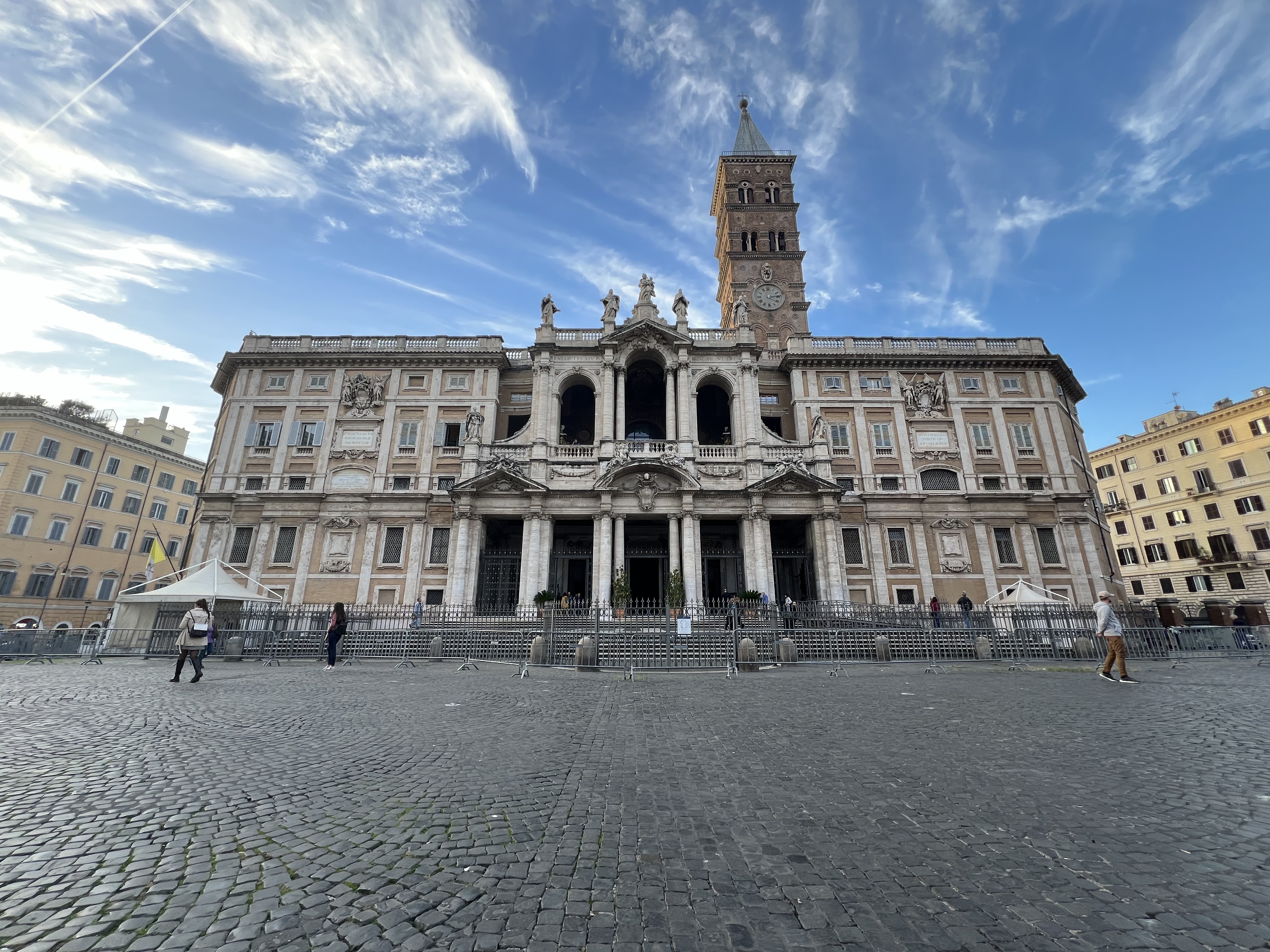
Statio ad St Mariam Majorem
On this day of shadows, when the Gospel recounts the quiet conspiracy of betrayal, the Church does not lead us to a place of judgment, but to a place of motherhood. We are brought again to Basilica of Saint Mary Major, to stand beside the Blessed Virgin Mary—not yet beneath the Cross, but already within its sorrow. Spy Wednesday reveals the hidden fracture of the human heart: that capacity to walk with Christ outwardly while turning from Him inwardly. And so the liturgy places us where fidelity is perfect, where no shadow of treachery has ever entered—the heart of the Mother of God.
Here, everything speaks of the mystery of the Incarnation: the gleaming mosaics, the ancient columns, the silent presence of the manger relics below. Yet this is not merely a meditation on Christ’s birth, but on the cost of that birth. The Child laid in the manger is the Lamb destined for sacrifice. The wood that held Him in Bethlehem foreshadows the wood that will receive Him on Calvary. And Mary, who once received Him in joy, now begins to receive Him in sorrow. To stand in this basilica today is to realise that the Passion did not begin in the Garden—it began in the willing “yes” of a Virgin, and it unfolds now in the quiet fidelity of her suffering heart.
Beneath the altar lies the memory of Bethlehem; above it, the Church prepares for Calvary. And between these two mysteries stands the Christian soul. Spy Wednesday asks a question that cannot be avoided: where do I stand? With Judas, calculating and divided? Or with Mary, faithful and undivided? The presence of Saint Matthias in this basilica is not incidental—it is providential. Where one apostle fell, another was raised up. Where betrayal entered, grace restored. This is the quiet promise of the day: that even in the face of sin, God’s work is not undone, but renewed.
The icon of Salus Populi Romani looks out upon the pilgrim with a gaze both tender and grave. It is the gaze of one who knows what is coming—and who remains. That is the lesson of this station: not brilliance, not strength, not even understanding—but perseverance. To remain with Christ when others depart. To remain when the cost becomes visible. To remain when silence replaces consolation.
And so the Church, in her wisdom, brings us here before the Triduum begins, as if to say: if you would follow Christ to the Cross, you must first learn to stand with His Mother. For it is in her school that we learn the deepest truth of discipleship—that love does not flee when it is wounded, but endures; that faith does not collapse in darkness, but waits; and that redemption is not grasped through power, but received through fidelity.
RELATED ARTICLES


LATEST ARTICLES
- STABAT MATER DOLOROSA: The Seven Sorrows of the Blessed Virgin MaryThe traditional feast of the Seven Sorrows on 15 September contemplates Mary’s spiritual martyrdom from Simeon’s prophecy to the Burial of Christ. Distinct in origin from the Passion Friday feast of the Compassion, the September observance came especially through the Servite tradition and was extended to the Latin Church by Pius VII before being raised in rank and fixed to 15 September under St Pius X. Its Mass, Stabant juxta Crucem, presents Mary’s sorrow not as sentimental grief but as perfect faith, charity and conformity to Divine Providence, wholly dependent upon and ordered to the unique redemptive Sacrifice of Christ.
- THE FLAG THEY NEVER EXPLAINEDThe transgender pride flag has become ordinary institutional iconography, but the civic account of its origins is highly abbreviated. Its creator, Monica Helms, is male and began living as a woman in 1997. Helms’s autobiography describes sexual excitement associated with presenting himself as female, closely corresponding to what sexologist Ray Blanchard termed autogynephilia, alongside stolen women’s underwear, adult-video work, sex clubs and sexually themed fiction. The flag’s blue and pink also have separate documented uses as sex-coded colours within paedophile symbolism and child-sex markets, although there is no evidence of any connection with Helms’s design. More significant is the flag’s institutional history. It became embedded throughout public life during the same period in which gender-identity assumptions entered law, medicine, schools and safeguarding practice. The Supreme Court, revised RSHE guidance, KCSIE 2026 and the WellBN investigation now reveal a substantial correction towards biological reality, parental involvement, evidence and professional curiosity.
- NSPCC: THE SAFEGUARD THEY REMOVEDThe NSPCC has removed from its new schools guidance the previous recommendation that, where possible, children changing clothes should be supervised by adults of the same sex. Yet in the same month NSPCC Sport retained precisely that principle, while the 2026 statutory safeguarding framework strengthened sex-based protections for school changing rooms. The issue is not suspicion of teachers but why an elementary safeguard protecting children’s privacy, dignity and staff themselves has quietly disappeared.
- PEACE WITHOUT THE KING, UNITY WITHOUT THE CHURCHThe CCEE–CEC meeting in Germany marks the active reception of the revised Charta Oecumenica, whose programme reaches from common prayer and evangelisation to movement towards Eucharistic fellowship. Read beside Pius XI’s Quas Primas and Mortalium Animos, and against the clarifications of Unitatis Redintegratio, Dominus Iesus, Ecclesia de Eucharistia and Apostolicae Curae, the issue is not whether Catholics may cooperate with other Christians. It is whether an ecumenical culture of convergence is beginning to obscure the Social Kingship of Christ, the Catholic missionary claim and the already-existing visible unity of His Church.
- DEFEATED — BUT NOT SETTLEDThe Commons has voted against assisted suicide in England and Wales, with scrutiny revealing concerns over vulnerability, prognoses, and palliative care. Shifted positions among some MPs and the absence of others led to the defeat. The debate underlines the challenges of translating public support into effective legislation amid complex ethical considerations.



Leave a Reply