
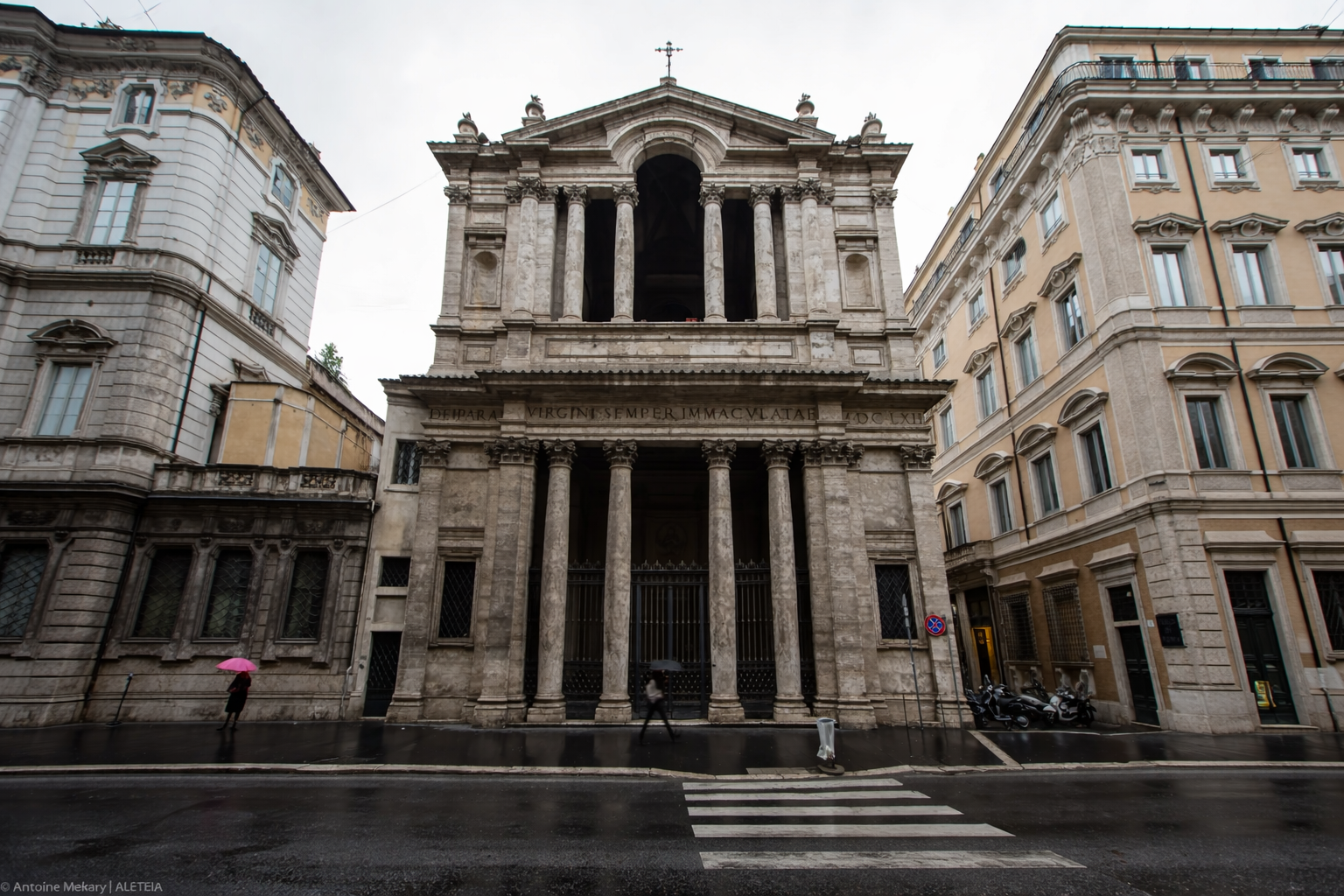
Statio ad Sanctum Cyriacum (Sanctam Mariam in Via Lata)
May our fasts be acceptable to Thee, O Lord,
and expiate our sins;
may they make us worthy of Thy grace,
and lead us unto life everlasting.
Through Our Lord…

The Roman Missal preserves for this day the memory of the ancient station at the titular church of St. Cyriacus, once situated near the vast complex of the Baths of Diocletian. Though the original sanctuary has long since fallen into ruin, its liturgical memory endures—a striking testimony to the Roman instinct for continuity even amid material loss. The relics of the martyr-deacon were translated in the Middle Ages to Santa Maria in Via Lata, and it is here that the stational observance is now held, preserving in a new locus the ancient devotion.
This shift from a vanished basilica to a living church encapsulates the layered history of Rome herself. The original titulus Cyriaci, attested as early as the fifth century and frequently mentioned in the Liber Pontificalis, stood in a low-lying area prone to flooding, which gradually undermined its foundations. Despite successive restorations—by Pope Sergius I in the seventh century, Leo IX in the eleventh, and later interventions by Eugenius IV and Innocent VIII—the structure ultimately succumbed to decay and abandonment. By the late fifteenth century it was already counted among the ruined churches of the city, its remnants lying amid vineyards near the Certosini monastery adjacent to Baths of Diocletian. Today, only archaeological traces beneath modern structures hint at its former presence.
By contrast, Santa Maria in Via Lata stands as one of the most historically resonant churches of central Rome. Built upon what tradition identifies as the site of Saint Paul’s house arrest, the church preserves beneath its pavement a series of ancient chambers long venerated as the Apostle’s dwelling during his Roman imprisonment. Here, according to longstanding tradition, Paul preached, received visitors, and perhaps composed portions of his epistles—an association that imbues the present station with apostolic depth. The site thus unites martyrial memory with apostolic witness: Cyriacus the deacon, faithful unto death, and Paul the Apostle, bound yet preaching.
The liturgical peculiarities of this day further situate it within the austere progression of Passiontide. Until Maundy Thursday, the preparatory Psalm Judica me (Psalm 42) is omitted, along with the Gloria Patri after both the Introit and the Lavabo. These omissions are not accidental but deliberate signs of intensifying liturgical sobriety: the Church, as it were, strips away consolation to lead the faithful more deeply into the mystery of the Passion. Even the stational discipline reflects this gravity. The ancient Ordines Romani record that, by long-standing custom, no station was ordinarily held on Mondays, Tuesdays, or Thursdays, except on feasts of martyrs. The very assignment of St. Cyriacus to this day, therefore, underscores the primacy of martyrdom within the Lenten pilgrimage: only the witness of blood justifies the suspension of silence.
The figure of Cyriacus himself reinforces this theme. A Roman deacon and martyr of the early fourth century, he was venerated not only in Rome but also in the East, where tradition links him—albeit loosely—to the court of King Sapor of Persia. This association invites comparison with the prophet Daniel, whose trial in the lions’ den forms the scriptural lesson of the day. Just as Daniel bore witness to the true God in the midst of a pagan court, so Cyriacus is remembered as exercising his apostolate in hostile surroundings, remaining steadfast under persecution. The recurrence of Daniel’s image in the catacombs—frequently depicted as a symbol of deliverance and fidelity—suggests how deeply this typology was embedded in early Christian consciousness.
Within the present church, layers of history continue to accumulate. The crypt evokes the memory of apostolic Rome; the thirteenth-century icon of the Vergine Avvocata above the altar speaks to medieval devotion; the tombs of Renaissance figures and the association with figures such as Blessed Pius IX attest to the continuity of ecclesial life across centuries. The church’s role as one of the ancient Roman deaconries further connects it to the Church’s early structures of charity and service, echoing the diaconal ministry of Cyriacus himself.
Thus the station of this day is marked by a profound convergence: a lost church remembered, a martyr translated, an apostle recalled, and a liturgy deepened in austerity. The faithful who gather at Santa Maria in Via Lata do not merely substitute one location for another; they participate in a living tradition that binds together ruin and renewal, memory and presence, suffering and fidelity. In this way, the Roman station becomes not only a geographical destination but a theological statement: that nothing offered in witness to Christ is ever lost, but is gathered, translated, and preserved within the enduring life of the Church.
Grant us, we beg Thee, Lord,
a steadfast obedience to Thy will,
so that our time may see Thy subject people
enlarged both in merit and in numbers;
through Our Lord…
RELATED ARTICLES


LATEST ARTICLES
- WHEN THE BISHOP BECOMES THE MESSAGE: The Cult of Personality, Episcopal Pride and the Betrayal of Apostolic TrustArchbishop Josef Grünwidl of Vienna has openly advocated for women’s ordination, reflecting a troubling trend among bishops who express personal opinions at odds with established Catholic doctrine. This practice undermines their primary role of teaching the faith and raises concerns about episcopal pride and the proper handling of doctrinal authority by the Church.
- SANDIE PEGGIE: WHEN THE UNION FAILS THE WOMEN IT SHOULD DEFENDThe Royal College of Nursing successfully defended its actions in a discrimination case brought by Sandie Peggie, yet the ruling highlights concerns about the union’s failure to acknowledge members’ rights amid ideological conformity. This raises critical questions regarding the adequacy of trade union representation for employees facing complex workplace issues.
- Today’s homily: St Winefride of HolywellSt Winefride’s courage, and the survival of devotion to her through centuries of persecution, reveal the cost and beauty of Christian fidelity. Her feast challenges us to move beyond outward observance, cultivate genuine holiness, resist compromise, and persevere in sanctifying grace, ready to meet Christ, our divine Bridegroom.
- Today’s Mass: November 3 St Winefride of HolywellThe spring attached to her legend has given its name to Holywell (Tre Ffynnon), Clwyd, and down the centuries, and right up to the present day, pilgrims have travelled there in the hope of finding healing for their illnesses. Such pilgrimages even continued throughout the Reformation with 14,000 people and 150 priests gathered there on St Winefride’s feast day in 1629 – a time when Catholics were still dying as martyrs.
- THE GOSPEL IS NOT AN ALIBI FOR BUREAUCRACYBishop Philip North contends that spiritual renewal is paramount for the Church of England, sidelining organisational reform. He defends diocesan administration despite concerns over rising costs and declining clergy and congregations. This editorial emphasises the need for both faithful evangelisation and responsible financial stewardship as interconnected necessities for the Church’s survival.




Leave a Reply