
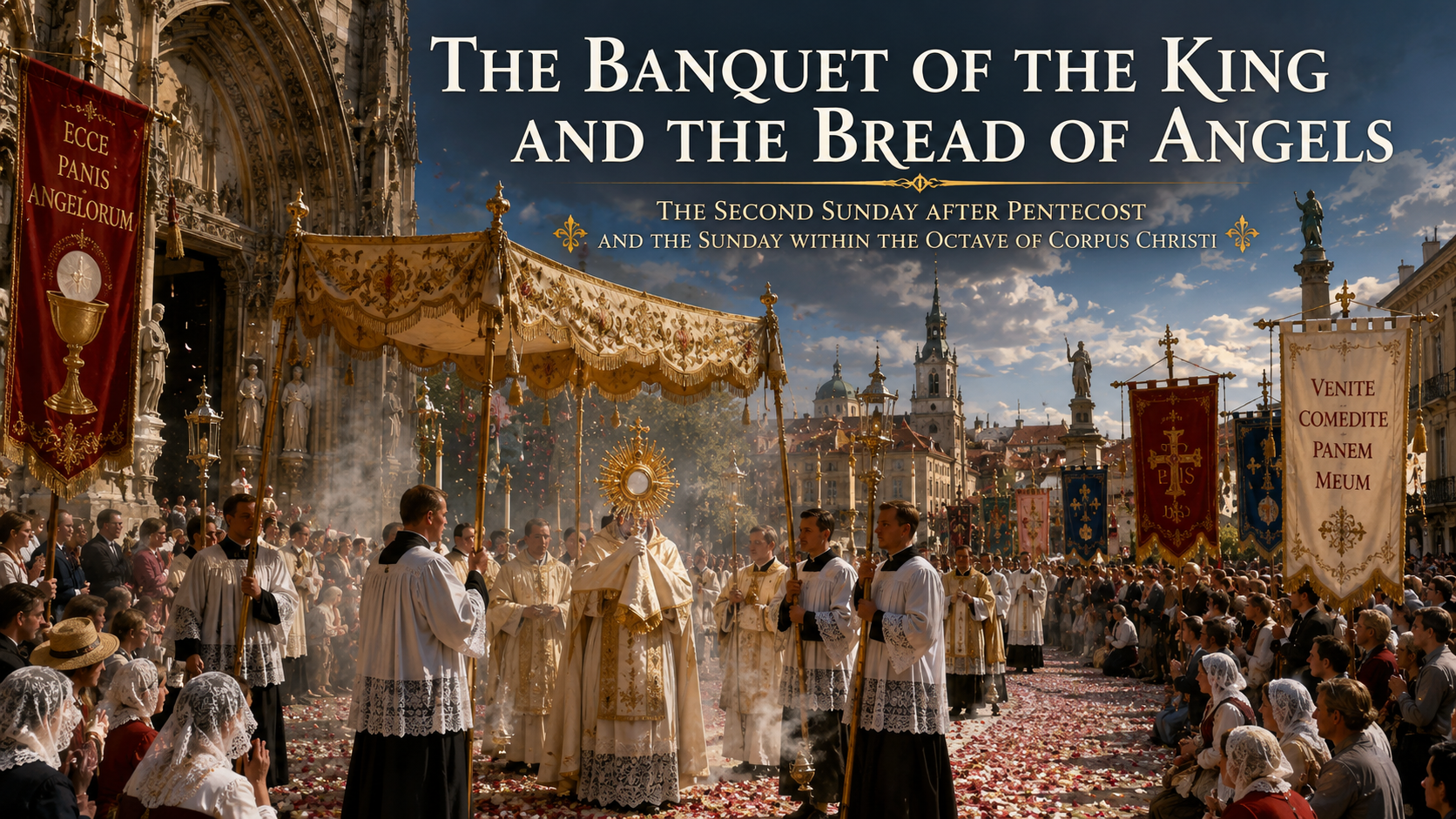
The Banquet of the King and the Bread of Angels: The Second Sunday after Pentecost and the Sunday Within the Octave of Corpus Christi
The traditional Roman liturgy presents a profound Eucharistic synthesis in the conjunction of the Second Sunday after Pentecost and the Sunday within the Octave of Corpus Christi. The invitation to the Great Supper proclaimed in the Gospel of St Luke reaches its fulfilment in the Eucharistic mystery celebrated throughout the Octave. Drawing upon the Fathers, scholastics, mystics, and great liturgical commentators, the Church reveals the drama of grace, the tragedy of refusal, and the inexhaustible riches of Christ’s sacramental presence.

The season after Pentecost has often been described as the season of the Church. The great mysteries that dominated the first half of the liturgical year have now unfolded before the faithful in their full splendour. Advent awakened expectation; Christmas revealed the Incarnate Word; Lent prepared the soul through penance and conversion; Easter proclaimed Christ’s triumph over sin and death; the Ascension directed the eyes of believers toward heaven; Pentecost manifested the descent of the Holy Ghost upon the Apostles; and Trinity Sunday crowned these mysteries with the revelation of the Triune God Himself. Having contemplated the mighty works of redemption, the Church now turns to the work of sanctification—the gradual transformation of souls through grace.
Yet it is striking that almost immediately after Trinity Sunday the Church interrupts the ordinary rhythm of the season to celebrate Corpus Christi and its octave. This interruption is deliberate and deeply theological. The Church knows that spiritual growth requires nourishment. The Christian life cannot be sustained by memories of past events, however glorious. The mysteries of Christ must remain present. Before sending her children into the long pilgrimage of the post-Pentecostal season, Holy Mother Church directs their gaze toward the Blessed Sacrament and reminds them that the Incarnate Lord who walked the roads of Galilee remains among His people still. Corpus Christi is therefore not merely another feast. It is the feast that gathers together and preserves the fruits of every preceding feast.¹
Dom Prosper Guéranger observed that Corpus Christi occupies a unique place within the liturgical year because it serves as the perpetual continuation of the mysteries already celebrated.² Christmas would become a historical remembrance were Christ not still present among His people. Calvary would recede into the distant past were its sacrifice not perpetually represented upon the altar. Pentecost itself would become merely an anniversary were the Holy Ghost not continually drawing souls into communion with Christ through the sacraments. Corpus Christi proclaims that the mysteries of salvation remain living realities. The Child of Bethlehem, the Victim of Calvary, the Victor of Easter, and the King of the Ascension are all present beneath the sacramental veils of bread and wine.
This reality forms the hidden foundation of the Gospel of the Second Sunday after Pentecost, one of the most penetrating and unsettling parables in Sacred Scripture. Our Lord describes a great man who prepares a magnificent supper and invites many guests. Yet when the appointed hour arrives, those invited begin to excuse themselves. One has purchased a field and wishes to inspect it. Another has acquired oxen and intends to prove them. A third has married and therefore cannot come. The master of the feast responds with righteous indignation and commands that the poor, the blind, the lame, and eventually all who can be found along the highways and hedges be brought in so that his house may be filled.³
The Fathers consistently interpreted this parable as a summary of salvation history. St Augustine sees in the banquet the entire economy of redemption unfolding through the ages.⁴ The master of the feast is God Himself. The servants are the prophets and Apostles. The invited guests represent first Israel and then all mankind. The banquet hall is the Church. Yet Augustine’s interpretation extends beyond history into sacramental theology. The supper is simultaneously the Eucharist and Heaven. The sacramental banquet of the altar anticipates and participates in the eternal banquet of the Kingdom. Thus every Mass becomes both remembrance and foretaste, participation and anticipation.
St Gregory the Great focuses his attention upon the excuses offered by the invited guests, and his observations possess an enduring relevance that transcends every age.⁵ The tragedy of the parable lies not in open rebellion but in polite refusal. None of the guests rejects the invitation because he hates the host. None openly mocks the feast. Their excuses concern legitimate concerns: property, labour, family life. The danger, Gregory teaches, lies not in these things themselves but in allowing them to assume a place that belongs to God alone. Souls are seldom lost through conscious hatred of heaven. More often they are lost because earthly concerns gradually crowd out eternal realities.
This insight may be more relevant now than at any previous period in history. The field and the oxen remain with us, though they have assumed different forms. They now appear as careers, mortgages, investments, entertainments, political causes, endless digital distractions, and the relentless pursuit of comfort and convenience. Modern civilisation suffers from a peculiar spiritual exhaustion. Never have men possessed so many means of communication, yet never have they seemed less capable of hearing the voice of God. Never have they enjoyed such abundance, yet never have they appeared so busy. The modern man does not generally reject Christ with hostility. More often he simply has no time for Him.
The bells still ring.
The tabernacle still waits.
The invitation remains open.
Yet countless souls find themselves occupied elsewhere.
This is why the Church places the Gospel of the Great Supper immediately before the Eucharistic mysteries of Corpus Christi. The invitation of the King finds its fulfilment in the Blessed Sacrament. When the Church hears the words, “Come, for now all things are ready,” she recognises in them the voice of Christ calling souls to the altar. The banquet is no metaphor. It exists. The table is prepared. The Bread of Heaven has been provided. The invitation continues to resound from every tabernacle in Christendom.
The Sunday within the Octave of Corpus Christi deepens this Eucharistic contemplation through the Gospel of the multiplication of the loaves and fishes from the sixth chapter of St John. The Church has always understood this miracle as far more than an act of compassion toward a hungry multitude. It is a sign, a prophecy, and a preparation. St Cyril of Alexandria teaches that Christ first satisfies bodily hunger in order to elevate the minds of His hearers toward spiritual nourishment.⁶ St John Chrysostom likewise observes that the miracle prepares the crowd for the greater revelation that follows immediately afterward in the Bread of Life discourse.⁷
The sequence is profoundly important. First comes bread. Then comes the Bread. First comes the sign. Then comes the reality. First comes the miracle. Then comes the sacrament.
The details of the miracle themselves reveal the abundance of divine grace. Five loaves feed thousands. Twelve baskets remain after all have eaten their fill. Christ provides not merely enough but more than enough. The Fathers repeatedly return to this theme because it reveals the inexhaustible generosity of God. Throughout history countless millions have approached the altar, and yet Christ remains wholly present to every communicant. As St Thomas Aquinas teaches, the faithful receive not a part of Christ but Christ entire.⁸ The sacrament may be divided in appearance, but the Lord remains undivided in reality.
No figure shaped the theology of Corpus Christi more profoundly than St Thomas Aquinas. When Pope Urban IV instituted the feast for the universal Church through the bull Transiturus de hoc mundo in 1264, he entrusted Aquinas with the composition of its liturgical texts.⁹ The result was one of the greatest achievements in Christian worship. The Lauda Sion, Pange Lingua, Sacris Solemniis, and Verbum Supernum together constitute a complete Eucharistic theology expressed through poetry and prayer. The Angelic Doctor presents the doctrine of the Real Presence, transubstantiation, Eucharistic sacrifice, and sacramental communion with a clarity that has never been surpassed. Yet what is perhaps most remarkable is his ability to unite theological precision with contemplative wonder. The Eucharist remains for Aquinas not merely a doctrine to be defended but a mystery to be adored.
The mystics carried this Eucharistic theology into the realm of lived experience. St Gertrude the Great speaks of Holy Communion as an encounter with the living Heart of Christ.¹⁰ St Mechtilde of Hackeborn describes the Eucharist as the furnace of divine charity through which Christ draws souls into the depths of His Sacred Heart.¹¹ St Catherine of Siena repeatedly returns to the image of the Precious Blood as the bridge that unites earth and heaven.¹² Centuries later, St Peter Julian Eymard would call the Eucharist “the life of the soul and the soul of the Christian life.”¹³ For all these saints, the Eucharist was not simply one devotion among many. It was the centre of reality itself.
The historical origins of Corpus Christi further illuminate its significance. The feast emerged during a period when Eucharistic faith faced renewed challenges. The controversies associated with Berengar of Tours had exposed how vulnerable Christian belief could become when separated from Eucharistic devotion.¹⁴ Providence responded through both doctrine and sanctity. The visions of St Juliana of Liège inspired a movement that eventually culminated in the universal institution of the feast. Significantly, the Church’s response to doubt was not merely to condemn error. She intensified worship. She increased adoration. She clothed the mystery with splendour. The answer to unbelief was not less devotion but more.
This principle remains urgently relevant. Contemporary Catholicism faces a Eucharistic crisis of extraordinary proportions. Numerous surveys conducted in recent decades suggest widespread confusion concerning the doctrine of the Real Presence among those who identify as Catholic.¹⁵ Eucharistic adoration remains uncommon in many places. Benediction has largely disappeared from ordinary parish life. Processions that once drew entire cities into the streets are often attended only by a faithful remnant. The irony is painful. Never has the Church spoken more frequently about participation, and yet many have forgotten the One in whom they are called to participate.
The great Corpus Christi processions of Christendom were never merely devotional exercises. They were public acts of theology. When clergy carried the Blessed Sacrament beneath a canopy through flower-strewn streets, they proclaimed visibly what the Church professed invisibly. Christ is King—not merely of private consciences but of societies; not merely of churches but of nations; not merely of heaven but of earth. Long before Pope Pius XI articulated the doctrine of the Social Kingship of Christ in Quas Primas, Catholic civilisation proclaimed it annually through Corpus Christi processions.¹⁶ Entire communities accompanied their King through the streets.
The contrast between that world and our own is impossible to ignore. Medieval cities emptied themselves into the streets at the approach of the Blessed Sacrament. Today many cities scarcely notice Him. The bells still ring, but fewer hear them. The tabernacle remains occupied, but fewer visit it. The procession still passes, but many no longer recognise the significance of what is carried before them. The deepest crisis of modern Catholicism may ultimately be a crisis of memory. We have not formally denied the Real Presence. We have simply forgotten it.
Corpus Christi exists precisely to cure that forgetfulness.
The Church therefore lingers over this feast through an octave because one day is insufficient. The mystery is too vast to be exhausted in a single celebration. Christmas receives an octave because the Incarnation transformed history. Easter receives an octave because the Resurrection transformed creation. Corpus Christi receives an octave because the Eucharist perpetuates both. Every tabernacle is a continuation of Bethlehem. Every altar is an extension of Calvary. Every worthy Communion is a participation in the life of Heaven itself.
Ultimately, the liturgies of the Second Sunday after Pentecost and the Sunday within the Octave of Corpus Christi converge upon a single question. Will we accept the invitation? The banquet has been prepared. The Bread of Angels has descended from Heaven. The King waits for His guests. The saints accepted the invitation and found in Christ the fulfilment of every desire. The tragedy of the invited guests in the Gospel was not that they hated the King. It was that they considered other things more urgent. The challenge posed by the liturgy remains exactly the same today. Amid all the noise, distractions, ambitions, anxieties, and preoccupations of modern life, Christ continues to speak from every altar and every tabernacle:
“Come, for now all things are ready.”
- Prosper Guéranger, The Liturgical Year: Corpus Christi and the Sacred Heart (Fitzwilliam, NH: Loreto Publications, repr. ed.), 1–32.
- Ibid.
- Luke 14:16–24 (Douay-Rheims).
- Augustine, Sermon 112, in Nicene and Post-Nicene Fathers, First Series, vol. VI, ed. Philip Schaff (Peabody, MA: Hendrickson, 1994).
- Gregory the Great, Forty Gospel Homilies, Homily 36, trans. David Hurst (Kalamazoo, MI: Cistercian Publications, 1990).
- Cyril of Alexandria, Commentary on the Gospel of John, Book IV.
- John Chrysostom, Homilies on the Gospel of John, Homily 42.
- Thomas Aquinas, Summa Theologiae, III, q. 76, a. 3.
- Pope Urban IV, Transiturus de hoc mundo (11 August 1264).
- Gertrude the Great, The Herald of Divine Love, Book III.
- Mechtilde of Hackeborn, The Book of Special Grace, Part I.
- Catherine of Siena, The Dialogue, Treatise on Divine Providence.
- Peter Julian Eymard, The Real Presence (New York: Society of St Paul, 2000), 21.
- G. R. Evans, The Thought of Berengar of Tours (Cambridge: Cambridge University Press, 1970), 118–142.
- United States Conference of Catholic Bishops, National Eucharistic Revival materials discussing contemporary survey data concerning belief in the Real Presence.
- Pope Pius XI, Quas Primas (11 December 1925), §§17–19.
related articles


Latest articles
- Anglican Orders II: Saepius Officio — Anglicanism’s Strongest Reply to Apostolicae CuraeIn 1897, the Archbishops of Canterbury and York defended Anglican Orders against Leo XIII’s Apostolicae Curae through Saepius Officio. While it challenges Leo’s arguments on sacramental theology and order validity, it acknowledges significant theological alterations in the Edwardine rites, questioning the continuity of sacrificial meaning in priesthood and Eucharist within Anglicanism.
- Today’s homily: Sunday XVI Post PentecostThe sermon focuses on the themes of humility and pride as depicted in the Gospel. It contrasts the visible illness of a man with dropsy and the invisible pride of his companions. Highlighting Christ’s teachings, it emphasises the necessity of recognising one’s dependence on God’s grace, advocating that true Christian humility leads to spiritual healing and lasting fulfilment.
- Today’s Mass: September 13 Sunday XVI Post PentecostThe Sixteenth Sunday After Pentecost celebrates the importance of humility and the grace of God, emphasised in the Gospel through Jesus’ healing and teachings. As believers are called to seek God’s mercy, the commemoration of the Blessed Virgin Mary’s Nativity highlights the beginning of salvation and the pursuit of good works through divine grace.
- Sermon for Sixteenth Sunday after PentecostIn the epistle to the Ephesians, St. Paul encourages believers to remain steadfast amid trials, highlighting the significance of humility and unity in Christ. He contrasts worldly values of pride with the Kingdom’s values, emphasising that true fulfilment comes from reliance on God’s grace and prioritising love for God and neighbour.
- The Line Held Again: UK Parliament Rejects Assissted Suicide Bill – and Reverses Its Own VerdictThe House of Commons has rejected the Terminally Ill Adults (End of Life) Bill, marking a significant parliamentary reversal in views on assisted suicide, shifting from a 55-vote majority for to a 16-vote majority against in less than two years. Concerns over safeguards and support for vulnerable patients informed this decision.



Leave a Reply