
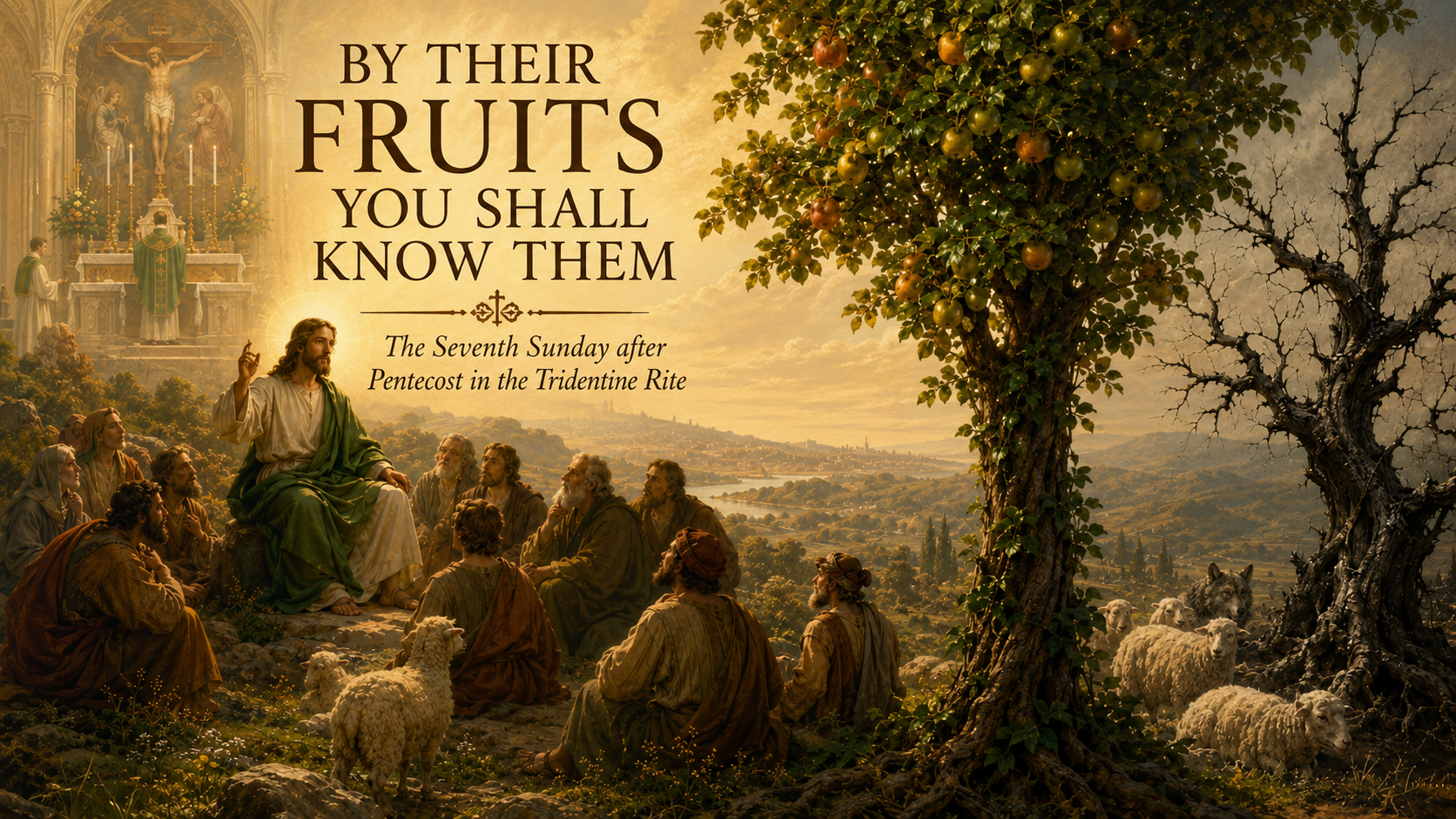
By Their Fruits You Shall Know Them: The Seventh Sunday after Pentecost and the Catholic Measure of Truth
The Seventh Sunday after Pentecost places doctrine, conduct and devotion beneath the judgement of Christ. The Roman liturgy teaches that grace must become sanctification, faith must issue in obedience, and every teacher—and every Christian soul—must finally be known by the fruit produced.
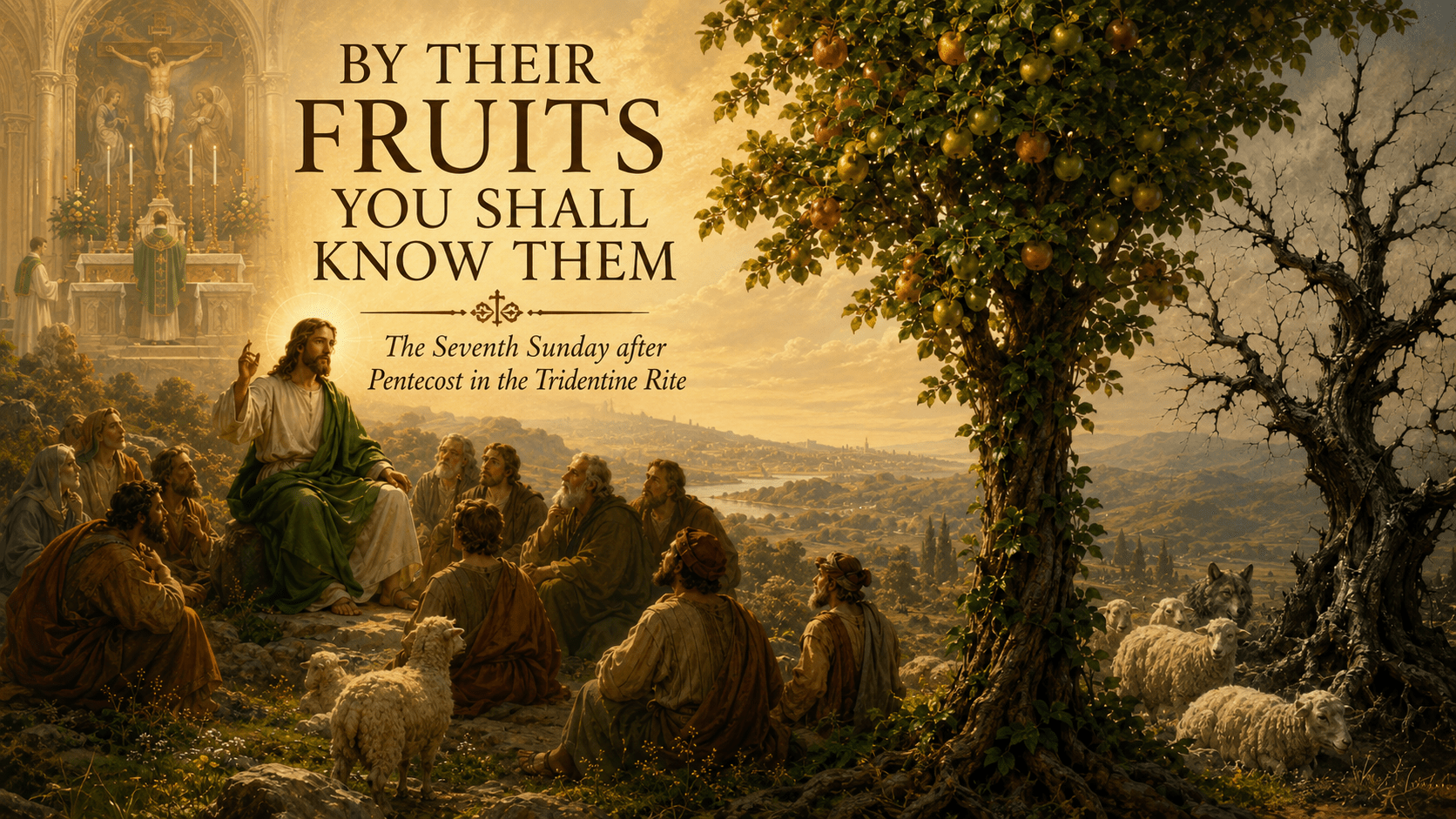
The Time after Pentecost is the season of Christian maturity. The mysteries of redemption have been accomplished: Christ has died, risen and ascended; the Holy Ghost has descended; the Church has been equipped for her pilgrimage through history. The liturgy now turns from the proclamation of these mysteries to their development within the life of the baptised. What Easter bestowed sacramentally must become visible morally. What Pentecost infused must ripen into holiness.
Dom Pius Parsch observes that the Seventh Sunday begins a sequence in which the Roman liturgy draws an increasingly sharp contrast between the kingdom of God and the kingdom of the world, the faithful Christian and the unfaithful Christian. The renunciation once pronounced at the baptismal font—of Satan, his works and his pomps—must now be made effective in conduct. Baptism has transferred the Christian’s allegiance; the Sundays that follow ask whether his life corresponds to that transfer.¹
This is why the Mass Omnes gentes is constructed around the image of fruit. The Epistle speaks of the fruit of sin and the fruit of sanctification. The Gospel distinguishes the good tree from the evil tree. The Offertory presents the interior sacrifice of the faithful. The Secret unites their offerings to the one perfect Sacrifice. The Postcommunion asks that the Eucharistic medicine may free them from perversity and lead them to righteousness. The whole Mass concerns the passage from profession to reality, from grace received to grace made fruitful.
The Kingship of God and the Judgement of Providence
The Introit opens in triumph:
“O clap your hands, all ye nations: shout unto God with the voice of joy. For the Lord is most high, He is terrible: He is a great King over all the earth.”
The acclamation is universal. All nations are summoned to acknowledge the dominion of God. The Church is not one religious association among others, offering a private consolation to those disposed to receive it. Her Gospel announces a King whose jurisdiction extends over every nation, society, ruler, family, conscience and soul. The joy of the Introit is the joy of subjects who recognise that the world does not belong ultimately to violence, appetite, fashion or falsehood, but to God.
Yet the Collect immediately tempers this triumph with an appeal for discernment:
“O God, whose providence faileth not in its designs, we humbly entreat Thee: to put away from us all hurtful things, and to give us all things which be profitable for us.”²
This prayer supplies the governing principle of the Sunday. Fallen man does not reliably know what will profit him. He is inclined to call profitable whatever gratifies his passions, confirms his opinions or protects him from sacrifice. He calls harmful whatever contradicts, disciplines, humiliates or purifies him. The Church therefore does not ask God simply to grant what appears desirable. She asks Him to remove what is truly harmful and bestow what is truly conducive to salvation.
That distinction is indispensable when false prophets appear. Their attraction frequently consists in reversing the judgement of Providence. They represent the divine commandments as harmful and emancipation from them as profitable. They describe restraint as oppression, penance as pathology, obedience as servility, dogma as narrowness and indulgence as compassion. Before teaching her children to recognise such prophets, the Church teaches them to distrust their own disordered estimation of good and evil.
The Collect also prevents a merely worldly interpretation of “fruits”. Success, popularity, influence, wealth and institutional permanence may be providential goods, but none is an infallible mark of divine approval. Failure, opposition, poverty and persecution may be temporal evils, but none necessarily proves divine rejection. The fruit must be judged according to God’s purpose for man: truth, holiness and eternal life.
Two Servitudes and Two Harvests
The Epistle, Romans 6:19–23, continues the baptismal doctrine proclaimed on the previous Sunday. St Paul does not ask whether man shall serve. He declares that man will serve either sin or God:
“As you have yielded your members to serve uncleanness and iniquity unto iniquity, so now yield your members to serve justice unto sanctification.”
The Apostle speaks “a human thing” because of the infirmity of his hearers. He employs the familiar image of slavery to express a supernatural reality. Sin does not liberate. It establishes dominion. A sinful act strengthens the disposition from which it proceeds; indulgence produces habit, habit produces bondage, and bondage tends towards death. Hence St Paul speaks of “iniquity unto iniquity”. Sin is not static. It generates further sin and progressively subjects the faculties of man to its rule.
Dom Prosper Guéranger reads the Epistle in direct continuity with Baptism. The old man has been crucified with Christ and sacramentally buried beneath the baptismal waters. The tyrant’s legal claim has been broken. Concupiscence remains, but it no longer possesses an uncontested sovereignty. The baptised man has been delivered from an inherited slavery and given the grace by which he can resist the attempt of sin to reconstitute its former dominion.³
Christian freedom, therefore, is not freedom from the service of God; it is freedom for that service. Man is released from a master who degrades him and placed beneath a Master whose service perfects him. Sin uses the powers of the body and soul against the nature and end for which they were created. Grace restores those powers to their proper order. The eyes, tongue, imagination, appetites, intellect and will that once served uncleanness are to be consecrated to justice.
The Apostle commands an equality of earnestness: “as you have yielded” yourselves to sin, “so now yield” yourselves to justice. Father Leonard Goffine presses the point with pastoral severity. Many men, he remarks, would become holy if they laboured as diligently for heaven as they once laboured for sin. The sinner accepts fatigue, expense, danger, secrecy and humiliation to obtain a passing gratification; yet, after conversion, he imagines that salvation should cost no effort. St Paul demands that the energy formerly expended in self-destruction be redirected towards sanctification.⁴
The two servitudes are known by their fruits:
“What fruit therefore had you then in those things, of which you are now ashamed? For the end of them is death. But now being made free from sin, and become servants to God, you have your fruit unto sanctification, and the end life everlasting.”
Sin offers an immediate appearance of fruit but leaves shame behind it. Grace often demands immediate sacrifice but yields sanctification. The contrast reaches its summit in the final verse: “For the wages of sin is death. But the grace of God, life everlasting, in Christ Jesus our Lord.”
St John Chrysostom draws attention to St Paul’s deliberate inequality of language. Death is called the wage of sin because it is earned according to the strict logic of sin. Eternal life, however, is called the grace or gift of God. The Apostle does not say that eternal life is simply the wage of unaided human virtue. Liberation, justification and the supernatural capacity to perform meritorious works are themselves gifts bestowed through Christ.⁵
This does not abolish Catholic teaching concerning merit; it establishes its foundation. St Thomas Aquinas explains that man without grace cannot merit eternal life, because no purely natural act possesses proportion to a supernatural end. The justified man, however, acting in charity under the motion of grace, truly merits because God has freely ordained to crown His own gifts within him. Eternal life remains grace from beginning to end, yet the works produced through that grace are genuinely the works of the renewed man and are rewarded by God according to His promise. The Council of Trent would express the same doctrine: Christ continually communicates His power to the justified, and the goodness of God is such that He wills His gifts in them to become their merits.⁶
The Epistle therefore excludes both presumption and naturalism. It excludes the presumption that Baptism, orthodoxy or religious profession will save a man whose members remain habitually surrendered to iniquity. It excludes the naturalism which imagines that sanctity is the unaided achievement of moral determination. The Christian must yield himself; yet the life by which he yields, the charity which gives supernatural value to his acts, and the everlasting end towards which they tend are gifts of grace in Jesus Christ.
“Come, Children, Hearken to Me”
The Gradual introduces the Gospel with the words of Psalm 33:
“Come, children, hearken to me: I will teach you the fear of the Lord. Come ye to Him and be enlightened: and your faces shall not be confounded.”
Before the Church warns her children against false teachers, she identifies the disposition necessary to receive true teaching: spiritual childhood, docility and the fear of the Lord. Discernment does not begin in suspicion, intellectual vanity or delight in controversy. It begins in a willingness to be taught by God.
The fear of the Lord enlightens because it removes the chief cause of spiritual blindness: the determination to preserve one’s sins. A man who has already decided what he will believe, because he has already decided how he wishes to live, cannot judge prophets rightly. He will prefer the teacher who sanctifies his preferences. The child who approaches God to be instructed may be enlightened; the ideologue who approaches revelation to revise it will remain in darkness.
The Alleluia then returns to the words of the Introit: “O clap your hands, all ye nations: shout unto God with the voice of joy.” The liturgy has moved from the universal Kingship of God, through the fear of the Lord, back to joy. Christian fear is not servile terror. It is the reverence that restores the creature to truth and therefore makes authentic joy possible. The soul rejoices because it no longer needs to invent its own good, its own truth or its own end.
Wolves upon the Narrow Way
The Gospel, Matthew 7:15–21, belongs to the conclusion of the Sermon on the Mount. Immediately before it, Our Lord has spoken of the narrow gate and strait way leading to life. The warning against false prophets is therefore not detached from what precedes it. The false prophet appears beside the narrow way precisely in order to divert souls from it:
“Beware of false prophets, who come to you in the clothing of sheep, but inwardly they are ravening wolves.”
St John Chrysostom regards these disguised enemies as more dangerous than open adversaries. Open hostility declares itself; the wolf in sheep’s clothing approaches under an appearance of safety. Our Lord therefore commands not panic but exact vigilance. Falsehood habitually imitates something true, and vice disguises itself beneath the outward form of virtue.⁷
The Christian must resist two opposite errors. The first is credulity: the assumption that anyone employing Christian words, vesture, gestures or sentiments must therefore be a safe guide. The second is cynicism: the rejection of the sheep’s clothing itself because wolves sometimes steal it. Prayer does not become hypocrisy because hypocrites pray. Fasting does not become theatre because vain men fast. Ecclesiastical office, learning, austerity and zeal do not become contemptible because they can be counterfeited.
St Augustine insists that the clothing must not be mistaken for the fruit. Exterior practices capable of proceeding from either a good or an evil intention do not by themselves disclose the heart. He also warns against presuming to judge matters morally indifferent as though they were manifest sins. God alone sees the secret intention; man may judge what is objectively contrary to the divine law and what a doctrine consistently produces, but he may not claim divine knowledge of every hidden motive.⁸
This distinction prevents “by their fruits” from becoming a warrant for reckless suspicion. The command concerns genuine moral and doctrinal fruit, not personal distaste, rumour, temperament or factional allegiance. Discernment must itself be just.
St Thomas Aquinas, in his Paris sermon Attendite, analyses the sheep’s clothing with scholastic precision. False prophets may assume the exterior garments of worship, justice, penitence and innocence. Their worship gives them the appearance of devotion; their public works the appearance of mercy; their austerity the appearance of mortification; their manner the appearance of purity. If these exterior works truly proceeded from interior justice, they would not be wolves. The deception consists in possessing the appearance without the inward reality.⁹
Aquinas further distinguishes the shepherd, the hireling, the thief and the wolf. The shepherd seeks the good of the flock. The hireling principally seeks his own advantage. The thief appropriates what does not belong to him. The wolf seeks the destruction and dispersal of the sheep. This prevents every weakness or mixed motive in a pastor from being labelled formal wolfishness, but it also identifies the decisive test: what is being done to souls?
The wolf seizes, scatters, refuses mercy and persists in destruction. He may acquire adherents, but he does not gather them into Christ. He binds them to error, personality or faction. He may speak incessantly of compassion while leaving men enslaved to the sins from which Christ came to deliver them. He may speak of freedom while separating them from the truth that alone makes free.
Aquinas also insists that the true intention of the teacher is the welfare of the people: their edification in devotion, readiness for good works and consolation in adversity. The ecclesiastical teacher who makes temporal gain, applause or personal ascendancy the object of his ministry adulterates the word entrusted to him. He treats the Bridegroom’s gifts as instruments for attracting the Bride to himself.
Doctrine Is Also a Fruit
Cornelius a Lapide observes that “prophet” in this passage means not only one who foretells future events but also a doctor or teacher. The principal fruit of a teacher, considered precisely as a teacher, is his doctrine. False doctrine may be concealed beneath appeals to liberty, selective quotations from Scripture, promises of reform, affected simplicity, moral indignation or eloquent professions of gentleness.¹⁰
The immediate context is again decisive. The false prophet makes the narrow way appear unnecessarily narrow. He promises Christianity without mortification, discipleship without the Cross, mercy without repentance, grace without obedience and heaven without sanctification. He does not always deny the words of Christ openly. More commonly, he rearranges their meaning so that the demands of Christ disappear while Christian language remains.
The fruit of doctrine is not measured merely by immediate emotional effects. A teaching is not vindicated because it reassures, includes, attracts or pacifies. Neither is it condemned simply because it disturbs, divides or provokes opposition. Our Lord’s own doctrine divided hearers, exposed consciences and caused many disciples to depart. The martyrs did not preserve social tranquillity. The good fruit of doctrine is its conformity to revelation and its power, under grace, to produce faith, repentance, charity, purity, justice and perseverance.
Nor may the personal sins of Catholics be used to refute Catholic doctrine unless those sins are the consequence of obeying it. The corrupt fruit of adultery does not proceed from the Church’s teaching on marriage but from its rejection. Cruelty does not proceed from the commandment of charity but from disobedience to it. The doctrine must be judged by what it commands and by what it produces when faithfully lived.
Conversely, a teacher’s occasional statement of truth does not vindicate the system of error within which he places it. Poison need not consist entirely of poison. Its danger often depends upon its mixture with what is nourishing. A false prophet must use enough truth to appear as a prophet at all.
The Judgement Turns upon the Hearer
It is easy to hear this Gospel as a warning about other men. Yet Our Lord turns abruptly from false prophets to false disciples:
“Not every one that saith to Me, Lord, Lord, shall enter into the kingdom of heaven: but he that doth the will of My Father Who is in heaven.”
The condemned man is not an atheist. He speaks the name of Christ. He may speak it repeatedly and fervently: “Lord, Lord.” His failure lies not in religious language but in the refusal to conform his will to the Father.
The Gospel therefore places the teacher and the hearer beneath the same test. A man may correctly expose every false prophet and remain himself a barren tree. He may possess exact doctrine, defend the traditional liturgy, denounce every modern error and yet refuse the will of God in his duties, appetites, speech, finances, relationships or interior life. Catholic truth cannot be reduced to a weapon for judging others. It is first the rule according to which the man who professes it will himself be judged.
Goffine accordingly defines good works not as any activity carrying a benevolent appearance, but as actions performed according to the will of God, in the state of grace and for the love of God. The three traditional forms—prayer, fasting and almsgiving—represent the worship of God, the mortification of self and charity towards one’s neighbour. The good tree is not merely harmless. It bears fruit. The servant who buried the talent was condemned not for wasting it upon evil but for failing to use it for good.¹¹
Christian mediocrity frequently rests upon the defence that one has done nothing gravely wrong. The Gospel asks instead what good fruit has been produced. Where is the growth in prayer, purity, patience, courage, mercy and truth? What passion has been brought under obedience? What duty is now performed more faithfully? What sacrifice has charity made possible? What has the grace of Baptism, Confession and Holy Communion actually changed?
The Tree in the Vineyard
Father Gabriel of St Mary Magdalen develops the mystical meaning of the Sunday through the image of the Christian as a tree planted by Christ in the garden of the Church. It has been watered by grace, pruned through trials, healed through the Passion and nourished by the Precious Blood. Christ may ask of it, in the words of Isaias, what more He could have done for His vineyard.¹²
This removes every excuse for sterility. The Christian is not commanded to manufacture supernatural life from within himself. He has been grafted into Christ. Yet the very abundance of divine assistance establishes the seriousness of his obligation to bear fruit. The sacraments are not decorations hung upon a dead tree; they communicate the life by which the tree may become fruitful.
Father Gabriel invokes the teaching of St Catherine of Siena: fallen man was a tree of death, but God grafted divine life into him. The image preserves the whole Catholic doctrine of sanctification. The graft is gratuitous; man did not create the divine life communicated to him. Yet he must remain united to it, permit it to transform him and cooperate in producing its fruit. God created man without his assistance, but He does not sanctify him as though he possessed neither intellect nor will.
Mystical union is therefore not a flight from moral obedience. The higher the claimed contemplation, the more searching the test of fruit. Authentic union with God produces conformity to His will. Extraordinary impressions, consolations, visions, eloquence or influence cannot compensate for the absence of humility, obedience, purity and charity. The mystic and the ordinary Christian are judged by the same words: “he that doth the will of My Father.”
The Sacrifice within the Furnace
The Offertory is taken from the prayer of Azarias amid the Babylonian furnace:
“As in holocausts of rams and bullocks, and as in thousands of fat lambs; so let our sacrifice be made in Thy sight this day, that it may please Thee.”
The Temple sacrifice was unavailable. The faithful servants of God were captives in a foreign land, stripped of the ordinary means by which Israel offered worship. They therefore offered themselves: a contrite heart, a humbled spirit and fidelity amid the fire.
The position of this text after the Gospel is profoundly significant. Having heard that words alone will not enter the kingdom of heaven, the faithful place themselves upon the altar. The fruit demanded by Christ is sacrificial. To do the Father’s will requires the surrender of those things within us that resist Him. The body once yielded to iniquity must now become an offering of justice.
The Secret makes explicit what the Offertory anticipates:
“O God, Who hast justified the variety of sacrifices of the Law by the perfection of this one Sacrifice: accept the Sacrifice of Thy servants who are dedicated to Thee, and sanctify it with a blessing like to that which Thou didst bestow upon the gifts of Abel.”
The many sacrifices of the Old Law find their perfection in the one Sacrifice of Christ. The Christian does not produce good fruit independently of Calvary. His obedience becomes acceptable only in union with the obedience of the Son; his sacrifice enters the Father’s sight because it is taken into the perfect oblation of Christ.
The reference to Abel recalls the first division between acceptable and unacceptable worship. Cain and Abel both presented offerings, but God regarded Abel and his gifts. The difference lay not in religious activity considered abstractly, but in the worshipper and the sacrifice he offered. The Sunday’s warning reaches even to the altar: not every offering, merely because it is religious, is therefore fruitful. True worship requires faith, justice and self-oblation.
The Medicine of Immortality
The Communion antiphon is a cry of need:
“Bow down Thine ear, make haste to deliver me.”
After all the warnings concerning servitude, false prophets, evil trees and judgement, the communicant does not claim self-sufficiency. He asks to be delivered. The Eucharist is the food of those who know that perseverance exceeds their natural strength.
The Postcommunion supplies the final interpretation of the Mass:
“May Thy healing work, O Lord, both mercifully free us from our perversities, and lead us to those things which are right.”¹³
The sacred mysteries are medicinal. They do not merely reassure man while leaving his disorder intact. They liberate him from perversity and conduct him towards righteousness. The Eucharist is not divine approval of whatever the communicant presently is. It is Christ working within him to destroy the fruit of death and produce the fruit of sanctification.
The sequence of the Mass is now complete. The King summons all nations. Providence distinguishes what is truly harmful from what truly profits. Baptism frees man from the tyranny of sin. Grace commands his members in the service of justice. The fear of the Lord makes him teachable. Christ warns him against teachers who counterfeit holiness and broaden the narrow way. The Gospel turns the judgement upon his own barren profession. The Offertory places him sacrificially within the furnace. The Eucharist heals his perversity and leads him into righteousness.
The Seventh Sunday after Pentecost thus provides the Catholic measure of truth. A prophet is tested by his doctrine and by what that doctrine produces. A Christian is tested by whether grace has become obedience. A devotion is tested by whether it conforms the will to God. A liturgy is fruitful when it carries the worshipper into the Sacrifice of Christ and returns him to the world more firmly resolved to do the Father’s will.
“By their fruits you shall know them” is not merely an instrument for exposing wolves. It is the sentence beneath which every tree in the vineyard stands. At the judgement, clothing will not suffice, slogans will not suffice, office will not suffice, knowledge will not suffice, nor will the repeated cry of “Lord, Lord”. The question will be what the life of Christ, so abundantly communicated through His Church, was permitted to produce within us.
- Pius Parsch, The Church’s Year of Grace, vol. 4, trans. William G. Heidt (Collegeville, MN: Liturgical Press, 1953), Seventh Sunday after Pentecost.
- Missale Romanum, Dominica VII post Pentecosten, Introit and Collect.
- Prosper Guéranger, The Liturgical Year, Time after Pentecost, Seventh Sunday after Pentecost.
- Leonard Goffine, The Church’s Year, “Instruction on the Seventh Sunday after Pentecost.”
- John Chrysostom, Homilies on the Epistle to the Romans, Homily XII, Romans 6:22–23.
- Thomas Aquinas, Summa Theologiae, I–II, q. 114, aa. 2–3; Council of Trent, Session VI, Decree on Justification, ch. 16 and can. 26.
- John Chrysostom, Homilies on the Gospel of Matthew, Homily XXIII, Matthew 7:15–20.
- Augustine, De Sermone Domini in Monte, bk. II, chs. 24–25.
- Thomas Aquinas, Attendite: Sermo de falsis prophetis, Paris, 26 July 1271.
- Cornelius a Lapide, The Great Commentary, commentary on Matthew 7:15–20.
- Goffine, The Church’s Year, “Instruction on Good Works.”
- Gabriel of St Mary Magdalen, OCD, Divine Intimacy: Meditations on the Interior Life for Every Day of the Liturgical Year, “The Fruits of Life”; Catherine of Siena, prayer cited therein.
- Missale Romanum, Dominica VII post Pentecosten, Gradual, Alleluia, Offertory, Secret, Communion and Postcommunion.
related articles


Latest articles
- Today’s Mass: October 18 St Luke the Evangelist; Commemoration of Sunday XXI Post PentecostSaint Luke was born a Greek and a Gentile in Antioch, Syria. He was a physician and it is believed that he may have also been a slave, as it was not uncommon in his day for slaves to be educated in medicine so the family would have a resident physician.
- “ONLY LUKE IS WITH ME”: THE EVANGELIST OF MERCY AND APOSTOLIC FIDELITYThe feast of St Luke, celebrated on 18 October, honours the beloved physician and Evangelist whose writings convey crucial Christian truths. He emphasises the vital link between divine mercy, repentance, and sacrifice. As St Paul’s companion, Luke’s narrative preserves the essence of the Gospel, reminding the Church to uphold and transmit revelation faithfully.
- Today’s Mass: October 17 St Gall, Confessor;Saint Gall, born in Ireland in the sixth century, became a notable confessor after accompanying Saint Columban to France and later Switzerland, where he preached and converted idolaters. Despite his significant contributions, he humbly declined the position of bishop of Constance. He died in 646, leaving a lasting legacy.
- 18.10.26 Nuntiatoria CXXVIII: NON POTEST VERITAS SUBDI POTESTATIThis editorial asserts that truth should not be subjugated to authority, emphasising that legitimate power derives from truth rather than mandates it. It critiques contemporary tendencies in both ecclesiastical and societal contexts where authority prioritises institutional credibility over accountability. Ultimately, it calls for a return to truth as the foundation of authority, urging faithful adherence to moral principles.
- ORDO w/c 18.10.26The liturgical calendar from 18 to 25 October 2026 includes the feast of St Luke the Evangelist, commemorating essential themes of forgiveness and evangelisation. Subsequent days honour St Peter of Alcantara, St John Cantius, St Ursula and St Raphael, culminating in the celebration of Christ the King, affirming His universal sovereignty over all creation.




Leave a Reply