
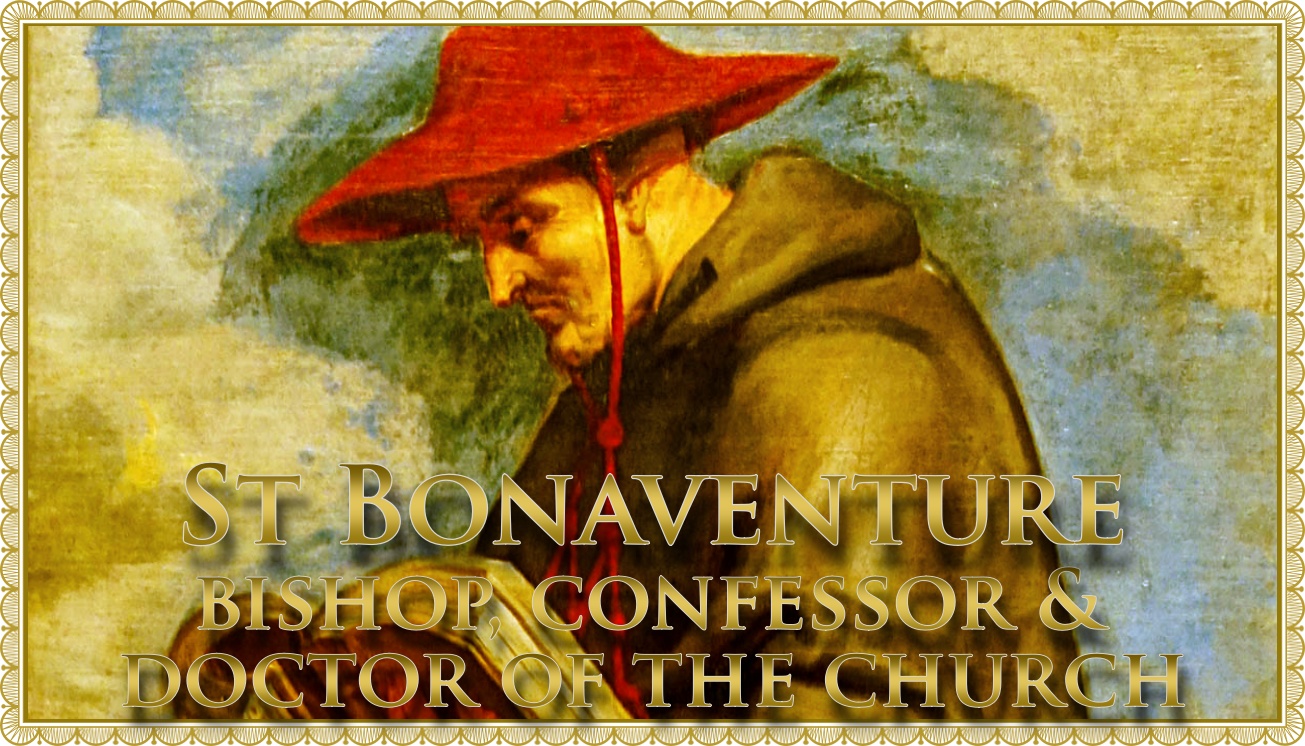
St. Bonaventure
Today we celebrate the feast of St. Bonaventure. He was a Franciscan who studied at the University of Paris under Alexander of Hales, and rose to become Minister General of the Franciscan order, as well as being a great scholastic theologian. He died during the attempt to reconcile the Western and Eastern Church at the Council of Lyons in 1274, and was commended on both sides for his learning and piety.
St. Bonaventure is sometimes referred to as the second founder of the Franciscan order, in that he sought to reconcile the particular vocation of the Franciscan order with the world of learning and scholarship. St. Francis of Assisi had modelled his life and work and that of his order on the first followers of Jesus, who went out without purse and scrip among the villages and towns of Galilee preaching the Gospel and healing the sick. He emphasised a practical application of Christianity that repudiated the world of books and learning, as it repudiated all other earthly possessions. St. Bonaventure sought to perpetuate the same Franciscan life of poverty and simplicity, but he sought to take it into the world of learning and scholarship in the universities (which is why he is sometimes referred to as the second founder of the Franciscan order). Some saw this as a betrayal of the distinctive Franciscan vocation since St. Francis himself had repudiated books and learning. Bonaventure argued in response that the friars could participate in the world of scholarship and learning so long as they did not own the books that they were using for their studies. Thus, it came about that the Franciscan friars, along with their Dominican counterparts, came to dominate the medieval universities. They did so not by abandoning their original vocation, but applying it in a new context.
In today’s Epistle St. Paul exhorts Timothy to hold fast to the faith he had been taught and to preach the Gospel in season and out of season. This did not mean that it could not be applied in new contexts, so long as the faith once delivered to the saints continued to be taught and upheld. In like manner, St. Bonaventure sought to apply the vocation of the Franciscan friars in a new context, that of the university, but he did so not by abandoning the Franciscan vocation, but by applying it in a new context.
The life of St. Bonaventure has close parallels with that of his contemporary, St. Thomas Aquinas. Both were born in Italy and later taught at the University of Paris. They died in the same year, 1274. St. Bonaventure is known as the seraphic doctor, whereas St. Thomas is known as the angelic doctor. Although they were both great scholastic theologians their approaches were actually very different. St. Thomas sought to appropriate the writings of Aristotle for Christian use in a way that had never been done previously. Though he did not in any way deny the fundamentally supernatural character of the Christian faith he sought also to do justice to the natural order and the conviction of Aristotle that sense experience was the path to knowledge. Hence, there was a place for the study of philosophy as a discipline as well as theology. By contrast, St. Bonaventure stood firmly in the Platonic tradition of St. Augustine. He did not believe that sense experience was the path to knowledge, but rather that all knowledge required the divine illumination of the human mind. Hence, philosophy was not an autonomous discipline and placing too much emphasis on the natural order in the way that Aristotle had done would lead people to neglect the fundamental principles of theology.
It is important to emphasise this difference today as it is often supposed that scholasticism involved the imposition of an alien rationalism into the Christian faith. It is said that the failing of scholasticism was that it came to view theology as an academic discipline and consequently had a tendency to separate theology from the life and liturgy of the Church. While this criticism can legitimately be made of some scholastic theologians it was certainly not true of others such as St. Bonaventure. He remained first and foremost a mystical theologian. He stood firmly in the tradition of Hugh of St. Victor and St. Bernard of Clairvaux in emphasising that all theology began and ended in prayer and contemplation rather than academic and philosophical speculation.
Perhaps his most famous treatise was on the Ascent of the Mind to God and it is worth quoting from this to gain an insight into St. Bonaventure’s mystical approach to theology. He invited the reader to “the groaning of prayer through the crucified Christ through whose blood we are purged of the uncleanness of sins; and I invite him first to prayer lest perchance he believe that it is enough for him to have reading without holiness, speculation without devotion, investigation without admiration, circumspection without exaltation, industry without piety, knowledge without charity, understanding without humility, study without divine grace, a mirror without divinely inspired wisdom… with the contention that the mirror that is offered to us from the outside means little or nothing unless the mirror of our mind has been cleansed and polished.
But since to this end nature avails nothing and industry very little, very little should be granted to enquiry and much to devotion, little to outward speech and much to interior joy, little to the spoken and written word and the whole to the gift of God, that is, to the Holy Spirit, little or nothing to the creature and the whole to the creative essence, the Father and the Son and the Holy Spirit, addressing the Trinity in the words of Dionysius as follows: “O super essential Trinity, super God and super good director of the divine wisdom of Christians, direct us towards the supremely unknown and supremely bright and sublime peak of mystical knowledge. There the new and absolute and incorruptible mysteries of theology are hidden according to the super brilliant darkness of a secretly teaching silence, a darkness that illuminates an obscurity that is most manifest, in which everything is revealed, and which completely fulfils unseeing intellects with the splendours of unseen supreme goods.”
If you should enquire how these things may be, direct your question towards grace, not towards instruction, towards desire, not towards understanding, towards the groaning of prayer, not the inquiry of reading, towards the spouse, not the teacher, towards God, not man, towards darkness, not brightness; not towards the light, but towards that fire that completely inflames and leads to God by transporting devotions and most burning desires.
Let us therefore die and go forth in darkness. Let us still our cares and desires and our imaginings. Let us go with Christ crucified from “this world to the Father”, so that, when we have seen the Father, we may say with Philip: “It is enough for us”, and we may hear with Paul: “My grace is sufficient for thee”; and so that we may exalt with David and say: “My flesh and my heart have fainted away: thou art the God of my heart and the God that is my portion for ever. Blessed be the Lord for ever, and let all the people say: so be it, so be it.” Amen.”
by the Revd Dr Robert Wilson PhD (Cantab), Old Roman Apostolate UK




Leave a Reply