

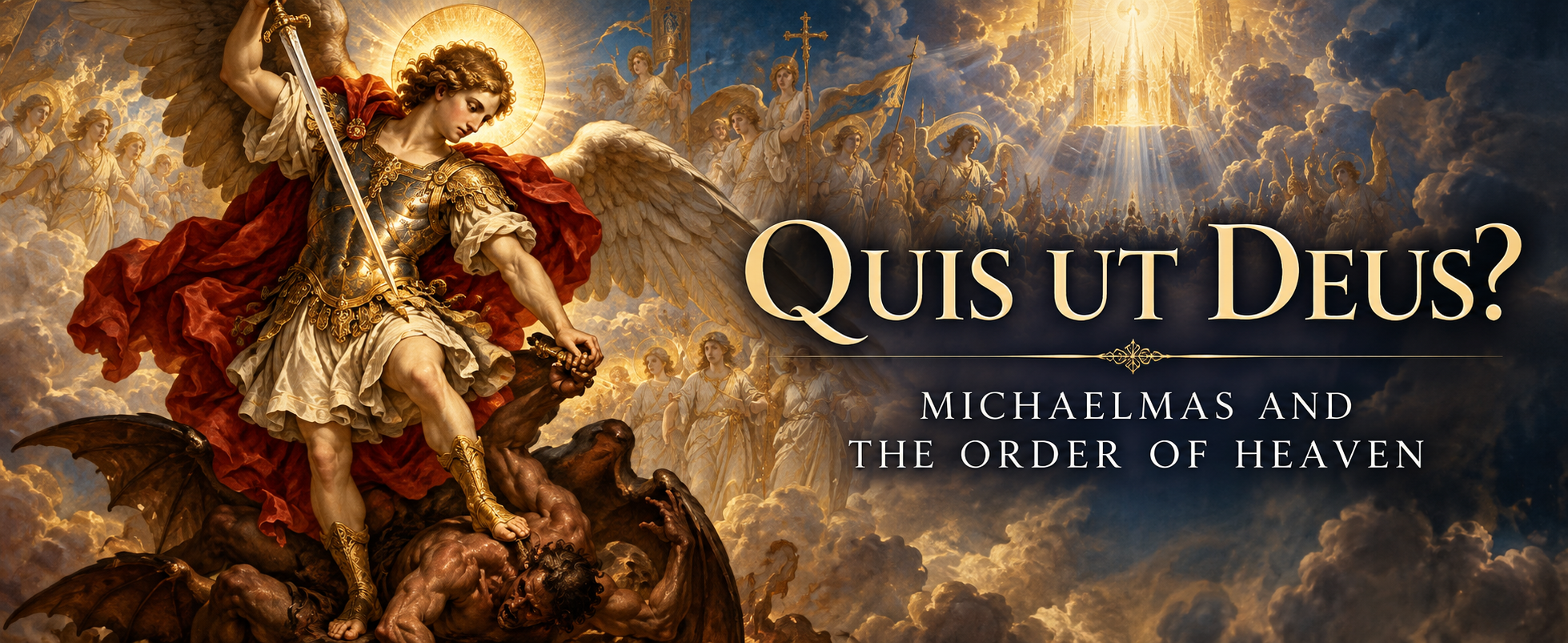
Who is like unto God?
MASS Benedícite Dóminum
LESSON Apocalypse 1:1-5
GOSPEL St Matthew 18:1-10
HOMILIST Mt Revd Jerome Lloyd OSJV

In the Name of the Father, and of the Son, and of the Holy Ghost. Amen.
It is an extraordinarily human question with which to begin the feast of Saint Michael. The disciples want to know about precedence. Who stands highest? Who possesses the greater dignity? Who occupies the first place? And Our Lord answers by calling a little child, setting him in their midst, and saying: “Unless you be converted, and become as little children, you shall not enter into the kingdom of heaven.”
And standing invisibly behind that Gospel is the great Archangel whose very name answers the disciples’ question: Michael — Quis ut Deus? — Who is like unto God?
There is the key to today’s feast. The disciples ask which creature is greatest; Michael points away from every creature towards the Creator. The disciples are thinking of rank; Christ teaches littleness. Lucifer desired exaltation and fell; Michael humbled himself before the Majesty of God and was exalted. The whole drama of the spiritual life is contained in those few words: Who is like unto God?
Today’s feast has its immediate Roman origin in the dedication of an ancient basilica of Saint Michael on the Via Salaria, while the other great traditional feast of the Archangel, on 8 May, commemorates his apparition at Monte Gargano. Yet the Roman liturgy binds these observances closely together, employing the same great Mass, Benedicite Dominum. Dedication and apparition therefore lead us into the same mystery. The Introit does not merely say, “Bless the Lord, Michael,” but: “Bless the Lord, all ye His Angels: you that are mighty in strength, and execute His word.” The Church opens a window upon heaven and allows us, for a moment, to hear its worship.
And that is the first thing we must understand about Saint Michael. Before he is a warrior, he is a worshipper. Before he fights the dragon, he beholds God. Before he defends the people of God, he obeys God. We remember the sword, the armour and the dragon beneath his feet, but the liturgy directs us first towards something greater: the angels standing before the divine Majesty, receiving His commands and accomplishing them.
Saint John Damascene describes an angel as an intellectual being, bodiless, free, ministering to God, possessing immortality by grace. That last point matters enormously. Michael is magnificent beyond anything our senses can comprehend; his intelligence exceeds ours, his power exceeds ours, his mode of existence exceeds ours. Yet Michael is still a creature. Between the lowest angel and the highest Seraph there are degrees of created excellence; between the highest Seraph and God there remains the infinite gulf between creature and Creator.
Michael knows this.
Lucifer would not accept it.
The fundamental temptation of the devil was not to become wicked in some vulgar sense. It was to refuse creatureliness, to seek an excellence turned towards self rather than God. Christian tradition summarises that rebellion in the terrible words: Non serviam — I will not serve. Against it stands Michael: Quis ut Deus? Who is like unto God? Lucifer contemplates his own splendour and becomes enamoured of it. Michael beholds the splendour of God and adores. Lucifer attempts to rise and falls. Michael bows down and is exalted.
Now we understand why Holy Church gives us this particular Gospel. We might have expected only the Apocalypse: Michael and his angels fighting against the dragon. Instead Christ places a child before us. Why? Because the Church understands the battlefield better than we do. The decisive conflict between Michael and Lucifer is repeated, in miniature, within the human heart whenever we must choose between humility and pride, obedience and self-will, God and self.
We imagine spiritual warfare as something extraordinary: demonic manifestations, dramatic temptations, visible assaults upon the Church. Such things may occur. But most of us encounter the enemy in much more ordinary circumstances. He comes when we refuse to apologise because our pride has been wounded; when we preserve a resentment because forgiveness would cost us something; when we know perfectly well that a particular habit, website, friendship or conversation leads us towards sin but insist that we can control it; when we prefer winning an argument to saving a friendship; when we would rather appear righteous than become holy.
Behind every such temptation lurks some echo of the ancient lie: You shall be as gods. You decide what is good. You determine the limits. Your judgment is sufficient. Your desires shall make their own law.
And Michael answers: Who is like unto God?
That question should follow us home. When I place my judgment above Christ’s commandments: Quis ut Deus? When I excuse in myself what I condemn in another: Quis ut Deus? When wounded pride tells me that reconciliation is beneath me: Quis ut Deus? When I know something is sinful but invent circumstances which supposedly make me the exception: Quis ut Deus? When reputation, pleasure, possessions or comfort begin to occupy the throne belonging to God: Quis ut Deus?
The name of Michael is an exorcism of the ego because it restores the proper order of reality. God is God. I am His creature.
But Sacred Scripture reveals that this warfare extends beyond the individual soul. In the Book of Daniel, Michael appears as the heavenly defender of God’s people. Behind the rise and fall of earthly kingdoms Daniel glimpses another dimension of history, an invisible conflict which cannot be reduced simply to politics, economics or human ambition. Saint Paul will later remind Christians that “our wrestling is not against flesh and blood; but against principalities and powers.”
Here the Christian must avoid two opposite errors. We do not see a demon behind every inconvenience, illness or political event; Christianity is not superstition. But neither do we imagine that material causes exhaust reality. The visible world is not the whole world. Human history unfolds within a supernatural order. Grace is real. Temptation is real. Providence is real. Angelic assistance is real. Demonic malice is real. And above all these stands the sovereign providence of Almighty God.
That should produce confidence, not fear, because Christianity is not a religion of two approximately equal supernatural powers fighting to see which will prevail. Satan is not God’s opposite. Satan is a creature. Christ is God.
Our Lord tells the disciples: “I saw Satan like lightning falling from heaven.” Approaching His Passion He declares: “Now shall the prince of this world be cast out.” Through the Cross and Resurrection the decisive victory has already been won. The devil may still tempt; he may accuse; he may rage against the Church and seek the ruin of souls. But he does so as a defeated enemy whose final judgment is certain.
This is why authentic devotion to Saint Michael must always be Christocentric. Michael did not shed his blood for us. Christ did. Michael does not redeem us. Christ does. Michael fights because Christ has conquered. The Archangel’s entire ministry exists within the victory of the Incarnate Word.
And that is precisely where today’s Epistle leads us. Saint John receives the Revelation through angelic ministry, but the passage culminates not in the angel but in Jesus Christ, “Who hath loved us, and washed us from our sins in His own Blood.” There is our confidence. Not our strength. Not Michael considered apart from God. Not some occult knowledge of invisible powers. The Blood of Jesus Christ.
Then Our Lord becomes frighteningly practical: “If thy hand or thy foot scandalise thee, cut it off, and cast it from thee.” If your eye is an occasion of sin, pluck it out. He is not commanding bodily mutilation. He is commanding ruthless separation from occasions of sin.
We want repentance without renunciation. We ask God to deliver us from sins whose occasions we carefully preserve. A man prays for purity while keeping ready access to what destroys purity. Another asks for peace while repeatedly returning to the grievance which nourishes anger. Another desires recollection while surrendering every idle moment to a screen. We ask for victory while continuing to supply ammunition to the enemy.
Christ says: cut it off.
That is spiritual warfare. If something repeatedly leads you into grave sin, remove it. If an application must go, delete it. If a relationship corrupts you, establish the necessary boundary. If gossip is your weakness, leave the conversation. If something repeatedly destroys your self-command, stop pretending that another experiment will somehow produce a different result. Grace does not abolish prudence. Once we know what obedience requires, we must act.
Our Lord then speaks with tremendous severity about scandal: “He that shall scandalise one of these little ones who believe in Me, it were better for him that a millstone should be hanged about his neck.” Scandal in the Gospel does not mean merely causing offence or attracting bad publicity. It means placing a stumbling-block before another soul.
Parents should take those words seriously. Clergy should take them seriously. Teachers should take them seriously. Every Christian whose conduct influences another should take them seriously. A child learns whether Mass matters by watching adults. He learns whether confession matters by discovering whether repentance exists in the home. He learns reverence by seeing others kneel. He learns charity by hearing how adults speak about people who are absent. We can teach the Catechism correctly and contradict it by the lives we lead.
Then comes one of the most beautiful revelations in the Gospel: “Their angels in heaven always see the face of My Father who is in heaven.”
The angels who assist us do not cease to behold God. Scripture shows their ministry accompanying human life from beginning to end. An angel strengthens and delivers; Saint Peter is led from prison by angelic assistance. In the Apocalypse an angel offers incense with the prayers of the saints before God. And when poor Lazarus dies, Our Lord says that he “was carried by the angels into Abraham’s bosom.” From our pilgrimage through temptation and prayer even to the passage of death, Providence surrounds human weakness with angelic ministry.
And now look at today’s Offertory: “An Angel stood near the altar of the temple, having a golden censer in his hand; and there was given to him much incense; and the smoke of the perfumes ascended before God.”
We have arrived at the altar.
Earth and heaven are not conducting two unrelated acts of worship. In the Holy Mass the Church militant is caught up into the worship of heaven. Soon the Preface will speak of Angels and Archangels, Cherubim and Seraphim, who cease not to cry: Sanctus, Sanctus, Sanctus. Our frail human voices are permitted to join theirs.
Perhaps this is therefore one of Saint Michael’s greatest lessons for an age obsessed with self: learn again to adore. The angels do not ask whether worship entertains them. They do not judge divine worship by whether it corresponds to their preferences. They behold Majesty and adore. The creature who truly learns to kneel before God has already begun to break the logic of Lucifer.
So when we pray, “Saint Michael the Archangel, defend us in battle,” let us know what battle we mean. Certainly, defend Holy Church. Defend Christian families. Defend priests. Defend children. Defend those tormented by temptation and those approaching death. But do not ask Michael merely to fight enemies somewhere else.
Ask him to stand beside you against the enemy within: your pride, your habitual sin, your cherished resentment, your impurity, your cowardice, your spiritual laziness—whatever within you still whispers Non serviam.
And make his name your answer.
The Apostles ask: Who is greatest?
Christ places before them a child.
Lucifer says: I will ascend.
Michael answers: Who is like unto God?
There is the road to heaven. Become little before God. Cut away what leads you into sin. Never become the occasion of another soul’s fall. Adore where Lucifer refused to adore. Obey where he refused to obey. And when the battle seems long, remember that its decisive victory is already accomplished: Jesus Christ has loved us and washed us from our sins in His own Blood.
One day our warfare will end. Faith will become sight. The guardian appointed to accompany our pilgrimage will have completed his charge. And, by the mercy of God, we shall enter that heavenly liturgy which today’s Mass permits us dimly to hear, joining Angels and Archangels before the throne of the Lamb.
Until then:
Sancte Michael Archangele, defende nos in proelio.
Saint Michael the Archangel, defend us in battle.
And teach us, against every pride of earth, every temptation of the flesh and every rebellion of hell, to answer until our dying breath:
Quis ut Deus?
Who is like unto God?
In the Name of the Father, and of the Son, and of the Holy Ghost. Amen.
Homilies Archive

Mass Propers


DAILY MASS ONLINE
One of the earliest online apostolates dedicated to the Traditional Latin Mass, Old Roman TV began broadcasting the Holy Sacrifice on the Feast of the Assumption, 15 August 2008. During the COVID-19 pandemic, additional programming — devotions, catechesis, and conferences — was added to support the faithful in prayer and formation.
Support the daily Holy Mass on Old Roman TV by offering a Mass intention — for loved ones, thanksgiving, or the repose of souls. Your intention helps sustain the sacred liturgy and brings grace to those you remember before God’s altar.
SUPPORT THE DAILY MASS ONLINE
Likely the world’s longest-running daily online broadcast of the
Traditional Latin Mass, streaming faithfully since the
Feast of the Assumption 2008.

This apostolate cannot continue without immediate help
Please support us with a contribution toward
chapel rent, sacristy supplies, operating costs, and web-hosting.
Our essential monthly costs reach £1,000.



Leave a Reply