
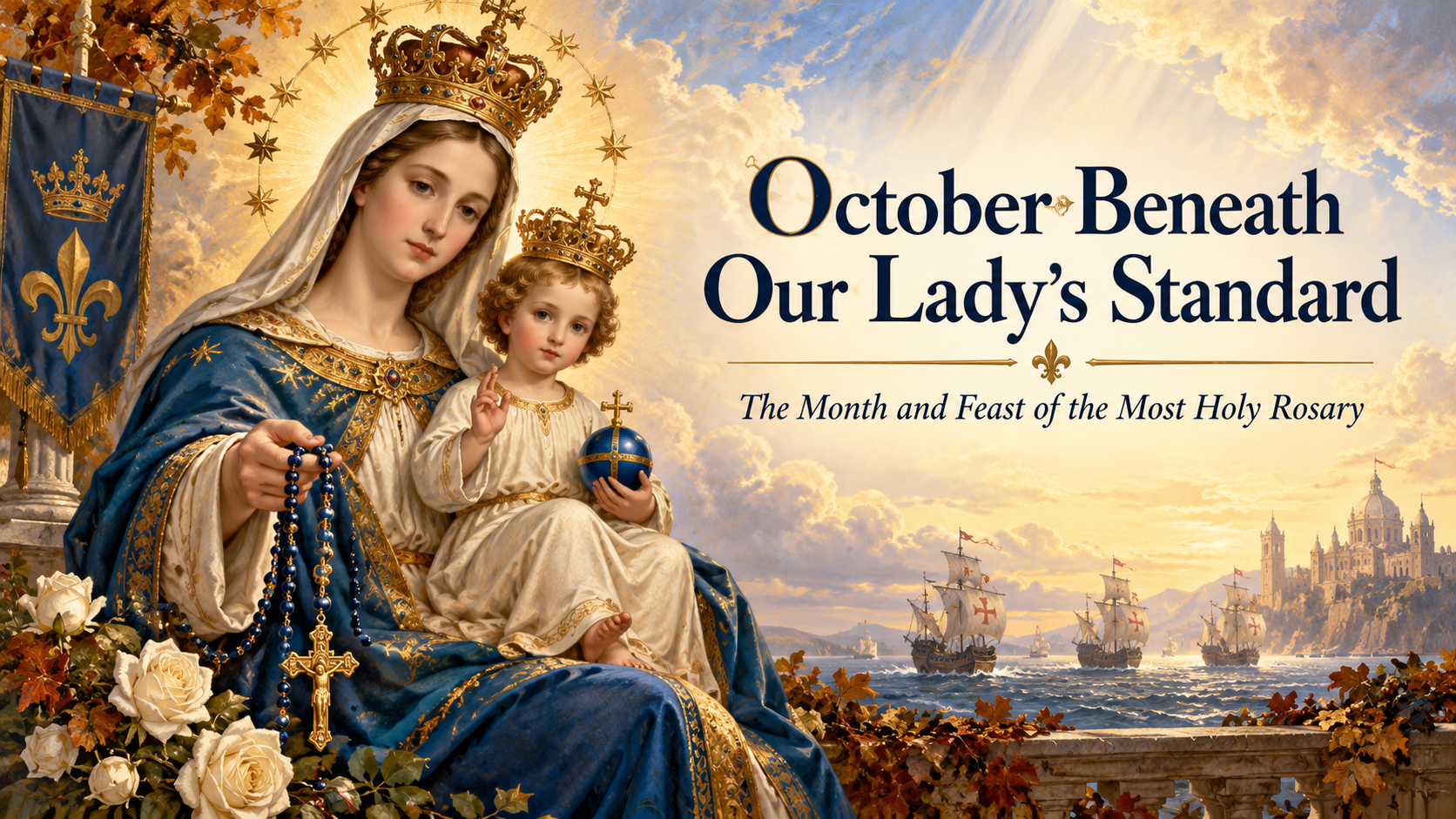
The Month and Feast of the Most Holy Rosary
The Feast of the Most Holy Rosary and the dedication of October to the Rosary belong to the same Catholic inheritance, but they arose centuries apart. The feast grew from the Church’s thanksgiving after Lepanto in 1571; the month acquired its particular Rosary character principally through the repeated interventions of Pope Leo XIII three centuries later. Together they teach a characteristically Catholic lesson: in times of danger the Church acts, perseveres and fights where necessary, but she does so on her knees, conscious that victories of lasting importance depend finally upon grace.
October begins with something remarkably concrete. The Church does not merely propose a Marian sentiment for the month or invite us to admire another aspect of Our Lady’s privileges. She places the Rosary into our hands. Bead follows bead, decade follows decade, and mystery follows mystery. The lips repeat the familiar prayers while the mind is drawn through the Incarnation, Passion and triumph of Jesus Christ. The world may be noisy, the Church may be troubled, families may be suffering, and circumstances may seem beyond our control; the Rosary answers all of this not with passivity but with persevering supernatural action.
Two histories meet in October and ought not to be confused. The Feast of the Most Holy Rosary has its decisive historical origin in the sixteenth century and the victory of Lepanto. The dedication of the whole month of October to the Rosary, by contrast, received its great papal impetus under Leo XIII in the late nineteenth century. The feast came first; the month-long observance developed later. Understanding that distinction makes the relationship between them richer rather than weaker.
The story of the feast takes us to Sunday, 7 October 1571. On that day the fleet of the Holy League engaged the Ottoman fleet in the Gulf of Patras near Lepanto. The strategic and political circumstances were complicated, but the religious significance attached to the battle at Rome was unmistakable. Pope St Pius V had urged prayer throughout Christendom and placed particular confidence in the intercession of the Blessed Virgin. Rosary confraternities prayed while the fleets fought. The unexpected Christian victory entered Catholic memory as a deliverance obtained under Our Lady’s patronage.¹
The liturgical commemoration developed in stages. Pius V ordered a commemoration of the victory; in 1573 Gregory XIII authorised the feast associated with the Holy Rosary in churches possessing an altar dedicated under that title, assigning it to the first Sunday of October. Clement X extended its observance throughout the Spanish dominions in 1671. Following renewed victories over Ottoman forces in 1716, Clement XI extended the feast to the universal Church. Benedict XIII subsequently incorporated its historical lessons into the Roman Breviary.²
The original Sunday placement is important. Lepanto happened on 7 October because 7 October was the first Sunday of October in 1571. The liturgical feast therefore commemorated more than a numerical date on the calendar: it remained attached to the Sunday on which Christian people had prayed and Christian arms had prevailed. For centuries the Roman Church knew the celebration as the solemnity of the Rosary upon the first Sunday of October.
Leo XIII gave the feast still greater liturgical dignity. In 1887 it was raised to the rank of Double of the Second Class, and in 1888 a proper Office and Mass were extended to the universal Church. The Office itself beautifully unfolds the traditional fifteen mysteries: the Joyful Mysteries at First Vespers, the Sorrowful Mysteries at Matins and the Glorious Mysteries at Lauds. The liturgy therefore does not merely praise the Rosary as an object of devotion; it prays through the mysteries which constitute it.³
This is the arrangement preserved by the 1888 Roman books. It has a particularly striking consequence in 2026. The first Sunday of October falls this year on 4 October. Under the Tridentine 1888 calendar, therefore, Sunday 4 October is the Solemnity of the Most Holy Rosary of the Blessed Virgin Mary, Double of the Second Class, with the Nineteenth Sunday after Pentecost commemorated. St Francis of Assisi, whose feast normally falls on 4 October and is ranked Double Major in that calendar, yields to the higher-ranking Rosary feast and is transferred to Monday 5 October; Ss Placid and Companions are commemorated on that day.⁴
The familiar observance on 7 October belongs to a later arrangement. St Pius X’s Abhinc duos annos of 23 October 1913 laid down the principle that feasts hitherto permanently assigned to Sundays should ordinarily be moved to fixed calendar dates, so that Sunday Offices would no longer so frequently disappear beneath saints’ days and other celebrations. The Rosary feast accordingly passed from the first Sunday of October to 7 October in the reformed calendar.⁵
October itself became the Rosary month through another chapter of the Church’s history. Leo XIII, confronted by what he regarded as grave threats to the liberty of the Church, Christian society and the integrity of the Faith, repeatedly prescribed the Rosary as a public remedy. In Supremi Apostolatus Officio of 1 September 1883 he ordered special Rosary observances throughout October, prescribing at least five decades together with the Litany of Loreto in parish churches and encouraging Mass, exposition of the Blessed Sacrament, Benediction and public processions. His intention was explicitly ecclesial and corporate. Catholics were to pray together for the necessities of the Church.⁶
The initial legislation concerned that particular year, but Leo renewed the observance. In Superiore Anno in 1884 he recalled that the previous year he had ordered the Blessed Virgin to be honoured by the Rosary “during the whole of the month of October” and renewed his appeal. By 1891, in Octobri Mense, he could speak of October as already “dedicated and consecrated” to the Virgin of the Rosary, urging the faithful once again to approach her “throughout the month”. Finally, in Diuturni Temporis in 1898, looking back over his Rosary initiatives, Leo explicitly described himself as having consecrated the entire month of October to this devotion.⁷
There is therefore an historical progression worth preserving. 1571 gives us Lepanto; 1573 gives the first-Sunday Rosary feast its established form; 1716 gives it universal extension; and the pontificate of Leo XIII gives us October as the Rosary month in the developed sense familiar to Catholics thereafter. These are not competing origins. They are successive layers of one tradition.
Nor is the reason for that tradition difficult to understand. The Rosary is Marian because we pray it with and through the Mother of God; but it is profoundly Christological because its subject is Jesus Christ. Our Lady continually directs the soul towards her Son. At the Annunciation we contemplate His Incarnation; at Bethlehem His Nativity; in the sorrowful mysteries His Passion and sacrificial death; in the glorious mysteries His Resurrection, Ascension and the fruits of His victory. The Rosary places Mary beside us while compelling us to look at Christ.
Its traditional fifteen decades also explain the old designation of the Rosary as the Marian Psalter. Medieval devotion developed forms of repeated Pater Nosters and Aves that paralleled the 150 Psalms prayed in the Divine Office. The mature fifteen-decade Rosary contains 150 Hail Marys and came naturally to be understood as a Psalter accessible to the faithful. It would be too simple historically to imagine that the complete Rosary appeared at one moment in precisely its later form; its development was gradual. Yet the relationship between the 150 Psalms and 150 Aves became deeply embedded in Catholic devotional consciousness.⁸
This matters because repetition in the Rosary is sometimes misunderstood. The Hail Mary is not repeated because Catholics imagine that multiplication of words has some magical efficacy. Repetition provides the rhythm within which meditation becomes possible. The lips pray while the mind rests upon the mystery. Vocal and mental prayer are joined. Paul VI expressed the traditional point memorably when he warned that without contemplation the Rosary risks becoming “a body without a soul”.⁹ The beads are therefore not a substitute for thought; they discipline thought and return it repeatedly to the mysteries of Redemption.
The traditional Rosary gradually furnishes the imagination with the life of Christ. At the Annunciation we learn obedience. At the Nativity we confront divine humility. At the Presentation we learn that belonging to Christ entails sacrifice. In Gethsemane we see obedience maintained beneath anguish. At the Scourging and Crowning with Thorns we encounter the terrible gravity of sin. On Calvary we learn what redemption costs. At the Resurrection we see that death does not have the final word. At Pentecost we see the Church living by the Holy Ghost. In the Assumption and Coronation we behold the destiny towards which sanctifying grace tends.
This explains why the Rosary has so often been commended in periods of crisis. It is not an escape from reality. At Lepanto the Christian fleet still had to sail. Commanders still had to command, sailors still had to fight, and political authorities had to make prudential decisions. Prayer did not abolish human action. It placed human action under Providence. The Catholic lesson is therefore neither quietism nor activism. We employ legitimate human means while acknowledging that human means do not command grace and cannot guarantee the outcome.
Leo XIII applied precisely that principle to circumstances very different from Lepanto. His adversaries were not principally an approaching navy but forces seeking to remove the Church from public life, weaken Christian institutions and replace a Catholic understanding of society with explicitly secular principles. His response was doctrinal, political and pastoral, but also intensely supernatural. Again and again he returned to the Rosary because he did not regard prayer as what Christians did after practical measures had failed. Prayer itself belonged among the practical measures.
That correction remains necessary. Catholics today can consume extraordinary quantities of information about the crisis of the Church, moral confusion, doctrinal disputes, political developments, family breakdown and cultural decline. Some of that knowledge is necessary. Yet knowledge of a crisis is not the same thing as confronting it supernaturally. A man may understand every ecclesiastical controversy of the hour and still neglect the prayer by which his own soul is sanctified. He may diagnose the sickness of an age while leaving untouched the disorder within himself.
October calls us back from that temptation. There are errors which must be refuted and duties which must be performed, but there are also graces which must be obtained. Sinners must be converted. Priests must be sanctified. Children must be protected. Marriages must be strengthened. The dying must be assisted. The dead must be remembered. Enemies of the Church require not merely defeat but conversion. The restoration of Christian life requires holiness as surely as it requires clarity.
This is why the family Rosary deserves particular recovery. A household in which parents and children regularly kneel together and pray the mysteries acquires habits which no religious-education programme can reproduce by itself. Children learn that difficulties are brought before God, that the dead are remembered, that gratitude is expressed, that repentance is normal, and that the Blessed Virgin belongs not to an abstraction called “Catholic identity” but to the actual life of a Christian home. Doctrine becomes habit before the child is old enough to analyse it.
October consequently suggests a practical rule of life. Those who do not presently pray five decades each day might begin. Those who already do might recover greater recollection and deliberately name intentions. Families might restore the common Rosary. The traditional fifteen mysteries might be prayed more frequently when time permits. Parishes and chapels might revive public recitation, Rosary processions, exposition and Benediction where circumstances allow. The Church does not leave us needing to invent an October spirituality; she has already handed one down.
Particular intentions can also restore purpose to familiar prayers. One decade may be offered for the Church, another for the Pope and bishops, another for priests and vocations, another for families and children, another for the conversion of those who have abandoned the Faith. The Rosary may be offered for the sick, the dying, the Holy Souls, persecuted Christians, the conversion of enemies and the restoration of peace. Repetition ceases to be mechanical when charity gives every decade an object.
Yet the deepest reform may simply be to pray more attentively. At the Annunciation, remain for a moment at Nazareth. At the Nativity, enter the poverty of Bethlehem. At the Agony, watch with Christ when His disciples sleep. At the Crucifixion, stand beside His Mother. At the Resurrection, allow the fact of the empty tomb to judge every temptation to despair. At the Coronation, remember that the hidden Virgin of Nazareth is Queen in Heaven. The Rosary trains memory until the mysteries of Christ become the habitual landscape of the Christian mind.
Seen in this light, the Feast of the Most Holy Rosary is considerably more than an anniversary of a naval battle, and October is considerably more than a convenient month for Marian decoration. Lepanto remains important precisely because it embodies a permanent doctrine of Christian conduct: Providence governs history; prayer obtains grace; Our Lady intercedes; human action remains necessary; and apparent numerical or worldly superiority does not possess the last word.
There is something especially fitting, therefore, in keeping the feast according to its ancient first-Sunday placement. The Sunday itself carries us back to that first Sunday of October in 1571, when Christians prayed while events whose outcome they could not know were unfolding upon the sea. The 1888 calendar preserves that historical memory with unusual immediacy. In 2026 it gives us the Rosary feast on 4 October and asks the Church once again to begin the month not merely talking about prayer, but praying.
October should find the beads worn rather than decorative. The Rosary belongs in the pocket, beside the bed, in the sickroom, before the Blessed Sacrament, in the family home and in the hands of the dying. Its strength lies partly in its humility. A child can learn it; the simplest Catholic can pray it; yet no theologian exhausts the mysteries upon which it meditates.
The Church’s answer to darkness has never been despair, because despair implicitly concedes that visible circumstances are the whole of reality. They are not. Grace is real. Providence is real. The Communion of Saints is real. The intercession of the Mother of God is real. The mysteries contemplated in the Rosary are not religious metaphors but events in the history of salvation whose consequences reach into eternity.
That is why October belongs to the Holy Rosary. The feast recalls a particular deliverance; the month universalises its spiritual lesson. Catholics are to work where duty requires work, resist where fidelity requires resistance, endure where Providence requires endurance, and pray throughout it all. The Rosary does not promise that the Church will never suffer. It teaches her children how to remain faithful while she does.
And so October begins beneath Our Lady’s standard: not with presumption that every temporal outcome will be the one we desire, but with confidence that no faithful prayer is wasted and no circumstance lies beyond Divine Providence. Bead by bead, mystery by mystery, the Christian is led through Mary to Christ, from the Incarnation to Calvary and from the empty tomb to heavenly glory.
That is a programme sufficient for a month. It is also sufficient for a lifetime.
¹ Herbert Thurston, Feast of the Holy Rosary — Catholic Encyclopedia.
² Pope Leo XIII, Augustissimae Virginis Mariae, 12 September 1897.
³ Breviary Hymns of the Rosary — Catholic Encyclopedia; Congregation of Sacred Rites, decrees of 11 September 1887 and 5 August 1888, historical details summarised in Rosary — Enciclopedia Cattolica.
⁴ Divinum Officium — Tridentine 1888, 4 October 2026; Divinum Officium — Tridentine 1888, 5 October 2026.
⁵ Pope St Pius X, Abhinc duos annos, 23 October 1913.
⁶ Pope Leo XIII, Supremi Apostolatus Officio, 1 September 1883.
⁷ Pope Leo XIII, Superiore Anno, 30 August 1884; Pope Leo XIII, Octobri Mense, 22 September 1891; Pope Leo XIII, Diuturni Temporis, 5 September 1898.
⁸ Dom Prosper Guéranger, The Liturgical Year — Feast of the Most Holy Rosary.
⁹ Pope Paul VI, Marialis Cultus, §47; see also Pope John Paul II, Rosarium Virginis Mariae, 16 October 2002.




Leave a Reply