
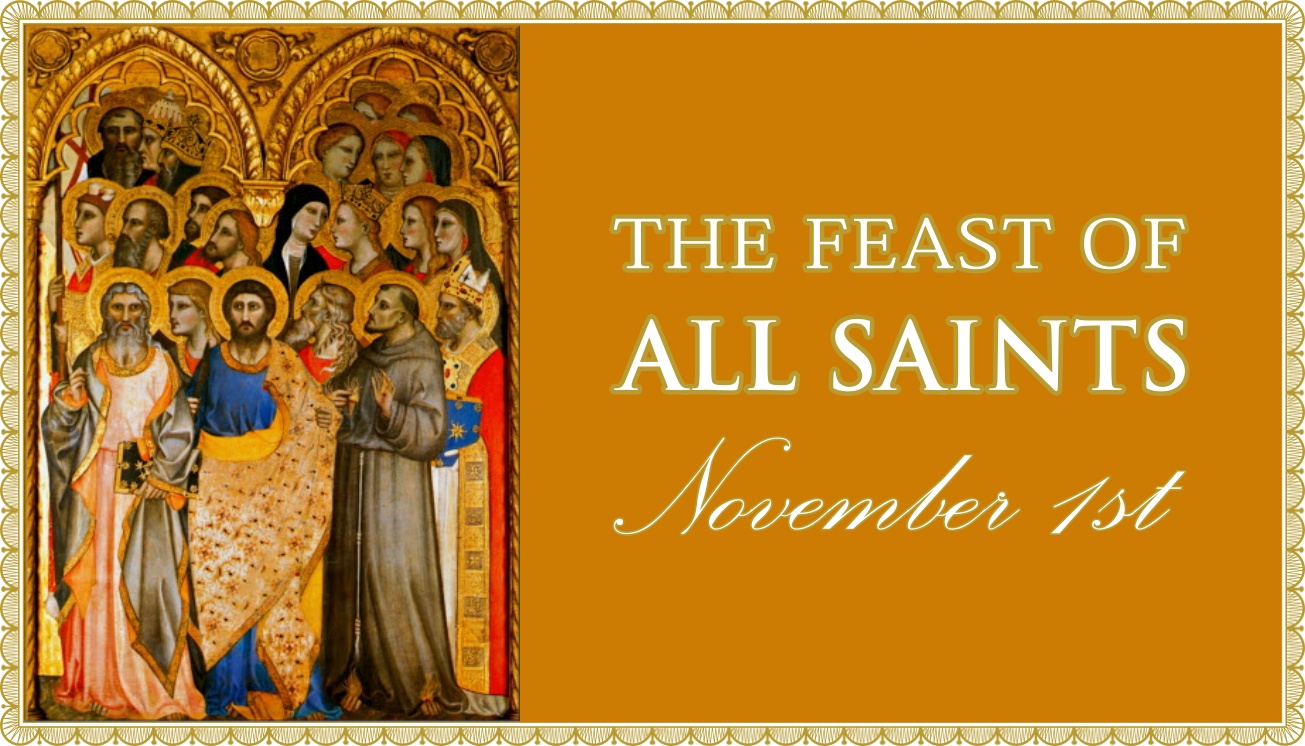
All Saints/Twenty-Third Sunday after Pentecost
Today we celebrate the great feast of All Saints, as well as commemorating the Twenty-Third Sunday after Pentecost. The feast of All Saints was instituted to remember especially those who we do not commemorate in our ecclesiastical calendar, and yet have also been the chosen vessels of God’s grace and lights of the world in their several generations.
But who or what is a saint? In popular usage, the word saint tends to be used to designate one of exceptional sanctity, of whom the world is not worthy. The image is of one far removed from ordinary mortals. The saint is one who sets an ideal which it is impossible for ordinary people to attain. The impression is sometimes given that there are two completely different types of Christians, the saints and ordinary Christians, who, with their multitude of sins and failings, are definitely not saints. At the opposite extreme some Christians have emphasised that all of us who believe in Jesus Christ and have been baptised are already saints, because we have been saved by his grace, and now belong to the blessed company of all faithful people.
Yet when St Paul begins his epistles he says that those who belong to Christ are called to be saints. He is addressing all the Christians in a particular place, not just those who are saints in the popular sense, as if there were two different categories of Christian, the saints and ordinary Christians. On the other hand, he does not say, as some modern Christians do, that they are already saints. Instead he says that they are all called to be saints. By that he means that all who have been baptised into Christ and have obtained the forgiveness of sins and become heirs of the Kingdom of heaven are called to be saints. In other words they are now called to be sanctified, to be made holy, to do all such good works as God has prepared for them to walk in. Despite their manifold sins and shortcomings which still persist in this life they are called to be saints, to live by the fruit of the spirit, of love, joy, peace, patience, kindness and self control. Forsaking what is behind and pursuing what lies before they are to press on to the goal of eternal salvation, to be sanctified, to be made holy.
In the Old Testament the Israelites, the chosen people of God, were called to live up to their vocation to become holy, as God is holy. The call to holiness was addressed to all, not just to some. They were fallen and sinful, and were subject to many temptations. Yet there were some who especially stood out for their faithfulness to God, namely the patriarchs and the prophets. They too had many sins and shortcomings, but their faithfulness to God marked them out as heroes of the faith. The Epistle to the Hebrews recalls them as those who live by faith.
If this is true of the old covenant how much more is this true of the new covenant, which not only promises salvation, but actually imparts it. For the new covenant, as Jeremiah foretold, is no longer written on tablets of stone, but on the hearts of men. In the Sermon on the Mount Jesus proclaims himself to be the full, final and definitive revelation of God’s will. He came not to set aside the Law and the Prophets, but to fulfil them. He lays down a law of righteousness surpassing that of the scribes. The truly blessed are the poor in spirit, those who mourn, the meek, the pure in heart, the merciful, the peacemakers, those who hunger and thirst after righteousness. Blessed are ye when men shall revile you and say all manner of evil against you falsely for my sake. Rejoice and be exceeding glad, for great is your reward in heaven, for so persecuted they the prophets who were before you. This is the calling of all his followers, not just some. Be ye therefore perfect, as your heavenly Father is perfect.
Yet down the ages there have been those from the time of the apostles onward, who like the patriarchs and prophets of old, have been marked out by their faithfulness. In the early ages of the Church, they were the martyrs, in the later ages of faith the confessors, those who, though not martyrs, had shown by their lives that they had died to this world, and now lived by the law of Christ. Not that they were already perfect, or always right in their opinions and actions (neither were the patriarchs and prophets of old), but that they persevered. Some we commemorate in our calendar, others are known only to God (which is why we especially keep this day).
If we are to remain stedfast to the faith once delivered to the saints, we must seek to follow the example of those who have gone before us. We are to put our faith in what G. K. Chesterton called the “democracy of the dead”. He defined tradition as:
“Democracy extended through time. It is trusting to a consensus of human voices rather than some isolated and arbitrary record… It is the democracy of the dead. Tradition refuses to submit to the small and arrogant oligarchy of those who merely happen to be walking about… The ancient Greeks voted by stones; these shall vote by tombstones. It is all quite regular and official, for most tombstones, like most ballot papers, are marked with a cross.”
Much has been written on the issue of whether the saints can hear our prayers. Some have thought it probable that they can because they already share in the Beatific Vision, while others have suggested that our prayers are revealed to them by God. However, what ultimately matters was well expressed by the great Russian theologian Khomiakoff:
“If anyone believes he is in the communion of faith; if he loves he is in the communion of love; if he prays he is in the communion of prayer. Wherefore no one can rest his hope on his own prayers, and every one who prays asks the whole Church for intercession, not as if he had doubts of the intercession of Christ, the one Advocate, but in the assurance that the whole Church ever prays for all her members. All the angels pray for us, the apostles, martyrs and patriarchs, and above them all, the Mother of our Lord, and this Holy Unity is the life of the Church.”
The life of holiness is expressed in many different ways. The saints are all different, for every human being is different. Yet the underlying calling is the same. We are all called to be saints. We cannot achieve it by our own strength, but only by the grace of God. C. S. Lewis put it like this:
“Give up yourself, and you will find your true self. Lose your life and you will save it… Look for yourself and you will find in the long run only hatred, loneliness, despair, rage, ruin and decay. But look for Christ and you will find him, and with him everything else thrown in.”
by the Revd Dr Robert Wilson PhD (Cantab), Old Roman Apostolate UK






Leave a Reply