
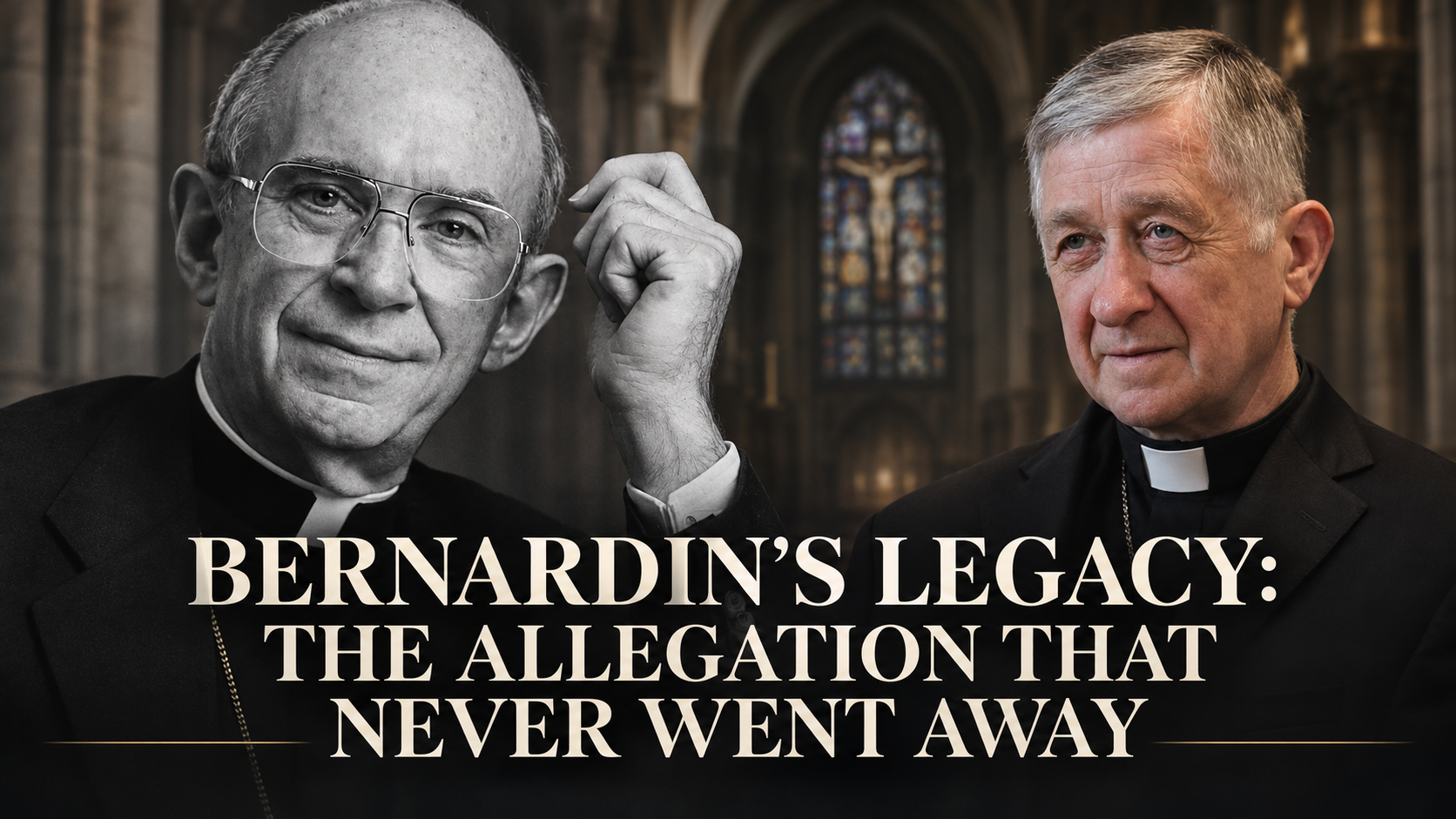
As Cardinal Blase Cupich and Vatican News celebrate the late Archbishop of Chicago, an elderly woman has renewed allegations of childhood sexual abuse which first reached public attention more than thirty years ago. The allegations remain unproven, but the historical record raises questions about their handling, while an official investigation has already exposed serious failures in Bernardin’s episcopal administration. If the Church wishes to commend his example, ought it not be prepared to examine the whole of his legacy?
Cardinal Joseph Bernardin is once again being presented as a model for the Catholic Church. With the thirtieth anniversary of his death approaching on 14 November, his successor in Chicago, Cardinal Blase Cupich, travelled to Italy in October to commemorate his life and achievements. The addresses were affectionate, the admiration considerable, and the late cardinal’s influence upon contemporary Catholic moral thought warmly commended. Vatican News published Cupich’s principal lecture under the headline Cardinal Bernardin: An Example for the Church and the World. Evidently, the legacy of the man who did so much to shape the postconciliar American hierarchy is considered worthy of renewed attention, particularly by those who regard his approach to moral theology and ecclesiastical government as a model for the present pontificate.¹
There is nothing objectionable about remembering a distinguished prelate, provided that remembrance does not become an exercise in selective history. Yet the timing of Bernardin’s rehabilitation has proved unfortunate. On 5 November, Fr David Nix published the testimony of an eighty-year-old woman who alleges that Bernardin sexually abused her in 1957, when she was eleven. The account, published through his Padre Peregrino platform, describes an alleged episode of ritual abuse at St Mary’s Catholic Church in Greenville, South Carolina, implicating Bernardin, then a young priest, Bishop John Joyce Russell of Charleston, and several unidentified individuals. It includes allegations of rape, psychological manipulation and sacrilege involving what she was told was a consecrated Host.²
Fr Nix reports having spent four hours with the woman and her husband. He evidently believes her account, describing her without qualification as Bernardin’s victim. His personal conviction may be sincere, but the evidence publicly available does not presently establish the truth of her accusations. An interview, however lengthy or persuasive, is not an investigation. Nevertheless, there is considerably more to this story than the word of an anonymous woman appearing for the first time in 2026. The allegations have a history, and it is that history which makes the present intervention worthy of serious attention.
On 12 November 1993, Bernardin publicly acknowledged that he had received an accusation from a woman alleging his involvement in a satanic rite some thirty-five or thirty-six years earlier. The following day’s Chicago Tribune reported the allegation, which concerned alleged sexual abuse in South Carolina during the 1950s. Bernardin categorically denied it, along with two other accusations of sexual misconduct which had been brought to his attention. According to his archdiocesan spokeswoman, the woman’s complaint had been referred to Chicago’s recently established clergy sexual abuse review board, but the investigation had been discontinued because she declined to cooperate with its procedures.³
That is an important piece of contemporary evidence. The accusation was known during Bernardin’s lifetime, publicly acknowledged by him, and sufficiently specific to be referred to an ecclesiastical body responsible for examining complaints of abuse. We are therefore dealing with an allegation which has persisted for more than three decades, not one conveniently invented to embarrass Cardinal Cupich’s commemorations. Whether it was properly investigated is another matter. The archdiocese’s explanation that the process was discontinued tells us nothing about the truth of the complaint. Was evidence examined? Were witnesses approached? Was the matter referred to Rome? Or did the refusal of the complainant to accept Chicago’s proposed procedure simply provide a convenient conclusion to an uncomfortable business?
The allegations resurfaced in considerable detail around 2000, when Stephen Brady, founder of the lay organisation Roman Catholic Faithful, published an account concerning a woman identified under the pseudonym Agnes. Brady described substantially the same alleged events in Greenville in 1957, including the supposed involvement of Bishop Russell and Bernardin. He claimed that his organisation had examined affidavits, correspondence and other supporting materials. His investigation was subsequently republished in an edited form by Catholic commentator Matt C. Abbott in August 2018, who stated that he was himself in contact with the woman concerned.⁴
These earlier publications are not independent corroboration of the alleged abuse. Brady’s account included assertions which require verification, and his conclusions cannot be adopted merely because he claimed to possess supporting material. Yet the publications demonstrate the remarkable longevity of the allegation. The woman has not remained wholly silent until this week, whatever impression may have been given by the manner in which Fr Nix introduced her testimony. She has renewed her account in her own words, apparently prompted by the renewed celebration of Bernardin’s reputation, but her accusations were circulating long before his present admirers began speaking of his legacy.
Her latest statement also clarifies her association with the late Malachi Martin, whose 1996 novel Windswept House incorporated elements of her alleged experience into a fictional narrative concerning corruption within the Church. She says Martin was recommended to her as someone capable of bringing the matter to the attention of Pope John Paul II, and that she entrusted him with personal details believing he would assist her. Instead, according to her account, he employed them in a sensational novel, changing the date, altering circumstances and introducing associations with supposed events in Rome of which she had no knowledge. She was particularly distressed by his treatment of what she considered an intensely personal experience of divine grace.
She recalls resisting her alleged assailants by appealing to the goodness of God, and attributes her courage to the grace received through Confirmation. There is something deeply Catholic in that recollection. Confirmation strengthens the Christian for fidelity to Christ, especially when such fidelity demands courage in the face of evil. Whether the events happened as described remains to be established, but the spiritual meaning she attaches to her resistance is perfectly intelligible. One need not accept the historical accuracy of every particular to understand why she should have resented its appropriation for a work of fiction. Neither should the religious character of her account be treated as an invitation to speculation about satanic conspiracies. The allegations are sufficiently grave without embellishment.
The historical circumstances can at least be established. Bishop Russell governed Charleston from 1950 until his transfer to Richmond in 1958. Bernardin was ordained by Russell in 1952 and served within the diocesan administration during the period in question. St Mary’s in Greenville was an established Catholic parish. The people and places described by the woman therefore belong to a recognisable historical setting, although their association proves nothing concerning the alleged offences. She also mentions Fr Eugene Condon, whom she says subsequently served in her parish and had previously shared accommodation with Bernardin. Condon was later convicted of offences involving boys in South Carolina, receiving a probationary sentence in 1998. His criminal record is established; the alleged connection between his misconduct and the events described by the woman is not.⁵ ⁶
The better-known accusations made by Steven Cook require similar care. In November 1993, Cook, a former participant in a Cincinnati seminary programme, brought a civil action alleging that Bernardin had sexually abused him during the 1970s, when the latter was Archbishop of Cincinnati. Bernardin emphatically denied the allegation. In February 1994, Cook withdrew it, explaining that recollections which had emerged through hypnosis were unreliable and that he could no longer be certain of their accuracy. He continued to pursue separate allegations against another priest, Ellis Harsham. Bernardin and Cook subsequently met, and in January 1995 the cardinal publicly described their reconciliation.⁷ ⁸
The woman now speaking through Fr Nix disputes aspects of that reconciliation, claiming that Cook privately expressed a different understanding of his withdrawal and continued to believe elements of his earlier recollections. There may be matters here which could be clarified through surviving correspondence, but Cook’s documented public statements cannot simply be displaced by another person’s recollection of a private conversation. He died in September 1995 and cannot now resolve the disagreement. His withdrawal remains a significant part of the record, even if it does not answer the separate allegations made by Agnes.
What is striking about these events is how readily the public discussion became concerned with Bernardin’s reputation rather than the adequacy of the processes by which the allegations were examined. His standing within the American hierarchy was considerable. He was widely admired for his pastoral manner, his theological influence and his response to the emerging clerical abuse crisis. These achievements undoubtedly shaped the reception of accusations against him. Yet personal reputation, however deserved in other respects, provides no reliable measure of whether a particular allegation is true. The Church has learnt that lesson at considerable cost, although there remain occasions when one wonders whether she has entirely absorbed it.
The woman explains that she refused to submit her complaint to Chicago’s review board because she believed that only the Pope possessed jurisdiction over a cardinal. Her objection was not without canonical foundation. Canon 1405 §1 reserves the judgement of cardinals to the Roman Pontiff, although this does not preclude properly authorised preliminary inquiries or the collection of evidence by others. The distinction is important. An internal diocesan review board might receive information or advise concerning a complaint, but it could not exercise the judicial authority reserved to the Holy See. Whether the arrangements proposed in 1993 adequately respected this distinction requires examination. Her refusal to cooperate cannot, by itself, be treated as proof that her allegations lacked substance.⁹
According to her present account, she pursued the matter through several channels, including correspondence with Bernardin, attempts to obtain legal assistance and a visit to Vatican officials with her husband. She says she retains copies of correspondence and notes of conversations. Those documents, if available and authentic, would provide a means of establishing what ecclesiastical authorities knew, when they knew it, and what action followed. The question is not simply whether Bernardin denied the allegation, for that he certainly did, but whether the complaint received an investigation proportionate to its gravity. An allegation may ultimately prove unfounded; it does not become unfounded merely because the authorities have ceased to enquire.
There is, moreover, an aspect of Bernardin’s episcopal record which requires no speculation about his private conduct. The Illinois Attorney General’s 2023 investigation into clerical sexual abuse documented serious failures in the Archdiocese of Chicago’s handling of offending priests during his administration. The case of Fr Robert Mayer is particularly disturbing. Allegations concerning Mayer’s behaviour towards boys had reached archdiocesan officials before Bernardin arrived in 1982. Subsequent complaints described alcohol being supplied to minors, pornography, inappropriate sexual behaviour and allegations of abuse. Yet Mayer continued to receive parish appointments, despite accumulating evidence that he presented a danger to young people.¹⁰
Bernardin was personally involved in decisions concerning Mayer. In October 1982, he acknowledged the possibility that transferring the priest could produce difficulties elsewhere. Mayer was nevertheless moved to another parish in 1983. Further allegations followed, and in 1987 restrictions were imposed upon his unsupervised contact with young people. Even then, he continued to receive assignments, including appointment as a parish priest in 1990. He was finally removed from ministry in 1991 and subsequently convicted of aggravated criminal sexual abuse. The Attorney General’s report records the archdiocese’s knowledge of allegations and its repeated failure to take effective protective action. These are findings based upon contemporary records, not retrospective rumours concerning a deceased cardinal.
It is true that Bernardin later introduced important safeguarding reforms. The largely lay review board established in Chicago in 1992 represented an advance upon practices common in many American dioceses, and the Illinois investigation acknowledged its significance. But this cannot erase the failures which preceded it. A bishop who introduces safeguards after serious errors may deserve credit for the reform, while remaining answerable for decisions which exposed children to danger. The two judgements are perfectly compatible. Indeed, it would be a peculiar account of episcopal virtue which celebrated the policy while overlooking the circumstances that made it necessary.
The duties of a bishop are not confined to preaching, administering sacraments and representing the Church in public affairs. His office carries responsibility for the government of the faithful, including their protection from those who would abuse ecclesiastical authority. This obligation belongs to justice and charity, not merely to modern safeguarding regulations. The bishop is consecrated to be a shepherd, and the welfare of the flock must take precedence over the convenience of the clergy or the reputation of the institution. Where known dangers are allowed to persist through failures of government, the resulting harm concerns the very exercise of episcopal office. One might reasonably expect this to feature prominently in any serious assessment of a bishop proposed as an example to his successors.
It is particularly relevant to Cardinal Cupich’s present commendation of Bernardin because his legacy is being promoted as something more than an interesting chapter in American ecclesiastical history. Cupich regards the cardinal’s consistent ethic of life, commonly associated with the expression seamless garment, as a continuing model for Catholic moral teaching. In his October lecture, he maintained that Bernardin’s approach had been substantially vindicated by John Paul II’s Evangelium Vitae, and connected it with the pastoral priorities of Popes Francis and Leo XIV.¹¹
Nuntiatoria examined this argument in May 2025 in A Shroud for the Unborn: The Seamless Garment and the Collapse of Catholic Moral Hierarchy. The difficulty is not that Catholics should disregard threats to human dignity beyond abortion and euthanasia. Catholic moral theology has always recognised the obligations of justice towards the poor, the vulnerable and those suffering from violence or oppression. The difficulty arises when intrinsically evil actions, which no circumstances can justify, are treated as though they occupied the same moral category as questions involving legitimate prudential judgement. John Paul II’s defence of human life cannot reasonably be invoked to abolish the distinctions upon which his teaching depends.¹²
This earlier criticism of Bernardin’s theological influence is independent of the allegations against him personally, but the connection with his present rehabilitation is nevertheless instructive. Ecclesiastical admiration has a tendency to extend beyond the particular achievements which originally inspired it. A bishop whose ideas are favoured by his successors becomes a figure whose entire ministry is presented as exemplary. His influence supplies the argument for his virtue, and his reputation becomes evidence of the wisdom of those who continue his programme. It is a convenient arrangement, although it has little to commend it as an exercise in historical judgement.
Fr Nix’s complainant says she has renewed her testimony because she has heard of a movement to canonise Bernardin. There is no verified evidence that a formal cause for his beatification or canonisation has commenced. The distinction between celebrating someone’s memory and initiating a canonical cause should be obvious, although enthusiastic ecclesiastical commemorations can sometimes give the impression that the former is intended to prepare the way for the latter. The woman concludes by lamenting the diminished role of the traditional Devil’s Advocate, whose responsibility was to scrutinise claims of sanctity and raise objections which admirers of the candidate might prefer to overlook.
The office of Promoter of the Faith was not simply abolished by the reforms of 1983, although its former adversarial role was substantially altered. Nevertheless, her concern touches upon an essential principle. The Church’s declaration of heroic virtue is not a reward for administrative achievement, theological influence or personal popularity. It requires the serious examination of a candidate’s life, including evidence which might count against the proposed cause. John Paul II’s Divinus Perfectionis Magister provides for precisely such scrutiny. Were Bernardin’s cause ever formally proposed, both the allegations against him and the documented failures of his administration would demand careful consideration.¹³
The Church has surely had sufficient experience of the consequences when ecclesiastical reputation is allowed to interfere with the investigation of wrongdoing. The abuse scandals of recent decades exposed not only criminal acts committed by priests and bishops, but an institutional disposition to protect respected individuals whose misconduct was considered improbable because of their standing. In some instances, victims were disbelieved because the accused appeared beyond reproach. Elsewhere, allegations were managed as threats to public confidence rather than complaints requiring the exercise of justice. The result was suffering compounded by betrayal, with consequences for the Church’s credibility which remain painfully evident.
It would be wrong to presume that Bernardin’s case belongs among those examples merely because allegations were made against him. His categorical denials remain part of the historical record, and no determination of personal guilt can responsibly be reached upon the evidence presently available. Bishop Russell, likewise deceased, cannot answer the accusations against him. The passage of nearly seventy years places obvious limitations upon the recovery of evidence and the examination of witnesses. These considerations impose a particular responsibility upon anyone reporting the matter, especially where the alleged offences are so grave.
But we possess sufficient historical material to warrant further enquiry. The accusation was publicly acknowledged in 1993, recounted in greater detail around 2000, republished in 2018, and now renewed by the woman herself. She says she has preserved documents which may clarify her dealings with the ecclesiastical authorities. An independent examination of those records, alongside whatever survives in Chicago and Rome, would establish at least whether the original complaint was properly considered. It might also determine whether any corroborating evidence exists. There is no legitimate reason to confuse the difficulty of proving an allegation with an excuse for declining to examine it.
Nor should the woman’s anonymity be treated as an impediment which relieves investigators of their responsibilities. She explains that she concealed her identity to protect her family, and says that legal advice reinforced her concern about the possible consequences of publicity. The credibility of her testimony must ultimately depend upon evidence, but its examination need not require her public exposure. Confidential procedures exist precisely because complainants may have legitimate reasons for protecting their identities, especially when allegations concern sexual violence committed during childhood.
The moral obligations here are neither obscure nor novel. The Eighth Commandment forbids false witness, and the Church rightly condemns calumny and unjust injury to reputation. Bernardin’s good name is entitled to protection against accusations which cannot be substantiated. Yet the same divine law requires justice towards those who may have suffered serious wrongs. Where there is a legitimate reason for disclosure and investigation, the protection of reputation cannot become an absolute prohibition upon examining alleged misconduct. A just investigation serves both purposes: it protects the innocent from false accusation and seeks redress where wrongdoing can be established.
There is a further theological consideration which appears strangely neglected in the present celebration of Bernardin’s legacy. The Church does not derive her holiness from the personal virtue of her ministers. She is holy because Christ is her Head and the Holy Ghost sanctifies her, notwithstanding the sins and failures of those entrusted with her government. To acknowledge the faults of a bishop therefore does not diminish the Church’s divine constitution. What damages her witness is the pretence that her authority requires the maintenance of reputations which the evidence may no longer support.
Bernardin died on 14 November 1996. His eternal judgement belongs to Almighty God, Who knows with certainty what human investigators may never fully establish. In this month dedicated to the Holy Souls, Catholics may properly pray for him, as indeed the woman who accuses him says she prays for those involved in the alleged events of 1957. Such prayer neither presumes guilt nor proclaims sanctity. It recognises the universal need for divine mercy, and the distinction between the judgement of God and that of men.
Cardinal Cupich is entitled to remember Bernardin with affection and to commend whatever he believes worthy of imitation in his ministry. But the invitation to regard a deceased bishop as an example for the Church necessarily invites examination of the whole historical record. The documented failures of his administration cannot be disregarded because they disturb a preferred account of his leadership. Neither can the longstanding allegations against him personally be dismissed merely because they remain uncomfortable or unresolved.
The Church has no need to manufacture saints from distinguished ecclesiastics, nor to defend every action of those whose theological influence she wishes to preserve. Her obligation is to the truth, and truth is not served by either an uncritical celebration of reputation or the indiscriminate acceptance of accusations. If Bernardin was falsely accused, a properly conducted investigation may help establish that fact. If serious complaints were inadequately examined, the Church ought to acknowledge the failure. The faithful deserve an honest account of both his achievements and the circumstances which call his example into question.
A cardinal’s reputation may be worth defending. The truth is worth considerably more.
¹ Archdiocese of Chicago, Cardinal Blase J. Cupich, “Homily on the Commemoration of the 30th Anniversary of the Death of Joseph Cardinal Bernardin”, 15 October 2026; Vatican News, “Cardinal Bernardin: An Example for the Church and the World”, 17 October 2026.
² Fr David Nix, “Cardinal Bernardin’s Victim Speaks Out”, Padre Peregrino, 5 November 2026.
³ Michael Hirsley and Jan Crawford, “I’ve Led a Chaste Life, Bernardin Says”, Chicago Tribune, 13 November 1993; Edward Walsh, “Chicago Cardinal Denies Sex Abuse Claim in Suit by Former Student”, Washington Post, 13 November 1993.
⁴ Stephen Brady, “The Bernardin Legacy”, Roman Catholic Faithful, c. 2000, republished in Matt C. Abbott, “‘Agnes’ and the Bernardin Legacy”, RenewAmerica, 11 August 2018.
⁵ Diocese of Charleston Archives, “Bishop John J. Russell (1950–1958)”; St Mary’s Catholic Church, Greenville, “History”.
⁶ BishopAccountability.org, “Fr Eugene L. Condon”, Diocese of Charleston Clergy Abuse Database.
⁷ Edward Walsh, “Man Who Accused Cardinal Bernardin of Sexual Abuse Drops Lawsuit”, Washington Post, 1 March 1994.
⁸ Edward Walsh, “Cardinal Describes ‘Profound Reconciliation’ with Former Accuser”, Washington Post, 5 January 1995.
⁹ Code of Canon Law (1983), Canons 1405–1406, Holy See.
¹⁰ Office of the Illinois Attorney General, Report on Catholic Clergy Child Sex Abuse in Illinois, “Archdiocese of Chicago: History of Handling Claims”, 2023; “Robert E. Mayer”, Investigative Narrative.
¹¹ Archdiocese of Chicago, Cardinal Blase J. Cupich, “Lecture on Cardinal Bernardin’s Legacy for the Church and the World”, 16 October 2026.
¹² Nuntiatoria LVI, “A Shroud for the Unborn: The Seamless Garment and the Collapse of Catholic Moral Hierarchy”, 23 May 2025; John Paul II, Evangelium Vitae, 25 March 1995.
¹³ John Paul II, Apostolic Constitution Divinus Perfectionis Magister, 25 January 1983.




Leave a Reply