
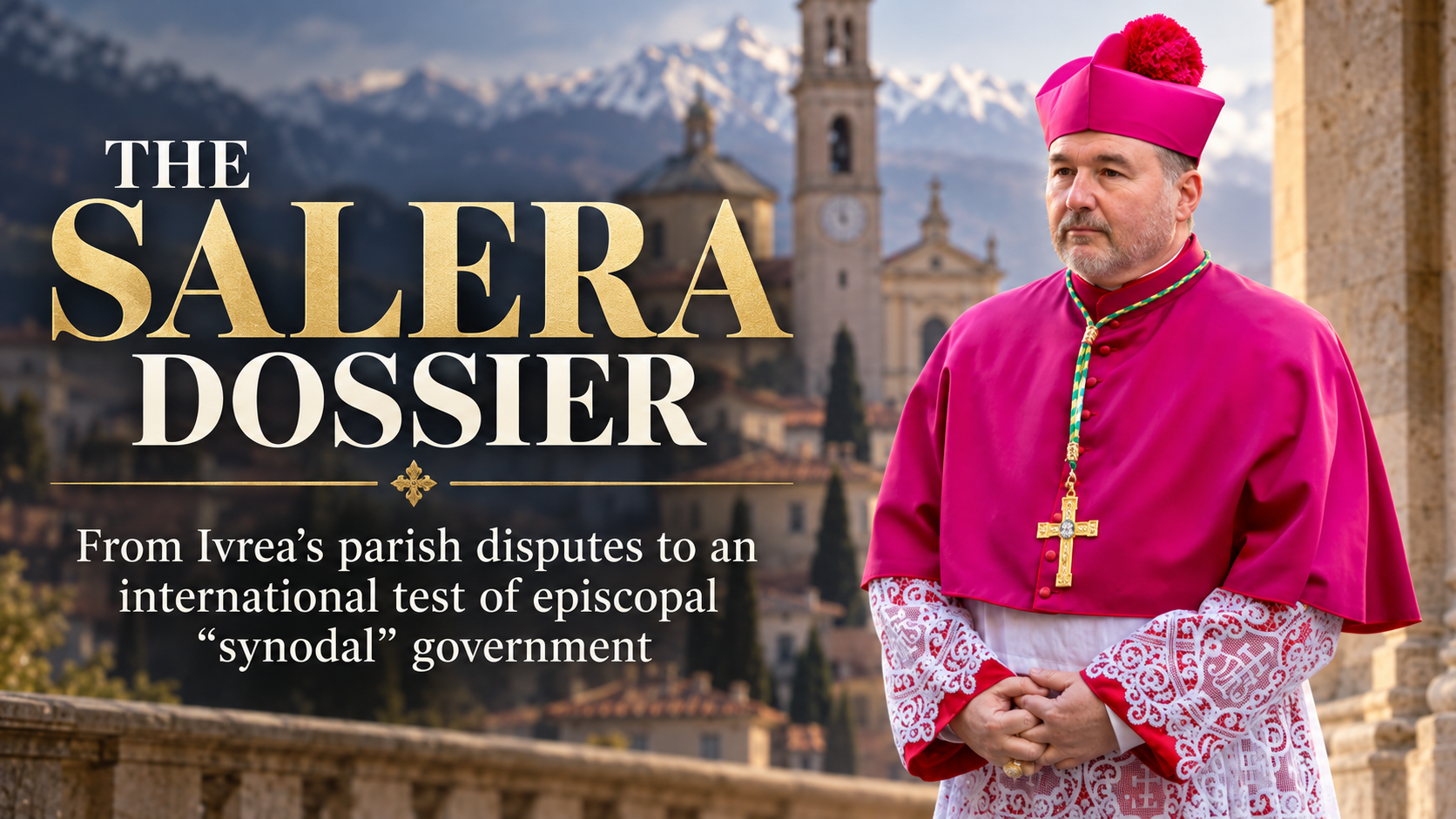
From Ivrea’s parish disputes to an international test of episcopal “synodal” government
The controversies surrounding the Diocese of Ivrea have crossed the language barrier and returned home. After La Voce devoted an article to Nuntiatoria’s examination of Bishop Daniele Salera’s troubled first nineteen months, politicians reportedly began asking the newspaper another question: “Which faction does the Bishop belong to?” Salera’s record places him unmistakably within the Francis-era synodal culture, but his biography also reveals something more interesting than a factional label: substantial parish experience combined with an unusually formation-heavy career in sociology, catechetics, seminary education and the training of formators. Ivrea therefore raises a deeper question. Can a Church which speaks constantly of listening distinguish between forming others and allowing itself to be corrected by what it hears?
There is a satisfying circularity in journalism when a local newspaper supplies much of the evidence for an investigation abroad, only to discover that the resulting foreign analysis has itself become part of the local story. That is now what has happened in Ivrea. On 21 September, La Voce published an article under the sardonic headline, “Thanks to the Bishop, Ivrea caput mundi. The diocese’s problems are also translated into English.” Its author noted that controversies which had once belonged almost entirely to the Canavese press were now being examined in English by Nuntiatoria and AdVaticanum. More importantly, he had actually read what Nuntiatoria argued.¹
That matters because the argument was not that every grievance against Bishop Daniele Salera must be true, nor that every disputed decision was canonically invalid, nor even that all the controversies belonged to one category. La Voce noticed precisely this restraint. Nuntiatoria had expressly declined to allege financial impropriety in the dispute concerning approximately €190,000 belonging to the parish at Montalenghe; it had acknowledged the bishop’s authority to transfer priests and govern the diocese; and it had distinguished the existence of protest from proof that every protester was right. “And this,” La Voce remarked, “is where Nuntiatoria does something smart.”¹
That deserves acknowledgment. In an ecclesial climate in which disagreement is too often caricatured before it is answered, La Voce did something more serious: it read the argument, preserved its qualifications and directed readers to the original article so that they could judge it for themselves. The important thing is not that an Italian newspaper noticed us. It is that it represented the argument fairly. A publication which asks others to read it carefully ought to recognise when somebody has done exactly that.
The cumulative case nevertheless remains striking. Rivarolo concerned restrictions surrounding the older Roman liturgy. Cuceglio concerned Catholics arriving at a sanctuary to conclude an SSPX-associated pilgrimage with prayer and finding the door closed. The case of Don Mario Viano produced protest and a torchlight procession. At Mazzè and Villareggia, 1,078 people petitioned against the transfer of Don Alberto Carlevato after roughly twenty-five years of ministry. Montalenghe brought the departure of Don Ugo Lodi, resignations from the Pastoral Council, petitions and questions about parish funds. Then came Rondissone and Fr David Kamal Chelladurai, whose public letter alleged humiliating living and pastoral conditions and culminated in the startling declaration that he was struggling to live “like a slave”.¹
These are not manifestations of a single organised rebellion. The people involved do not constitute one ideological constituency, and the issues range from liturgy and clerical appointments to parish administration, money and relations between priests. That diversity is precisely what makes the accumulation significant. One conflict may be a misunderstanding; another may arise from an unpopular but necessary decision; another may ultimately prove to have been badly reported. But where substantially different communities and priests repeatedly encounter serious conflict with diocesan government, it becomes reasonable to ask whether something in the method of government itself deserves examination.
La Voce understood that point so clearly that, when considering the absence of seminarians in Ivrea, it described Nuntiatoria as having “hit the nail on the head”. Bishop Salera cannot reasonably be blamed for a vocational crisis built over decades before his arrival. But a diocese which presently has no seminarians has particular reason to value the priests it possesses, the communities which remain alive, and even the conflicts which reveal fractures requiring pastoral repair. A young man discerning priesthood does not look only at vocation posters. He also sees how priests are treated when difficulties arise.¹
The affair then took another revealing turn. On 26 September, La Voce reported that its newsroom had begun receiving calls from mayors, regional councillors, parliamentarians and other public figures interested in the developing diocesan controversy. Yet the recurring question was apparently not simply what had happened in Ivrea. It was: “What current is Salera?” Was he progressive or conservative, Bergoglian or traditionalist, synodal or Ratzingerian? Only after establishing the bishop’s ecclesiastical tribe, the article suggested with some amusement, did some callers appear ready to decide how seriously the controversy should be regarded.²
The instinct is recognisable far beyond Ivrea. Modern ecclesiastical argument increasingly borrows the habits of partisan politics. Establish the label first; consider the evidence afterwards. A bishop associated with one camp will be excused for something which would produce outrage had it been done by the other. Principles become strangely elastic when friends exercise power.
There is no evidence before us that Salera belongs to the Italian political Left, supports the Democratic Party, intends to vote for Elly Schlein rather than Giorgia Meloni, or possesses any other partisan allegiance. La Voce’s political comparison is satire, not evidence. The ecclesiastical question is narrower and answerable. Salera’s episcopal provenance and declared pastoral programme belong unmistakably to the Francis-era synodal current.
Yet his biography is more interesting than the label suggests. Salera was not a career curialist raised to the episcopate without having known parish life. Ordained in 2002, he spent six years as parish vicar at Santa Maria Madre del Redentore in Tor Bella Monaca. From 2016 until his episcopal appointment in 2022 he was parish priest of San Frumenzio in Rome. Between those periods, however, lay eight highly formative years within the structures of priestly and catechetical formation: from 2008 to 2014 he served as an educator at the Pontifical Roman Major Seminary and collaborated with the diocesan Catechetical Office and catechumenate service; from 2014 to 2016 he was vice-rector of the seminary. He holds a degree in Sociology from La Sapienza, a licentiate in Spiritual Theology and undertook specialist studies in the sciences of formation for formators. After Francis appointed him auxiliary bishop of Rome in 2022, Salera was entrusted with the northern sector of the Diocese of Rome and with Christian formation.³
That record disposes of the easy accusation that Salera simply lacks parish experience. He does not. Twelve years of direct parish work, six of them as parish priest, are substantial. But another feature of the record is equally conspicuous: formation is the recurring theme of his ministry. Sociology, spiritual theology, the training of formators, seminary education, seminary government, catechetics, scouting formation and later episcopal responsibility for Christian formation form an unusually coherent thread through his career. When Rome announced his transfer to Ivrea in December 2024, it described him not only as auxiliary bishop for the northern sector but as responsible for Christian formation and head of the Jubilee secretariat.⁴
That cannot establish Salera’s motives, temperament or private habits of judgment, and it would be irresponsible to pretend otherwise. It does, however, suggest a legitimate interpretative question. A culture devoted to formation naturally learns to think in terms of accompaniment, pedagogy, discernment, development and helping others to mature. Those can be valuable pastoral instincts. Yet they contain a possible danger when carried into government: the assumption that the person being listened to is principally the person who needs to be formed.
There is another kind of listening. It begins from the possibility that the person in authority, the institution, the pastoral arrangement or the decision itself might require correction.
The distinction matters in Ivrea because the conflicts confronting Salera are not chiefly requests for further formation. Parishioners opposing a transfer are not necessarily asking to be accompanied towards accepting it; they may be saying that the decision itself is mistaken. Traditional Catholics asking for the inherited liturgy are not necessarily seeking help in understanding why they should eventually relinquish their attachment; they may be asking that the attachment itself be respected. A priest who reports that existing arrangements have become intolerable is not necessarily asking to be helped through a difficult emotional period; he may be asking his bishop to determine whether what he reports actually happened. None of these possibilities proves that the objectors are right. They do require a form of listening in which authority itself remains capable of being corrected.
This makes Salera’s first pastoral letter particularly significant. Devoted to living and proclaiming reconciliation, it speaks the now familiar language of synodality, listening, participation, co-responsibility, dialogue, mission, transparency and accountability. Salera presents formation as relational, describes fraternity as an essential form of priestly life, and asks how ministers can build living communities unless genuine fraternity first exists among them. He explicitly connects that fraternity with a synodal Church in which clergy grow together by sharing the burdens and joys of ministry.⁵
None of this is objectionable in itself. The Church possessed councils, synods, chapters, consistories and structures of consultation centuries before anyone organised a “listening session”. Catholics need not choose between modern synodality and episcopal autocracy. Priests ought to advise bishops; bishops ought to know the condition of their clergy and faithful; lay Catholics possess genuine responsibilities deriving from Baptism; consultation can assist prudent government. Nuntiatoria’s criticism has never required pretending otherwise.⁶
The question is what “synodality” has been made to mean.
Under Francis the term underwent a remarkable expansion. In his 2015 address marking the fiftieth anniversary of the Synod of Bishops, Francis declared that “it is precisely this path of synodality which God expects of the Church of the third millennium” and described the project as “journeying together — laity, pastors, the Bishop of Rome”. In the same address he invoked the sensus fidei of the whole People of God and rejected a vision in which only professionally qualified actors evangelise while the rest of the faithful remain passive recipients.⁷
That was an enormous ecclesiological claim. Synodality was no longer merely one method of consultation among others, nor simply the periodic gathering of bishops envisaged by Paul VI. It was increasingly presented as a permanent way of being and operating as Church. Nuntiatoria has repeatedly examined the consequences: an episcopal advisory body became embedded within a much wider process involving parish consultations, diocesan structures, national syntheses, continental stages, Roman assemblies, implementation phases and an expanding class of people professionally equipped to administer and interpret them.⁸
Properly understood within Catholic ecclesiology, synodality may describe a mode of communion, consultation and ordered participation in the Church’s life. It does not constitute another source of Revelation, another principle of ecclesial authority or another mark of the Church alongside one, holy, catholic and apostolic. It cannot stand above the deposit of Faith, alter the divine constitution of the hierarchy, renegotiate the nature of Holy Orders or turn received doctrine into material awaiting collective discernment. The Church does not deliberate herself into existence. Her constitution is antecedent to her consultation, her sacraments antecedent to her committees, and Revelation antecedent to every listening exercise. The Church is receptive before she is deliberative. Accipere, non fingere: receive, do not invent.⁶
This is why our criticism of Francis-era synodality has never required a blanket rejection of synods, consultation or episcopal collegiality. The objection is narrower and more serious. Synodality becomes problematic when process is absolutised, when the range of acceptable outcomes is effectively preconditioned, when inherited doctrine or liturgy is treated as a difficulty to be managed, or when participation is invoked selectively and ceases to matter once those participating resist the preferred direction. The problem is not listening. The problem is listening which cannot bear to be contradicted.
The deepest irony is that a programme repeatedly offered as an antidote to clericalism has itself generated an elaborate ecclesiastical apparatus of facilitators, coordinators, synthesis writers, theologians, diocesan teams, episcopal structures, continental working groups, secretariats and specialists. Organisation is not itself objectionable; any serious consultation requires it. The difficulty begins when the people controlling the organisation acquire an informal authority to determine what the faithful are understood to have said.
The faithful did not design the global synodal process. They did not collectively choose its categories, formulate its vocabulary, appoint its secretariats, select its delegates or determine how thousands of contributions would be compressed into successive syntheses. A parish discussion became a parish report; parish reports became diocesan syntheses; diocesan syntheses became national texts; national material informed continental documents; continental documents fed the Roman process. At every stage somebody had to decide what was recurrent, important, marginal, prophetic, problematic or worthy of preservation. No bad faith is required for meaning to change under repeated mediation. Interpretation is unavoidable. The mistake lies in forgetting that it has occurred.⁸ ⁹
This is functional clericalism, even when some of those exercising it are lay people. The point is not to pretend that an unordained facilitator becomes a cleric. It is that the characteristic vice traditionally associated with clericalism — privileged access, control of interpretation, distance from ordinary accountability and the assumption that the institution knows what the faithful really need — can migrate from an ordained caste into a professional ecclesiastical caste. The anti-clerical project can thereby create a new clerisy whose authority derives not from Orders but from appointment, access, expertise and mastery of the approved process.⁹
The vocabulary itself becomes part of that professionalisation. “Listening”, “lived experience”, “journeying together”, “discernment”, “co-responsibility”, “inclusion”, “accompaniment”, “process” and “participation” can describe legitimate realities. Yet a heavily mediated process inevitably translates raw testimony into categories intelligible to those conducting it. The danger is not necessarily falsification but domestication: difficult claims can be redescribed in terms congenial to the institutional framework interpreting them. The more specialised the vocabulary becomes, the more those fluent in it acquire power over what an experience is taken to mean.
Representation raises an equally serious difficulty. Participants in a consultation are not automatically representative of the faithful, and neither are they identical with the sensus fidelium. Francis’s own 2015 address appealed to Vatican II’s teaching concerning the supernatural sense of faith manifested when the whole body of the faithful, “from the bishops to the last of the faithful”, displays universal agreement in matters of faith and morals.⁷ That is a theological reality, not an ecclesiastical opinion poll.
A self-selecting listening group cannot become “the People of God” by nomenclature alone. Nor can limited participation bear the rhetorical weight of universal Catholic discernment. Those who attended synodal consultations were entitled to be heard; their testimony could be valuable; their concerns could reveal realities bishops had missed. But a consultation of some Catholics is not automatically the voice of Catholicism, and a synthesis written from their contributions cannot simply be identified with the sensus fidelium. Nuntiatoria has repeatedly challenged the inflation of participation into representation precisely because the distinction is ecclesiologically important.⁸
Nor is the difficulty solved by saying that everybody had an opportunity to speak. A process is not genuinely open merely because microphones are provided. The decisive question is whether authority is capable of hearing something it did not expect, did not prefer and may not wish to implement. If every acceptable contribution must ultimately fit the conceptual framework of the consultation, or if disagreement with the process chiefly produces another demand for deeper participation in the process, synodality becomes difficult to falsify. Failure generates further process; opposition demonstrates the need for more listening; low engagement demands more formation; dissatisfaction proves that implementation has not yet gone far enough. A prudential method risks becoming a self-validating system.
Few episodes exposed this tension during Francis’s pontificate more clearly than Traditionis Custodes. Francis himself stated that the Congregation for the Doctrine of the Faith had undertaken a detailed consultation of the bishops in 2020 regarding Benedict XVI’s Summorum Pontificum, and that he had carefully considered its results and the wishes expressed by the episcopate.¹⁰ The bishops’ individual responses and complete underlying results were not contemporaneously published, leaving Catholics unable at the time to compare the full body of episcopal evidence with the interpretation publicly offered by Rome. What followed was nevertheless unmistakable: a consultation invoked in justification of one of the most centralising liturgical interventions of the Francis pontificate.
Benedict XVI had substantially removed celebrations according to the older Missal from a system of case-by-case episcopal permission. Traditionis Custodes reversed that trajectory, restricting the older liturgy and subjecting it to increasingly elaborate diocesan and Roman controls. Whatever judgment one makes about papal competence to enact those provisions, the episode demonstrates an important distinction: being consulted is not the same thing as possessing any meaningful influence over the resulting judgment. That distinction lies at the heart of the present Ivrea question as well.¹⁰
Traditional Catholics experienced the contradiction particularly acutely. Elsewhere they heard repeated insistence upon accompaniment, complexity, patient discernment and sensitivity towards lived realities. Their own living liturgical communities frequently encountered permissions, dispensations, deadlines, authorisations and prohibitions. This was not merely an argument over the merits of the older Missal. It exposed the structural question of whether synodal language places any practical restraint upon authority when those being heard want something substantially different from the institutional objective.
Ivrea brings the global contradiction down to diocesan scale.
Salera does not suffer from a shortage of participation. He has rather a great deal of participation which his administration did not itself convene. A petition bearing 1,078 signatures is participation. A torchlight procession is participation. Parishioners asking questions about parish affairs are participating. Catholics continuing to request the older Roman liturgy are participating. A priest putting his complaints into writing is participating. None of these acts obliges the bishop to concede the desired result, but neither can they cease to count merely because they arise outside the structures through which the diocese prefers participation to occur.
That is the particularly uncomfortable test for synodal government. If approved councils, facilitated consultations and diocesan assemblies count as participation while petitions, demonstrations, persistent objections and inconvenient priests are principally regarded as resistance to be managed, authority has effectively decided in advance which forms of participation are legitimate. A process advertised as the overcoming of clericalism then acquires one of clericalism’s oldest habits: authority determining which voices among the faithful really count.
The Kamal affair makes the problem still more concrete because his allegations concern not merely policy but priestly life. Fr Kamal alleged unauthorised entries into his accommodation, interference with personal possessions, being unable to enter the house after returning from Lourdes, difficulties created by the use of Piedmontese at shared meals, pastoral decisions imposed without meaningful discussion and Mass schedules so compressed that he claimed on one occasion to have celebrated in ten minutes before travelling to another appointment. Most seriously, he described himself as struggling to live “like a slave”.¹¹
Those remain allegations. Publication does not transform them into established fact. Fr Davide Smiderle has offered a substantially different account, saying that recent exchanges between the two priests had appeared friendly and even jocular and that Kamal’s public accusations came as a shock. Expressions of support have also been issued for Smiderle and Bishop Salera. The correct response is therefore neither automatic belief nor reflexive institutional defence, but establishment of what happened.¹²
Salera has, moreover, corrected an important part of Kamal’s account. Kamal wrote that he had effectively been presented with two alternatives: return to India or enter a psychiatric community for treatment. Salera denies proposing psychiatric treatment. He says he suggested a facility in the Biella area where priests help other priests through difficult periods, or alternatively some time with Kamal’s family before a possible return. That materially qualifies the most inflammatory version of the allegation and ought to be reported plainly.¹³
Yet precisely here Salera’s formation-centred background gives rise to an important question without permitting us to infer his intentions. When a priest comes to a bishop reporting alleged mistreatment, is the first pastoral problem the priest’s need to be helped through a difficult period, or the need to determine whether the conditions he reports actually existed? Both may ultimately require attention, but the order matters.
La Voce isolated the procedural point. After Kamal brought his complaints to his bishop, were those allegations checked with Smiderle before discussion turned towards Kamal’s future placement or period away? Did Salera ask about the alleged entries into the house, the possessions, the locked door, the compressed Mass schedule and the other concrete accusations? If he did, what was the response? If he did not, why was the complaining priest’s situation addressed before the substance of the complaint had apparently been resolved?¹²
The question is particularly important because Smiderle himself deserves fairness. He should not be condemned upon Kamal’s word. That is precisely why inquiry is necessary. Hearing both parties is not hostility towards diocesan government; it is the minimum procedure required to protect everybody involved. If attention moves too quickly from what a priest alleges to what should be done with the priest making the allegation, pastoral accompaniment risks turning into administrative containment.
Here Salera’s biography and his vocabulary meet. His career suggests long familiarity with the language and practice of formation. His pastoral letter stresses formation, relationship, fraternity and a synodal style. None of that proves that he has confused formation with government. But Ivrea supplies an unusually clear test of the distinction. Can a formation-centred ecclesial culture listen not merely in order to accompany and form others, but in order to discover whether it must itself be corrected?
This question reaches beyond one bishop. The contemporary Church has become exceptionally fluent in the language of formation. Catholics must be formed for synodality, formed for participation, formed for mission, formed to discern, formed to receive change. Sometimes formation is precisely what is needed. But there is a subtle clericalism in assuming that disagreement principally reveals a deficit in the person disagreeing. The pastor then becomes the educator of resistance rather than the recipient of correction.
A thousand parishioners may be mistaken. A traditional Catholic community may misunderstand the bishop. A priest may misrepresent his colleagues. Genuine listening must nevertheless leave the propositions reversible: the bishop may also have misjudged the transfer; diocesan policy may be unnecessarily restrictive; the priest’s complaint may reveal a genuine failure in the arrangement established around him. Consultation which does not permit those possibilities is not reciprocal listening. It is formation towards compliance.
The traditional Catholic conception of authority is more demanding than either managerial autocracy or democratised ecclesiology. A bishop remains a bishop. His jurisdiction does not arise from a parish referendum, and no number of signatures transforms a diocese into a legislature. But authority is stewardship rather than ownership. The bishop receives an office ordered towards realities which precede him: Revelation, sacramental constitution, Tradition, justice, charity and the salvation of souls. Jurisdiction establishes who must decide; it does not guarantee that every prudential decision is wise.
A shepherd listens because he needs to know the condition of the flock, not because the flock creates revealed truth. He governs because his office requires judgment, not because office renders judgment infallible in administrative affairs. He receives Tradition because he is its custodian rather than its proprietor. Consultation is perfectly Catholic when ordered beneath truth and authority; it becomes confused when process itself begins to claim theological significance which belongs to the Faith the process is supposed to serve.
This is why Benedict XVI’s insistence upon continuity remains relevant. Authentic reform receives before it reforms. Authentic development preserves the intelligible identity of what develops. Authentic synodality, if the term is to possess durable Catholic meaning, must likewise begin with realities which no consultation created and no synthesis can overturn. Otherwise the Church of process gradually substitutes movement for destination and conversation for judgment.
Nuntiatoria has repeatedly described the danger of permanent ecclesial process: meetings leading to consultations, consultations to syntheses, syntheses to implementation, implementation to evaluation, and evaluation to another stage of consultation. The machinery requires specialists; the specialists require formation; the vocabulary becomes increasingly technical; and ordinary Catholics may then be told that the system created to include them requires further initiation before they can properly understand it.⁸ ⁹
There is a revealing circularity in such an outcome. A process promoted as an escape from clericalism becomes difficult to navigate without professional interpreters. A project intended to empower ordinary Catholics requires an initiated class to explain it. A model presented as the voice of the whole People of God operates through consultations in which only part of that people participates. Formal responsibility remains episcopal and papal, as Catholic doctrine requires, while informal interpretative power accumulates elsewhere. Clericalism has not necessarily disappeared. It has changed clothes.
That is why La Voce’s treatment of Nuntiatoria deserves returning to before the conclusion. The Italian paper did not commend our earlier article because it had identified the correct ecclesiastical faction. It recognised instead that the article had refused to turn suspicion into proof. It noticed that we acknowledged Salera’s authority, did not allege financial wrongdoing without evidence, and treated the individual controversies as distinct events whose cumulative significance concerned governance. It then directed its readers to our article rather than merely telling them what to think about it.¹
That is, in miniature, what serious listening ought to look like. Read the argument actually made. Preserve its qualifications. Allow the reader to encounter the source. Do not reduce disagreement to identity before examining evidence. La Voce writes with a pungent and sometimes mischievous editorial voice, but in its treatment of Nuntiatoria it was fair, and that fairness deserves acknowledgment.
Its subsequent question — “What current is Salera?” — therefore becomes more revealing still. Salera’s episcopal career plainly belongs to the Francis-era synodal culture. That is useful context, not a verdict. His biography tells us that he is not an inexperienced chancery product; it also tells us that formation, sociology, catechesis and institutional pedagogy have occupied an unusually important place in his ministerial life. His pastoral letter tells us that he wishes reconciliation, listening and priestly fraternity to characterise his episcopate. The controversies now provide the examination.
No serious conception of listening requires a bishop to grant every request. No serious conception of participation requires him to surrender his office. No serious conception of fraternity requires pretending that priests never fail one another. What those principles do require is that they alter something about the manner in which difficult decisions are reached, explained, reviewed and, where necessary, corrected. Otherwise they become decoration: the language of horizontal participation applied to structures which remain as vertical as ever when authority encounters resistance.
Ivrea contains precisely the sort of participation that cannot easily be choreographed: petitions, processions, disappointed parishioners, traditional Catholics and a priest whose allegations have embarrassed the diocesan administration. Those voices may prove right, wrong or somewhere between. The point is that they are real, and they did not need a facilitator to become so.
The question facing Bishop Salera is therefore more interesting than whether he is progressive, Bergoglian or synodal. It is whether the synodal government he professes can recognise participation which it did not organise, correction which it did not request and disagreement which cannot simply be formed away.
For more than a decade Catholics have been told that the Church is learning to listen. The claim cannot finally be verified by counting questionnaires, facilitators, working groups, consultations, synthesis documents or experts in synodality. It is verified when somebody says something authority did not want to hear and the possibility remains that authority, not merely the speaker, may need to change.
Ivrea has supplied that moment. What happens next will tell us rather more about “synodal” government than another consultation ever could.
¹ Grazie al vescovo, Ivrea caput mundi. Le grane della diocesi tradotte anche in inglese — La Voce, 21 September 2026
² Il vescovo Salera di che corrente è? È di destra o di sinistra? — La Voce, 26 September 2026
³ S.E. Mons. Daniele Salera — Diocese of Rome
⁴ Monsignor Daniele Salera nominato nuovo vescovo di Ivrea — Diocese of Rome, 16 December 2024
⁵ Lettera pastorale 2025/2026 — Diocese of Ivrea, 22 August 2025
⁶ When Listening Has a Predetermined Answer — Nuntiatoria, 21 August 2026
⁷ Ceremony Commemorating the 50th Anniversary of the Institution of the Synod of Bishops — Pope Francis, 17 October 2015
⁸ Synodality for the Initiated: How Collegiality Became Permanent Process — Nuntiatoria, 14 July 2026
⁹ The Most Clerical Revolution in Modern Catholic History — Nuntiatoria, 21 August 2026
¹⁰ Letter to the Bishops Accompanying Traditionis Custodes — Pope Francis, 16 July 2021
¹¹ Ivrea: When Synodality Meets a Closed Door — Nuntiatoria, 20 September 2026
¹² Il Vangelo secondo Don Davide e Monsignor Salera: “Scherzavamo”. Ma alle accuse chi risponde? — La Voce, 21 September 2026
¹³ CHIVASSO-RONDISSONE — Scontro tra i parroci, un’altra gatta da pelare per la diocesi di Ivrea — Quotidiano Canavese, 20 September 2026





Leave a Reply