
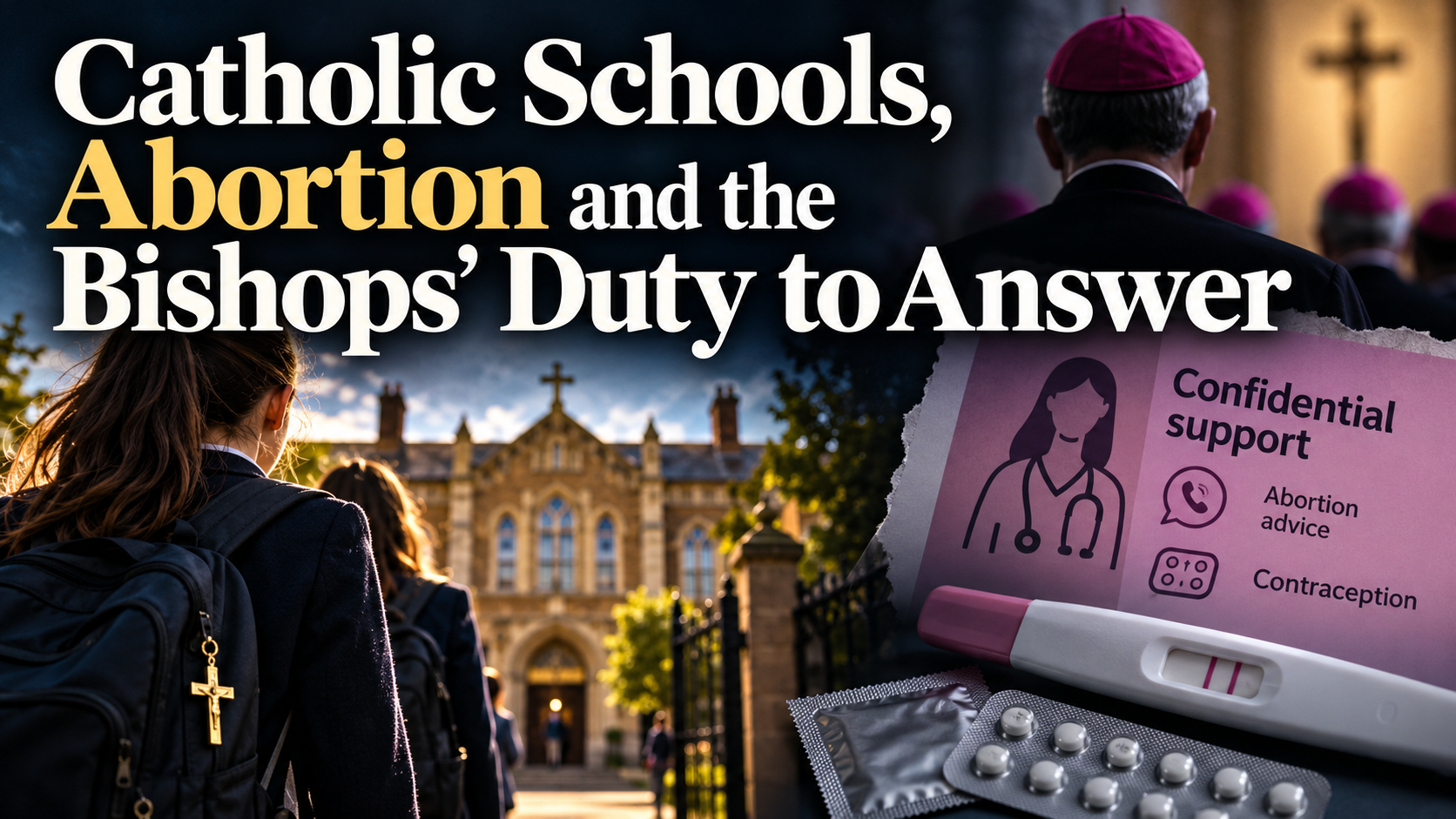
John Smeaton has challenged the Catholic Education Service over the teaching of abortion, contraception and confidential sexual health advice. The evidence raises a question which cannot be settled by assurances about Catholic ethos: what are children actually being taught, and where are they being directed?
Catholic parents have a right to expect that schools established in the name of the Church will teach the Church’s moral doctrine without ambiguity. John Smeaton’s investigation raises serious questions about the Catholic Education Service and the widely used Life to the Full programme. The response from Ten Ten Resources deserves a fair hearing, but neither statutory compliance nor an assurance of good intentions can substitute for demonstrable fidelity to Catholic teaching.
A Catholic school should not need to be investigated by Catholic parents to establish whether it is teaching Catholic doctrine. The very name ought to carry a guarantee. Parents entrust their children to these institutions because they expect something more than a respectable education accompanied by prayers, religious assemblies and occasional references to Christian values. They expect the faith to govern the education itself, particularly where questions of life, marriage and morality are concerned. If they must examine lesson plans to discover whether abortion is being presented as a morally acceptable option, the difficulty is not confined to the wording of a curriculum. It concerns the purpose of Catholic education and the confidence placed in those responsible for it.
John Smeaton has brought that difficulty into sharp focus. Writing for Voice of the Family on 7 October 2026, he alleges that most Catholic schools in England and Wales are promoting information about confidential access to abortion and contraception through relationships and sex education provision aligned with the Catholic Education Service (CES). He identifies the CES model curriculum, a policy adopted by a Catholic girls’ school in north London, and the widespread use of Life to the Full, produced by Ten Ten Resources, as evidence of a problem extending beyond individual schools. His allegation is a serious one. It deserves neither automatic acceptance nor the familiar institutional response that concerns over Catholic teaching have simply arisen from misunderstanding.¹
The first distinction is essential. Smeaton reports that Life to the Full is used in more than 80 per cent of Catholic schools. That does not establish that the same proportion actively directs children towards abortion providers. Use of a programme is not proof that every lesson is delivered identically, that every resource remains unchanged, or that every reference to an external service constitutes a recommendation to obtain an abortion. The actual materials, their current versions and their use in individual schools must be examined. Yet it would be equally mistaken to dismiss the investigation because its opening claim goes further than the available evidence conclusively demonstrates. The substance of the concern is sufficiently important to require an answer.
Smeaton quotes the policy of a north London Catholic school under which Year 10 pupils, generally fourteen and fifteen years old, are to learn where they can obtain confidential sexual and reproductive health advice and treatment. He connects this to the CES model curriculum, which includes learning about sources of sexual health advice and support in the event of an unintended pregnancy.¹ The language derives from the vocabulary of statutory relationships and sex education. In the civil context, such provision may encompass information about contraception, abortion and confidentiality. In a Catholic school, however, the question cannot end with the identification of legally available services. The school must also communicate the moral principles by which their use is to be judged.
Here lies the fundamental distinction between providing information and providing moral formation. A pupil may properly be taught that abortion is permitted by civil law in specified circumstances. A pupil may be informed that contraceptives exist and understand what they do. An older pupil may need to understand the law governing medical confidentiality. None of these matters, considered in isolation, requires the school to approve what the Church condemns. But a curriculum is not morally neutral simply because it describes itself as factual. The selection of information, the treatment of competing arguments, the language of personal choice and the direction given towards further advice all convey an understanding of human conduct. A Catholic school must be able to account for that understanding.
The Catholic Education Service itself recognises the obligation. Its published guidance states that Catholic schools must deliver relationships and sex education in accordance with the teaching of the Church and regards this obligation as compatible with the requirements of the Department for Education.² That is a substantial commitment. It means that Catholic doctrine is not supposed to appear as an optional supplement to a fundamentally different account of sexuality. It should govern the curriculum’s approach to the human person, marriage, parenthood and the protection of life. The question is whether that principle is consistently realised in the resources and teaching practices which the CES supports.
The statutory position also needs precision. The revised Department for Education guidance came into force in England on 1 September 2026. It requires schools to address reproductive health, contraception, pregnancy and abortion within an age-appropriate curriculum, while recognising the distinctive position of schools with a religious character.³ Wales operates under its own Relationships and Sexuality Education framework within the Curriculum for Wales. The two jurisdictions must not be treated as though they were governed by a single English statute. The CES and Ten Ten provide training connected with both systems, but the statutory duties must be examined separately.⁴
The existence of a legal requirement does not remove the responsibility of Catholic educators to decide how that requirement is fulfilled. There is an enormous difference between teaching that abortion is legally available and teaching that it is morally permissible. There is a further difference between explaining where confidential medical advice may be obtained and directing a child towards organisations which facilitate acts contrary to Catholic teaching. These distinctions are neither obscure nor impractical. Schools make judgments about external providers, educational resources and safeguarding referrals every day. They cannot plausibly claim that judgments become impossible when the subject is abortion.
Some of the most troubling passages cited by Smeaton concern the presentation of abortion itself. He describes a Life to the Full dramatisation entitled Pregnancy and Abortion, in which a fictional pupil, Holly, faces a decision about her pregnancy. The lesson, according to the extracts he supplies, encourages pupils to develop their own values and attitudes towards the issue. Smeaton also quotes presenters discussing differing perspectives on the beginning of life and the vulnerability of the unborn child.¹ His objection is that a matter upon which the Church teaches definitively appears to have been placed within a framework inviting pupils to arrive at their own conclusions.
There is a legitimate pedagogical place for examining arguments and asking pupils to reason. Catholic education should cultivate the intellect, not demand the unthinking repetition of approved conclusions. But intellectual formation has an end: the apprehension of truth. To ask a pupil to understand why the Church condemns abortion is one thing. To leave the impression that its morality must ultimately be determined by whatever values the pupil chooses to adopt is another. The former respects the intellect; the latter risks reducing moral truth to personal preference.
The biological and moral questions must also be distinguished with care. Fertilisation ordinarily begins the development of a new human organism. That biological account should not be confused with philosophical disputes over personhood or legal debates about the protection afforded to the unborn. It would be scientifically careless to present the existence of developing human life as merely a Christian opinion. Equally, the biological description alone does not settle every philosophical argument about moral status. Catholic teaching supplies the moral judgment: human life must be respected and protected from conception. In Evangelium Vitae, St John Paul II unequivocally reaffirmed the grave moral wrong of direct abortion.⁵ That is not a position which a Catholic school is free to leave unresolved.
Ten Ten Resources has not remained silent under criticism. In November 2024, responding to an earlier Voice of the Family investigation, it published an extensive defence of Life to the Full. It maintained that its materials were faithful to Catholic doctrine, disputed the interpretation of particular extracts and argued that critics had failed to consider the full sequence of lessons. It pointed to resources which explicitly communicate the Church’s teaching about abortion and explained the difficulties involved in presenting morally serious subjects to children at different developmental stages.⁶ Those answers deserve proper consideration. A programme containing clear condemnation of abortion must not be represented as though it never teaches that abortion is wrong.
But the defence also exposes the difficulty of assessing a curriculum through isolated passages. A declaration of fidelity in one lesson does not automatically resolve ambiguity in another. The issue is the coherent understanding communicated to pupils over the course of their instruction. Children do not encounter doctrinal propositions in isolation. They encounter stories, dilemmas, conversations, exercises, suggested resources and the judgments their teachers choose to emphasise. A curriculum may contain every necessary proposition somewhere in its materials and still fail to give those propositions their proper governing place.
Ten Ten’s discussion of contraception is especially revealing. Responding to criticism of its Year 9 material, the organisation acknowledged that an earlier lesson had concentrated on the characteristics and effectiveness of contraceptive methods and concluded by encouraging abstinence before marriage rather than explaining fully the moral wrong of contraception within marriage. It defended that approach on pedagogical grounds, while stating that a subsequently revised version explicitly presented the Catholic teaching that contraception is wrong.⁶ Both facts matter. The original omission was doctrinally significant; the reported revision prevents the older criticism from being treated without qualification as an accurate description of the current lesson.
The significance of the omission should nevertheless be understood. The Church’s teaching on contraception is not simply that unmarried people should abstain from sexual intercourse. Humanae Vitae concerns the deliberate frustration of the procreative meaning of the marital act itself.⁷ Teaching children that sexual intercourse belongs within marriage, while leaving contraception within marriage unexplained, risks conveying a materially incomplete account of Catholic doctrine. Age-appropriate instruction may require gradual explanation. It does not justify presenting a partial moral principle as though it were the complete teaching.
One particularly contentious aspect of the investigation concerns Childline. Smeaton argues that referrals to the service expose pupils to information about obtaining abortion and contraception confidentially, including links to organisations offering reproductive health services.¹ Ten Ten replies that its references to Childline occur in safeguarding contexts, particularly where a child may be experiencing abuse or feel unable to approach parents or other trusted adults. It explicitly denies directing pupils towards Childline’s abortion or contraception material.⁶ This distinction is decisive in assessing the allegation. A safeguarding referral is not, without further evidence, an abortion referral.
That does not make the question of external signposting irrelevant. It changes the question which must be answered. Schools should consider the purpose of a referral, the material available through the recommended organisation, the age and vulnerability of the pupils concerned, and whether parents and teachers understand the limits of the recommendation. A service may provide essential assistance to children experiencing abuse while also publishing advice which conflicts with Catholic teaching. Both realities can exist simultaneously. The proper Catholic response is not to deprive abused children of confidential assistance, but to ensure that safeguarding arrangements are sound and that referrals do not inadvertently substitute an incompatible moral framework for the one the school is bound to teach.
Catholic parents should not have to choose between the safety of their children and fidelity to the faith. Nor should those defending Catholic moral teaching speak as though every confidential conversation between a vulnerable child and a safeguarding professional is an assault upon parental rights. Genuine abuse, coercion and exploitation require protection, and sometimes a child cannot safely turn first to a parent. The Church’s teaching concerning parental authority does not authorise indifference to such circumstances. Equally, exceptional circumstances cannot justify treating parents generally as obstacles to be circumvented in matters of their children’s moral formation.
Parental authority is not merely an interest which schools should consult as a courtesy. It is a duty and a right grounded in the natural family. Canon law expressly recognises the responsibility of parents to provide for their children’s education and their right to choose an education consistent with the Catholic faith. Familiaris Consortio describes parents as the first and principal educators of their children.⁸ A school assists them in discharging that responsibility. It does not replace them or acquire an unrestricted mandate to decide what moral convictions their children should develop.
This principle connects directly with concerns previously examined in Nuntiatoria over PSHE provision, safeguarding, third-party materials and the interpretation of parental rights. Those controversies have demonstrated how readily the authority of public bodies, professional organisations and educational providers can come to be treated as a sufficient answer to questions about the content of instruction. The dispute concerning Catholic RSE makes the issue more uncomfortable because the institutions whose judgment is being questioned are ecclesiastical. A parent may reasonably expect greater, not lesser, clarity from an agency operating under the authority of the bishops.
There is also an important institutional fact which deserves closer examination. The CES and Ten Ten have worked together on teacher-training programmes for relationships and sex education, including publicly accessible courses for schools in England and Wales. The CES training materials describe their collaboration, while the CES publishes model curricula and policies.⁹ Ten Ten has stated that its individual programmes are not formally approved by the CES through a national approval process.⁶ That distinction should be preserved. Partnership, promotion, curricular alignment and formal approval are not interchangeable terms. Nevertheless, a partnership which publicly associates an educational provider with the bishops’ educational agency creates a reasonable expectation that the doctrinal content will be subject to serious and continuing scrutiny.
The bishops cannot be expected to examine every sentence spoken by every teacher. They can, however, establish the doctrinal standards by which schools and resource providers must operate. They can require transparency about materials, insist upon accurate presentation of the Church’s moral teaching and ensure that diocesan educational authorities respond meaningfully to complaints. They can also ask whether the pursuit of statutory compliance has gradually led Catholic education towards a division between religious aspiration and classroom practice: Catholic doctrine affirmed in principle, but its authority weakened when pupils are required to consider particular moral decisions.
That danger is not peculiar to relationships and sex education. It belongs to a wider ecclesiastical temptation to preserve Catholic terminology while adopting assumptions drawn from secular institutions. Terms such as dignity, freedom, inclusion, wellbeing and personal choice may be perfectly legitimate, but their meaning depends upon the anthropology in which they are employed. Catholic teaching understands freedom in relation to truth and the good. A curriculum which leaves pupils with the impression that morality is constituted by autonomous choice is not made Catholic by occasional references to virtue or religious belief.
The controversy must not obscure the pastoral needs of an actual pupil facing an unexpected pregnancy. Such a child requires immediate compassion, careful safeguarding, practical support and freedom from coercion. The Catholic response must protect both mother and unborn child, recognising the fear, isolation or pressure which may accompany such circumstances. It must offer assistance rather than simply recite prohibitions. But precisely because the situation is serious, the Church must not conceal her teaching. To present direct abortion as a morally neutral option would abandon the unborn child and fail to offer the mother the full truth which Catholic education exists to communicate.
For the same reason, vague assurances about a programme’s Catholic character are insufficient. Parents should be able to inspect the current lesson materials, including videos and supplementary resources, rather than merely a published policy or promotional overview. They should know whether their school uses revised or older versions of disputed lessons, how teachers are instructed to present Catholic doctrine, and which external organisations pupils are encouraged to contact. Ten Ten states that full programme access is available to parents on request through the school’s RSE lead.⁶ That offer provides an obvious starting point. It should be used.
The responsibility of governors is no less important. A governing body which adopts a Catholic educational programme because it is widely used or associated with an ecclesiastical agency has not necessarily discharged its duty of oversight. It must ask whether the actual provision corresponds to the doctrinal commitments contained in the school’s foundation and policies. Diocesan authorities, in turn, should ensure that governors possess the competence and support needed to make such judgments. The familiar practice of deferring upwards to an external provider or national body cannot absolve those who are directly responsible for the education delivered.
The bishops of England and Wales could provide a decisive answer to the present controversy by commissioning a transparent review of Catholic RSE provision. That review should examine the CES model curricula, distinguish the statutory obligations applicable in England and Wales, inspect the current versions of widely used programmes, assess the treatment of abortion and contraception against the Church’s teaching, and clarify the position regarding external referrals. Providers should have the opportunity to respond to specific criticisms. Parents should be told what has been examined and what conclusions have been reached. If deficiencies are identified, they should be corrected openly rather than concealed behind the language of reassurance.
Such a review would not require the bishops to adopt every allegation made by Smeaton. It would require them to recognise the legitimacy of asking whether schools claiming Catholic authority are fulfilling Catholic responsibilities. His investigation may overstate the evidence for the claim that most schools actively promote access to abortion. Ten Ten may be correct in disputing particular interpretations of its materials. But neither point removes the duty of the CES and diocesan educational authorities to demonstrate that the teaching provided under Catholic auspices is substantially and consistently Catholic.
There is a historical obligation here which should not be forgotten. Catholic schooling in England and Wales was established and sustained through considerable sacrifice. Families accepted hardship, made financial contributions and defended the independence of their schools because they believed their children needed an education formed by the faith. That inheritance was never intended to produce institutions which differ from their secular counterparts chiefly in religious observances while approaching the gravest moral questions through the same assumptions about personal choice.
The test is not whether a school mentions Catholic teaching. It is whether that teaching governs what the school says and does. No amount of religious branding, episcopal association or curricular accreditation can replace that test.
John Smeaton has asked parents to check the abortion policy of their child’s Catholic school. They should. But the matter ought not to end with individual parents obtaining documents and pursuing explanations from headteachers. The Catholic Education Service and the bishops whose authority it represents should be able to give a clear, public and verifiable account of what Catholic children are being taught.
The burden of establishing fidelity should not fall upon parents who have already entrusted their children to the Church. It belongs first to those who have accepted responsibility for educating them in her name.
1. John Smeaton, Check the Abortion Policy of Your Child’s Catholic School, Voice of the Family, 7 October 2026.
2. Catholic Education Service, Relationship and Sex Education, guidance and associated model resources, updated March 2026.
3. Department for Education, Relationships Education, Relationships and Sex Education (RSE) and Health Education, revised statutory guidance, effective 1 September 2026.
4. Catholic Education Service Wales and Ten Ten Resources, Relationships and Sexuality Education: Training for Catholic Schools in Wales.
5. John Paul II, Evangelium Vitae, 25 March 1995, §§57–62.
6. Rod Isaacs, Ten Ten Resources, Life to the Full: Response to the Voice of the Family Report, 26 November 2024.
7. Paul VI, Humanae Vitae, 25 July 1968, §§11–14.
8. John Paul II, Familiaris Consortio, 22 November 1981, §§36–37; Code of Canon Law, Canons 226 §2 and 793.
9. Catholic Education Service and Ten Ten Resources, Relationships, Sex and Health Education: Teacher Training Platform; Catholic Education Service, RSE: CES Model Framework Policy to Support Schools, March 2026.





Leave a Reply