
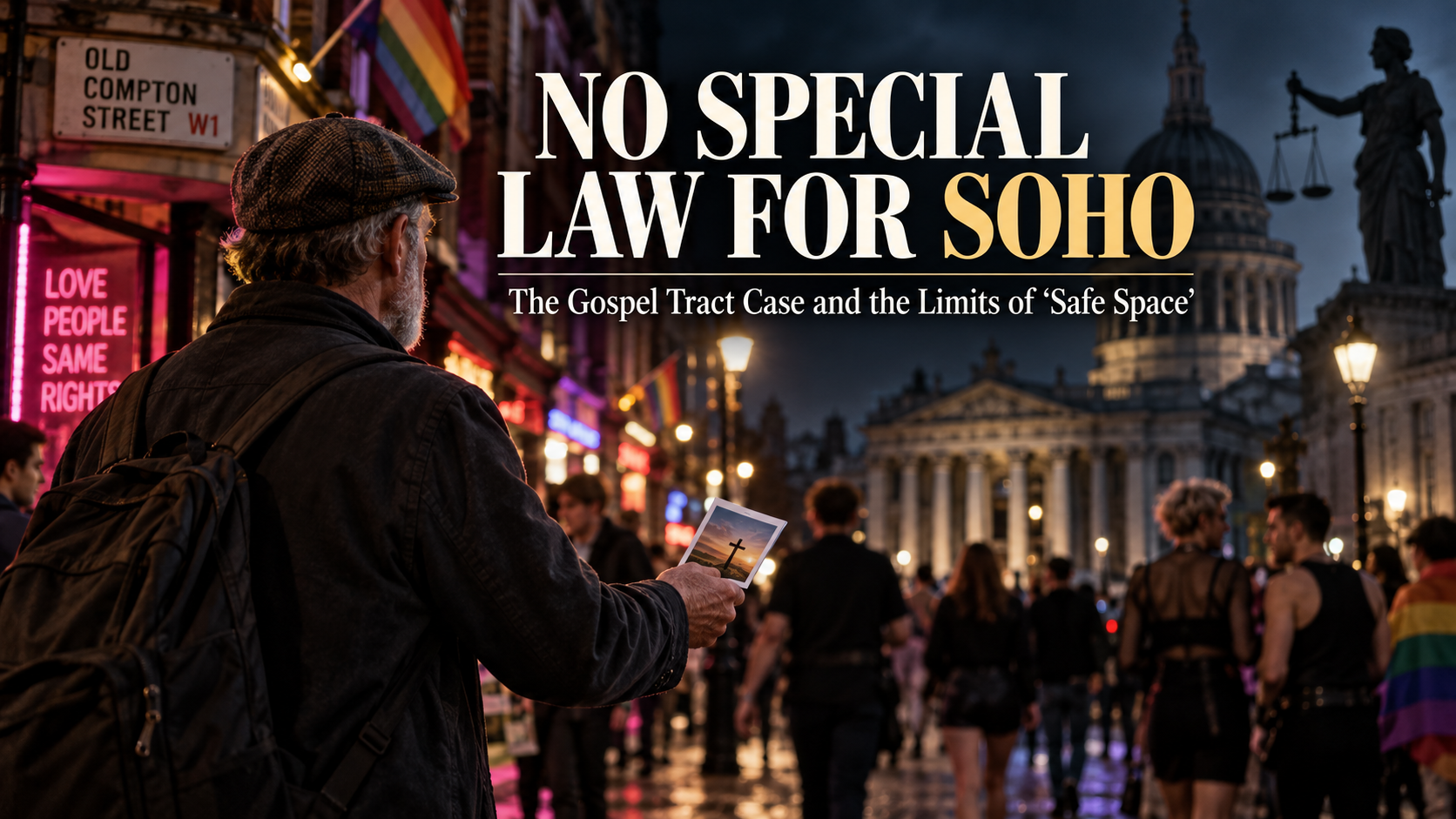
For nearly seventeen months Richard Johnson faced criminal proceedings because of an evangelical tract distributed in Soho. His acquittal matters beyond one preacher and one provocative leaflet. At issue was whether the identity of an audience, and the cultural character of a neighbourhood, can make otherwise protected religious expression more susceptible to prosecution. The magistrates have answered with an important reminder: offence is not itself a crime, and Soho does not possess a separate law of speech.
On 14 April 2025 Richard Johnson went into Soho carrying Christian literature. On 4 September 2026 he finally left the City of London Magistrates’ Court acquitted. Between those dates lay police involvement, charging decisions, adjournments and the knowledge that a criminal conviction remained possible because of an illustrated Gospel tract called Doom Town.¹
Johnson is a 72-year-old evangelical Christian. The tract, published by Chick Publications, retells the biblical account of Sodom and Gomorrah and applies an explicitly evangelical message concerning homosexuality, sin, divine judgement, repentance and salvation. It is not subtle literature. Nor is it designed to be. Its purpose is conversion, and its method is the highly graphic, confrontational form of evangelism for which Chick tracts have long been known. Catholics may have reservations about the theology, method and prudence of such material without accepting that its distribution therefore belongs in the criminal courts.
Johnson’s own account was that he had spent part of the day at the British Library before travelling through the West End with a substantial quantity of Christian literature. Most of the tracts he carried had nothing to do with homosexuality. In Old Compton Street, however, he distributed copies of Doom Town outside Comptons and spoke of his own earlier same-sex experiences before his conversion to evangelical Christianity. Two younger men subsequently followed him, shouting at him to “get out of Soho”. Johnson said that he feared he might be assaulted and eventually left the area.²
The prosecution which followed was brought under section 4A of the Public Order Act 1986, the offence of intentional harassment, alarm or distress. That provision is more exacting than a general prohibition upon upsetting people. The prosecution must establish the relevant threatening, abusive or insulting words, behaviour or visible representation; an intention to cause harassment, alarm or distress to a specific victim; and actual harassment, alarm or distress resulting from the conduct. The Crown Prosecution Service’s own charging guidance expressly warns that intention alone is insufficient and that the effect upon the alleged victim must itself be proved. It also recognises that the statutory defence of reasonable conduct must be interpreted consistently with freedom of expression and that interference with protected expression requires convincing justification.³
That legal structure matters because the criminal law does not treat anger, offence, indignation, harassment, alarm and distress as synonyms. Nor may courts simply substitute the vocabulary of contemporary cultural conflict for the statutory language enacted by Parliament. A person may despise a religious tract, regard it as insulting and passionately object to its message without thereby establishing the ingredients of section 4A.
The evidence exposed precisely that distinction. The complainant who appeared at trial described Doom Town as shameful and inflammatory and repeatedly spoke of his anger at its contents. Yet Johnson had not personally handed him the tract. It had reached him through another person after Johnson had moved away from the immediate vicinity. The complainant later telephoned the number written on the tract, left a message saying that he considered it disgusting and would report Johnson to the police, and then returned to the pub.⁴
The second allegation was weaker still. The other complainant had discovered a copy of the tract on a window sill at the French House and had neither seen nor spoken with Johnson. He did not attend the trial. The CPS sought to introduce his statement as hearsay under section 114 of the Criminal Justice Act 2003; Johnson’s barrister, Michael Phillips, opposed the application; the court refused it; and the prosecution then offered no evidence on that charge.⁴
The surviving prosecution therefore required the magistrates to distinguish strong personal offence from the constituent elements of a criminal offence. They acquitted Johnson. The court accepted that the literature was offensive and that it had caused genuine upset, but found that the prosecution had not established all the necessary elements. There had been no threatening conduct, and the expression before the court had not crossed the high threshold necessary before criminal sanction could be imposed. A defence costs order followed.¹
The most troubling feature of the prosecution, however, was not merely the content of the tract. It was the significance attached to where Johnson had chosen to distribute it.
One complainant described Soho as an LGBT “safe space”. The prosecution’s closing case relied upon Johnson’s deliberate decision to take literature dealing with homosexuality into a district closely identified with LGBT life. His defence understood the argument to imply that controversial Christian expression delivered in Soho might properly be treated differently from equally controversial expression in a traditional forum such as Speakers’ Corner. Phillips described the danger as the creation of a de facto “gay buffer zone”.¹
Precision is important here. The CPS did not enact, and plainly could not enact, a separate legal jurisdiction for Soho. Nor did it formally declare the district an LGBT exclusion zone for Christian evangelism. The phrase “safe space” came from a complainant. The constitutional concern is more serious precisely because it is less crude: the identity of the anticipated audience and the cultural character of the location were being relied upon as circumstances tending towards criminal liability.
That presents a problem which cannot be answered merely by saying that context always matters. Of course context matters in criminal law. A threat whispered outside a victim’s home is not identical to the same words in an academic discussion. A course of targeted abuse differs from a general political speech. Conduct, intention, audience and surrounding circumstances may all be evidentially relevant. But the character of a neighbourhood cannot itself lower the threshold protecting lawful expression simply because particular beliefs are especially unwelcome there.
If that principle were conceded, the implications would be considerable. Christian teaching on homosexuality would become legally more hazardous in Soho because Soho contains a large and visible LGBT community. Criticism of Islam might become legally more hazardous in a predominantly Muslim district. A secular campaigner entering a strongly Christian neighbourhood could likewise find that deliberate engagement with the people most likely to reject his message counted against him. The public highway would begin to fragment into informal ideological territories in which the practical freedom to speak depended upon the dominant identity of those expected to hear.
That is not pluralism. It is the territorialisation of opinion.
Article 10 of the European Convention on Human Rights exists in part because freedom of expression would be almost meaningless if it protected only agreeable expression. Since Handyside v United Kingdom, the Strasbourg jurisprudence has repeatedly affirmed that the freedom extends not only to ideas favourably received or treated as inoffensive but also to those which “offend, shock or disturb”. The European Court regarded that protection as a consequence of the pluralism, tolerance and broadmindedness without which a democratic society cannot exist.⁵
The qualification matters. Article 10 is not absolute. Expression may lawfully be restricted for legitimate purposes where the interference satisfies the Convention standard. Threatening behaviour, criminal harassment, incitement and other genuine wrongdoing do not acquire immunity merely because their perpetrator attaches a religious label to them. An evangelist may commit a public-order offence while evangelising just as a political activist may commit one while protesting.
What Article 10 prevents is the reversal of the burden by which controversiality itself begins supplying the reason for suppression. If an expression receives constitutional protection only until those hearing it become sufficiently offended, those most intolerant of disagreement acquire the greatest practical power to restrict it.
The High Court confronted a related problem earlier this year in DPP v Coskun. Hamit Coskun had burned a Qur’an outside the Turkish Consulate while expressing fierce hostility towards Islam. His conduct was deliberately provocative and factually remote from Johnson’s evangelical tract distribution. Yet the legal connection is important. After Coskun’s conviction had been overturned, the CPS asked the High Court to intervene. On 27 February 2026 the Administrative Court rejected the challenge and left the acquittal standing. The courts again insisted upon the distinction between expression which is deeply offensive and conduct satisfying the requirements of a public-order offence.⁶
Nuntiatoria examined the developing litigation in February in England’s Free Speech Test: the Coskun Case and the Return of Blasphemy by Prosecutorial Means, and returned to the judgment later that month in Law, Blasphemy, and the Limits of Offence. The point was never that burning a Qur’an is admirable. It was that abolition of blasphemy becomes illusory if public-order law is made to perform substantially the same function whenever enough offence can be demonstrated.⁷
Johnson’s case presents the same constitutional problem in an even clearer religious-liberty setting. Christian evangelism is necessarily directed beyond those who already accept Christian teaching. “Going therefore, teach ye all nations” does not describe a closed devotional exercise among the converted. Evangelisation presupposes the proposition that another person may presently believe something false, practise something morally wrong or live apart from a truth which he ought to receive. Repentance is unintelligible without the possibility of moral disagreement.
A conception of religious freedom under which the Christian remains perfectly free to proclaim repentance except to those whose conduct he believes requires repentance is therefore not religious freedom in any substantial sense. It protects religion as ceremony, identity, private consolation and heritage while placing its missionary truth-claims under suspicion precisely where they cease to be socially agreeable.
None of this requires Catholics to defend every evangelical method. Doom Town is not Catholic catechesis. Johnson’s theology is not ours, and neither the editorial method of Chick Publications nor every prudential judgement made by an evangelical street preacher becomes worthy of imitation because a prosecution fails. The legal principle does not depend upon admiration for the speaker.
Catholics have a particular interest in maintaining that distinction. Once protection attaches only to religious expression considered temperate, modern or socially acceptable by secular authorities, Catholic teaching on abortion, marriage, sexual morality, the uniqueness of Christ, the necessity of conversion and the Last Judgement becomes protected only at the sufferance of those required to tolerate it.
This is why “safe space” is such a dangerous expression when it migrates from voluntary social arrangements into arguments concerning the criminal law. A private association may organise its own internal life around expectations of affirmation or ideological agreement. A pub may have a particular clientele. A club may cultivate a particular identity. None of that transfers proprietary rights over the surrounding streets or the ideas permitted upon them.
Soho has a long and conspicuous association with LGBT culture. That is a social reality. It does not create an LGBT jurisdiction. Gay men and lesbians are entitled to precisely the same protection from violence, threats, intimidation and criminal harassment as everybody else. They are not thereby entitled to ownership of the moral propositions which may be uttered within Old Compton Street.
The difference is between protecting persons and protecting propositions.
Christian moral teaching condemning homosexual acts may be expressed contemptuously or charitably, crudely or intelligently, prudently or foolishly. Its truth is a theological question; the manner in which it is expressed may raise moral and, in sufficiently serious circumstances, legal questions. But the proposition itself cannot become less legally speakable merely because it is voiced in the presence of people most likely to reject it.
The principle must operate reciprocally. Nuntiatoria made that argument in The State Erased the Case File: Blasphemy Law by Stealth when examining the Government’s definition of “anti-Muslim hostility”. Muslim citizens possess an unquestionable right to protection from violence, threats and unlawful discrimination. Islam does not thereby acquire a civil right not to be contradicted. The distinction between protecting Muslim persons and protecting Islamic propositions is indispensable to any serious conception of religious liberty.⁸
The same rule applies here. LGBT people are persons possessing dignity and civil rights. “LGBT” propositions about sex, identity, relationships and morality are propositions. They may be defended, contested or rejected. Confusing the inviolability owed to the human person with an imagined inviolability attaching to the ideas associated with his identity makes serious disagreement increasingly impossible.
That confusion is already reshaping political language. Orthodox Christian teaching is routinely redescribed as political extremity because progressive culture has moved sharply away from doctrines which Christians held before the modern categories of Left and Right existed. Nuntiatoria addressed precisely that problem this week in Christianity Is Right ~ Not Right Wing. The Christian doctrine of marriage did not originate as a manifesto commitment of the contemporary Right. The fact that ancient Christian moral teaching is now acutely politically controversial describes a change in the surrounding culture, not a transformation in the historical origin of the doctrine.⁹
Johnson’s prosecution should also be considered in light of a wider institutional temptation documented elsewhere. In The FBI Put Catholic Tradition on the Extremism Map, Nuntiatoria examined how religious belief and practice entered an American intelligence framework which began with a legitimate investigation of violent conduct but expanded until traditional Catholic communities, priests and doctrines became analytical markers. The jurisdictions and facts differ profoundly, but the warning is related. Institutions become dangerous when they cease beginning with unlawful conduct and begin instead with disfavoured beliefs, identities or associations from which evidence of possible wrongdoing is then sought.¹⁰
That is why the correct response to Johnson’s acquittal is not triumphalism. There remain legitimate questions about evangelistic prudence, social courtesy and the Christian manner of addressing those with whom we profoundly disagree. Charity forbids contempt. It does not require silence about sin. Indeed, Christianity understands charity to seek the real and ultimate good of the person loved. Whether Johnson’s chosen tract represented the wisest means of doing that is a different question from whether distributing it satisfied the elements of a criminal offence.
The court answered the latter question.
The unanswered question belongs to the CPS and the police. How did the case reach a full criminal trial?
Johnson lived for nearly seventeen months with prosecution hanging over him. One complainant had never received the literature from Johnson himself. The second had never encountered Johnson at all and ultimately did not appear. The prosecution nevertheless proceeded under an offence requiring proof of intentional harassment, alarm or distress. At trial, the identity of Soho as an LGBT district became a significant part of the argument. The magistrates ultimately found the criminal threshold unmet.
The process cannot simply be dismissed as irrelevant because the verdict was correct. Criminal prosecution carries consequences before conviction: anxiety, cost, disruption, reputational damage and the coercive authority of the State. That is why prosecutorial judgement matters. An acquittal can vindicate the accused without demonstrating that the preceding decision to prosecute was proportionate or wise.
Nor should the lesson be reduced to a request for special solicitude towards Christians. Christians need no privileged law for Soho. They require the same law.
A Muslim preacher must be free to advance Islamic claims which Christians find offensive. An atheist must be free to denounce Christianity. A homosexual campaigner must be free publicly to reject Christian sexual morality. A Christian must be free peacefully to say that homosexual acts are sinful and that repentance is necessary for salvation. Where any of them threatens, intimidates or criminally harasses another, the ordinary criminal law remains available.
What cannot survive alongside meaningful freedom is a system in which the identity of the audience quietly alters the threshold at which disagreement becomes prosecutable.
The significance of Johnson’s acquittal therefore lies beyond Doom Town, beyond one evangelical preacher and beyond Soho. It concerns whether Britain will maintain a genuinely plural public square or replace it with a collection of culturally demarcated spaces whose dominant communities acquire an informal veto over unwelcome expression.
“Safe space” may describe a social aspiration. It must not become a principle of territorial censorship.
There can be no Muslim quarter in which Islam becomes less criticisable, no Christian enclave in which atheism loses protection, no political district in which opposition is presumptively inflammatory, and no LGBT neighbourhood in which Christian teaching moves closer to criminality merely because it is Christian teaching delivered to those most likely to reject it.
The law should protect the people in Soho.
It should not protect Soho from ideas.
Britain needs one public law for one public square.
¹ Christian Concern, “Evangelist acquitted after CPS says Soho is LGBT ‘safe space’”, 9 September 2026; Christian Today, “Street preacher acquitted in Soho ‘safe space’ case”, September 2026. Christian Concern records that the full-day trial took place on 4 September 2026 and that Johnson was acquitted of all charges.
² Christian Concern, “Evangelist acquitted after CPS says Soho is LGBT ‘safe space’”, account of the events of 14 April 2025 and Johnson’s evidence concerning Old Compton Street and Rupert Street.
³ Crown Prosecution Service, “Public Order Offences incorporating the Charging Standard”, section 4A guidance; Crown Prosecution Service, “Verbal abuse and harassment in public”. The CPS states that section 4A requires intention to cause harassment, alarm or distress to a specific victim and evidence that somebody actually suffered that effect; it also recognises the relevance of freedom of expression to the statutory defence of reasonable conduct.
⁴ Christian Concern, “Evangelist acquitted after CPS says Soho is LGBT ‘safe space’”; The Eye of Media, “Sexual Abuse Survivor Turned Evangelist Cleared After Soho Gospel Leaflet Prosecution”, 10 September 2026. Both report the first complainant’s evidence, the second complainant’s absence, the rejected hearsay application and the CPS decision to offer no evidence on the second allegation.
⁵ European Court of Human Rights, Handyside v United Kingdom, judgment of 7 December 1976, §49. The Court’s established Article 10 formulation protects ideas which “offend, shock or disturb” as part of the pluralism necessary to democratic society. See also European Court of Human Rights materials reiterating the principle.
⁶ High Court of Justice, Administrative Court, Director of Public Prosecutions v Coskun [2026] EWHC 427 (Admin), 27 February 2026. See also Nuntiatoria’s account of the judgment and its treatment of the distinction between offensive expression and the statutory public-order threshold.
⁷ Nuntiatoria, “England’s Free Speech Test: the Coskun Case and the Return of Blasphemy by Prosecutorial Means”, 13 February 2026; Nuntiatoria, “Law, Blasphemy, and the Limits of Offence: The Coskun Judgment and the Return of a Forbidden Word”, 28 February 2026.
⁸ Nuntiatoria, “The State Erased the Case File: Blasphemy Law by Stealth”, 21 August 2026.
⁹ Nuntiatoria, “Christianity Is Right ~ Not Right Wing”, 8 September 2026.
¹⁰ Nuntiatoria, “The FBI Put Catholic Tradition on the Extremism Map”, 4 September 2026.



Leave a Reply