
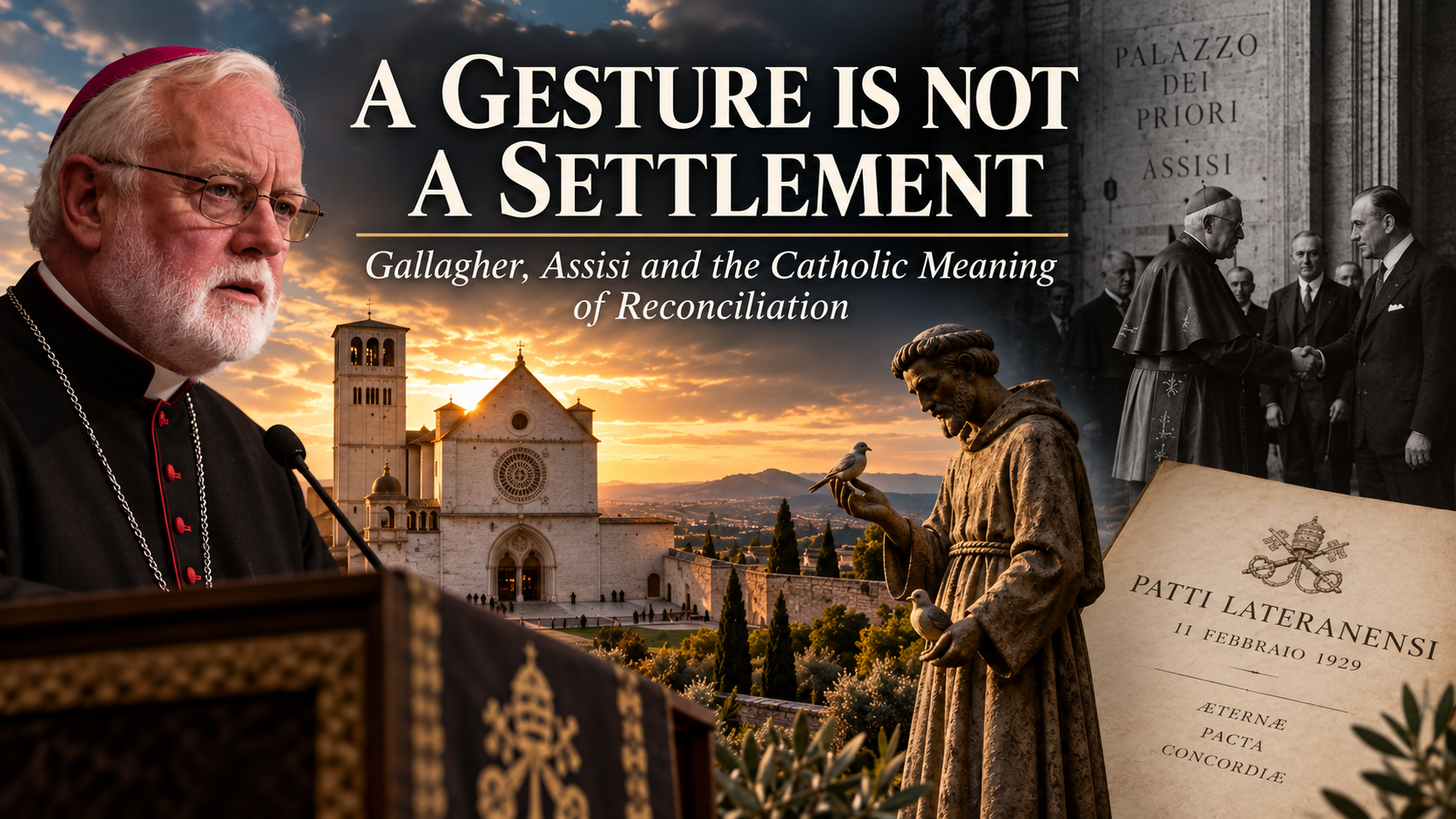
Archbishop Paul Richard Gallagher’s address in Assisi contained a proposition more demanding than the usual ecclesiastical praise of dialogue. Encounter may begin reconciliation, he argued, but gestures must become “just and lasting rules”; diplomacy cannot manufacture peace, but it can establish the human, political and juridical conditions in which peace takes root. The history he invoked explains why. Reconciliation does not consist in pretending differences have disappeared. It requires them to be faced honestly enough for a durable order to replace permanent estrangement. That lesson belongs first to diplomacy, but not only to diplomacy. It also deserves attention in a Church which now speaks incessantly of listening, dialogue and process while some of its deepest disputes remain unsettled.
On 7 September, during the year marking the eighth centenary of the death of St Francis of Assisi, ✠Paul Richard Gallagher, the Holy See’s Secretary for Relations with States and International Organizations, addressed the annual seminar for theology professors and pastoral assistants of the Università Cattolica del Sacro Cuore. The setting carried unusual historical weight. The seminar met in Assisi’s Palazzo dei Priori, where a century earlier, on 4 October 1926, Cardinal Rafael Merry del Val, representing Pope Pius XI, met Pietro Fedele, Minister of Public Instruction in the Kingdom of Italy. It was the first official encounter of its kind between a papal legate and an Italian Government minister since the rupture created by the events of 1870.¹
The meeting did not resolve the Roman Question. It broke the impasse which had made resolution possible. Gallagher drew the distinction plainly. “No agreement is born without a willingness to meet,” he said, but gestures must eventually be translated into “just and lasting rules”. Assisi opened a road which, three years later, led to the Lateran Pacts of 11 February 1929. His summary deserves to be remembered: “A gesture can open a road; law can give it stability.”²
That sentence is rather more exacting than much of the vocabulary now used in Catholic public life. “Dialogue”, “encounter”, “listening”, “accompaniment”, “discernment” and “process” are all capable of describing necessary things. None tells us whether anything has actually been settled. A conversation may be sincere and still fail. Listening may be extensive and still evade judgement. Institutions can spend years discussing a division without becoming any clearer about what would count as its resolution. The danger begins when the method acquires a prestige independent of the result.
The Lateran settlement was not vague. Italy recognised the sovereignty of the Holy See and the Vatican City State; the Holy See recognised the Kingdom of Italy with Rome as its capital and declared the Roman Question closed. The accompanying Concordat regulated the position of the Church in Italy. The settlement was later revised, most notably in 1984, but that does not diminish what happened in 1929. A political and ecclesiastical conflict which had lasted for nearly sixty years was converted into a juridical relationship in which rights, obligations and competencies could be stated rather than merely inferred.³
No sensible Catholic need romanticise the Fascist Government with which the agreement was made, still less treat the Lateran Pacts as conferring moral approval upon Mussolini’s regime. Pius XI himself would later confront Fascist claims with considerable force. Diplomacy has never required the Church to sanctify the person sitting across the table. It requires clarity about what can be agreed, what cannot be surrendered and what arrangement may secure a just peace between parties whose convictions remain very different.
Gallagher returned repeatedly to that point. Distinction need not become estrangement; collaboration need not become confusion; stability need not mean immobility. The language is careful because the realities are. The Church and the State are not the same society and do not possess the same ends. The possibility of cooperation depends upon recognising that distinction, not abolishing it. Likewise, a settlement remains capable of lawful revision without ceasing to have been a settlement in the first place.⁴
The important point is not that differences cease to matter once people begin talking. Gallagher said almost the opposite. Authentic dialogue, he observed, “does not erase differences”, but seeks the circumstances in which they may coexist with loyal cooperation. Diplomacy cannot generate peace simply by assembling the right people in a room. It prepares the “human, political and juridical conditions” in which peace may become possible.⁵
The analogy with disputes inside the Church has obvious limits. A State and the Church can remain fundamentally different in nature while reaching agreements about their relations. Within the Church, revealed truth cannot be treated as merely one negotiating position among several. Catholic communion is not preserved by allowing contradictory doctrines to coexist under an agreed procedural framework. The Deposit of Faith is received; it is not produced by compromise.
Yet that limitation sharpens rather than weakens Gallagher’s underlying point. Reconciliation requires an honest account of what the dispute actually is. The language surrounding a conflict cannot be permitted to replace the conflict itself.
The peace Pius XI actually meant
The historical setting is also worth recovering because the 1926 encounter is easily detached from the pontificate which produced it. Merry del Val did not represent a Church retreating from Catholic claims in order to discover a neutral common ground with the modern State.
Less than ten months before the Assisi meeting, Pius XI had promulgated Quas Primas and instituted the Feast of Christ the King. His programme was summed up in the phrase “the peace of Christ in the Kingdom of Christ.” In Ubi Arcano Dei Consilio, his first encyclical, he had already rejected the notion that peace consisted in external courtesy or the simple management of antagonisms. Justice and charity were indispensable; right order mattered; the law of Christ could not be excluded from public life without consequences. Quas Primas repeated the same conviction from another direction, insisting that no enduring peace could be expected from a social order which treated Christ’s sovereignty as irrelevant.⁶
There was therefore no contradiction between Catholic principle and negotiation. Merry del Val could meet a minister of the Italian State without pretending the theological differences between them were unimportant. Pius XI could conclude a concordat without abandoning Catholic teaching on the rights of the Church or the Kingship of Christ. The possibility of agreement depended upon knowing where agreement was possible and where it was not.
Pope Leo XIV himself returned to this history last October when he described Merry del Val as a “true diplomat of encounter”. His praise was not for a diplomacy of doctrinal concealment. Those serving the Church, Leo said, should not seek to make their own voices prevail, but rather allow “the truth of Christ” to speak. He coupled truth with charity, prudence with boldness and service with humility.⁷ That is a rather different vision from the assumption that dialogue succeeds whenever disagreement has been made less visible.
The present Franciscan centenary reinforces the same point. At its opening in January, Leo recalled St Francis’s greeting, “May the Lord give you peace”, while insisting that Christian peace is given “from above”. It is not diplomatic etiquette dressed in religious language. The peace associated with Francis is finally rooted in Christ crucified, whom Leo described as **“the source of all reconciliation”.**⁸ Diplomacy has its work to do, and so does ecclesiastical prudence, but neither creates the peace whose deepest cause is grace.
When process becomes the destination
Gallagher’s address therefore sits rather awkwardly beside one of the recurrent features of contemporary ecclesiastical language: the elevation of process almost to the status of a good in itself.
Nuntiatoria has examined this repeatedly. In “Synodality for the Initiated: How Collegiality Became Permanent Process”, we looked at the expansion of synodality into a complex machinery of questionnaires, facilitators, syntheses, assemblies and implementation structures. “Experts in Synodality: Leo XIV and the Rise of the Church of Process” considered what follows when a particular methodology begins generating its own professional class. “When Listening Has a Predetermined Answer” returned to the more fundamental question of what listening is supposed to achieve in a Church which receives Revelation rather than voting it into existence.⁹
Gallagher’s Assisi formulation supplies an uncomplicated test. What has the process clarified? What has it resolved? What concrete form of ecclesial order is supposed to follow?
There is nothing objectionable in patience. Some disputes require years of theological work, careful consultation and practical experience. Premature settlements can conceal rather than heal divisions. But delay and discernment are not the same thing, and an unfinished process does not become more fruitful merely because its continuation has acquired a theological vocabulary. Eventually the Church must teach, judge, govern or decide that no further conclusion can presently be reached.
The Roman Question illustrates the difference. The encounter of 1926 was not celebrated as the achievement of permanent dialogue. Negotiation followed. Drafts were produced. Competencies were defined. Agreements were signed. A conflict which had structured Church–State relations in Italy since 1870 ceased to be indefinite.
That is what successful process looks like. It reaches a point at which something has changed.
And then there is Écône
The application to the Society of Saint Pius X requires particular care. Gallagher did not mention the SSPX, nor should his address be repackaged as though it were a veiled comment on the episcopal consecrations of 1 July. But the Holy See cannot reasonably articulate principles about dialogue, difference, reconciliation and juridical settlement in one sphere and expect Catholics never to ask how those principles look when applied elsewhere.
Nuntiatoria has consistently argued that the SSPX controversy cannot be reduced to a preference for the older liturgy or to the administrative fact of canonical irregularity. “Rome Must Name the Doctrine” asked the Holy See to specify which propositions attributed to the Society are incompatible with Catholic communion and what precise assent is required in their place. “The SSPX Is Not Really on Trial — The Post-Conciliar Settlement Is” examined ✠Athanasius Schneider’s argument that the dispute inevitably reopens questions concerning religious liberty, ecumenism, liturgical reform and the interpretation of Vatican II. “The Questions Rome Still Has Not Settled” returned to objections originally brought before Rome by ✠Marcel Lefebvre and ✠Antônio de Castro Mayer. Most recently, “Crisis is the Cause; Necessity is the Effect” argued that responsibility cannot be assigned only in one direction: Rome must answer the substantive claim of crisis, while Écône must show that the extraordinary measures it has taken were genuinely necessary and proportionate.¹⁰
It would be equally wrong, however, to write as though Rome had never attempted serious dialogue. Benedict XVI understood very well that the disciplinary and doctrinal questions were distinct. When he remitted the excommunications of the four SSPX bishops in 2009, he stated explicitly that the Society’s lack of canonical status was ultimately bound up with doctrinal difficulties, particularly those involving Vatican II and the post-conciliar Magisterium. Formal doctrinal discussions followed.¹¹
The sequence matters. A disciplinary obstacle was removed so that substantive engagement could proceed. The doctrinal dispute was then addressed with the intention that canonical regularisation might follow if sufficient agreement were reached. That is recognisably the same architecture which Gallagher described at Assisi: the opening of contact, serious engagement with the dispute, and a juridical arrangement once the grounds for one exist.
The failure is that the final stage never came.
The events of 2026 have made the consequences of that failure more acute. Rome is entitled to maintain that episcopal consecration carries public and juridical consequences and that no bishop possesses a private right to create successors according to his own judgement. The SSPX, for its part, cannot merely invoke necessity as a slogan; the existence, gravity and proportionality of the claimed emergency require argument. Yet none of that answers the doctrinal questions which continue to divide the parties. A canonical decree can establish how Rome judges an act. It cannot by itself demonstrate the continuity of Dignitatis humanae with the preceding Magisterium, settle disputed accounts of ecumenism, or answer the historical and theological objections raised against the liturgical reform.
This is where Gallagher’s distinction becomes useful. Law can give durability to reconciliation once reconciliation has been achieved. It cannot perform the work of reconciliation by legislative force.
Where the underlying disagreement remains intact, juridical action may regulate behaviour, impose penalties or define institutional boundaries. Sometimes it must. But it should not be confused with an answer to the argument which produced the conflict.
The same question appears in another form when ecclesiastical institutions speak of hospitality and inclusion. Our recent reporting from Lourdes noted the striking contrast created when organised Anglican worship could be accommodated within the Sanctuary while the SSPX was prohibited from celebrating Mass or organising public prayer there. Whatever judgement one reaches about the canonical position of Écône, such contrasts cannot be treated as pastorally meaningless. A Church which speaks with great generosity about dialogue beyond Catholic communion while addressing an internal traditionalist dispute almost entirely through the language of restriction and discipline will inevitably invite questions about the consistency of its principles.¹²
The freedom of the Church is not negotiable
Another part of Gallagher’s address deserves at least equal attention. Speaking of libertas Ecclesiae, he insisted that the freedom of the Church is not a corporate privilege. It exists so that the Church may fulfil her mission and includes the institutional dimension of religious liberty.
That principle should be applied to Vatican diplomacy itself.
In “The Constitutional Church and the Patriotic Church: The Lesson Rome Forgot”, Nuntiatoria examined the present accommodation with Communist China alongside the historical experience of the Civil Constitution of the Clergy in revolutionary France. The situations are plainly not identical, but the ecclesiological question beneath them is recognisable. States may regulate civil affairs affecting religious bodies; they cannot become the source of episcopal authority or redefine the constitution which the Church received from Christ. Diplomacy may accept unsatisfactory circumstances and negotiate limited improvements where nothing better is immediately available. It may proceed gradually in order to protect Catholics exposed to persecution. What it cannot do is treat the divine constitution of the Church as one more term available for exchange.¹³
Gallagher’s defence of libertas Ecclesiae provides a useful criterion precisely because it is not absolutist. The success of an agreement is not measured by the fact that signatures were obtained. The important question is whether the settlement actually protects the Church’s freedom to carry out the mission entrusted to her.
That is also why the Assisi address is more significant than its conventional language might initially suggest. Gallagher did not offer a sentimental account of reconciliation. He described a discipline. One must be prepared to meet an opponent without pretending he is not an opponent; to preserve distinctions which matter; to cooperate where cooperation is possible; to translate progress into a stable order; and to recognise that some things remain beyond the competence of diplomacy altogether.
The Church needs that discipline internally as much as externally.
Conflict should never become an identity. Catholics gain nothing by cherishing estrangement from Rome, treating every act of authority as suspect or assuming that reconciliation necessarily means betrayal. Neither does the Church gain anything by replacing disputed doctrines with procedural language, by allowing disciplinary acts to stand in for theological answers, or by describing an unresolved relationship as healed because the vocabulary around it has become more accommodating.
Reconciliation is difficult because it demands more than either exclusion or capitulation. It requires the truth to be stated clearly enough that charity has something real to work upon.
Pius XI understood that when the Roman Question was still open. Merry del Val practised it in Assisi. Leo XIV has praised the tradition. Gallagher has now explained, with unusual precision, why encounters become meaningful only when they are capable of producing something more durable than the encounter itself.
A gesture may open the road. What matters is whether anybody intends to arrive.
¹ Antonella Palermo, L’Osservatore Romano, 8 September 2026, “Nella diplomazia le radici della riconciliazione”; ANSA, 8 September 2026, report on the centenary commemoration of the 4 October 1926 Assisi meeting.
² Antonella Palermo, L’Osservatore Romano, 8 September 2026, “Nella diplomazia le radici della riconciliazione”.
³ Secretariat of State, 11 February 1929, “Patti Lateranensi”.
⁴ Antonella Palermo, L’Osservatore Romano, 8 September 2026, “Nella diplomazia le radici della riconciliazione”.
⁵ Ibid.
⁶ Pius XI, 23 December 1922, “Ubi Arcano Dei Consilio”; Pius XI, 11 December 1925, “Quas Primas”.
⁷ Leo XIV, 13 October 2025, “Address to Participants in the Meeting of Studies on Cardinal Rafael Merry del Val”.
⁸ Leo XIV, 10 January 2026, “Letter on the Opening of the Eighth Centenary of the Death of St Francis of Assisi”.
⁹ Nuntiatoria, 14 July 2026, “Synodality for the Initiated: How Collegiality Became Permanent Process”; Nuntiatoria, 14 August 2026, “Experts in Synodality: Leo XIV and the Rise of the Church of Process”; Nuntiatoria, 21 August 2026, “When Listening Has a Predetermined Answer”.
¹⁰ Nuntiatoria, 26 June 2026, “Rome Must Name the Doctrine”; 18 August 2026, “The SSPX Is Not Really on Trial — The Post-Conciliar Settlement Is”; 21 August 2026, “The Questions Rome Still Has Not Settled”; 6 September 2026, “Crisis is the Cause; Necessity is the Effect”.
¹¹ Benedict XVI, 10 March 2009, “Letter to the Bishops of the Catholic Church concerning the remission of the excommunication of the four Bishops consecrated by Archbishop Lefebvre”; Secretariat of State, 4 February 2009, note concerning the Society of Saint Pius X.
¹² Nuntiatoria, 21 August 2026, “Open to Canterbury, Closed to Écône: Lourdes”.
¹³ Nuntiatoria, 14 August 2026, “The Constitutional Church and the Patriotic Church: The Lesson Rome Forgot”.



Leave a Reply