
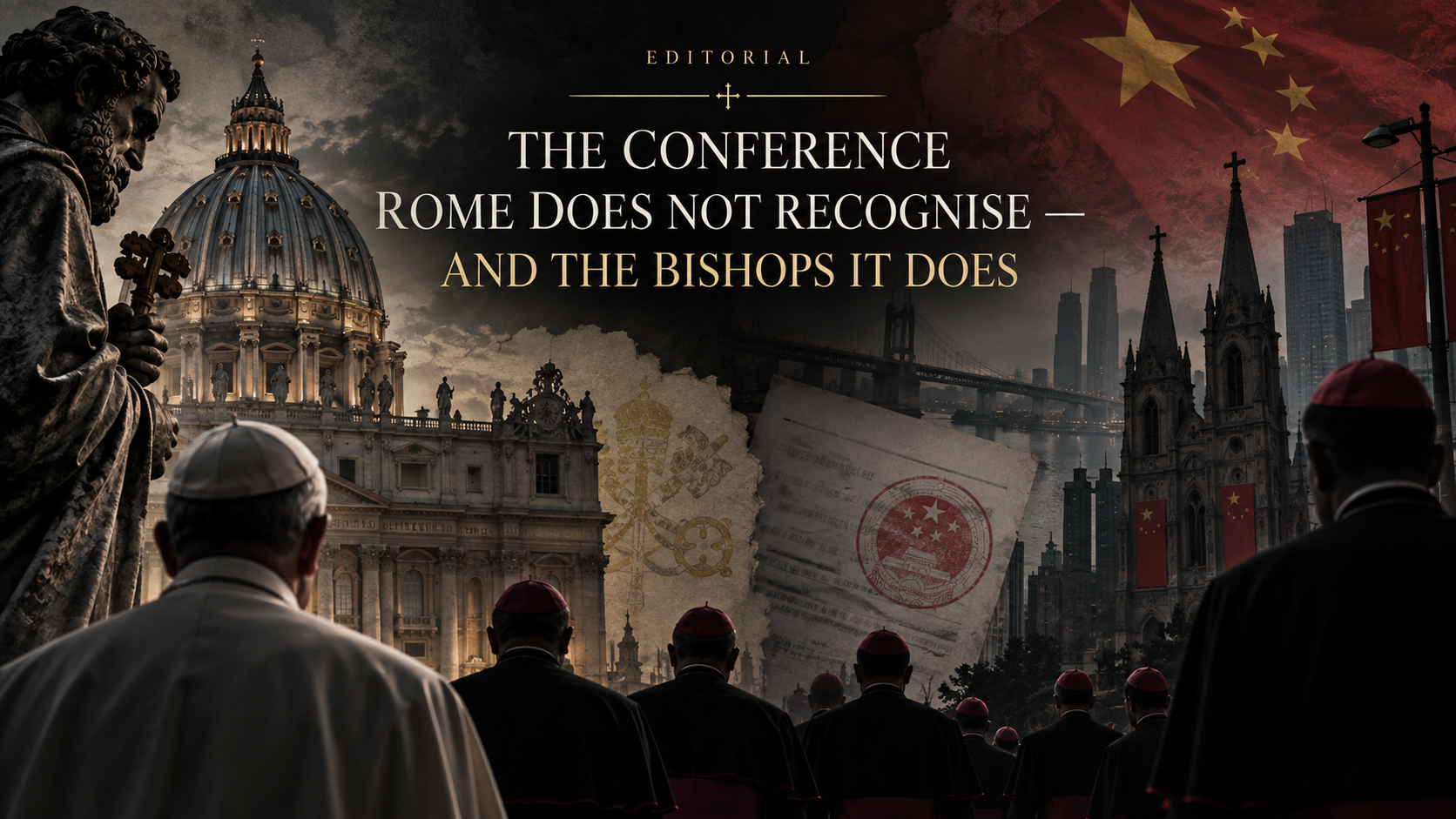
The consecration of ✠Andrew Ding Yang as Archbishop of Chongqing exposes something more consequential than Chinese influence over episcopal appointments. Rome is increasingly recognising as Catholic bishops the men who constitute and administer an ecclesiastical structure which the Holy See has never publicly recognised as a legitimate episcopal conference, and whose present statutes continue to profess principles Benedict XVI identified as incompatible with Catholic ecclesiology.
Anyone attempting to understand the appointment of ✠Andrew Ding Yang as Archbishop of Chongqing from the Holy See’s announcement alone would receive a curiously incomplete picture. Rome tells us that he was born in 1981, studied at the Beijing seminary, served at St Joseph’s parish in Yuzhong, pursued further theological studies in Macao, worked as a formator at the National Seminary in Beijing, studied for a period in Rome and subsequently served as a parish priest at several places within Chongqing. Then comes the decisive sentence: on 28 July 2026 Pope Leo XIV appointed him Archbishop of Chongqing, “having approved his candidacy within the framework of the Provisional Agreement between the Holy See and the People’s Republic of China.”¹
All of that is true. What the Vatican biography does not tell us is at least as important. China’s officially recognised Catholic apparatus identifies ✠Ding as deputy secretary-general of the Bishops’ Conference of the Catholic Church in China, vice-chairman of Chongqing’s Catholic “two associations”, and secretary-general of their Committee for Ecclesiastical Affairs. Its account states that he had already been elected bishop-elect of Chongqing on 15 April 2026. At his episcopal consecration on 8 September, Fr Yang Yu, secretary-general of that same Chinese bishops’ body, formally read its document of approval. The principal consecrator was ✠Joseph Li Shan of Beijing, president of the Chinese Catholic Patriotic Association and vice-president of the bishops’ body; among the co-consecrators were its vice-presidents ✠He Zeqing, ✠Peter Luo Xuegang and ✠Francis Cui Qingqi, together with two of its deputy secretaries-general.²
The chronology therefore requires precision. On 15 April, Ding was elected as episcopal candidate through the official Chinese structure. On 28 July, Leo XIV approved his candidacy under the secret Sino-Vatican Agreement and canonically appointed him Archbishop of Chongqing. On 8 September, the Chinese bishops’ body’s document of approval was read at his consecration. The Chinese election did not itself supply Catholic episcopal jurisdiction, nor did the document read at the consecration constitute the pontifical mandate. The canonical act belongs to the Pope. Serious criticism of the Agreement should not obscure that distinction.
Neither, however, should that distinction obscure what the public record demonstrates. The Archbishop whom Rome has appointed to Chongqing was not simply a priest living reluctantly within a system imposed upon the Church from outside. He was already a senior officer within the Chinese episcopal organisation itself. The bishops who consecrated him include senior officers of the same organisation. The candidate emerged through the Chinese structure before receiving papal appointment, while that organisation publicly retained its own language of election and approval.
The divergence between the Roman and Chinese accounts is therefore not merely one of emphasis. Each side describes the same appointment through the logic of its own institutional order. Rome stresses pontifical appointment and the Provisional Agreement. The Chinese account stresses election, approval and the role of the state-recognised episcopal machinery. Read together, the two accounts expose the structure now taking shape more clearly than either does alone.³
The real question is institutional.
It takes us directly back to Pope Benedict XVI’s 2007 Letter to Catholics in the People’s Republic of China. Benedict did not object simply to the presence of politically inconvenient officials around Catholic institutions. He addressed an ecclesiological principle. Organisations “desired by the State and extraneous to the structure of the Church”, he wrote, could not legitimately become the principal determinants of Catholic life. The preaching of the Gospel, catechesis, charitable activity, liturgical worship and pastoral choices belonged to the bishops with their priests and could not be subjected to external interference. He then addressed the official principles of “independence and autonomy, self-management and democratic administration of the Church” and pronounced them **“incompatible with Catholic doctrine.”**⁴
Benedict was equally specific about the Chinese episcopal organisation. An authentic episcopal conference, he explained, expresses the communion of legitimate bishops and cannot be subjected to civil authority in matters of faith, morals or sacramental life. He therefore concluded that what was then called the College of Catholic Bishops of China “cannot be recognized as an Episcopal Conference by the Apostolic See”: clandestine bishops in communion with Rome were excluded; illegitimate bishops were included; and its statutes contained elements incompatible with Catholic doctrine.⁴
Nineteen years have altered part of that situation considerably. Pope Francis reconciled previously illicit bishops, and the Agreement has produced an episcopate in which bishops can possess both public recognition in China and full hierarchical communion with Rome. Vatican News accordingly stated when the Agreement was extended in October 2024 that episcopal ordinations without papal consent had effectively ceased and that a “radically changed scenario” had emerged. That is a genuine accomplishment. A permanent division between rival episcopal hierarchies would itself be profoundly contrary to Catholic order, and the Church plainly has an interest in securing bishops who possess a pontifical mandate while being permitted to exercise their ministry publicly.⁵
But the personnel problem identified by Benedict was never the whole problem.
The present statutes of the body now styling itself the Bishops’ Conference of the Catholic Church in China are explicit. It describes itself as the national governing organisation for Catholic ecclesiastical affairs. Its purpose includes support for the leadership of the Chinese Communist Party and the socialist system, the study and implementation of Xi Jinping Thought on Socialism with Chinese Characteristics for a New Era, adherence in political, economic and ecclesiastical affairs to the principle of an independently and autonomously administered Church, and the continued Sinicisation of Catholicism. The organisation places itself under the guidance and supervision of state authorities. It also claims functions directly relevant to episcopal appointments: together with the Patriotic Association, it directs diocesan episcopal elections, examines and approves candidates emerging from those elections, and organises and directs episcopal consecrations.⁶
These are not characterisations supplied by critics of Communist China. They are provisions published by the organisation itself.
Nor is the political context obscure. Following the institutional reforms of 2018, the State Administration for Religious Affairs was incorporated into the Chinese Communist Party’s United Front Work Department. Chinese officials themselves explained that this demonstrated the strengthening of the Party’s “centralized, unified leadership over religious work”, while reiterating the policy that religions in China must be Chinese in orientation and guided towards adaptation to socialist society.⁷
Ding’s own record therefore assumes greater significance than the Vatican curriculum vitae suggests. On 30 June this year, little more than a month before his papal appointment, he was functioning publicly as vice-chairman of Chongqing’s Catholic “two associations” and secretary-general of their ecclesiastical-affairs committee at the conclusion of an eight-month programme for clergy. The official report records systematic study of state religious regulations and Chinese Catholic disciplinary measures. ✠He Zeqing, who would subsequently assist at Ding’s consecration, concluded the meeting by calling for continued study of the decisions of the Communist Party’s twentieth congress and its plenary sessions, stronger national, civic and legal consciousness, adherence to the principle of an independent and self-governing Church, and continuing adaptation to socialist society. Ding himself delivered the report reviewing the programme.⁸
That evidence must be handled fairly. It does not establish that ✠Ding privately rejects any doctrine of the Catholic Faith, still less does it entitle outsiders to pronounce upon his subjective culpability. Chinese clergy operate under pressures which Western Catholics can easily underestimate. Participation in official structures may involve conviction, pastoral prudence, coercion, accommodation undertaken to protect the faithful, or some complicated mixture of all four. Catholic moral analysis must distinguish the objective character of institutions from facile judgments about the consciences of individual men.
But the same fairness prevents us from pretending that Ding merely happens to live under Communist rule. He was part of the administration through which the officially recognised Church in Chongqing was being governed. He had already been engaged publicly in its programme of Sinicisation and state-regulated religious formation. He became a deputy secretary-general of the national bishops’ organisation. And when he was consecrated, senior leaders of that organisation formed the episcopal group surrounding him.
The composition is important because it reveals a process broader than Ding himself. ✠Li Shan, the principal consecrator, is simultaneously Bishop of Beijing, president of the Chinese Catholic Patriotic Association and vice-president of the official bishops’ organisation. ✠He Zeqing, ✠Luo Xuegang and ✠Cui Qingqi are all vice-presidents. Cui and Luo had themselves held senior posts in the organisation before receiving or assuming their present leadership roles. The official biographies make clear how thoroughly the personnel of the recognised episcopate and the personnel governing the state-approved ecclesiastical structure now overlap.⁹
This is where Chongqing advances the argument Nuntiatoria has been developing throughout its reporting on China. In Rome’s Red Line Runs Through Écône, Not Beijing, we examined the present statutes of the Patriotic Association and bishops’ body and asked why Rome appeared willing to conduct an extraordinarily patient accommodation with an organisation whose published principles still raised the very objections Benedict XVI had articulated. In The Constitutional Church and the Patriotic Church: The Lesson Rome Forgot, we placed that controversy within the older Catholic struggle for libertas Ecclesiae: the Church’s resistance whenever civil government attempts not merely to regulate her temporal activity but to reconstruct her supernatural government. In The Bishops in the Shadows: China, Écône, and the Question Rome Cannot Avoid, we examined reports of clandestine episcopal provision in Fujian. Most recently, Bishops in the Light, Bishops in the Shadows considered the appointment of ✠Paul Liu Honggang at Datong and asked whether recognised episcopal succession by itself resolves the deeper crisis when the men supplied as bishops have risen through structures of political Sinicisation.¹⁰
Chongqing takes us one stage further. The principal issue is no longer adequately expressed by saying simply that Beijing chooses first and Rome supplies the mandate afterwards. That formulation usefully describes the visible chronology in cases such as Datong and Chongqing, but the secret Agreement prevents us from knowing how much prior consultation may occur before the public Chinese election. There is no evidence sufficient to prove that Beijing alone selects a finished candidate and presents Rome with a fait accompli, and Nuntiatoria has never needed that allegation.
What the public evidence establishes is more difficult to answer. The institutions through which episcopal candidates emerge are themselves increasingly administered by bishops recognised by Rome.
This is the paradox. The Holy See has never publicly announced that the Chinese bishops’ organisation has become a canonically recognised episcopal conference. Its published statutes continue to contain precisely the kind of political and ecclesiastical provisions against which Benedict XVI warned. Yet its president, vice-presidents, secretaries and senior officers increasingly belong to an episcopate possessing Roman recognition. These men participate in the structures of election and approval described in the organisation’s own statutes; they consecrate one another after pontifical appointment; and the distinction between the personnel of the canonical hierarchy and the personnel of the state-approved ecclesiastical structure becomes progressively less visible.
The danger is that a problem Benedict defined ecclesiologically is being solved administratively.
The original difficulty was not merely that the wrong bishops happened to occupy seats within the official organisation. If that had been the whole problem, reconciliation of illicit bishops and the ending of episcopal consecrations without papal consent might substantially have resolved it. Benedict’s objection went deeper. Organisations created under state auspices could not determine Catholic life in matters belonging to the divine constitution of the Church; an episcopal conference could not be subject to civil power in matters of faith and ecclesial life; and the proposition that the Church should be “independent” of the universal hierarchy in her internal government could not be reconciled with Catholic doctrine.
Those principles have not vanished from the published Chinese statutes. What has changed is the canonical status of the men inhabiting the structure.
That may be precisely what Vatican diplomacy intends. There is a respectable argument for such a strategy. If every bishop occupying or eventually entering the official Chinese organisations is in hierarchical communion with Rome, the old practical schism between “official” and “underground” episcopates diminishes. The Pope retains the canonical act of appointment. Illicit consecrations become exceptional rather than routine. Bishops capable of operating publicly may provide sacramental and pastoral stability for millions of Catholics. Patient Roman recognition of individuals might, in time, transform the institutions those individuals inhabit.
Those are not trivial goods, and dismissing them would reduce a grave ecclesiastical problem to polemic.
But the strategy raises an unavoidable question: which side is transforming which?
If the state-created organisation gradually fills with canonically recognised bishops while its constitutional commitments remain substantially unchanged, one cannot simply infer that the organisation has thereby become Catholic in the full ecclesiological sense Benedict required. Canonical legitimacy belongs to persons and offices according to Catholic law; it does not automatically baptise every statute, political obligation or institutional relationship surrounding them.
Nor does the fact of a genuine papal appointment settle the separate question of whether the Pope’s freedom is being exercised within an antecedently conditioned field. Benedict himself acknowledged that Chinese civil authorities might understandably take an interest in bishops because episcopal office has social as well as religious consequences. Catholic history likewise contains concordats under which temporal rulers possessed rights of nomination or presentation. The problem has never been that Caesar may under no circumstances express an interest in who becomes a bishop. The problem arises when the State’s machinery begins determining the structures, ideological qualifications or effective pool from which the Church’s pastors can emerge.
That distinction is particularly important here. The Pope unquestionably appointed ✠Ding. But before that appointment Ding had already been elected through the recognised Chinese ecclesiastical system, already occupied senior office within that system, and already participated in the state-facing programme of religious governance which accompanies it. His consecration then took place under bishops who themselves occupy the leadership of the same official structure. The pontifical act is real; so is the institutional environment in which the candidate reached it.
The continued secrecy of the Sino-Vatican Agreement therefore becomes more consequential with every appointment. Rome may have secured safeguards which cannot be seen from outside. It may possess a genuine veto over candidates. It may conduct extensive consultation before the public Chinese election takes place. It may have negotiated limits intended eventually to strengthen episcopal independence. The terms remain unpublished, so responsible journalism should not pretend to know what they contain.
Yet secrecy cannot answer what the public Chinese statutes themselves disclose. We know what the bishops’ organisation claims for itself. We know the ideological principles to which it commits itself. We know that it participates in episcopal elections and approvals. We know the official positions occupied by Ding and his consecrators. We know that Ding’s public election preceded the announcement of his papal appointment. And we know what Benedict XVI said about external interference, ecclesiastical independence and the canonical character required of an episcopal conference.
The burden therefore lies increasingly upon Rome to explain what has changed at the level of principle.
Has the Holy See concluded that “independence and autonomy” now bears a meaning compatible with Catholic ecclesiology? If so, how does that interpretation coexist with statutes pledging support for Communist Party leadership and Xi Jinping Thought in the same foundational article? Has the official Chinese bishops’ organisation effectively become a Catholic episcopal conference despite the absence of a public act recognising it as such? If so, how have Benedict’s objections been resolved? If it has not, what precisely is the ecclesiastical status of a national body whose senior officers are recognised Catholic bishops and which nevertheless claims functions in episcopal election, candidate approval, doctrine, pastoral regulation and consecration?
These are not semantic objections. They concern libertas Ecclesiae.
The Church does not claim freedom because bishops require political privilege. She claims it because her constitution is received from Christ rather than created by the State. A bishop is not simply a religious functionary whom government permits to administer approved worship. He is a successor of the Apostles, possessing a sacred office ordered to teaching, sanctifying and governing a particular Church in hierarchical communion with Peter. That is why episcopal appointments “touch the very heart of the life of the Church”, as Benedict wrote, and why papal appointment guarantees hierarchical communion. It is also why Benedict insisted in the same document that ecclesiastical government could not be subordinated to an external authority.
These two principles belong together. Peter must be free to constitute the hierarchy; the bishops constituted in communion with Peter must be free to govern as bishops.
The Holy See’s desire for an accommodation with China is therefore not itself the problem. Benedict wanted dialogue with Beijing. Pope Francis pursued it. Leo XIV has inherited the Agreement and continues to implement it. Diplomacy with an authoritarian State can require patience, confidentiality and compromises over circumstances which would be intolerable as compromises over doctrine. Chinese Catholics require bishops and sacraments; clandestinity is not an ecclesiological ideal; reunion is preferable to schism; and a government capable of making Catholic life extremely difficult cannot simply be wished out of existence.
The test is whether accommodation gradually enlarges the Church’s freedom or normalises the machinery that restricts it.
That was the underlying question in our earlier reporting, and Chongqing makes it harder to evade. At Datong, Nuntiatoria asked what kind of episcopate results when Rome recognises candidates whose public careers have developed inside the Patriotic structures. Chongqing now shows one of those structures beginning to reproduce its own Roman-recognised leadership: a deputy secretary-general becomes Archbishop; vice-presidents consecrate him; the secretary-general reads the organisation’s approval; the Pope’s mandate supplies canonical legitimacy.
There is an important difference between regularising bishops within a defective ecclesiastical system and regularising the system through its bishops.
The former is a traditional exercise of Roman authority and mercy. Bishops may be reconciled, jurisdiction supplied and wounds to communion healed without endorsing everything surrounding their previous condition. The latter would be much more consequential. If repeated canonical recognition of the organisation’s personnel eventually causes the state-created structure itself to be treated as though its ecclesiological defects no longer matter, then administrative normalisation will have achieved indirectly what Rome has never publicly conceded directly.
Nothing in the available evidence proves that this is the Holy See’s intention.
But the trajectory deserves scrutiny precisely because intentions do not settle ecclesiological consequences.
Benedict XVI supplied an unusually clear standard in 2007. Nearly two decades later the official Chinese episcopal organisation still publicly professes independent ecclesiastical self-government, Communist Party leadership, the socialist system and Xi Jinping Thought. The Holy See has never publicly explained that these provisions have ceased to present the doctrinal difficulty Benedict identified. At the same time, the men administering that organisation are becoming progressively harder to distinguish from the bishops whom Rome itself recognises.
That is the significance of Chongqing.
The Agreement remains secret; the institutional roster does not. The question is no longer merely whether Beijing participates in episcopal appointments, nor whether Leo XIV retains the final canonical act. He plainly does. The deeper question is what kind of ecclesiastical architecture is being created by the cumulative operation of the Agreement.
Benedict XVI said that the Chinese episcopal organisation could not be recognised because its composition and governing principles were incompatible with the requirements of a Catholic episcopal conference. Nineteen years later, much of the old problem of illegitimate bishops has been resolved. Yet the principles remain written into the organisation’s published statutes, while its senior personnel are increasingly bishops in recognised communion with Rome.
Rome therefore owes the Church an explanation of how the first reality is being reconciled with the second.
For the decisive question is no longer whether canonical legitimacy is entering the official Chinese structure. Plainly it is.
It is whether that legitimacy is transforming the structure according to Catholic ecclesiology — or whether the structure is gradually becoming the normal environment within which the recognised Catholic episcopate in China must exist.
¹ Holy See Press Office, “Consecration of Archbishop of Chongqing, China”, 8 September 2026.
² Chinese Catholic Patriotic Association / Bishops’ Conference of the Catholic Church in China, “The Catholic Diocese of Chongqing Holds the Consecration Ceremony of Bishop Ding Yang”, 8 September 2026; Bishops’ Conference of the Catholic Church in China, “Biographies of the Leadership of the Bishops’ Conference”, 21 September 2022.
³ InfoVaticana, “China consecrates a new bishop under the agreement with the Vatican: Rome highlights the papal appointment and Beijing omits it”, 8 September 2026.
⁴ Benedict XVI, “Letter to the Bishops, Priests, Consecrated Persons and Lay Faithful of the Catholic Church in the People’s Republic of China”, 27 May 2007, especially §§7–9; Holy See, “Explanatory Note — Letter of His Holiness Pope Benedict XVI to Chinese Catholics”, 27 May 2007.
⁵ Holy See Press Office, “Communiqué on the extension of the Provisional Agreement between the Holy See and the People’s Republic of China regarding the appointment of bishops”, 22 October 2024; Vatican News, “Holy See and China extend Provisional Agreement on appointment of bishops”, 22 October 2024.
⁶ Bishops’ Conference of the Catholic Church in China, “Statutes of the Bishops’ Conference of the Catholic Church in China”, published 12 May 2023.
⁷ State Council Information Office of the People’s Republic of China, “SCIO briefing on China’s protection of the freedom of religious belief”, 6 April 2018; CPC Central Committee, “Plan on Deepening Reform of Party and State Institutions”, March 2018.
⁸ Chongqing Catholic “Two Associations”, “Summary Meeting and Preaching Exchange for the ‘Study Regulations, Observe Discipline, Emphasise Cultivation, Establish Image’ Educational Programme”, 30 June 2026.
⁹ Bishops’ Conference of the Catholic Church in China, “Biographies of the Leadership of the Bishops’ Conference”, 21 September 2022; Chinese Catholic Patriotic Association / Bishops’ Conference, “Conclusion of the Tenth National Congress of Chinese Catholicism”, 20 August 2022.
¹⁰ Nuntiatoria, “Rome’s Red Line Runs Through Écône, Not Beijing”, 7 August 2026; “The Constitutional Church and the Patriotic Church: The Lesson Rome Forgot”, 14 August 2026; “The Bishops in the Shadows: China, Écône, and the Question Rome Cannot Avoid”, 28 August 2026; “Bishops in the Light, Bishops in the Shadows”, 4 September 2026.


Leave a Reply