
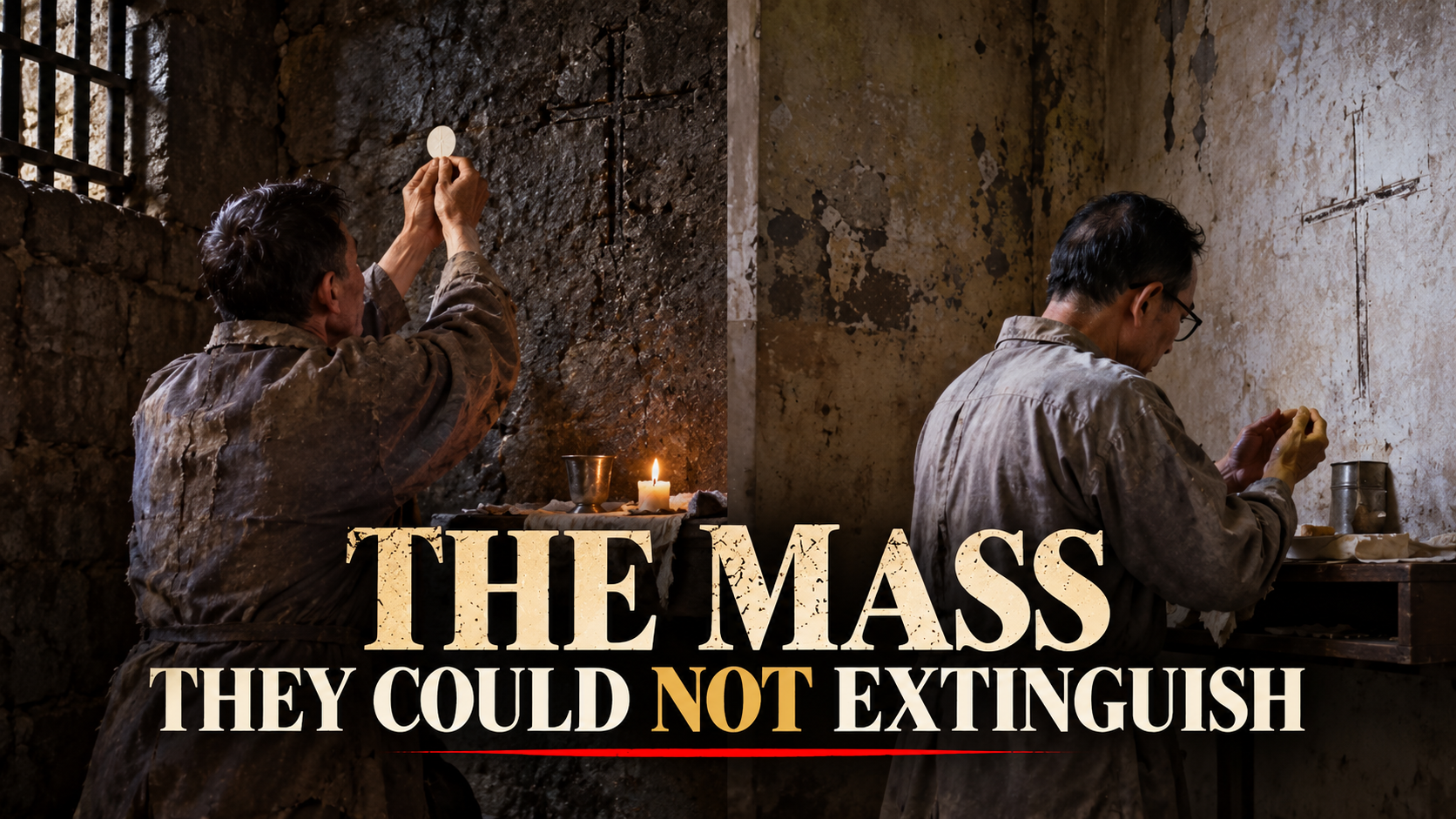
From the mines of communist Albania to a Vietnamese prison cell and the underground Church in China, the Holy Sacrifice has endured where political power sought to silence it.
On 31 July 2026, ninety-seven-year-old Cardinal Ernest Simoni returned to the Albanian prison camp where he had secretly celebrated the traditional Roman Mass from memory under threat of execution. His witness recalls that of Cardinal François-Xavier Nguyễn Văn Thuận, who offered the Eucharistic Sacrifice during thirteen years of imprisonment in communist Vietnam. Both endured persecution rather than abandon their priestly vocation. Their testimony presents the contemporary Church with an uncomfortable question: while successive Popes have honoured the confessors of communist persecution, underground Catholic priests and bishops in China continue to face political coercion, even as the Holy See pursues diplomatic accommodation with Beijing.
On 31 July 2026, Cardinal Ernest Simoni returned to Spaç, the Albanian prison camp where he had once worked in the mines and risked execution for exercising his priesthood. He was ninety-seven years old. Among the things he brought was the miner’s helmet he had worn during his imprisonment. This time he had come to celebrate Mass publicly, remembering those who had suffered and died under Enver Hoxha’s communist dictatorship. The government that had sought to silence him had disappeared. Before an assembled congregation, the elderly priest offered the same Holy Sacrifice he had once celebrated in secret, when discovery might have cost him his life.¹
Spaç was among the most notorious institutions in Albania’s penal system, where political prisoners were compelled to extract copper and pyrite under brutal conditions. During the uprising of 21–23 May 1973, prisoners defied their captors and raised the Albanian flag without its communist star. Four men — Pal Zefi, Skënder Daja, Dervish Bejko and Hajri Pashaj — were executed following the suppression of the revolt, while dozens of others received additional sentences. Their protest exposed the cruelty of a regime that demanded submission in every sphere of life, religious and political. The names of those who died deserve remembrance alongside the testimony of those who survived. The freedom in which Simoni celebrated Mass more than half a century later had been denied to an entire generation of Albanians.²
Simoni had been arrested on Christmas Eve 1963 and condemned to death as an enemy of the communist state. His sentence was commuted to imprisonment and forced labour. He spent eighteen years in captivity, twelve of them working in mines. Following the uprising at Spaç, he was accused of encouraging the prisoners, an allegation he rejected. His release in 1981 brought little immediate freedom. He remained under surveillance and was compelled to clean sewers in Shkodër, continuing his priestly ministry clandestinely until communist rule collapsed. The authorities had attempted to strip him of everything that gave his life its purpose. They had not succeeded.³
In an interview with the National Catholic Register in July 2017, Simoni recalled that he secretly offered Mass in Latin for prisoners he could trust. Bread and wine were smuggled into the camp by a friend. Possessing no missal, he relied upon his memory of the Latin Canon. These were the prayers of the Roman Mass in which he had been formed before the postconciliar reforms, learned so thoroughly that imprisonment could not deprive him of them. The authorities could confiscate his books, search his belongings and prevent public worship, but the Canon remained. He carried within himself the words by which the Church offers the Sacrifice of Christ.³
Ordained in 1956, Simoni belonged to a generation of priests whose understanding of the sacred liturgy had been formed through the traditional Roman Rite. The Canon was not simply a text he remembered because he had repeated it frequently. Its theology of sacrifice, priesthood, grace and divine worship had become integral to his spiritual life. In captivity, when the external circumstances of worship had been stripped away, that formation sustained him. The traditional Roman Mass was no decorative remnant of an earlier ecclesiastical culture. It was the liturgical inheritance through which he continued to exercise his priesthood under the most terrible privations.
There was nothing theatrical about his persistence. Simoni did not celebrate Mass in order to demonstrate his independence of the authorities. He celebrated because he was a priest. The Eucharist was the centre of his vocation, the sacramental re-presentation of Christ’s one Sacrifice upon Calvary. His captors could prevent its public celebration and threaten punishment for clandestine ministry, but they could neither alter its supernatural reality nor destroy the indelible character conferred by Holy Orders. Their power extended over his movements, his labour and the conditions of his captivity. It did not extend to the priesthood instituted by Christ.
Thousands of miles away, another Catholic prelate endured a remarkably similar deprivation. On 15 August 1975, Archbishop François-Xavier Nguyễn Văn Thuận, recently appointed Coadjutor Archbishop of Saigon, was arrested by Vietnam’s communist authorities. He remained imprisoned without trial for thirteen years, including nine years in solitary confinement. Deprived of his cathedral, his ordinary pastoral ministry and almost every material resource associated with episcopal life, he nevertheless continued to regard the Eucharist as indispensable to his vocation.⁴
When permitted to request necessities from his family, Nguyễn Văn Thuận asked for wine, ostensibly to treat stomach trouble. His relatives understood the request and sent him Mass wine in a bottle labelled as medicine, together with small hosts concealed in a torch. In his prison cell, he celebrated the Eucharist with three drops of wine and a drop of water in the palm of his hand. At his funeral in September 2002, John Paul II recalled that the imprisoned bishop’s hand had become his altar and cathedral. The description expressed the extraordinary contrast between the poverty of the circumstances and the infinite dignity of the Sacrifice being offered.⁵
For Nguyễn Văn Thuận, the Eucharist remained the centre of his priestly life when almost everything else had been taken away. He had been ordained in 1953 and formed in the traditional Roman understanding of the sacrificial priesthood. The Mass offered in his prison cell was the same Sacrifice of Calvary he had celebrated in freedom. Neither the absence of his cathedral nor the poverty of his circumstances diminished its supernatural reality. He understood his imprisonment as an opportunity to unite his sufferings more completely with those of Christ, renewing at each celebration the offering of himself to God. John Paul II recalled that this union with the Crucified sustained him through years of isolation, uncertainty and suffering.⁵
That fidelity also bore fruit in his treatment of others. Nguyễn Văn Thuận sought to show kindness even towards his guards, refusing to allow injustice to make hatred the governing principle of his captivity. He spoke with them, answered their questions and regarded them as souls for whom Christ had died. His charity was not acquiescence in the demands of the regime. It was the expression of a supernatural life nourished by the Eucharist. The prison authorities had separated him from his flock, but they had not deprived him of the vocation to seek the salvation of souls.
Both men subsequently entered the College of Cardinals: Nguyễn Văn Thuận was created cardinal by John Paul II in 2001, Simoni by Francis in 2016. Neither possessed that dignity during his imprisonment. Their elevation acknowledged a fidelity already demonstrated without protection, public recognition or any assurance that they would survive. The honour followed the sacrifice.
When Francis visited Albania in September 2014, the testimonies of Simoni and Sister Marije Kaleta moved him so profoundly that he abandoned his prepared remarks during Vespers in Tirana. Here were Christians who had endured years of persecution without surrendering their Faith. Francis declared that those present had encountered living witnesses to martyrdom. Pope Leo XIV continued that recognition in his message for the Mass at Spaç, recalling St Paul’s assurance that neither tribulation, persecution nor death can separate the faithful from the charity of Christ. The message fittingly honoured those who had suffered and urged that their memory should remain alive.⁶
But remembrance imposes obligations. The Church can now honour Simoni without confronting the government that imprisoned him. Nguyễn Văn Thuận’s captivity belongs to an earlier chapter of Vietnam’s history. Their persecutors no longer determine the conditions of their ministry. Yet the demands imposed upon Catholic clergy by communist political authority have not disappeared. In China, bishops and priests continue to face restrictions, surveillance, detention and pressure to submit ecclesiastical life to state-controlled organisations.
China’s circumstances differ from those of Hoxha’s Albania. Officially recognised Catholic churches operate within the People’s Republic, and many of their clergy and faithful sincerely profess the Catholic Faith in communion with Rome. Yet the Chinese Communist Party claims extensive supervisory authority over religious organisations, clerical appointments, teaching and worship. The difficulty is not merely that the government regulates the public activities of religious bodies. It is that political authority seeks to determine the conditions under which the Church may exercise responsibilities deriving from her own divine constitution.
The extent of that interference was documented in an investigation published by Human Rights Watch on 15 April 2026. The organisation reported intensified ideological control, surveillance, restrictions upon religious education and pressure upon underground Catholics to enter state-approved structures. It identified Bishops Peter Shao Zhumin of Wenzhou and Vincent Guo Xijin of Mindong as being under house arrest, alongside other cases of detention, disappearance and restrictions upon episcopal ministry. New regulations have also tightened control over clergy travel, while religious instruction and the participation of children in Catholic worship have increasingly come under political supervision. These restrictions reach into the ordinary life of the Church, affecting the transmission of the Faith as well as the exercise of priestly and episcopal authority.⁷
Particularly troubling was testimony that Chinese officials had invoked the Holy See’s agreement with Beijing to pressure underground Catholics into joining the officially recognised ecclesiastical structure. One witness described clergy confronted with the prospect of accepting registration under the Patriotic Association or losing their livelihood and risking arrest. Others spoke of communities deprived of their previous freedom to gather, priests unable to minister openly and religious life increasingly subjected to political supervision. Human Rights Watch concluded that the agreement had facilitated the government’s campaign against underground Catholics. The allegation concerns the use made of the agreement by Chinese authorities, but its implications for the Church’s diplomatic policy are serious.⁷
The Holy See’s Provisional Agreement on the Appointment of Bishops, concluded in 2018 and renewed for four years in October 2024, was intended to address longstanding divisions within the Catholic Church in China. The existence of bishops appointed without papal approval, alongside clergy recognised by Rome but rejected by the state, had created grave difficulties for ecclesiastical government and communion. The Vatican’s desire to restore unity and regularise episcopal appointments is understandable. Some bishops have subsequently obtained official recognition, and the Holy See continues to present diplomatic engagement as a means of improving the Church’s position.⁸
But ecclesiastical freedom cannot be measured solely by the number of episcopal appointments regularised or the continuation of diplomatic discussions. The agreement’s complete text remains unpublished, while the demands imposed upon underground clergy continue to raise serious questions about the practical independence of the Church. If political officials invoke an agreement with Rome to compel priests into structures they believe incompatible with their ecclesiastical obligations, the resulting difficulty requires more than assurances about the benefits of dialogue. Whatever Rome’s intentions, the spiritual welfare and canonical rights of the faithful cannot become secondary considerations in a diplomatic settlement.
Benedict XVI addressed the essential principle in his 2007 Letter to the Catholics of China. He desired reconciliation between divided Catholic communities and acknowledged the legitimate sphere of civil government. Yet he insisted upon the Church’s own constitution, the authority of her bishops and the necessity of communion with the Successor of Peter. He recognised the fidelity of bishops who had accepted clandestine ministry rather than submit to undue political interference, while expressing the hope that they might eventually exercise their office openly. The distinction between loyalty to one’s country and submission to political control over ecclesiastical affairs was fundamental. The Church could seek peace with the state without permitting the state to determine what it meant to be Catholic.⁹
Indeed, the Holy See’s own pastoral guidelines of June 2019 acknowledged the dilemma confronting Chinese clergy required to register with the authorities. The Vatican recognised that registration could involve declarations accepting the independence and self-administration of the Church in China, expressions whose implications troubled Catholic consciences. It proposed ways in which priests might clarify their adherence to Catholic doctrine when registering, but also expressly respected those unable in conscience to do so. Most significantly, it called upon the Chinese authorities to refrain from intimidation of unofficial Catholic communities. The principle was therefore recognised by Rome itself: the refusal of registration could be an act of conscientious fidelity, deserving pastoral respect rather than coercion.¹⁰
Seven years later, reports of detention, surveillance and enforced registration make the continued application of that principle a matter of immediate concern. The question is not whether the Holy See has abandoned the doctrine of ecclesiastical independence, but whether its diplomatic arrangements are securing adequate protection for those who remain exposed to political pressure. A policy intended to reconcile the Church cannot be judged satisfactory if the price of public recognition is the disappearance of communities whose fidelity has been sustained through generations of persecution.
Nuntiatoria has repeatedly considered these questions, particularly in its examination of the Sino-Vatican agreement and the difficulties faced by underground clergy. The Constitutional Church and the Patriotic Church drew attention to the historical danger of political authorities reconstructing ecclesiastical life according to their own requirements, recalling the plight of France’s refractory clergy during the Revolution. Bishops in the Light, Bishops in the Shadows subsequently examined whether the public recognition of episcopal appointments through China’s official religious structures necessarily secured the freedom of the men appointed. The testimony of Simoni and Nguyễn Văn Thuận brings a further dimension to that discussion. The Church’s liberty is not merely a question of institutional arrangements or diplomatic recognition. It concerns the freedom of her priests and bishops to fulfil the sacred obligations entrusted to them by Christ.¹¹
Catholic obedience remains an obligation, and the ordinary exercise of the priesthood is governed by ecclesiastical law. Neither clandestine ministry nor resistance to authority constitutes an ideal in itself. But the claims of civil government cannot displace the authority which the Church receives from her divine Founder. Where political interference makes the ordinary exercise of the ministry impossible, fidelity may demand sacrifice rather than compliance. Simoni and Nguyễn Văn Thuận understood that obligation because their priesthood was not an appointment conferred by the state, and its responsibilities could not be cancelled by the commands of their captors.
Simoni’s testimony also deserves particular attention amid contemporary controversies surrounding the traditional Roman liturgy. The Latin Canon he carried in his memory was the prayer of the Mass in which he had been formed and through which he continued to exercise his priesthood under persecution. That inheritance had nourished his fidelity long before it became a subject of ecclesiastical dispute. A Church that honours such a confessor should recognise with gratitude the liturgical tradition that helped sustain him. The traditional Roman Mass cannot reasonably be dismissed as an embarrassing survival of an earlier ecclesiastical culture when its prayers remained the spiritual lifeblood of a priest prepared to die rather than abandon his ministry.
There is a lesson here for Catholics who enjoy freedom of worship. The Sacrifice for which these men risked imprisonment and death is the same Holy Sacrifice ordinarily available without danger in much of the Western world. Churches, sacred vessels, vestments, missals and the ordinary means of public worship are readily available, yet the Mass can still be approached with indifference. Simoni and Nguyễn Văn Thuận expose the poverty of such an attitude. Their fidelity was not sustained by an expectation of worldly advantage, social approval or ecclesiastical advancement. It arose from their conviction that the Eucharist was the supreme act of divine worship entrusted to the priesthood.
At Spaç, the miner’s helmet recalled the coercion inflicted upon a priest by the communist state. In Vietnam, Nguyễn Văn Thuận’s hand had become the humble altar upon which he offered the Eucharistic Sacrifice. The two images belong together. One represents what political power could inflict upon the imprisoned body; the other, the supernatural reality which that power could not extinguish. Both men endured the loss of almost everything ordinarily associated with their vocation, yet neither surrendered the priesthood through which he had been called to offer Christ’s Sacrifice.
Their lives deserve the gratitude of the universal Church. Their suffering should be remembered, their courage honoured and their example placed before successive generations of clergy and faithful. But remembrance must have consequences. It would be a bitter irony if the Church were to praise the fidelity of priests who resisted communist interference in Albania and Vietnam while failing to defend adequately those who confront political coercion in China today.
At ninety-seven, Cardinal Simoni has lived to offer Mass openly at the place of his captivity. His return was a triumph of Christian perseverance over a dictatorship that had imagined itself permanent. He could leave Spaç freely, carrying the helmet that once identified him as a prisoner. Some of China’s underground bishops and priests still possess no comparable liberty. Their circumstances deserve the same seriousness with which the Church now regards the testimony of those who endured persecution in the past.
The Church knows how to honour her confessors once the prison doors have opened. The harder test is whether she will defend them while those doors remain closed.
¹ Fabrizio Peloni, Pope to Cardinal Simoni: No Prison Can Separate a Person from God’s Love, Vatican News, 1 August 2026.
² Authority for Information on Former State Security Documents, Prisoners Sentenced to Death in the Spaç Revolt and Re-sentencing after the Spaç Revolt.
³ Fr Seán Connolly, Cardinal Ernest Simoni: The ‘Living Martyr’ of Albania, National Catholic Register, 26 July 2017.
⁴ Cardinal Nguyễn Văn Thuận Foundation, Biography of Cardinal François-Xavier Nguyễn Văn Thuận.
⁵ John Paul II, Homily at the Funeral Mass of Cardinal François-Xavier Nguyễn Văn Thuận, 20 September 2002.
⁶ Francis, Address at Vespers in the Cathedral of Tirana, 21 September 2014; Fabrizio Peloni, Pope to Cardinal Simoni: No Prison Can Separate a Person from God’s Love, Vatican News, 1 August 2026.
⁷ Human Rights Watch, China: Pressure on Catholics Escalates, 15 April 2026.
⁸ Holy See Press Office, Communiqué on the Extension of the Provisional Agreement between the Holy See and the People’s Republic of China Regarding the Appointment of Bishops, 22 October 2024.
⁹ Benedict XVI, Letter to the Bishops, Priests, Consecrated Persons and Lay Faithful of the Catholic Church in the People’s Republic of China, 27 May 2007, §§7–8.
¹⁰ Holy See Press Office, Pastoral Guidelines of the Holy See Concerning the Civil Registration of Clergy in China, 28 June 2019.
¹¹ Nuntiatoria, The Constitutional Church and the Patriotic Church: The Lesson Rome Forgot, 14 August 2026; Bishops in the Light, Bishops in the Shadows, 4 September 2026.





Leave a Reply