

Queer Milk, Public Money and the Child Made Secondary
A publicly financed Edinburgh health charity hosts a group that includes males seeking to induce lactation and feed babies. Ministers deny that government grants pay for lactation services. That narrow accounting answer does not resolve the medical, moral or safeguarding questions.
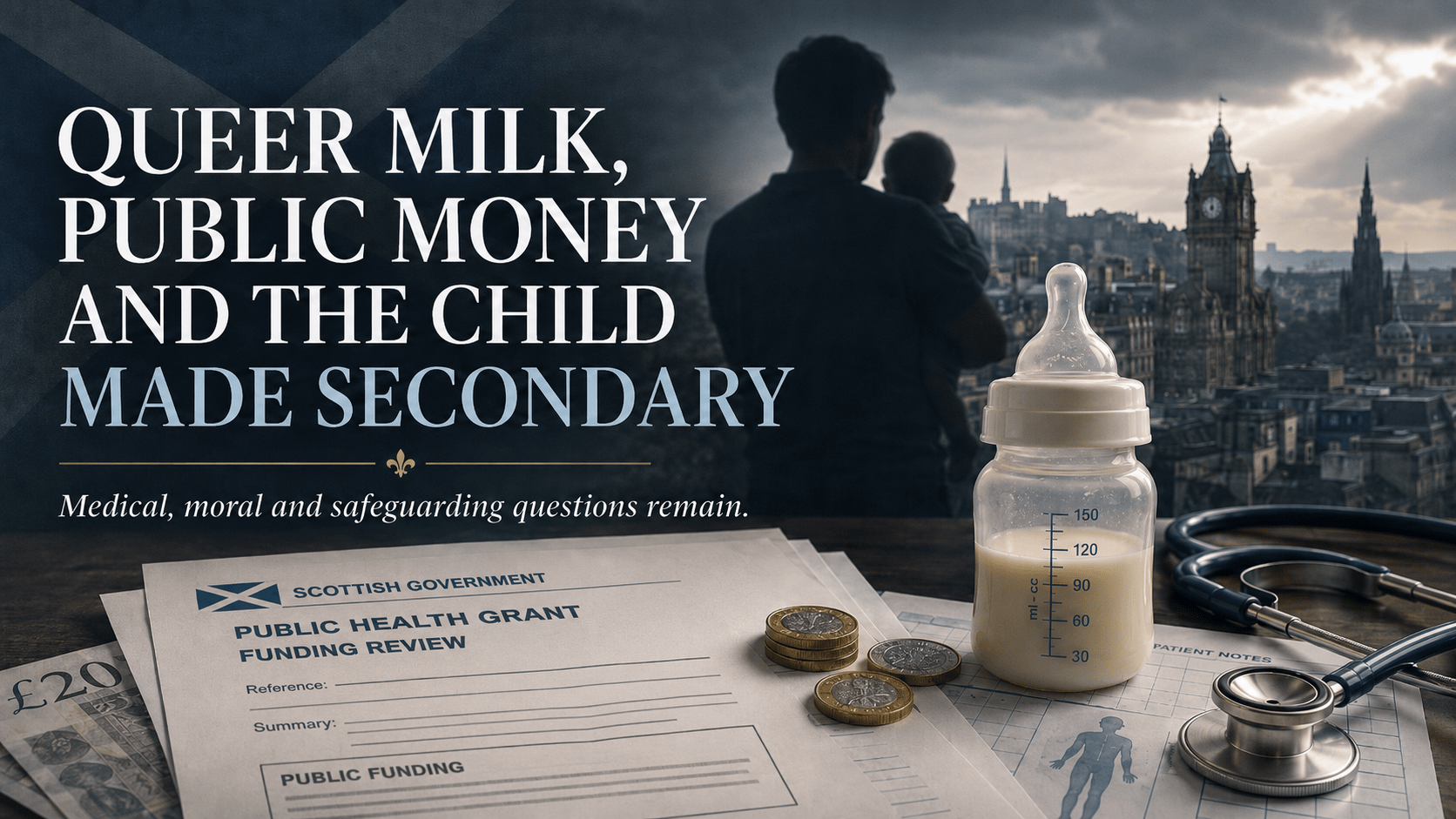
On 27 July, The Times reported that an Edinburgh group called Queer Milk offers support to males who identify as women and wish to induce lactation in order to feed infants. The group is hosted by LGBT Health and Wellbeing, the operating name of the registered charity LGBT Healthy Living Centre, and is advertised as a free service for LGBTQ+ parents who are “breastfeeding, chestfeeding, or giving human milk to their baby”.¹
The newspaper’s description of Queer Milk as a charity was imprecise. It is a community group operating under the auspices of a registered charity. That correction is necessary, not least because a serious argument should not depend upon a careless headline. The substance remains: a health organisation receiving large sums from government and NHS bodies places its premises, publicity and institutional standing behind a programme broad enough to include induced lactation by biological males.
The Scottish Government says that its Equality and Human Rights Fund does not finance lactation services. There is no published evidence that ministers awarded a grant specifically for teaching males to produce milk, nor that Queer Milk itself prescribes hormones or drugs. Those denials and qualifications belong in any honest account.
They do not exhaust the matter. LGBT Health and Wellbeing reported an income of more than £1.15 million for the financial year ending in March 2025. According to the charity’s accounts as reported by The Times, its income included £262,000 from the Scottish Government, £252,000 from NHS Lothian and a further £230,000 from health and social-care authorities in Edinburgh and Glasgow.² Queer Milk appears in the charity’s official programme and benefits from resources that would not exist on the same scale without substantial public support.
A grant may be restricted to one budget line while still sustaining the organisation that hosts another activity. Salaries, premises, administration, publicity, insurance and institutional credibility are not abstractions. Public bodies cannot reasonably finance a health charity, allow it to conduct infant-feeding work under its name, and then insist that the only relevant question is whether a particular invoice was charged to a particular fund.
The language used by Queer Milk covers several different circumstances, some of which raise no unusual moral or medical problem. A woman may breastfeed the child she has borne. An adoptive mother may attempt to induce lactation. A woman who identifies as male may retain her female reproductive organs, carry a child and nurse after birth. These cases should not be muddled together for rhetorical convenience.
The controversy concerns a male patient whose body is subjected to sustained hormonal intervention, breast stimulation and, in some cases, medication intended to provoke lactation. Queer Milk and the medical literature commonly describe such persons as “trans women”. Nuntiatoria does not use that expression as an accurate description of sex. Where the phrase appears in the titles of papers or in quotations, it records the terminology of the source. The persons concerned are male.
It is physiologically possible for a male body to produce milk. That fact should be admitted without hesitation. Denying it allows advocates to present every subsequent objection as ignorance or prejudice. The relevant medical question is not whether secretion can be induced, but whether the practice has been studied sufficiently to justify its presentation as a safe and ordinary form of infant feeding.
A case report published in 2018 described a male patient who received oestrogen, progesterone and domperidone while following a regimen of regular breast stimulation. The patient eventually produced enough milk for the child to receive no other nourishment during the first six weeks after birth. The authors recorded normal growth and development over the period described.³
The report established a possibility in one patient. It did not establish a general clinical standard. Later publications have remained sparse and have chiefly described individual cases. A 2023 paper analysed selected macronutrients in milk produced by one male patient. Other reports published in 2024 included a case in which only a small quantity was produced and feeding ceased after two weeks. The authors themselves noted the lack of extensive research and the absence of an agreed protocol.⁴
That is an important admission. Case reports can alert medicine to an unusual phenomenon or suggest an avenue for further study. They cannot determine long-term safety, identify uncommon adverse effects or prove that apparently similar outcomes will follow across a wider population. The infants described in this literature are few. Observation periods are short. Measurements of fat, protein, lactose and calories do not settle every question concerning hormones, medication exposure, immunological composition or the biological variability between patients.
Domperidone deserves particular attention because it is sometimes used to increase milk production. British pharmaceutical guidance permits its use for low milk supply only after assessment, with limited dosage and subsequent review. That guidance was developed principally in relation to women whose lactation followed pregnancy and childbirth. The United States Food and Drug Administration has not approved domperidone for stimulating lactation and has warned of potentially serious cardiac effects. It also notes uncertainties surrounding infant exposure through milk.⁵
Regulators may differ in their assessment of a medicine without either side believing it to be a harmless supplement for personal experimentation. The intervention requires clinical judgement. It becomes still less ordinary when the drug forms part of a broader attempt to make a male body imitate a maternal function.
No evidence presently available establishes that Queer Milk supplies domperidone, recommends hormone doses or instructs parents to use induced male milk as an infant’s sole nourishment. The group’s public material does not, however, explain the qualifications of those leading its sessions, the clinical advice offered to participants, or the safeguards applied when a child is fed by a male undergoing endocrine treatment.
These gaps do not prove negligence. They are precisely why the Scottish Government and NHS Lothian should ask for a full account. Who is responsible for advice given during the sessions? Are participants referred to paediatric and pharmaceutical specialists? Is the baby’s weight and hydration monitored by a qualified clinician? Are parents informed that the available research consists largely of isolated case reports? What procedures govern the use of hormones and galactagogues?
A publicly supported health body should already possess clear answers. It should also be willing to publish them. Infant feeding is too important to be governed by therapeutic enthusiasm, community affirmation or the assumption that every practice associated with an asserted identity must be welcomed before it is properly studied.
The medical uncertainties are serious, but the moral question runs deeper. The published case literature often describes induced male lactation in terms of bonding, gender affirmation and the experience of motherhood. These motives may be sincerely felt. They remain the desires of an adult. The child cannot consent to becoming the means through which that desired experience is achieved.
An infant is not present to ratify an adult’s understanding of himself. He is not a participant in an identity project. He is a dependent person whose parents and clinicians are obliged to choose according to his good. That obligation becomes more demanding where the practice is novel and the evidence slight.
Catholic theology begins with the body as created, not self-invented. The human person is a unity of body and soul, and sexual difference belongs to that unity. Male and female are not interchangeable social functions laid upon an otherwise neutral organism. The body discloses something true about the person which neither desire nor medical technique can annul.
Motherhood is therefore more than the performance of an isolated action associated with women. Its natural form is rooted in the female body’s ordering towards conception, gestation, birth and nourishment. A particular woman may be infertile, unable to carry a pregnancy or incapable of breastfeeding; none of these sufferings makes her less female. They are privations within a nature genuinely ordered towards maternity.
The male body possesses no corresponding natural orientation towards gestation or maternal nursing. When drugs are given to assist a mother whose milk supply has failed, medicine seeks to repair or support a function proper to her body. When the same or similar drugs are used to induce lactation in a male, no damaged male faculty is being restored. The intervention is directed towards producing the appearance and experience of a function proper to the opposite sex.
That moral distinction does not depend upon hostility to medicine. Catholic moral theology has never taught that every artificial intervention is forbidden. Surgery, anaesthesia, prostheses and pharmaceutical treatment may serve the natural good of the person. The question is whether medicine heals the body according to its nature or conscripts the body into contradicting the truth it bears.
Induced male lactation belongs to the latter category. Its purpose is bound up with the claim that a male may become, or should be treated as, a mother. The drugs and procedures do not cure a disorder in the male capacity to nurse children, because no such natural capacity exists. They create a simulation whose psychological meaning depends upon denying the significance of sex.
The infant is then drawn into that simulation. His feeding becomes the visible confirmation of the adult’s claimed maternity. Even where no immediate physical harm can be demonstrated, the moral order has been reversed: the child’s dependence is used to authenticate an adult identity rather than the adult’s conduct being governed by the child’s prior good.
That reversal should trouble any institution concerned with health, regardless of its religious commitments. It should concern a Catholic publication more profoundly because it touches the created meaning of fatherhood, motherhood and the body itself.
LGBT Health and Wellbeing should disclose whether Queer Milk has supported male participants in inducing lactation, what clinical advice was provided, and what safeguarding standards govern the feeding of infants. The Scottish Government, NHS Lothian and the relevant local authorities should determine whether publicly financed staff, premises or services have facilitated the practice. They should also explain what medical evidence they considered before permitting it to be presented within an officially supported health programme.
The charity promises support regardless of what a parent’s “feeding journey” looks like. That phrase places the adult’s experience at the centre. A health service must begin elsewhere, with the child who depends upon adults to distinguish between what is possible, what is prudent and what is ordered towards his welfare.
Public authorities have been anxious to ensure that no adult feels excluded from the language and experience of parenthood. In doing so, they appear to have overlooked the person at greatest risk from their mistakes. The infant cannot object, cannot choose another feeding arrangement and cannot ask whether the treatment given to the adult has been adequately studied. That silence is not consent. It is the reason his claim must come first.
- NHS Specialist Pharmacy Service, “Using domperidone for low milk supply”, 21 June 2024; United States Food and Drug Administration, safety information concerning domperidone and lactation.
- LGBT Health and Wellbeing, “Queer Milk”, community-group and events material, accessed 29 July 2026.
- Office of the Scottish Charity Regulator, financial return for LGBT Healthy Living Centre, year ending 31 March 2025; The Times, “‘Queer Milk’ charity gets public money to promote chestfeeding”, 27 July 2026; Scottish Government, Equality and Human Rights Fund awards.
- Tamar Reisman and Zil Goldstein, “Case Report: Induced Lactation in a Transgender Woman”, Transgender Health, vol. 3, 2018, pp. 24–26.
- Amy K. Weimer, “Lactation Induction in a Transgender Woman: Macronutrient Analysis and Patient Perspectives”, Journal of Human Lactation, vol. 39, 2023, pp. 488–494; J. E. van Amesfoort, A. M. van Mello and M. L. van Genugten, “Lactation induction in a transgender woman: case report and recommendations for clinical practice”, International Breastfeeding Journal, 2024; related case literature published in 2024.
RELATED ARTiCLES


LATEST ARTICLES
- QUI BENE DISTINGUIT, BENE DOCET ~ He who distinguishes well, teaches well: Spiritual Conference for Nuntiatoria CXXIIIIn a series of Tuesday conferences, the speaker explores themes about recognising reality, receiving divine gifts, and understanding spiritual truths. He highlights the importance of making careful distinctions to maintain sound judgment, especially in an age consumed by distractions and superficial assessments. True wisdom lies in distinguishing truth from perception and nurturing an authentic inner life centred on Christ.
- Today’s homily: Impression of the Stigmata upon St FrancisFrom serving the lepers he once shunned to receiving Christ’s wounds upon Mount Alvernia, Saint Francis shows how grace transforms a soul through obedient love. His stigmata call us to let the Cross shape our lives, beginning with the particular act of mercy or sacrifice we have been reluctant to offer.
- Today’s Mass: September 17 Impression of the Stigmata of St Francis of AssisiSaint Francis received the stigmata because he had first allowed the Cross to transform his soul. His wounds were not a spectacle, but God’s answer to a world growing cold: the visible sign of a life consumed by crucified love. We may never bear Christ’s wounds in our flesh, but we must bear their likeness through penance, fidelity, patience, mercy and sacrificial love.
- Sermon for Stigmata of St. FrancisToday marks the feast of St. Francis’ stigmata, celebrating his transformation from a wealthy merchant’s son to a devoted preacher of poverty and humility. He founded the Franciscan order, emphasising evangelisation and simplicity. His experience of receiving the stigmata exemplifies the Christian doctrine of redemption through suffering, distinguishing it from other faiths.
- Today’s homily: Wednesday Michaelmas EmberThe homily reflects on the significance of fasting and prayer in the Christian faith, emphasising their role in spiritual growth and self-mastery. By juxtaposing scripture from Amos and the Gospel of Mark, it highlights the need for gratitude and humility during abundance, urging believers to recognise their dependence on God. True repentance transforms and restores one’s relationship with Him.
CURRENT EDITION


Today’s Mass Propers
- Today’s Mass: September 17 Impression of the Stigmata of St Francis of Assisi
 Saint Francis received the stigmata because he had first allowed the Cross to transform his soul. His wounds were not a spectacle, but God’s answer to a world growing cold: the visible sign of a life consumed by crucified love. We may never bear Christ’s wounds in our flesh, but we must bear their likeness through penance, fidelity, patience, mercy and sacrificial love.




Leave a Reply