
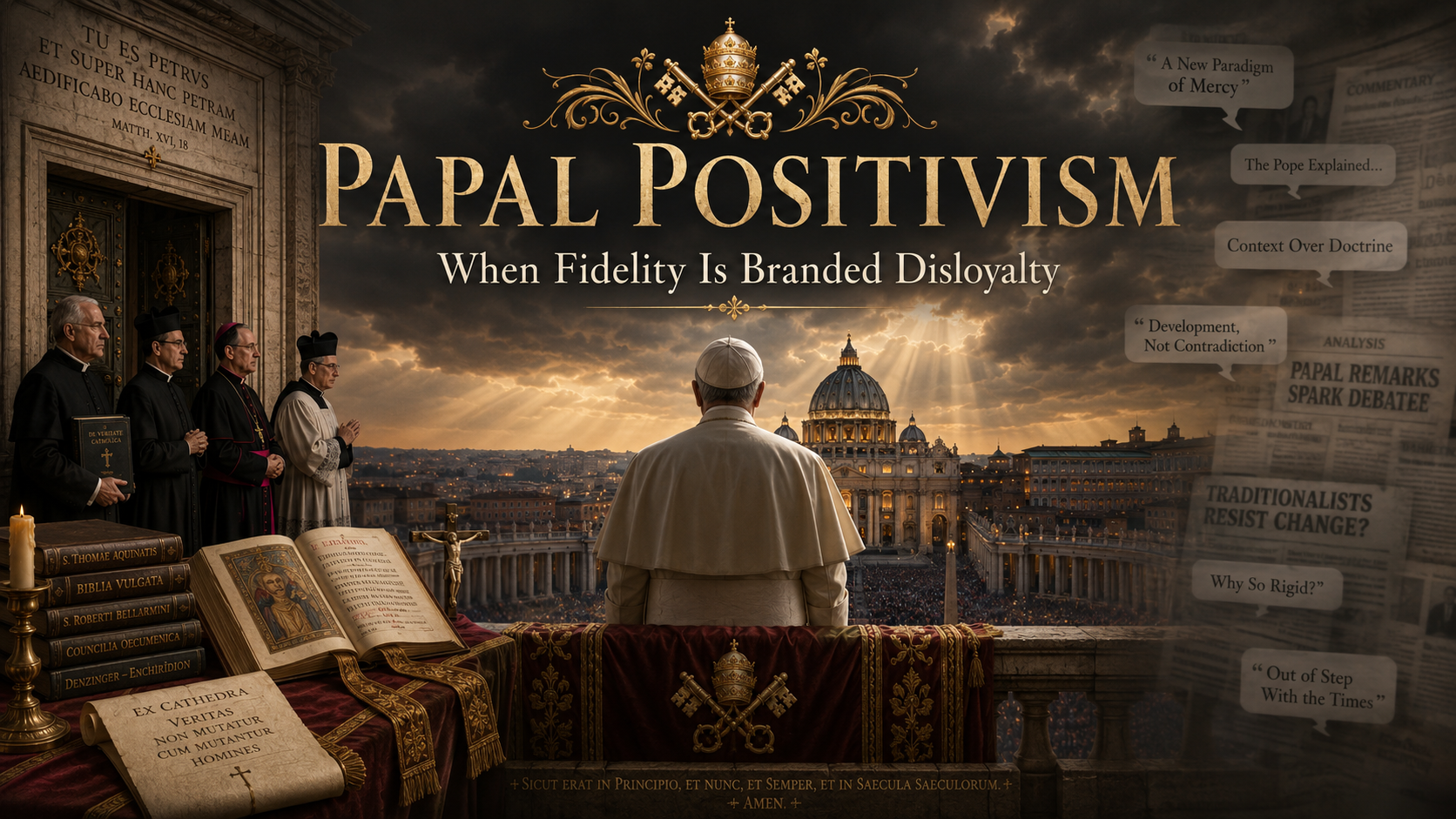
Papal Positivism and the Reinvention of Catholic Orthodoxy
The Pope possesses supreme authority in the Church, but he does not create revelation or determine reality by personal will. When agreement with the latest Roman policy becomes the test of fidelity, Catholics who remain attached to the perennial Magisterium can be declared disloyal precisely because they refuse to abandon it.

On 7 May 2005, Benedict XVI took possession of the Archbasilica of St John Lateran, the cathedral church of Rome. During his homily, the newly elected Pope stated a limitation upon his authority which ought never to have required explanation: “The Pope is not an absolute monarch whose thoughts and desires are law.”¹
Benedict was not diminishing the Petrine office. He was explaining why it possesses authority. The Pope is bound to Christ, to the Word of God and to the faith received through the centuries. He is the supreme guardian and interpreter of the apostolic deposit. He is not its author.
A peculiar contrary idea has nevertheless taken hold among Catholics. It would have been almost incomprehensible through much of Christian history, yet it is now routinely treated as the safest proof of orthodoxy: whatever the reigning Pope happens to say must be true because the Pope has said it.
This is papal positivism. The Pope gives an interview, answers an improvised question or allows a private conversation to be reported. Before the full text has appeared, Catholics divide into their usual factions. One side declares that the latest remark proves Rome has abandoned the Faith. The other begins constructing an elaborate defence intended to show that the Pope’s words are entirely orthodox, wholly traditional and perhaps what the Church has always taught, although nobody previously thought to express it in quite that manner.
By teatime, a casual papal aside may have acquired an exegetical tradition of its own.
The instinct to defend the Pope is not itself objectionable. Popes are misquoted and mistranslated. Journalists remove qualifications, social media rewards indignation, and determined critics seize upon the least favourable interpretation because it confirms a verdict already reached. Catholics should be slow to accuse the Roman Pontiff of error and willing to read his words fairly.
The difficulty begins when charitable interpretation becomes a system under which the Pope cannot be admitted to have spoken confusedly, imprudently or incorrectly. The conclusion is fixed before the evidence is considered. All that remains is to devise an explanation which preserves it.
If the Pope changes an emphasis, his defenders change theirs. If he offers a novel interpretation, the novelty becomes development. If he appears to contradict a predecessor, the earlier teaching is stretched until the difficulty disappears. When he later qualifies his position, or a successor abandons it, yesterday’s supposedly binding explanation is quietly forgotten.
The principle beneath this is not hard to identify. The reigning Pope has become, in practice, the source and measure of Catholic truth.
That is not the Catholic doctrine of the papacy.
The Roman Pontiff possesses supreme, full, immediate and universal jurisdiction over the Church. His primacy is not honorary, nor does his authority depend upon ratification by bishops, theologians or the faithful. Catholics may not reduce the Pope to the chairman of an ecclesiastical federation whenever his government becomes inconvenient.
Nor is authentic papal teaching a collection of optional opinions. The faithful owe assent and obedience according to the nature of the act and the authority with which it is proposed. The answer to papal positivism cannot be Gallicanism, conciliarism or the enthronement of private judgement.
The First Vatican Council nevertheless defined papal infallibility with deliberate precision. The Roman Pontiff enjoys the promised protection from error when, exercising his office as shepherd and teacher of all Christians, he defines by his supreme apostolic authority a doctrine concerning faith or morals to be held by the universal Church.²
Those conditions matter. Vatican I did not teach that every papal judgement is irreformable, every disciplinary measure prudent or every spontaneous remark immune from error. Infallibility belongs to particular exercises of the papal office. It is not a permanent perfection of the Pope’s personality.
The Council also explained why the Holy Ghost assists Peter’s successors. That assistance was not promised so that Popes might reveal new doctrine, but so that they might guard and faithfully expound the revelation delivered through the Apostles.² The Pope receives the deposit of faith under the same divine authority by which he is commissioned to teach it.
He may define doctrine, but he cannot create revelation. He may govern the Church and alter ecclesiastical discipline within the limits of divine law, but he cannot make an intrinsic evil good. He may condemn error; he cannot make contradictory propositions simultaneously true. The keys of Peter confer jurisdiction over the Church, not dominion over reality.
Papal positivism obscures this by treating radically different acts as though they possessed the same weight. A solemn definition is placed in the same hazy category as an interview. An administrative decision is spoken of as though it were a dogma. A prudential judgement concerning politics, diplomacy or economics is defended as though disagreement with it constituted rejection of the Faith.
Everything becomes “the Magisterium”, and the word is expected to end the discussion.
Catholic theology is more discriminating. A doctrine proposed as divinely revealed requires the assent of theological faith. A truth definitively proposed because of its necessary connection with revelation must be firmly accepted and held. Authentic but non-definitive teaching on faith and morals requires religious submission of intellect and will. The Church’s law adds that no doctrine is to be understood as infallibly defined unless that fact is manifestly evident.³
These distinctions do not permit Catholics to dismiss every teaching which has not been solemnly defined. Religious submission is a real interior obligation. The faithful must begin with docility, presume in favour of legitimate authority and make an honest effort to understand the teaching according to Scripture, Tradition and the Church’s previous Magisterium.
Religious submission is not, however, divine faith. Neither is it intellectual self-deception.
A Pope may speak as supreme teacher, legislator, governor, preacher, theologian or private individual. One man occupies all these roles, but they are not interchangeable. His identity gives significance to everything he says; it does not give identical authority to everything he says.
That distinction has become harder to maintain because the modern Pope is exposed to the world as no predecessor could have been. Catholics now receive papal interviews, video clips, press conferences, informal remarks and journalistic accounts of private conversations within minutes of their occurrence. They encounter not only the acts of the office but the personality of its holder in an apparently continuous stream.
The resulting intimacy is largely artificial. It nevertheless encourages the belief that every papal gesture establishes a policy, every preference indicates doctrine and every spontaneous sentence constitutes an ecclesiastical event.
The proper Catholic response is not to ignore papal speech, but to ask what kind of speech has occurred. Was the Pope defining doctrine, proposing non-definitive teaching, issuing law, making a prudential judgement, preaching a homily or expressing a personal opinion? What authority did he intend to exercise? How does the statement relate to what the Church has already taught?
These are not evasions. They are the ordinary work of theological judgement.
The Congregation for the Doctrine of the Faith acknowledged the necessity of such judgement in Donum Veritatis. The instruction firmly rejects habitual dissent and insists that loyal submission must remain the rule. It also recognises that some magisterial interventions concern disputed questions containing contingent and conjectural elements. Prudential documents may contain deficiencies, and serious difficulties can remain after conscientious study.⁴
The Catholic who encounters such a difficulty is not thereby licensed to conduct a public insurrection. He must examine the matter carefully, consider the authority with which the teaching was proposed and remain willing to correct his own judgement. Conscience is not a private magisterium, and personal preference does not become sacred merely because it is described as conscientious.
Yet Donum Veritatis does not require Catholics to deny an evident problem. Where a serious difficulty remains, it may be raised respectfully with the competent authority. The proper response is neither immediate rebellion nor the manufacture of explanations which the words themselves cannot sustain.
This is where many professional “popesplainers” go wrong. Their work begins not by identifying the nature and weight of the papal act, but with the predetermined conclusion that the Pope cannot have been mistaken.
An ambiguity becomes subtlety. A change of direction becomes organic development. A contradiction becomes an examination in hermeneutics for those unfortunate enough to understand ordinary language. If the first defence collapses, another is substituted without embarrassment.
Such a method cannot be corrected by evidence because no conceivable evidence would be permitted to disprove it. It is reputational crisis management disguised as theology.
Theology serves the papacy by establishing accurately what the Pope has taught, the authority with which he has taught it and its relationship to the apostolic Faith. It does not serve him by pretending that every utterance is beyond criticism. Flattery may spare an officeholder embarrassment for a few days; over time it burdens the office itself with claims Christ never made for it.
The consequences are not confined to papal interviews. Papal positivism also changes the meaning of Catholic loyalty. Fidelity ceases to be measured principally by adherence to the revealed Faith, the perennial Magisterium, the sacramental order and the divinely instituted primacy of Peter. It becomes agreement with the current Roman settlement.
This is where the histories of the Old Roman Apostolate and the Society of St Pius X become instructive. The two bodies are historically and canonically distinct, and their respective decisions are not beyond criticism. Yet both have professed adherence to the perennial Catholic Magisterium, preserved the traditional Roman rites, rejected sedevacantism and continued to recognise the Roman Pontiff as the visible head of the Church. Their clergy pray for the reigning Pope while resisting doctrines, disciplines or policies which they judge irreconcilable with the Faith received from their predecessors.⁵
Their loyalty did not disappear because Rome declared it insufficient.
A canonical judgement may establish legal consequences. It may regulate ministry, determine official standing and impose penalties. It cannot make an allegation true merely by pronouncing it. Where the evidence continues to show adherence to Catholic doctrine, recognition of papal primacy and an intention to remain within the Roman Church, an official description of disloyalty does not erase that evidence.
The Old Roman Apostolate and the SSPX were not first disloyal and afterwards excluded. In each case, attachment to the received Faith was treated as incompatible with submission to the ecclesiastical settlement demanded by Rome. Their refusal to abandon what they believed the Church had always taught was then presented as proof that they had rejected the Church’s authority.
The accusation became circular. They were judged disloyal because they resisted innovations; their resistance to those innovations was then cited as evidence that the judgement of disloyalty had been correct.
This does not mean that fidelity to doctrine excuses every act of disobedience or resolves every canonical dispute in their favour. Neither persecution nor exclusion confers impeccability. Prudential mistakes remain possible, and a claim of necessity must itself be examined rather than merely asserted.
It does mean that canonical irregularity and doctrinal disloyalty are not synonymous. Refusal of a particular command does not necessarily amount to repudiation of the authority issuing it. Still less can adherence to the perennial Magisterium become evidence against a Catholic simply because the authorities of the present regard that adherence as inconvenient.
Papal positivism cannot admit this, because it treats the contemporary judgement of Rome as self-validating. If Rome declares a man disloyal, he must have been disloyal; if the available evidence points elsewhere, the evidence must be reinterpreted. The judgement is allowed to manufacture the reality it purports to describe.
That is the same error in another form. “Whatever the Pope says is true” has become “whoever Rome calls disloyal must therefore have ceased to be loyal”.
The effects spread throughout the Church. Bishops begin to speak as regional representatives of a papal administration rather than successors of the Apostles charged with guarding the same deposit of faith. Theologians become advocates retained after the event. Ordinary Catholics are taught that doctrine is too unstable to be understood without a permanent class of interpreters explaining why the latest formulation means the same as whatever preceded it.
Orthodoxy becomes chronological. The safest Catholic position is whatever was said most recently.
A teaching emphasised for centuries may be relegated without formal repudiation. A newly favoured prudential judgement is presented as a moral demand of the Gospel. When a later Pope adopts another course, the supposedly binding position of his predecessor quietly returns to the realm of legitimate disagreement.
The Faith comes to be divided into pontificates, each with its own vocabulary, priorities and silences. Continuity survives mainly as an assertion made by commentators.
This exaggerated papalism also prepares the way for its apparent opposite. Papal positivists and sedevacantists frequently begin with the same false premise: that a true Pope could not commit the error or failure under discussion. The positivist therefore denies that the failure occurred. The sedevacantist accepts the evidence and concludes that the man cannot be Pope.
Catholic doctrine requires neither manoeuvre. A Pope may remain Pope while speaking ambiguously, governing imprudently or choosing poor counsellors. He may neglect a duty, favour an erroneous opinion outside an infallible act or fail to defend the Faith with the clarity demanded by his office. Human weakness does not extinguish his jurisdiction. Nor does jurisdiction transform weakness into wisdom.
At Antioch, St Paul “withstood” St Peter “to the face, because he was to be blamed”.⁶ Peter’s conduct had obscured the consequences of the Gospel for Jewish and Gentile converts. Paul did not deny Peter’s primacy or establish a rival Church. He corrected a superior whose behaviour had become harmful.
Peter could be blameworthy without ceasing to be Peter. The distinction ought not to seem revolutionary among Catholics.
There is, admittedly, another distortion. Some Catholics have responded to the confusion of recent decades by adopting a settled posture of contempt towards Rome. Every papal word is read as hostile evidence, every appointment presumed corrupt and every ambiguity interpreted in the worst available sense. “Tradition” becomes a licence for sarcasm, impatience and practical disobedience.
This is not Catholic resistance. The presumption remains in favour of legitimate authority. A Catholic should be reluctant to accuse the Pope of error, careful in establishing the facts and willing to accept any reasonable interpretation consistent with the Faith. Resistance cannot rest upon political dislike, personal taste or the flattering conviction that one alone has seen through every deception.
When a genuine conflict remains, however, obedience cannot require denial of an established truth. A later and less authoritative statement must be read in the light of earlier and more certain teaching. If reconciliation cannot honestly be achieved, the received doctrine retains its claim. The uncertain is judged by the certain, and the lesser authority by the greater.
The Congregation for the Doctrine of the Faith stated in 1998 that the Roman Pontiff, like every member of the faithful, is subject to the Word of God and to the Catholic faith. The limits of his primacy arise from divine law and from the constitution Christ gave His Church.⁷ These are not restraints devised by rebels. They belong to the office which Peter received.
What is required is neither a weaker papacy nor an inflated one. It is the papacy the Church actually teaches: a supreme authority ordered to preserve a revelation it did not create; an infallibility exercised under defined conditions; an obedience which is real, disciplined and governed by truth.
Catholics should pray for the Pope, defend him against injustice and receive his authentic teaching according to the authority with which it is proposed. They should not be required to prove their loyalty by calling every papal judgement wise, every formulation clear or every policy an expression of unbroken Tradition.
Nor should Catholics who remain demonstrably attached to the perennial Faith be declared disloyal merely because Rome has chosen a newer test of allegiance. Authority is owed obedience within its proper order. It is not owed the power to alter the facts upon which its own judgement depends.
Benedict XVI’s words at St John Lateran remain a better defence of Roman primacy than the anxious ingenuity of papal positivism. The Pope stands beneath the Word he is commissioned to teach and within the communion of faith extending through the centuries.
Peter confirms his brethren by guarding what he has received. The Faith does not become Catholic because the Pope has said it, and fidelity does not become disloyalty because Rome has chosen to call it so.
1. Benedict XVI, Homily for the Mass of Possession of the Chair of the Bishop of Rome, Archbasilica of St John Lateran, 7 May 2005.
2. First Vatican Council, Dogmatic Constitution Pastor Aeternus, chapter IV, 18 July 1870; Denzinger-Hünermann, nos. 3069–3074.
3. Code of Canon Law, canons 749 §3 and 752; Congregation for the Doctrine of the Faith, Doctrinal Commentary on the Concluding Formula of the Professio Fidei, 29 June 1998, nos. 5–11.
4. Congregation for the Doctrine of the Faith, Instruction Donum Veritatis: On the Ecclesial Vocation of the Theologian, 24 May 1990, nos. 23–31.
5. Old Roman Apostolate, “Old Roman Essentials” and “About the Old Roman Apostolate”; Society of St Pius X, Declaration of Catholic Faith addressed to Pope Leo XIV, 14 May 2026, and Profession of Catholic Faith of the Society of St Pius X, 24 June 2026; Dicastery for the Doctrine of the Faith, decree and explanatory note concerning the episcopal consecrations at Écône, 2 July 2026.
6. Galatians 2:11, Douay-Rheims.
7. Congregation for the Doctrine of the Faith, The Primacy of the Successor of Peter in the Mystery of the Church, 31 October 1998, nos. 7–10.
RELATED ARTiCLES


LATEST ARTICLES
- QUI BENE DISTINGUIT, BENE DOCET ~ He who distinguishes well, teaches well: Spiritual Conference for Nuntiatoria CXXIIIIn a series of Tuesday conferences, the speaker explores themes about recognising reality, receiving divine gifts, and understanding spiritual truths. He highlights the importance of making careful distinctions to maintain sound judgment, especially in an age consumed by distractions and superficial assessments. True wisdom lies in distinguishing truth from perception and nurturing an authentic inner life centred on Christ.
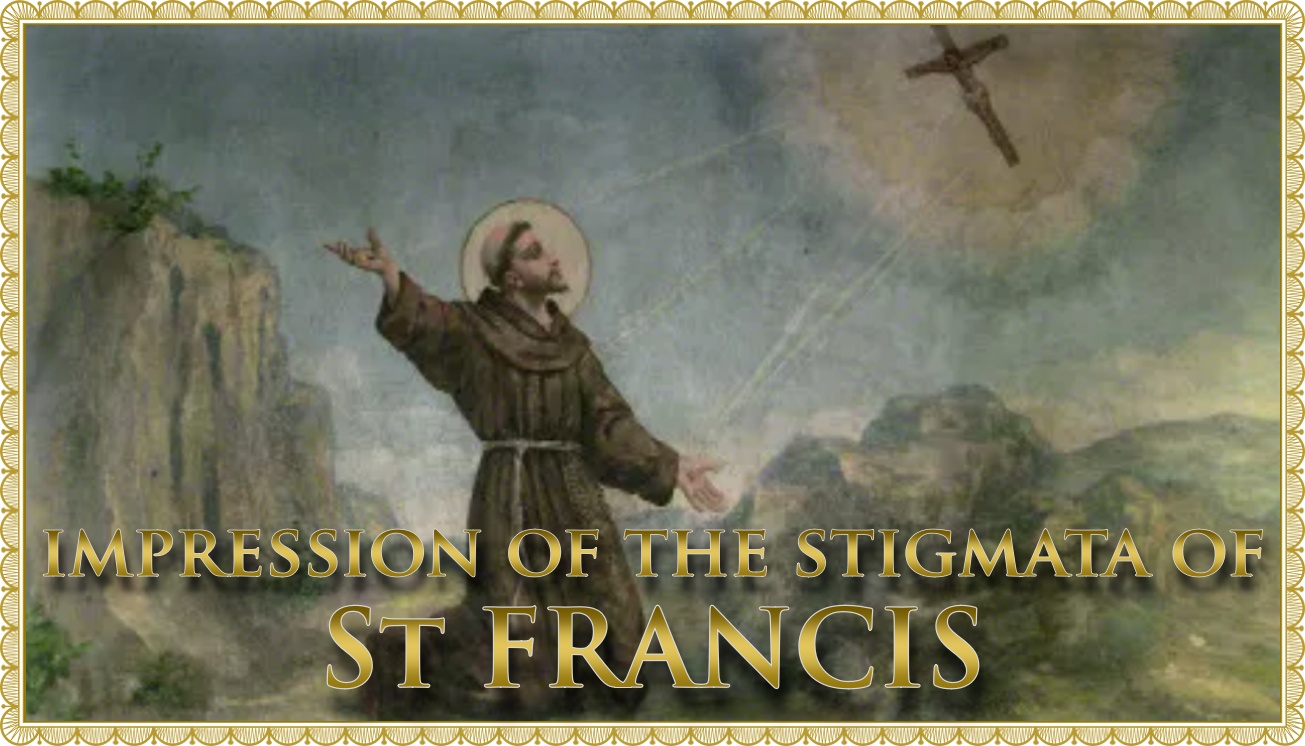
- Today’s homily: Impression of the Stigmata upon St FrancisFrom serving the lepers he once shunned to receiving Christ’s wounds upon Mount Alvernia, Saint Francis shows how grace transforms a soul through obedient love. His stigmata call us to let the Cross shape our lives, beginning with the particular act of mercy or sacrifice we have been reluctant to offer.
- Today’s Mass: September 17 Impression of the Stigmata of St Francis of AssisiSaint Francis received the stigmata because he had first allowed the Cross to transform his soul. His wounds were not a spectacle, but God’s answer to a world growing cold: the visible sign of a life consumed by crucified love. We may never bear Christ’s wounds in our flesh, but we must bear their likeness through penance, fidelity, patience, mercy and sacrificial love.
- Sermon for Stigmata of St. FrancisToday marks the feast of St. Francis’ stigmata, celebrating his transformation from a wealthy merchant’s son to a devoted preacher of poverty and humility. He founded the Franciscan order, emphasising evangelisation and simplicity. His experience of receiving the stigmata exemplifies the Christian doctrine of redemption through suffering, distinguishing it from other faiths.
- Today’s homily: Wednesday Michaelmas EmberThe homily reflects on the significance of fasting and prayer in the Christian faith, emphasising their role in spiritual growth and self-mastery. By juxtaposing scripture from Amos and the Gospel of Mark, it highlights the need for gratitude and humility during abundance, urging believers to recognise their dependence on God. True repentance transforms and restores one’s relationship with Him.
CURRENT EDITION


Today’s Mass Propers
- Today’s Mass: September 17 Impression of the Stigmata of St Francis of Assisi
 Saint Francis received the stigmata because he had first allowed the Cross to transform his soul. His wounds were not a spectacle, but God’s answer to a world growing cold: the visible sign of a life consumed by crucified love. We may never bear Christ’s wounds in our flesh, but we must bear their likeness through penance, fidelity, patience, mercy and sacrificial love.



Leave a Reply