
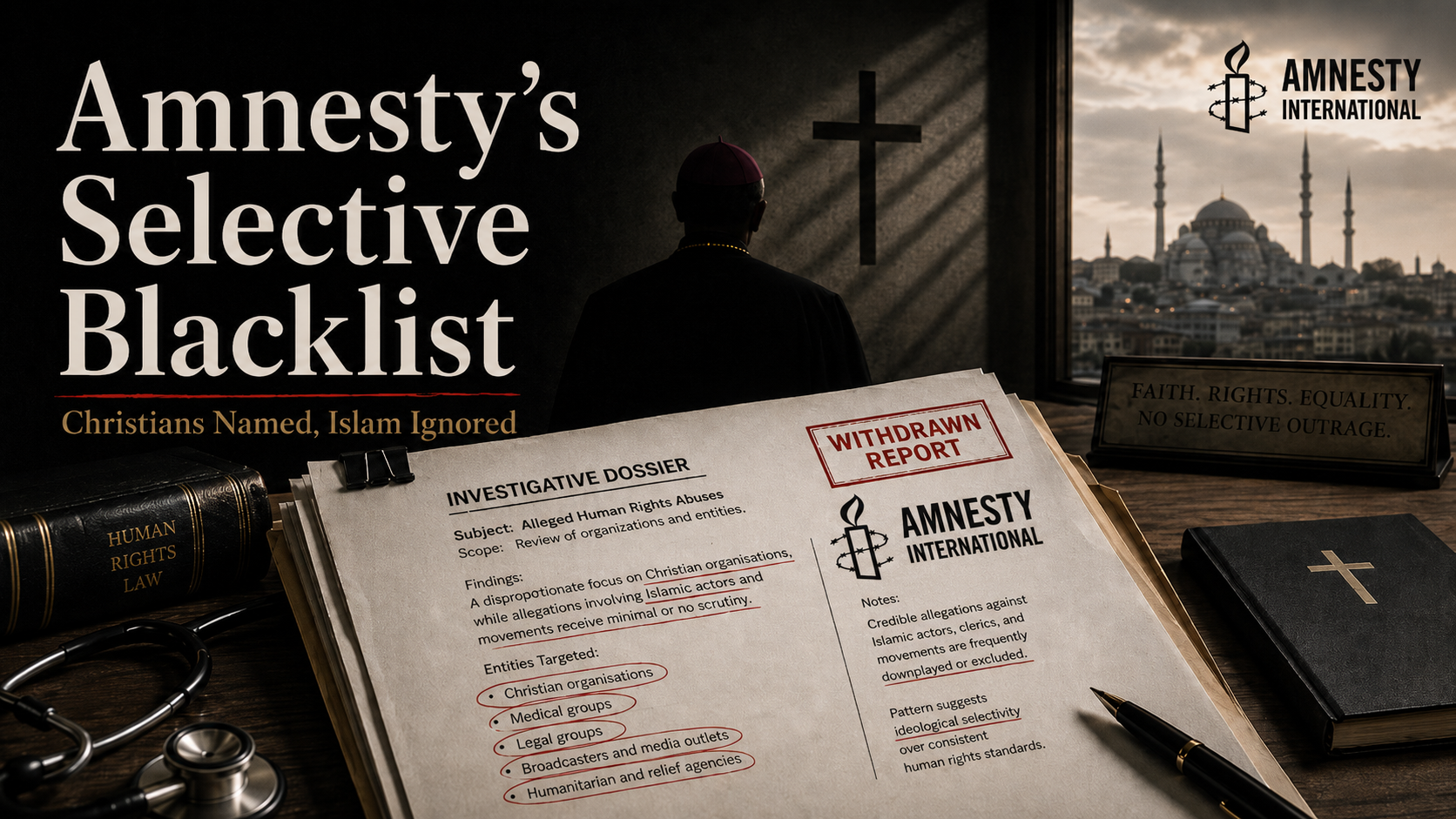
Amnesty’s Selective Blacklist: Christians Named, Islam Ignored
Amnesty International UK’s withdrawn report classified bishops, Christian doctors, lawyers, broadcasters, parliamentarians, women’s organisations and gay-rights campaigners as members of an “anti-rights ecosystem”. Among the 117 organisations it identified, however, not one was Muslim or Islamic. The answer is not an Islamic blacklist, but an end to ideological blacklisting altogether.

The joke after Amnesty International UK published A Growing Threat: the Anti-Rights Movement in the UK was that its researchers appeared to have listed every Christian organisation they could think of. Literally, that was an exaggeration. As a description of the report’s mentality, it was uncomfortably close to the truth.
Amnesty’s appendix identified 117 supposed “anti-rights organisations”. Among them were the Catholic Bishops’ Conference of England and Wales, the Evangelical Alliance, Christian Concern, the Christian Institute, CARE, the Anscombe Bioethics Centre, Christian Values in Education, the Catholic Medical Association, the Christian Medical Fellowship, the Christian Legal Centre and the Lawyers’ Christian Fellowship. It continued through the Catholic Herald, Premier Christian Radio, Anglican Mainstream, Christians in Parliament, the Conservative Christian Fellowship, Evangelicals Now, Lovewise and the Natural Family Planning Teachers’ Association. The Catholic Medical Association was included twice, an elementary duplication which revealed something of the quality control behind this supposedly forensic exercise.¹
The net extended far beyond expressly Christian bodies. Amnesty also listed women’s organisations, lesbian and gay groups, clinicians, therapists, professional networks and small voluntary associations. Beira’s Place, the women-only support service for survivors of sexual violence; For Women Scotland, whose interpretation of “sex” under the Equality Act was vindicated by the Supreme Court; the Gay Men’s Network; the Lesbian Project; LGB Alliance; Sex Matters; Transgender Trend; and dozens of workplace sex-equality networks were all placed within the same discrediting category.²
Catholic bishops, evangelical charities, pregnancy-support organisations, doctors, lawyers, gay men, lesbian feminists and women helping survivors of sexual violence were thus presented as components of one threatening political formation. The appendix supplied each organisation’s name, category, legal form and approximate date of establishment. It did not provide a corresponding body of organisation-specific findings establishing why each one deserved so grave a designation.
That matters because Amnesty was not merely describing these organisations as conservative, controversial or mistaken. It defined an “anti-rights actor” as one whose purpose was to restrict human rights by undermining their protection in law and practice. It asserted that the organisations formed an “anti-rights ecosystem” sharing objectives, methods and, in some cases, formal collaboration.³ The effect was to convert disagreement with Amnesty’s positions into evidence of hostility to human rights themselves.
Nor was the report merely rhetorical. Amnesty recommended that the Charity Commission reconsider the charitable status of organisations accused of seeking to remove human-rights protections, targeting minorities or promoting harmful practices. It urged institutional donors and grant-makers to strengthen their due-diligence procedures so as to reduce the risk of financing the organisations concerned. It also recommended: “Fund the ongoing monitoring of anti-rights movements and organisations.”⁴
This was not a statutory proscription list, but it performed the practical function of a blacklist. Amnesty publicly named organisations, attached a profoundly damaging classification to them, portrayed their expenditure and democratic activity as evidence of a coordinated threat, and invited regulators and funders to consider material consequences. The difference between that exercise and a blacklist is principally one of nomenclature.
Yet among the 117 organisations listed, not one was Muslim or Islamic. The appendix included no mosque, Muslim umbrella body, Islamic professional association, Islamic educational organisation or network of Muslim scholars. Indeed, the words “Muslim”, “Islam” and “mosque” do not appear anywhere in the report.⁵
That omission cannot be explained by Amnesty’s stated criteria. The report said that the organisations it opposed commonly promoted “traditional and restrictive ideas about gender, sexuality and family life”. It criticised appeals to natural distinctions between men and women, traditional family structures, marriage and religious freedom. It traced opposition to contemporary gender theory through the Holy See’s participation in international debates and treated Christian resistance to prevailing doctrines of abortion, sexuality and gender as part of the genealogy of the supposed threat.⁶
None of those subjects is peculiar to Christianity. Traditional Islamic teaching also contains definite doctrines concerning marriage, sexual conduct, family life and the distinction between men and women. The Muslim Council of Britain has stated unequivocally that “the practice and promotion of homosexuality is forbidden according to the teachings of Islam”. It immediately distinguished that religious conviction from civil discrimination, affirming its opposition to discrimination in the provision of goods and services.⁷
That distinction is indispensable to a plural society. A religious body may teach that conduct is morally wrong without believing that those who engage in it should be assaulted, denied ordinary services or deprived of legal protection. Moral disagreement is not civil persecution. The manifestation of religious belief is not automatically incitement. Disapproval of conduct is not necessarily hatred of persons.
It is precisely this distinction which Amnesty failed to extend to the Christian organisations it named.
The Catholic Church teaches that marriage is the union of a man and a woman, that sexual relations belong within marriage and that unborn human life must be protected. It also teaches that every human being possesses an inherent dignity and must be protected from violence and unjust discrimination. Amnesty may reject Catholic conclusions concerning abortion, marriage and sexuality, but disagreement with Amnesty does not turn a bishops’ conference into an enemy of human rights.
A doctor who refuses to participate in abortion is not thereby opposed to the rights of women. A lawyer who defends freedom of conscience is not attempting to abolish equality. A pregnancy-support charity which helps women who wish to continue their pregnancies is not illegitimate because it does not recommend abortion. A Christian broadcaster does not become part of a sinister political network because its contributors maintain Christian moral teaching.
Amnesty was entitled to investigate particular allegations of harassment, coercion, misinformation or unlawful discrimination. Where an organisation has committed specific wrongdoing, the evidence should be presented and the conduct assessed under a consistent standard. What Amnesty was not entitled to do was replace organisation-specific evidence with guilt by theological, political or professional association.
The conceptual failure became still clearer when Amnesty included organisations composed of women, lesbians and gay men. Beira’s Place exists to support female survivors of sexual violence. The Gay Men’s Network describes its purpose as opposing homophobia. For Women Scotland pursued litigation concerning the legal meaning of sex and prevailed in the Supreme Court. These organisations may advance positions which Amnesty dislikes, but political disagreement does not itself establish opposition to human rights.
The omission of Muslim organisations therefore places Amnesty before an unavoidable dilemma. If maintaining traditional religious doctrines concerning sex, marriage and family life is sufficient to make an organisation “anti-rights”, then the total absence of Islamic bodies is inexplicable under the report’s own criteria. If such doctrines are not sufficient, then Christian organisations should not have been listed merely because they maintain and publicly defend them.
The answer is not to demand that Amnesty compile an equivalent Islamic blacklist. Muslim organisations should no more be catalogued, stigmatised and threatened with regulatory or financial consequences merely for holding religious convictions than Christian organisations should. The omission is significant because it reveals that Amnesty’s criteria were not applied neutrally.
Christianity appears to have been treated as a permissible institutional target. Its doctrines could be stripped of theological context, classified as political extremism and linked to an allegedly threatening financial ecosystem. Comparable Islamic teaching was not examined at all. The contextual sensitivity which Amnesty would rightly insist upon when considering a minority faith was withheld from Christian bodies.
That double standard does Muslims no service. It implies that Muslim convictions cannot be subjected to the same open intellectual examination as Christian convictions, while suggesting that Christian religious liberty is somehow less worthy of protection. Genuine equality requires neither indiscriminate condemnation nor selective indulgence, but the same distinctions and standards for everyone.
A credible human-rights organisation should defend Muslims from religious hatred without requiring them to abandon Islam. It should protect homosexual people from violence and unlawful discrimination without requiring every religion to approve homosexual conduct. It should defend women’s safety and equality while acknowledging that serious legal and philosophical disagreements remain concerning the meanings of sex and gender. It should protect medical conscience without having to endorse the moral theology from which that conscience proceeds.
Human rights exist precisely because citizens disagree about morality, religion and the common good. Freedom of thought, conscience and religion; freedom of expression; and freedom of association are not permissions granted only after an organisation’s beliefs have received Amnesty’s approval. They are themselves protected under Articles 9, 10 and 11 of the European Convention on Human Rights. Religion or belief is expressly protected under the Equality Act 2010.⁸
These rights are not unlimited. Religious language does not excuse violence, coercion or unlawful discrimination. Freedom of expression does not eliminate responsibility for defamation, threats or incitement. But limitations must be justified by evidence of particular conduct, not imposed merely because an organisation holds an unpopular belief or contests an activist interpretation of another right.
Amnesty’s method inverted that principle. It first treated its preferred conclusions concerning abortion, sexual autonomy and gender identity as the exhaustive content of human rights. Organisations which challenged those conclusions could then be described as opposing human rights by definition. The reasoning was circular: Amnesty determined what rights required, and disagreement with Amnesty became evidence of hostility to rights.
Litigation, parliamentary lobbying, public campaigning, conscientious objection and the provision of alternative charitable services are ordinary features of democratic participation. Amnesty recast them as techniques by which an organised movement was attempting to erode human-rights protections. The organisation which once defended political dissenters had begun treating dissent itself as incriminating.
Amnesty withdrew the report within days. Its subsequent statement admitted that the briefing had been published without passing through its “established internal review processes” for consistency, accuracy and alignment with Amnesty International UK’s positions. It said that the report’s language did not reflect the organisation’s position and reiterated that no community should be singled out for unfair treatment.⁹
The admission was necessary, but inadequate. The document was not an accidental note or an unauthorised social-media post. It bore Amnesty’s name and branding. It contained an executive summary, methodology, financial analysis, findings, recommendations and a detailed appendix. Its research had been conducted over several months, and the report presented itself expressly as an update to Amnesty’s 2025 study combined with its May 2026 investigation of gender-critical organisations.
Nor has Amnesty repudiated the underlying campaign. Its continuing 2025 material still presents “ultra-conservative Christian groups” as part of a coordinated movement seeking to undermine reproductive and LGBT rights. It attributes to the organisations collectively the intention of restricting freedoms and describes their activity as a deliberate attack upon human rights.¹⁰ The withdrawn report’s most reckless language did not appear from an intellectual vacuum.
Amnesty should therefore do more than explain how the document escaped final review. It should disclose the criteria by which the 117 organisations were selected, identify the evidence used to classify each one, state whether those organisations were invited to respond before publication, and explain why no Islamic organisation appeared under criteria which were ostensibly applicable across religions.
It should apologise individually to organisations which it branded “anti-rights” without presenting adequate evidence against them. It should also reconsider the premise of a campaign which treats contested positions on abortion, sex and gender as a dividing line between support for human rights and opposition to them.
There are real enemies of human rights: regimes which torture prisoners, movements which murder civilians, institutions which traffic human beings, and authorities which suppress religious worship, political speech and peaceful association. Applying the same morally charged designation to bishops, doctors, lawyers, women’s refuges and gay-rights organisations because they challenge Amnesty’s social philosophy devalues the language needed to describe genuine oppression.
A human-rights organisation worthy of the name must defend more than an approved anthropology. It must protect the Christian physician, the Muslim parent, the gender-critical feminist, the homosexual dissenter and the transgender person from violence, coercion and unlawful discrimination. It must recognise that rights can conflict, that conscientious disagreement is inevitable and that pluralism means tolerating opinions one believes profoundly mistaken.
The proper response to Amnesty’s report is not to add Muslim organisations to the list. It is to throw away the list.
Universal rights begin where ideological agreement ends. Amnesty’s selective blacklist—Christian organisations named, Islamic organisations ignored—revealed an institution in danger of forgetting that elementary truth.
¹ Amnesty International UK, A Growing Threat: the Anti-Rights Movement in the UK, July 2026, pp. 17–21.
² Amnesty International UK, A Growing Threat, pp. 19–21.
³ Amnesty International UK, A Growing Threat, pp. 2–4 and 7.
⁴ Amnesty International UK, A Growing Threat, pp. 15–16.
⁵ Amnesty International UK, A Growing Threat, complete text and appendix, pp. 1–22.
⁶ Amnesty International UK, A Growing Threat, pp. 4–6.
⁷ Muslim Council of Britain, “MCB Statement on SORs”, 30 April 2007.
⁸ European Convention on Human Rights, Articles 9–11; Equality Act 2010, sections 4 and 10.
⁹ Amnesty International UK, “Briefing Review”, July 2026.
¹⁰ Amnesty International UK, “The Anti-Rights Movement”, 30 June 2025; A Growing Threat, pp. 2–3.
RELATED ARTiCLES


LATEST ARTICLES
- Today’s Mass: September 05 Saint Lawrence JustinianSaint Lawrence Justinian, the first Patriarch of Venice, dedicated his life to the poor and the establishment of monasteries, rejecting noble marriage. Renowned for his humility and pastoral dedication, he emphasised the spiritual integrity of Venice’s safety. He was a precursor to the reforms of the Council of Trent, dying on 8 January 1455.
- 06.09.26 Nuntiatoria CXXII: NOMEN MANET, RES DEESTThis edition of Nuntiatoria explores the disconnect between the names of Catholic institutions and the realities they signify. Despite retaining their titles, many aspects of Catholicism—such as episcopal authority in China and religious practice in Poland—exhibit deteriorating substance. The piece cautions against superficial continuity, stressing the importance of genuine faith and practice over mere nomenclature.
- ORDO w/c 06.09.26The document outlines the liturgical schedule for the week of 6 to 13 September 2026, highlighting significant religious observances such as the Fifteenth Sunday after Pentecost and the Nativity of the Blessed Virgin Mary. It reflects on themes of compassion, holiness, fidelity, and humility, underscoring their importance in Christian life.
- The Fifteenth Sunday after Pentecost: When the Procession of Death Meets the Lord of LifeThe Fifteenth Sunday after Pentecost focuses on the transformative power of Christ, emphasising the supernatural life granted through grace. The liturgy highlights the Church’s role as a nurturing mother, mourning the spiritually dead while seeking their restoration. Christ’s compassion leads to resurrection, demonstrating that true life is found in dependence on Him.
- If Cecchin Is Right, Fatima Is WrongFr Stefano Cecchin, President of the Pontifical International Marian Academy, has declared opposition to apparitions that speak of divine punishment, suggesting they are false. This stance contradicts fundamental Catholic doctrine, including teachings from Scripture, the Catechism, and specifically the Message of Fatima, which warns of divine consequences for sin.
CURRENT EDITION


Today’s Mass Propers
- Today’s Mass: September 05 Saint Lawrence Justinian
 Saint Lawrence Justinian, the first Patriarch of Venice, dedicated his life to the poor and the establishment of monasteries, rejecting noble marriage. Renowned for his humility and pastoral dedication, he emphasised the spiritual integrity of Venice’s safety. He was a precursor to the reforms of the Council of Trent, dying on 8 January 1455.



Leave a Reply