

Looking at Christ in the Storm: A review of HE ✠Jerome Lloyd’s spiritual conference on Écône, Peter and the Passion of the Church
In a conference of unusual balance and spiritual seriousness, HE ✠Jerome Lloyd refused both the easy absolutism of papal positivism and the equally dangerous temptation to make resistance an ecclesiology. Beginning with Peter’s confession at Caesarea Philippi and ending with Peter walking upon the water, the address placed the controversy surrounding Écône where it ultimately belongs: beneath the sovereignty of Christ and within the mystery of His suffering Church.

The strongest feature of this spiritual conference was its refusal to permit the present controversy surrounding the Society of Saint Pius X to remain merely a contest of canonical arguments, institutional loyalties or competing factions. The canonical questions were addressed clearly, but they were placed within a more fundamental theological and spiritual framework. Before asking whether an act was lawful, schismatic or justified by necessity, the conference asked the deeper question: what is the Church, and from whom does she receive her life?
The answer was established at the outset through Peter’s confession: “Thou art Christ, the Son of the living God.” Before dicasteries, decrees, canonical penalties or ecclesiastical disputes, there is Christ. Everything in the Church—her doctrine, hierarchy, sacramental life and indefectibility—depends upon Him. Peter matters because Christ established Peter; but Peter remains the servant and witness of Christ, never His replacement.
This distinction supplied the organising principle of the entire address. “The Church is not the mystical body of the Pope,” the conference insisted. “She is the Mystical Body of Christ.” That statement was not employed to minimise the papacy. The Roman Pontiff was expressly affirmed as the visible head of the Church on earth, the successor of Saint Peter and the principle of visible ecclesiastical unity. The office is neither optional nor merely administrative. Yet the visible head is not the divine Head. Christ alone is the source of the Church’s supernatural life. Peter guards the deposit; he does not manufacture it. He confirms his brethren in the Faith; he does not stand above the Faith he is commissioned to preserve.¹
This was the necessary answer to the hyperpapalist argument that has appeared repeatedly since the Écône consecrations: that resistance to a papal or curial act is necessarily rejection of Peter, and that any Catholic lacking regular juridical submission must therefore stand outside the Church. The conference exposed the weakness of that argument by reference to the most obvious ecclesiological fact: the Church survives a papal interregnum. When a Pope dies, the Church does not disappear, bishops do not cease to be bishops, priests do not cease to offer the Holy Sacrifice, and the sacraments do not cease to communicate grace. The Petrine office belongs permanently to the Church’s divine constitution, but the Church’s life is not generated by the present occupant of the Apostolic See.
This distinction allowed the conference to treat the SSPX question with greater accuracy than has characterised much recent commentary. The Society recognises the Roman Pontiff, names him in the Canon of the Mass, professes the divine institution of the papacy, denies that the Apostolic See is vacant and does not claim universal jurisdiction. Its stated position is that particular acts of authority may be resisted without denying the office from which those acts proceed.
That position may be challenged. Its internal consistency may be questioned. Particular acts may be judged unlawful, gravely disobedient or even objectively schismatic. The conference did not pretend otherwise. Its point was that the conclusion must be established rather than assumed. The expression “without Peter” cannot substitute for an argument when the Society itself continues expressly to profess the papacy.
The scriptural treatment of Saint Paul’s resistance to Saint Peter at Antioch was particularly effective. Paul “withstood him to the face,” not because he denied Peter’s office, but because Peter’s conduct had obscured the truth that his office existed to serve. Paul’s resistance defended the implications of Peter’s own confession. The episode does not prove that every act of resistance is justified. It proves that resistance to a particular act and repudiation of the Petrine office are not necessarily identical.
That distinction is indispensable to any serious consideration of schism. Disobedience is not automatically schism. A subject may resist an instruction without denying the superior’s authority in principle. A son may contest his father without denying his fatherhood. A cleric may act unlawfully without thereby founding a rival Church. The relevant question is whether the Society has rejected the Pope precisely as Pope, repudiated the papacy itself or refused ecclesiastical communion in the sense required to constitute formal schism.
The conference also brought welcome precision to the question of the faithful. The decree issued following the consecrations named and penalised the bishops who participated. It did not individually excommunicate every SSPX priest, nor did it excommunicate the faithful collectively. Whatever may be said about the severe language of the accompanying explanatory note, canonical penalties are not transmitted by association, rhetoric or atmosphere. They attach to persons according to law, intention and culpability.
A Catholic who attends an SSPX chapel because he seeks the traditional Roman liturgy, orthodox preaching and the sacraments is not, by that fact alone, denying the authority of the Roman Pontiff. There remains a real distinction between receiving spiritual goods from ministers in an irregular canonical condition and formally adhering to a schismatic separation. The conference therefore offered necessary reassurance to Catholics who had been led to believe that continued attendance at an SSPX Mass had automatically expelled them from the Church.
Yet the address did not become an uncritical defence of the Society. Indeed, its most impressive passage came when it turned the argument upon those attached to Écône. Papal positivism was identified as one danger: the belief that an assertion made by authority necessarily creates the theological reality it describes. But factional self-satisfaction was identified as the equal and opposite danger.
“Resistance can become an identity. Irregularity can become normality. Necessary caution can harden into contempt. A provisional remedy can become a permanent ecclesiology.”
Those sentences reached the heart of the spiritual problem. An exceptional condition cannot become the ideal constitution of the Church. Canonical order matters. Visible unity matters. Submission to legitimate authority matters. Even where resistance began from sincere motives and possesses substantial arguments, indefinite separation cannot be regarded as spiritually harmless.
The conference therefore refused the false choice between institutional triumphalism and self-justifying resistance. Rome must remember that authority exists to preserve tradition rather than eclipse it. The Society must remember that resistance cannot authenticate itself merely by continuing. The faithful must not become spectators applauding their preferred faction while the Mystical Body suffers.
At this point, the address moved from controversy into contemplation. The crisis cannot finally be resolved by canonical ingenuity, public humiliation or rhetorical victory. “There is no passage into God except through the Crucified.” Rome must pass through the Cross. Écône must pass through the Cross. Bishops, priests and faithful must allow pride, resentment, anger, fear and self-justification to be crucified.
This transformation gave the conference its true spiritual character. The controversy was not trivialised, nor were serious doctrinal and canonical questions evaded. Instead, they were subordinated to the purpose for which the Church exists: the sanctification and salvation of souls. No dicastery, society, movement or personality is the Church’s saviour. None contains the whole mystery of the Church within itself. Christ alone saves.
The treatment of Tradition was similarly well judged. Tradition is not “a museum of ecclesiastical preferences,” nor is it the preservation of a defensive tribal identity. It is the living transmission of Christ’s revelation through the Church. The liturgy exists to worship Christ; doctrine exists to confess Him; hierarchy exists to serve Him; and Peter exists to confirm his brethren in Him.
The final meditation upon Saint Peter walking upon the water brought the conference to an apt conclusion. Peter did the impossible, not because he possessed some independent strength simply by being Peter, but because his eyes were fixed upon Christ. When he looked instead at the wind and waves, he began to sink.
Rome, Écône, accusations, decrees, division and uncertainty are real storms. They are not the object of Catholic faith. The conference therefore ended where the whole dispute must end: not by staring perpetually at Rome, Écône or Peter considered in isolation, but by looking at Christ, who sustains Peter, preserves Tradition, communicates grace through the sacraments and holds His wounded Mystical Body together.
This was not a conference that offered a facile solution. It did something more valuable. It restored the proper hierarchy of truths. Christ before faction; truth with charity; authority as service; resistance as filial rather than revolutionary; canonical argument within the higher law of the salvation of souls.
Its central achievement was to show that one may defend the papacy without converting it into positivism, defend Tradition without turning resistance into an idol, and defend the faithful without pretending that ecclesiastical irregularity is desirable.
The Church belongs to Christ. Peter serves Christ. Tradition bears witness to Christ. The sacraments communicate Christ. In the midst of the storm, that is not an evasion of the controversy. It is the only perspective from which the controversy can finally be understood.
¹ HE ✠Jerome Lloyd, spiritual conference on Écône, the Petrine office and the present crisis in the Church, July 2026.
RELATED ARTiCLES


LATEST ARTICLES
- Today’s Mass: September 05 Saint Lawrence JustinianSaint Lawrence Justinian, the first Patriarch of Venice, dedicated his life to the poor and the establishment of monasteries, rejecting noble marriage. Renowned for his humility and pastoral dedication, he emphasised the spiritual integrity of Venice’s safety. He was a precursor to the reforms of the Council of Trent, dying on 8 January 1455.
- 06.09.26 Nuntiatoria CXXII: NOMEN MANET, RES DEESTThis edition of Nuntiatoria explores the disconnect between the names of Catholic institutions and the realities they signify. Despite retaining their titles, many aspects of Catholicism—such as episcopal authority in China and religious practice in Poland—exhibit deteriorating substance. The piece cautions against superficial continuity, stressing the importance of genuine faith and practice over mere nomenclature.
- ORDO w/c 06.09.26The document outlines the liturgical schedule for the week of 6 to 13 September 2026, highlighting significant religious observances such as the Fifteenth Sunday after Pentecost and the Nativity of the Blessed Virgin Mary. It reflects on themes of compassion, holiness, fidelity, and humility, underscoring their importance in Christian life.
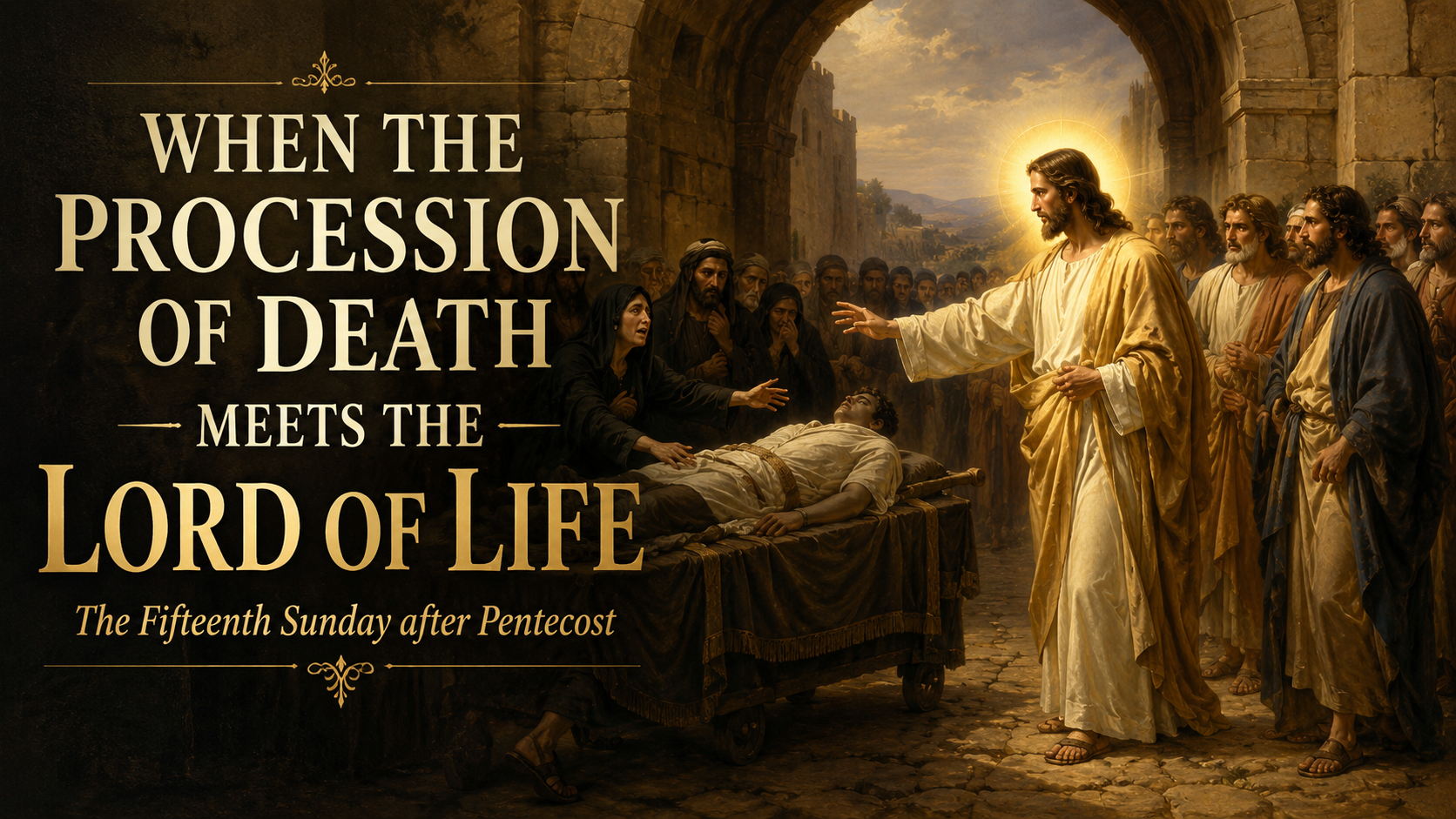
- The Fifteenth Sunday after Pentecost: When the Procession of Death Meets the Lord of LifeThe Fifteenth Sunday after Pentecost focuses on the transformative power of Christ, emphasising the supernatural life granted through grace. The liturgy highlights the Church’s role as a nurturing mother, mourning the spiritually dead while seeking their restoration. Christ’s compassion leads to resurrection, demonstrating that true life is found in dependence on Him.
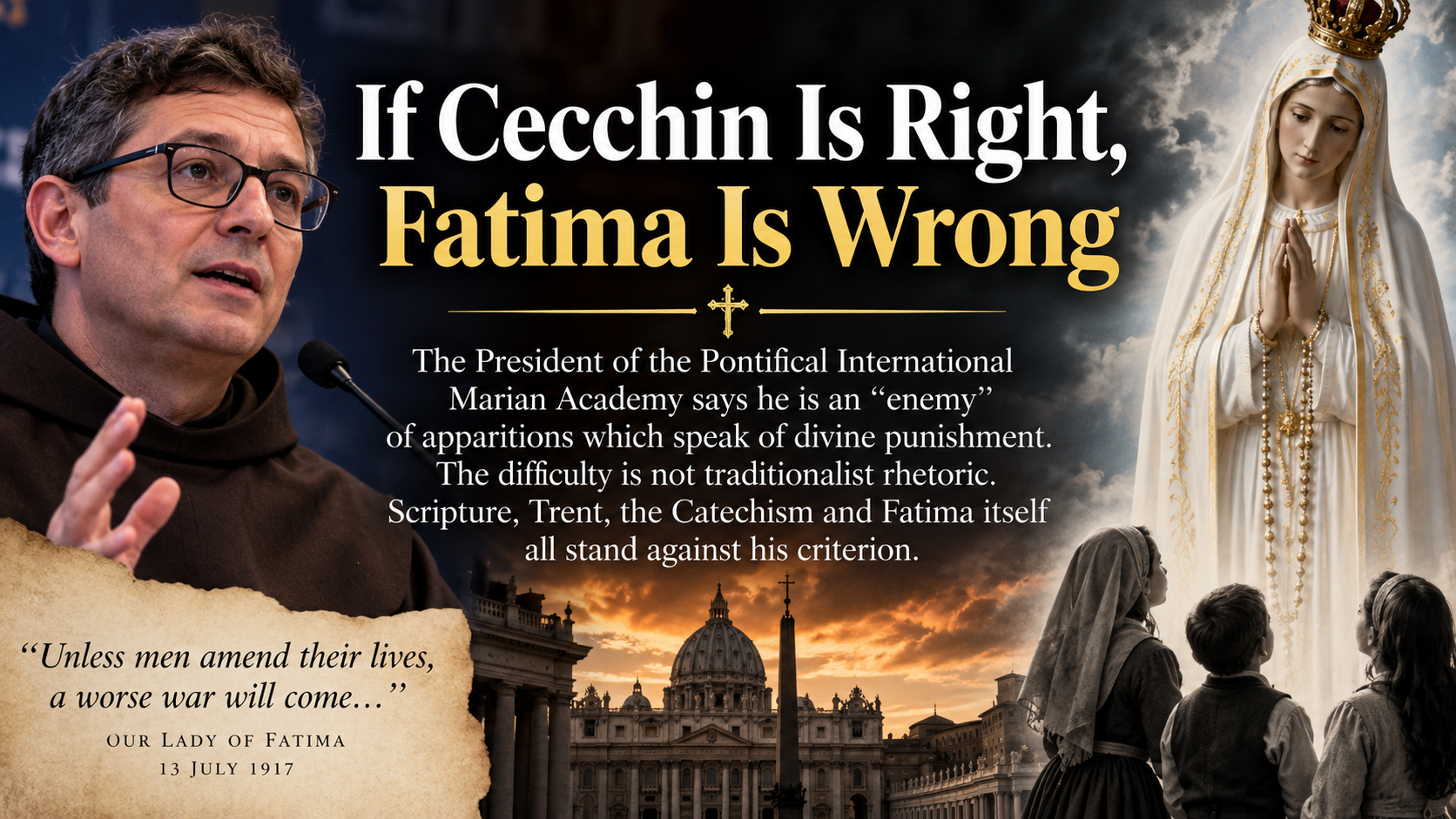
- If Cecchin Is Right, Fatima Is WrongFr Stefano Cecchin, President of the Pontifical International Marian Academy, has declared opposition to apparitions that speak of divine punishment, suggesting they are false. This stance contradicts fundamental Catholic doctrine, including teachings from Scripture, the Catechism, and specifically the Message of Fatima, which warns of divine consequences for sin.
CURRENT EDITION


Today’s Mass Propers
- Today’s Mass: September 05 Saint Lawrence Justinian
 Saint Lawrence Justinian, the first Patriarch of Venice, dedicated his life to the poor and the establishment of monasteries, rejecting noble marriage. Renowned for his humility and pastoral dedication, he emphasised the spiritual integrity of Venice’s safety. He was a precursor to the reforms of the Council of Trent, dying on 8 January 1455.


Leave a Reply