
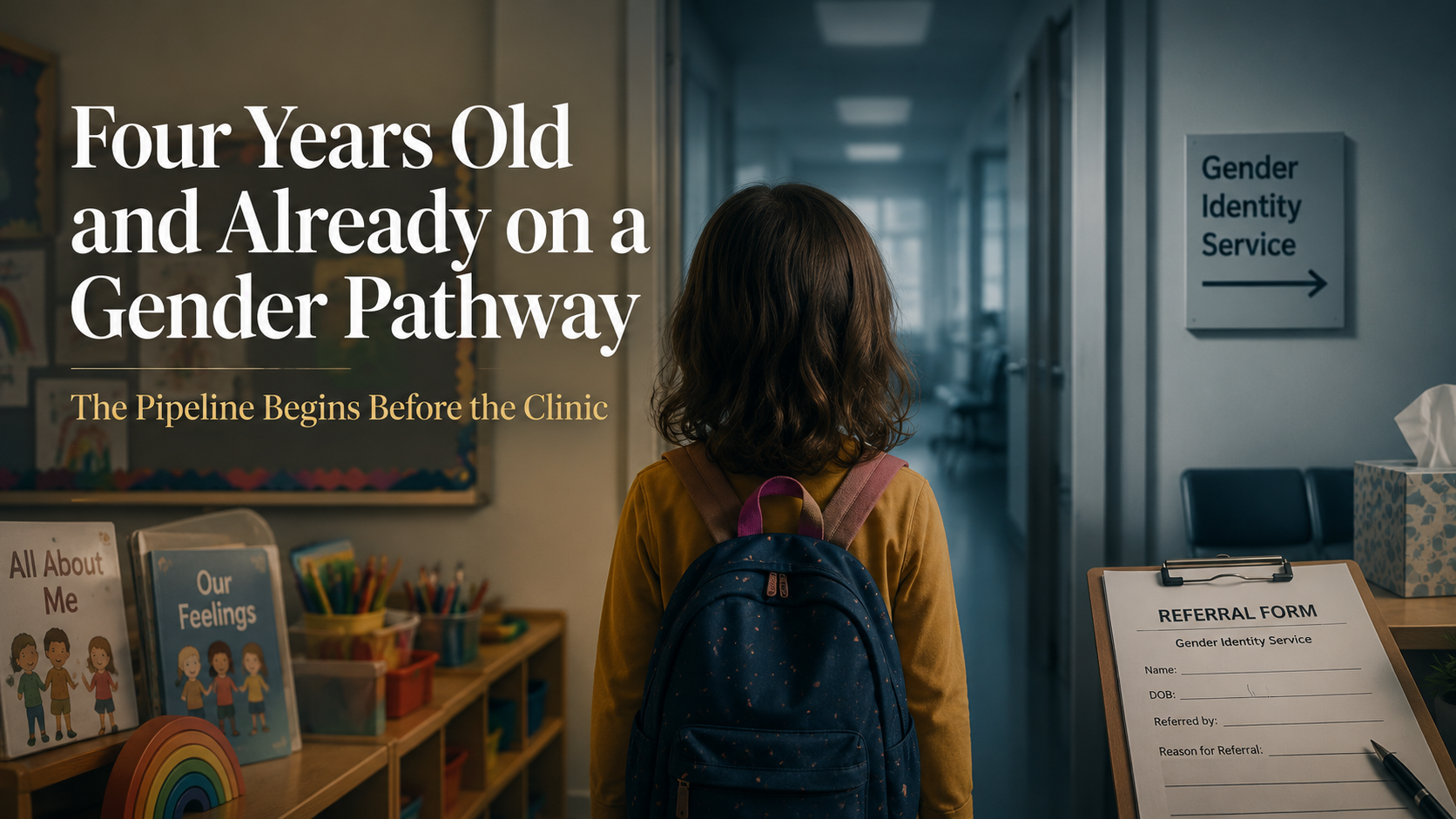
Four Years Old and Already on a Gender Pathway: The Pipeline Begins Before the Clinic
The referral of preschool children cannot be understood as an isolated NHS statistic. It belongs to a wider institutional environment in which picture books introduce the theory, curricula present it as knowledge, social transition gives it administrative form, and clinicians inherit a child whose distress has already been interpreted through gender identity. WellBN has shown where weakened safeguards can lead, while the language of discrimination and “conversion” threatens those who attempt to interrupt the process.

Twenty-three children aged between four and six were referred to NHS England’s National Referral Support Service for children’s gender provision between April 2024 and June 2026. A further seventy-five were aged between seven and ten. Among 3,724 referrals recorded in little more than two years were therefore ninety-eight children of primary-school age or younger.¹
The figures record referrals, not completed treatment. They do not establish that any four-year-old received medication, underwent a specialist assessment or acquired a formal diagnosis. The National Referral Support Service administers access to the waiting list; it is not itself a clinic. That distinction must be preserved, but it does not make the revelation innocuous. It brings the fundamental question into view: what can a child of four possibly say or do that adults should interpret as requiring entry into a national gender-service pathway?
A four-year-old cannot understand the adult concepts of gender identity, transition, fertility, medicalisation or lifelong bodily alteration. Children of that age inhabit a world of imitation, fantasy, experiment and rapidly changing preference. They may announce that they are animals, fictional characters, royalty, superheroes or members of the opposite sex. Such declarations may be sincerely felt in the moment, but sincerity is not maturity, imagination is not diagnosis, and repetition does not confer adult comprehension upon a preschool child.
A boy may prefer playing with girls, dislike competitive sport, admire his mother or enjoy toys and clothes conventionally associated with femininity. A girl may reject dresses, imitate her father, prefer rough games or insist that activities described as “for boys” should also belong to her. None of this establishes that the child’s body is mistaken. It may instead reveal how narrow adult assumptions about boys and girls have become.
The humane response is to enlarge the child’s freedom within his or her sex, not to make sex conditional upon personality. A gentle, artistic or unathletic boy is not less male. An assertive, practical or convention-defying girl is not less female. The child who resists a stereotype should be liberated from the stereotype, not encouraged to regard the body as the problem.
NHS England’s own April 2026 service specification recognises the need for caution. It states that “gender variant behaviour and preferences alone are not a basis” for diagnosis and that the relevant diagnosis cannot be assigned before puberty. NHS England also accepts the Cass Review’s conclusion that gender-nonconforming children presenting at a young age are most likely no longer to experience gender incongruence before puberty, while recognising that it may persist in a minority.²
Those admissions ought to govern the entire clinical approach. Where an experience is likely to be transient, adults must not respond in ways that consolidate it. Caution is not neglect, watchful waiting is not cruelty, and declining prematurely to interpret a child’s behaviour as an inner identity is not a refusal to listen. It is an acknowledgement that children require adults to understand what they cannot yet understand for themselves.
A distressed child must certainly be heard, but distress does not interpret itself. A four-year-old who says that he wants to be a girl may be expressing dislike of masculine expectations, identification with a female relative, anxiety, loneliness, imaginative play or a desire for reassurance. The statement may mean several things at once or very little beyond the present moment. The least responsible response is to assume that it means precisely what contemporary gender ideology says it means.
The same principle applies to older children. Anxiety, depression, autism, attention difficulties, trauma, family disruption, bullying, social isolation, emerging same-sex attraction and discomfort with puberty may all become entangled with the language of gender. The clinician’s task is not to affirm the first available explanation but to undertake differential diagnosis, explore the child’s developmental history and determine what is actually causing the distress.
The problem, however, does not begin when a clinician opens a referral. Children do not encounter the idea of gender identity in a cultural vacuum. They increasingly meet it through stories, school lessons, educational displays, online material, visiting speakers and the vocabulary employed by trusted adults.
A recent investigation into children’s publishing identified more than sixty picture books presenting disputed theories of sex, identity and transition through the reassuring language of kindness, friendship and self-acceptance. Children are introduced to the propositions that adults merely guess a baby’s sex, that identity is discovered through an inward feeling, that self-declaration determines what a person is, and that changing the body may express an authentic inner self.³
Some titles are aimed expressly at the youngest readers. One teaches transition through the story of a teddy who declares an inward female identity. Another defines gender identity as who someone feels or knows himself to be “inside”, while treating sex as a guess made from the body at birth. A pronoun book marketed for children aged three to six encourages them to ask one another for pronouns. Other books incorporate images of mastectomy scars into material presented under the language of body acceptance.³
This is not merely representation. A story can depict a transgender-identifying person without requiring the reader to accept that bodily sex is subordinate to inward feeling. Children should be taught not to bully, humiliate or exclude others, but courtesy towards persons is not the same thing as assent to propositions.
The instructional method is powerful precisely because it does not appear to be an argument. The contested belief is carried by the moral architecture of the story. The character who declares a new identity is anxious or rejected; affirmation restores friendship and happiness; questioning is placed emotionally on the side of cruelty. Before the child is capable of reasoning about the proposition, the approved answer has been attached to kindness, safety and goodness.
The same interpretative framework has appeared in formal teaching materials. Documentary evidence examined by Nuntiatoria included a Year 6 programme written by PSHE lead teachers on behalf of an English local authority. It encouraged teaching about gender identity, included the proposition that “some people don’t feel like a boy or a girl”, recommended the expression “all genders” and warned teachers not to assume that pupils would grow up to be “cisgender”.⁴
These were not unmarked worksheets discovered on an obscure activist website. They were professionally presented resources carrying the presumptive authority of local government and educational expertise. A school adopting them could reasonably believe that it was implementing accepted professional practice rather than introducing primary pupils to a disputed theory of the human person.
The significance of such material is not that every child who reads a gender-themed book will question his sex, nor that every referral can be traced to a particular lesson. The newly disclosed figures reveal neither the origin of each child’s language nor the circumstances of each family. No honest analysis should claim a causal connection that the evidence cannot establish.
Yet public institutions cannot introduce children to a conceptual framework, facilitate social transition under that framework, and then proceed as though a child’s subsequent declaration arose in a cultural vacuum. Adults supply the vocabulary through which children interpret experience. A child who has been taught that everyone possesses an inner gender, that it may conflict with the body, and that private feeling reveals the truth has been given a ready explanation for ordinary discomfort, nonconformity or anxiety.
The publication of the revised statutory guidance for Relationships, Sex and Health Education is therefore highly significant. From September 2026, schools must teach the facts and law concerning biological sex and gender reassignment while recognising that beyond those facts there is substantial debate. They should not “teach as fact that all people have a gender identity” and should avoid materials that perpetuate stereotypes or “encourage pupils to question their gender”. Parents must be consulted about external resources and allowed to inspect the material used.⁴
This is not a minor adjustment of terminology. It is an implicit repudiation of educational practices under which a contested theory of internal identity was presented as settled knowledge. Every school must now examine not merely its published policy but the actual lesson plans, scripts, films, books, diagrams, worksheets, websites and external organisations through which that theory may have entered the classroom.
The reading list must be audited alongside the curriculum. A book does not become educationally neutral because its propositions are expressed through a friendly animal, bright illustrations or the language of inclusion. Nor does the purchase of a title by a library relieve governors and teachers of responsibility for what it teaches. Literature forms imagination and moral judgement precisely because it reaches beyond the propositional language of the textbook.
The law has also reasserted the distinction that institutional policy had increasingly blurred. In For Women Scotland Ltd v The Scottish Ministers, the Supreme Court unanimously held that “man”, “woman” and “sex” in the Equality Act 2010 refer to biological sex. Gender reassignment remains separately protected, and transgender-identifying people retain enforceable protection against discrimination. The Court did not make dignity dependent upon denying biological reality.⁵
That distinction matters far beyond disputes about single-sex facilities. Recognition of biological sex is not discrimination. Teaching a child that he is a boy or she is a girl is not an assault upon dignity. Declining to affirm that personality, clothing or discomfort can alter sex is not hatred. The existence of gender-reassignment protection does not require schools, parents or doctors to treat every declaration of identity as an authoritative description of reality.
The revised RSHE guidance and the Supreme Court judgment address different legal questions, but they converge upon a necessary principle. Respect for persons does not require the state to teach disputed claims as fact. Equality cannot depend upon compelling children to doubt their bodies or compelling adults to affirm an interpretation they believe to be false.
The disclosed referral figures belong within this wider setting. The period began in April 2024, the month in which the Tavistock Gender Identity Development Service closed and the new regional model commenced. These are not predominantly statistics inherited from some distant, unreformed age. They belong to the post-Tavistock era and substantially to the period in which the NHS was implementing Cass.
The Cass Review did not recommend an absolute minimum referral age. It reasoned that families contemplating the social transition of a prepubertal child should have access to experienced professional advice. NHS England consequently retained a separate pathway for prepubertal children and their families, describing its purpose as early discussion and support.²
There is a defensible principle within that arrangement. Parents confronting a confusing and distressing situation should have access to sober, evidence-based advice. They should not be abandoned to internet activists, campaigning organisations, ideologically committed counsellors or unregulated private providers. Early professional assistance may prevent harm where it challenges stereotypes, discourages premature labelling and redirects attention towards the child’s broader needs.
There remains, however, a profound difference between consulting a paediatrician or child psychologist about a child’s development and placing that child upon a national waiting list constructed specifically around gender incongruence. The first begins with the whole child. The second risks beginning with an adult theory about what the child’s behaviour means.
For most of the period covered by the figures, referrals could ordinarily be made only by NHS paediatric services or NHS children’s mental-health services. Parents, schools and GPs could not refer directly. The restriction was intended to ensure that broader health, developmental and safeguarding needs had been considered before the child entered the specialist pathway.⁶
That safeguard makes the youngest cases more, not less, deserving of explanation. These were not merely informal enquiries from bewildered parents. Somewhere in the clinical process an NHS service judged each presentation sufficiently gender-related to warrant national referral. The public is entitled to know what threshold was applied where the child had barely begun school.
Referral is not a neutral administrative act. It confers a category, creates a record and places the child within an institutional narrative. Conversations have already occurred and adults have already interpreted something the child has said or done. Parents may have changed the child’s name or pronouns, while schools may have altered records, instructed classmates or reorganised facilities.
The referral itself may then appear to validate the interpretation that produced it. Parents can understandably suppose that entry into an NHS gender pathway confirms the existence of a specialised gender condition. Teachers may defer to the perceived authority of the clinical process. The child may conclude that the adults’ anxiety proves that an ordinary preference or discomfort signifies something profound and permanent.
This is why social transition cannot honestly be described as a neutral pause. Changing a child’s name, pronouns and public identity does not merely observe an independent reality. It alters the child’s relationships and environment and teaches the child what adults expect his experience to mean.
A young child quickly discovers that one kind of declaration produces intense attention, emotional reassurance, family discussions, school meetings and changes in everyone’s behaviour. What began as fantasy, discomfort or a search for belonging becomes a public identity. Retreat may then appear to involve disappointing parents, confusing classmates, embarrassing teachers or surrendering the special recognition attached to the adopted persona.
Names and clothes can theoretically be changed again, but expectations, memories, relationships and institutional records are not so readily reversed. A socially transitioned child may experience return to his or her sex not as relief but as failure. Adults who claim merely to be “following the child’s lead” may therefore be laying down the path upon which the child later feels obliged to continue.
The danger of weakened clinical discipline cannot be dismissed as a relic of the Tavistock. The WellBN scandal in Brighton established that unsafe gender-related prescribing continued outside the nationally commissioned service even while the NHS was publicly constructing its post-Cass model.
The independent patient-safety investigation found that WellBN had inappropriately prescribed gender-related medication to seventy-eight children and young people outside commissioned NHS services, policy and guidance. It concluded that potential harm had been caused to every young person within the investigation’s scope and that the practice’s overall clinical approach, including oversight by its partners, fell “far short of what could be considered safe or appropriate”.⁷
None of the clinicians whose care was examined was professionally competent to initiate or assume responsibility for the medication without specialist oversight. The investigation found an absence of support from paediatric endocrinologists, gender specialists, paediatricians, mental-health professionals and fertility specialists. Necessary physical tests were often omitted, medical records were poorly maintained, and the process of obtaining informed consent was deficient.⁷
This was not an abstract dispute over language. Children received endocrine intervention without the multidisciplinary assessment, diagnostic scrutiny and physical monitoring that would have been considered elementary in almost any other area of paediatric medicine. WellBN was identified as a national prescribing outlier, clinicians were referred for professional investigation, and the practice was ordered not to resume specialist gender care for minors.
WellBN does not explain the twenty-three referrals involving children aged between four and six, and its patients should not be conflated with them. Its relevance is evidential. It destroys any complacent assumption that post-Cass safeguards operate merely because NHS England has issued a new specification.
It also demonstrates that the relevant system extends beyond the formal gender clinics. Schools, local authorities, charities, private providers, online communities, general practices and specialist services form a wider ecosystem. A national pathway may adopt cautious language while children reach it with identities already named, socially affirmed and institutionally recorded elsewhere.
The medical reforms introduced after Cass make early caution more, not less, necessary. Puberty blockers ceased to be routinely available through NHS gender services, while restrictions upon their private supply to new under-eighteen patients were made indefinite. In 2026, NHS England also paused the initiation of masculinising and feminising hormones while consulting upon a policy that would end their routine prescription to minors because the evidence for safety and effectiveness remained very limited and weak.⁸
These decisions amount to an extraordinary institutional admission. Interventions once presented by campaigners as essential, reversible and potentially life-saving are now restricted because the evidential foundation was inadequate. It would therefore be irrational to continue treating the social and educational assumptions that can lead towards those interventions as beyond scrutiny.
A four-year-old is many years away from eligibility for endocrine treatment, but that does not make the early narrative harmless. The immediate danger is not a prescription issued tomorrow. It is the construction today of a social, psychological and clinical identity capable of shaping every subsequent stage of development.
The longer that narrative persists and the more adults invest in it, the harder reconsideration becomes. A child may feel that he has betrayed himself, embarrassed his family or invalidated the sacrifices made on his behalf. The promise that every step is independently reversible ignores the way in which each step alters the conditions under which the next decision is made.
The conversion-practices debate introduces another element into this institutional sequence. The Government’s June 2026 draft Bill establishes a high criminal threshold requiring abusive conduct and serious harm, alarm or distress. It also contains protections for legitimate healthcare and states that open discussion and ordinary therapeutic work are not intended to be criminalised. Dr Hilary Cass welcomed the clearer distinction and stressed that clinicians must remain free to provide holistic care without fear of litigation.⁹
Those safeguards are important, but legislation operates within a broader professional and cultural environment. The immediate danger is not necessarily that every parent who declines transition will be prosecuted. It is that parents, counsellors, clergy, teachers and clinicians may fear complaints, safeguarding referrals, regulatory proceedings or civil orders whenever they question a declared transgender identity.
This fear would produce a disastrous asymmetry. Social transition, changed pronouns, altered school records and referral to a specialist pathway would be described as passive acceptance, while waiting, exploring and maintaining confidence in the body would be treated as intervention. In reality, it is social transition that reorganises the child’s environment and establishes a particular developmental direction. Clinical restraint seeks to preserve possibilities.
Real abuse should be punished. Violence, threats, coercion, sexual assault, forced medication and deliberate psychological degradation are not legitimate therapy, parenting or pastoral care. No serious defence of clinical caution depends upon protecting such conduct.
The law must nevertheless preserve the freedom to ask why a child feels as he does, explore autism, trauma, sexuality and family circumstances, challenge stereotypes, decline social transition and help the child remain at peace with the body. A safeguarding system that makes such exploration professionally dangerous would reproduce the very closure of clinical thought that Cass was required to correct.
NHS England should now publish a detailed anonymised audit of every referral involving a child under eleven. Parliament and the public should be told the age and sex of those referred, the nature and duration of the presenting distress, whether social transition had already occurred, what neurodevelopmental or mental-health conditions had been identified, which service made the referral, whether it was accepted, what clinical interaction followed and what advice was ultimately given.
The audit should also examine the institutional history preceding referral. It should record whether a school had already changed the child’s name or pronouns, whether parents had been included from the beginning, whether external organisations had advised the family, and whether gender-identity concepts had featured prominently in the child’s curriculum or educational environment. This would not establish causation automatically, but without such information the NHS cannot understand the presentations reaching it.
Schools must conduct a corresponding audit before September. Governors should inspect the books, films, lesson plans, teacher scripts, external links and visiting organisations employed in Relationships and Sex Education. Materials must be tested against the revised statutory guidance rather than assumed to be suitable because they bear the approval of a local authority, established publisher or professional association.
Local commissioners must examine whether primary-care practices are complying with national gender policy. WellBN operated openly as an NHS general practice in Brighton and Hove. Its prescribing was not hidden in an overseas clinic or anonymous website. The failure continued within an established public-health system until the scale of the departure from ordinary standards could no longer be ignored.
These are not separate stories. The reading-list investigation concerns the concepts presented to children before they can evaluate them. The curriculum audit concerns the authority with which those concepts enter the classroom. The referral figures concern the point at which adults convert a child’s words into a specialist clinical concern. WellBN concerns the consequences when ideology and urgency outrun competence. The legal disputes concern whether those who reassert biological reality or question affirmation will be treated as discriminatory or abusive.
The sequence is not inevitable, and no individual child should be reduced to a theory about institutional causation. Yet the pattern is sufficiently coherent to demand action: children are introduced to the belief that inward feeling can supersede sex; discomfort is interpreted through that belief; social transition gives the interpretation public form; referral gives it clinical status; and opposition risks being redescribed as harm.
The NHS must prove that its post-Cass service interrupts this sequence rather than merely regulating its later stages. Schools must stop teaching contested anthropology as fact. Parents must be neither excluded nor intimidated. Clinicians must place differential diagnosis above affirmation, and the law must distinguish genuine abuse from the exercise of responsible adult judgement.
Compassion does not require adults to believe everything a child believes about himself. It requires them to remain calm when the child is confused, resist imposing permanent meanings upon temporary experiences, and give him the security of knowing that his body is not a mistake.
The scandal disclosed by the latest figures is not that four-year-olds have been proved to have received drugs or surgery. They have not. The scandal is that adults interpreted the words or behaviour of twenty-three children aged between four and six as sufficiently gender-related to justify entry into a national specialist pathway.
Reality is not discrimination, caution is not conversion, and childhood is not a diagnosis. Children require freedom from stereotypes, treatment for genuine distress and protection from institutions that mistake affirmation for care. Above all, they require adults who are prepared to remain adults.
¹ Thomas Godfrey, “Children as Young as Four Being Referred to Gender Services Clinics Because They Feel Transgender”, investigation based upon information obtained through a Freedom of Information request, The Sun, 17 July 2026. The figures reported were 3,724 referrals between April 2024 and June 2026, including twenty-three children aged four to six and seventy-five aged seven to ten.
² NHS England, Service Specification: NHS Children and Young People’s Gender Service, 1 April 2026; NHS England, Consultation Report for the Children and Young People’s Gender Service Specification, March 2026.
³ SEEN in Publishing, Transgender Trend and Biology in Medicine, Through the Looking Glass: A Report into Trans Activism in Children’s Literature and Library Services, June 2026; “The Reading List as Manifesto: When Children’s Books Become Ideological Instruction”, Nuntiatoria, 19 July 2026.
⁴ Department for Education, Relationships Education, Relationships and Sex Education and Health Education: Statutory Guidance for Introduction on 1 September 2026, especially paras 69–72; local-authority Year 6 RSE materials examined in “Before September: English Schools Must Audit the Curriculum, Not Merely Rewrite the Policy”, Nuntiatoria, 17 July 2026.
⁵ For Women Scotland Ltd v The Scottish Ministers [2025] UKSC 16; “Reality Is Not Discrimination”, Nuntiatoria, 19 July 2026.
⁶ NHS England, Referral Pathway for Specialist Service for Children and Young People with Gender Incongruence; NHS England, documentation concerning implementation of the Cass Review recommendations and establishment of the regional service model.
⁷ NHS Surrey and Sussex Integrated Care Board, Independent Patient Safety Investigation into Prescribing Practices at WellBN GP Practice in Brighton and Hove, findings published June 2026; “When Safeguarding Becomes ‘Conversion’: Tavistock, WellBN and the Legal Intimidation of Parents”, Nuntiatoria, 10 July 2026.
⁸ NHS England, children and young people’s gender-service clinical policies; NHS England, Clinical Policy: Prescribing of Masculinising and Feminising Hormones for Children and Adolescents Who Have Gender Incongruence or Dysphoria — Public Consultation Guide, 9 March 2026.
⁹ HM Government, Draft Conversion Practices Bill and accompanying explanatory material, June 2026; Office for Equality and Opportunity, “Government Pushes Forward with Conversion Practices Ban to Protect LGBT+ People from Abuse”, 25 June 2026.
RELATED ARTiCLES


LATEST ARTICLES
- Today’s homily: St John CantiusThe account of St John of Kenty illustrates true charity, as he prioritised the needs of a poor man over his own comfort, exemplifying how knowledge of faith must translate into actions. His life was marked by humility, generosity, and a dedication to both charitable works and doctrinal integrity, urging a holistic expression of faith.
- Today’s Mass: October 22 St John CantiusSt John of Kenty, originally a humble country lad, succeeded as a theology professor in Kraków but faced opposition that led to his role as a parish priest. Known for his kindness, he lived simply, aiding the poor. After winning his parishioners’ hearts, he returned to teaching, living a life of humility and faith.
- Today’s Mass: October 21 St Ursula, Virgin Martyr & CompanionsSt Ursula and Companions, Virgins and Martyrs; Commemoration of St Hilarion, Confessor. Though legends concerning Ursula and eleven thousand virgins are historically uncertain, early Christian martyrs were venerated at Cologne. St Hilarion, Palestinian hermit and disciple of St Anthony, embraced severe penance and solitude, dying in 371 aged eighty.
- FR RIPPERGER’S YEAR OF SILENCE: Obedience is not an explanationFr Chad Ripperger has accepted a year-long withdrawal from public speaking as requested by Archbishop Golka of Denver, aimed at focusing on his priestly community. This decision, following the removal of another exorcist, raises concerns about the Church’s balance between discretion and public witness regarding exorcism and supernatural matters.
- Today’s Mass: October 20 Octave Day of St Edward, King & ConfessorEdward the Confessor, England’s last Saxon king, ruled from 1042 until his death in 1066. Born in 1003, he fled to Normandy during Danish rule and returned to take the throne. His reign is debated, seen as both weak and a time of peace. Edward’s legacy includes the establishment of Westminster Abbey, where he is buried.
CURRENT EDITION


Today’s Mass Propers
- Today’s Mass: October 22 St John Cantius
 St John of Kenty, originally a humble country lad, succeeded as a theology professor in Kraków but faced opposition that led to his role as a parish priest. Known for his kindness, he lived simply, aiding the poor. After winning his parishioners’ hearts, he returned to teaching, living a life of humility and faith.



Leave a Reply