

Synodality for the Initiated: How Collegiality Became Permanent Process
Archbishop Paul Coakley’s warning that synodality risks becoming the preserve of specialists and “the initiated” exposes more than a communications problem. Traditionalist critics warned at Vatican II that occasional episcopal cooperation might develop into permanent collective government. Sixty years later, the Synod of Bishops has been absorbed into an enduring consultative apparatus whose foundational process engaged scarcely one Catholic in a hundred, yet whose mediated conclusions have repeatedly been presented as the voice of the People of God.

Archbishop Paul Coakley of Oklahoma City has said plainly what many Catholics have concluded after years of synodal questionnaires, listening sessions, synthesis reports, continental assemblies, facilitators and specialist terminology. Synodality, he observed, is frequently perceived as a “cumbersome and complicated process” and risks becoming the preserve of specialists or “the initiated” rather than an ordinary way of living the Catholic faith together.¹
Coakley was not repudiating the synodal project. As president of the United States Conference of Catholic Bishops, he remains committed to its implementation and believes that Pope Leo XIV intends to build upon the synodal vision inherited from Pope Francis. His proposed remedy is moderate: clearer language, better formation and more prayerful use of the consultative bodies already present in Catholic life. He specifically pointed to parish and diocesan pastoral councils, presbyteral councils, finance councils and school advisory bodies.
The significance of his admission should nevertheless not be softened by the diplomacy with which it was delivered. When an ecclesiastical programme has operated since 2021, passed through diocesan, national, continental and Roman stages, generated an extensive professional vocabulary and entered an implementation programme extending to 2028, yet still requires specialists to explain its elementary meaning, the problem may not be merely communicative.
The obscurity may belong to the project itself. What Coakley has identified is the emergence of a specialised ecclesiastical culture increasingly remote from the ordinary language and life of Catholics.
The deeper difficulty is constitutional. Vatican II’s doctrine of episcopal collegiality was controversial from the moment it was formulated. Traditionalist critics feared that legitimate episcopal cooperation might be transformed into a permanent principle of collective government, weakening both the free exercise of papal primacy and the proper, ordinary and immediate authority of each diocesan bishop.
Paul VI’s original Synod of Bishops incorporated the conciliar emphasis upon collegiality but also restrained it. The Synod remained episcopal, consultative, episodic in operation, convoked by the Pope and directly subordinate to him. The contemporary project has moved considerably further. The episcopal Synod has become one component within a potentially permanent consultative system involving selected bishops, priests, deacons, religious and laypeople.
This transformation has been justified through the language of listening, participation and inclusion. Yet the process upon which it was constructed appears to have engaged fewer than one Catholic in every hundred.
The project has therefore become at once more expansive in its ecclesiological claims and narrower in its actual participation. It speaks in the name of the People of God while being constructed from the responses of a minute, self-selecting minority and interpreted through an increasingly specialised class of ecclesiastical professionals.
That is the contradiction Coakley has exposed. It is also the culmination of a development Traditionalist critics warned might follow from the institutionalisation of permanent collegiality.
The Traditionalist objection to collegiality
The Traditionalist objection was never that bishops should not cooperate. Ecumenical councils, provincial councils, episcopal consultation and mutual assistance belong unquestionably to Catholic Tradition. Bishops are successors of the Apostles, united in faith and hierarchical communion, and each possesses a duty of solicitude extending beyond the boundaries of his particular Church.
The dispute concerned the nature of the episcopal college as a subject of universal authority and the danger that occasional cooperation might become permanent collective government.
Lumen gentium affirmed that the Roman Pontiff possesses full, supreme and universal power over the Church and remains always free to exercise it. It then taught that the order of bishops, considered together with and never apart from the Pope as its head, is also a subject of supreme and full power over the universal Church.²
Traditionalist critics asked whether this formulation introduced, at least conceptually, two subjects of supreme authority: the Roman Pontiff acting personally and the Roman Pontiff acting together with the episcopal college. Although the Pope remained included in both, the language appeared capable of making the collective subject seem ordinary, continuous and constitutionally parallel to the Pope acting alone.
The concern was sufficiently serious that Paul VI ordered the addition of the Nota explicativa praevia to govern the interpretation of the disputed chapter. The Note explained that “college” did not mean a body of equals delegating authority to a president. It insisted that the Pope retained his office and freedom of action without impairment; that the bishops could never act collegially without their head; and that the college, although permanently existent, was not permanently engaged in strictly collegial activity. It acted as a college in the full sense only from time to time and with the consent of the Roman Pontiff.³
Those clarifications excluded an openly conciliarist interpretation in which the Pope would become merely the presiding member of a governing committee. They did not, however, eliminate every Traditionalist reservation. The text still described the college with its head as another subject of supreme and full authority, while post-conciliar institutions increasingly encouraged government through conferences, commissions, secretariats and collective programmes.
Archbishop Marcel Lefebvre distinguished between moral collegiality and juridical collegiality. Moral collegiality meant the fraternal cooperation, common solicitude and mutual counsel that had always existed among bishops. Juridical or permanent collegiality threatened to make collective bodies habitual participants in the exercise of authority properly entrusted either to the Pope or to the individual diocesan bishop.
During the Council, Lefebvre warned that permanent collegiality would tend to surround the Pope with an episcopal senate participating habitually in his authority. At the local level, national episcopal assemblies, permanent councils, commissions and secretariats could similarly reduce the diocesan bishop’s personal government to the implementation of decisions formed collectively elsewhere.⁴
His objection was not that bishops would meet. It was that the exception might become the norm: occasional collective episcopal solicitude might be converted into the ordinary machinery of ecclesiastical government.
The Nota praevia declared that the college was not permanently engaged in strictly collegial action. The Traditionalist fear was that post-conciliar practice would nevertheless create a permanent culture of collegiality in which no bishop acted confidently without reference to the conference, its commissions or the emerging consensus of the episcopal bureaucracy.
That fear was not wholly imaginary. In 1998, John Paul II found it necessary to clarify that episcopal conferences existed to assist bishops rather than replace them. Apostolos suos warned against excessive bureaucratic development, reaffirmed that each diocesan bishop personally possesses proper, ordinary and immediate authority, and insisted that neither conferences nor their presidents and commissions could autonomously limit that authority.⁵
The need for those corrections demonstrated the practical danger Traditionalists had identified. Institutions established to facilitate episcopal cooperation could begin to act as filters between the bishop and his diocese, between the bishop and Rome, and between the bishop’s personal responsibility and decisions formed collectively elsewhere.
The Synod envisaged by Vatican II
The Second Vatican Council’s proposal for a Synod of Bishops must be read within that disputed theology of collegiality. It cannot simply be presented as an uncontested traditional baseline from which later synodality departed.
In Christus Dominus, the Council Fathers called for bishops selected from different parts of the world to assist the Supreme Pastor in a body bearing the proper name “Synod of Bishops”. These bishops would act on behalf of the Catholic episcopate and manifest that all bishops, in hierarchical communion with the Roman Pontiff, shared solicitude for the universal Church.⁶
The institution envisaged by the Council was episcopal in composition, collegial in significance and Petrine in orientation. It was intended to give regular institutional expression to the participation of bishops in the Pope’s concern for the whole Church.
From a Traditionalist perspective, this was already part of the contested post-conciliar development. The Church had always known ecumenical councils, local councils and episcopal consultation, but the creation of a permanent central body representing the worldwide episcopate was a novelty. It risked giving habitual institutional form to what the Nota praevia described as an exercise occurring only from time to time.
Yet the Council’s proposal remained markedly different from contemporary synodality. It did not envisage a representative parliament of all the baptised. Nor was it conceived as a perpetual opinion-gathering mechanism through which the Church would reconsider her constitution, doctrine or sacramental order.
It was a body of bishops assisting the Pope.
The Council also encouraged consultation at diocesan level. It commended pastoral councils through which clergy, religious and laypeople could investigate and consider matters affecting pastoral work. It recognised the knowledge, experience and apostolic responsibility of the laity. It understood that bishops could not govern prudently without hearing those familiar with the circumstances of families, parishes, schools and communities.
Yet the Council did not confuse those consultative bodies with the Synod of Bishops.
The distinction reflected the sacramental constitution of the Church. Lay Catholics possess genuine charisms, competence and apostolic responsibility. Priests cooperate with and advise their bishops. Pastoral councils assist in understanding local conditions. Bishops, by virtue of episcopal consecration and hierarchical communion, possess a particular responsibility for teaching, sanctifying and governing.
Communion did not require these vocations and institutions to be collapsed into one another. The Traditionalist question was whether the new emphasis upon collegiality would preserve that order in practice.
Paul VI’s restrained embodiment of collegiality
Paul VI implemented the Council’s proposal before Vatican II had formally concluded. In Apostolica sollicitudo, issued on 15 September 1965, he established in Rome a permanent council of bishops for the universal Church, directly and immediately subject to the Roman Pontiff.⁷
Its purposes were clearly defined: to promote closer union and cooperation between the Pope and the bishops; to provide accurate and direct information concerning the life of the Church and conditions in the world; and to facilitate agreement on essential matters of doctrine and ecclesiastical action.
Its ordinary role was informative and consultative. It could exercise deliberative authority only when the Pope expressly granted such power, and its decisions remained subject to papal ratification. The Pope determined when it would meet, the questions it would consider, its agenda and who would preside.
The institution was permanent in existence but temporary in the exercise of its function. Its members did not form an ecclesiastical senate remaining continuously in session. When the assembly for which they had been appointed concluded, their synodal office ceased.
The 1983 Code of Canon Law preserved this essential character. The Synod of Bishops remained a group of bishops selected from different parts of the world who met to foster unity with the Roman Pontiff, assist him with counsel and consider questions affecting the Church’s activity.⁸
Paul VI did not establish a permanent parliament of the baptised. He did not create an international consultation industry. He did not institute a continuous process through which the Church would repeatedly reconsider the form of her own government.
He instituted a council of bishops to assist the Pope.
From a Traditionalist standpoint, even this represented a new institutionalisation of conciliar collegiality. Yet Paul VI imposed significant restraints upon the development feared by Lefebvre. The Synod was directly subordinate to the Pope, ordinarily advisory, specifically convoked, limited to the business assigned to it and overwhelmingly episcopal in membership. It did not claim to constitute the whole Church in deliberation, nor to express a permanent method according to which every level of ecclesiastical government should operate.
It was therefore a restrained juridical embodiment of the disputed doctrine of collegiality.
Every structure of merely ecclesiastical law may be reformed by competent authority. Procedures can be altered, representation broadened and working methods refined. Development, however, ordinarily preserves the intelligible identity of the thing developed.
A council of bishops may consult priests, religious, theologians and lay experts while remaining a council of bishops. An episcopal advisory body may listen widely without claiming that everyone consulted has thereby become a member of the episcopal body.
When composition, purpose, methodology and claimed ecclesiological significance are all enlarged simultaneously, the question is no longer merely whether the institution has developed. It is whether it has been repurposed.
From collegiality to permanent process
Under Pope Francis, synodality expanded from a manner in which bishops exercised collegial responsibility into a proposed modus vivendi et operandi for the entire Church.
The 2018 apostolic constitution Episcopalis communio placed the episcopal assembly within a broader process comprising consultation of the People of God, the assembly itself and a subsequent implementation phase. It retained the Pope’s authority and continued to describe the Synod as episcopal, but also permitted non-bishops to be summoned, with their role determined by the Roman Pontiff.⁹
The preparatory document for the 2021 process made the conceptual enlargement explicit. Synodality was described as much more than ecclesiastical meetings or episcopal assemblies. It was presented as a constitutive dimension of the Church and the form, style and structure through which the whole People of God gathers, participates and journeys together.¹⁰
The subject had shifted. Vatican II had spoken of bishops assisting the Supreme Pastor. Paul VI had established an episcopal council. The new process concerned the entire Church becoming more synodal through a consultation whose object was synodality itself.
The transformation became visible in 2023, when priests, deacons, religious and laymen and women were admitted as full members with voting rights to an assembly still formally designated the Synod of Bishops. The General Secretariat insisted that this did not alter the assembly’s episcopal nature because bishops remained the majority and the Synod continued to assist the Pope.¹¹
That explanation establishes continuity of papal authority, but it does not settle the question of institutional identity. A Synod of Bishops in which selected non-bishops participate as voting members is not identical in composition to the episcopal institution described by Christus Dominus, established by Paul VI and defined in the Code of Canon Law.
The question is not whether the Pope possesses canonical authority to modify an institution of pontifical law. He plainly does. The question is whether the resulting body can be presented as the straightforward fulfilment of what Vatican II and Paul VI envisaged.
The Council proposed an episcopal body assisting the Pope. Paul VI instituted a permanent but episodically functioning council of bishops. The contemporary process gathers responses from selected members of the baptised, filters them through diocesan, national and continental structures, places bishops and non-bishops together as voting members, and seeks to embed the resulting methodology throughout ecclesiastical life.
The former was an exercise of episcopal collegiality under the Roman Pontiff. The latter is becoming a permanent system of managed ecclesiastical participation.
The Synod of Bishops became a Synod about synodality. The adjective swallowed the noun.
This is not an innovation wholly unrelated to collegiality. It is the radicalisation of the tendency Traditionalists perceived within its institutionalisation.
The movement has passed through successive enlargements. Papal government was supplemented by a permanent institution representing the episcopal college. The diocesan bishop increasingly operated within national conferences, councils and commissions. The episcopal Synod was placed inside a wider consultation of the baptised. Selected non-bishops then became voting members of the Roman assembly itself.
At each stage, personal authority was increasingly expected to operate through collective process.
The irony is that synodality ultimately supersedes collegiality. The original conciliar subject was the episcopal college with and under the Pope. The contemporary synodal subject is the whole People of God listening, discerning and journeying together, with bishops, clergy, religious and laity participating according to differentiated roles.
The enlargement begins by strengthening the collective participation of bishops against Roman centralisation and ends by relativising the bishops’ own distinctive responsibility within a wider ecclesial process.
The bishop becomes a listener to the process, a participant in the conference, a recipient of synthesis reports and an implementer of discernment generated through structures whose conclusions have passed through numerous hands.
Formal authority remains papal and episcopal. Informal influence migrates towards those who design consultations, formulate questions, facilitate conversations, select themes, compose syntheses and interpret what the Spirit is said to be communicating through the process.
What Traditionalists feared as government by episcopal committee has developed into government influenced by an ecclesiastical ecosystem extending well beyond the episcopate.
The Nota praevia said the episcopal college was not permanently engaged in strictly collegial activity. Contemporary synodality is expressly being embedded as a permanent style and process at parish, diocesan, national, continental and universal levels.
What the explanatory note treated as occasional has become habitual. What Paul VI instituted as an advisory council has become a continuing methodology. What began as episcopal collegiality has expanded into managed participation by the whole Church.
The voice of scarcely one Catholic in a hundred
This enlargement might be defended as a fuller realisation of the participation of the baptised were the process genuinely representative of the faithful. The available evidence suggests otherwise.
The Synod on Synodality was repeatedly presented as an unprecedented exercise in listening to the People of God. Official documents referred to what the faithful had expressed, what the People of God desired and what had emerged from listening throughout the Church.
Yet Archbishop Timothy Broglio, Coakley’s predecessor as USCCB president and himself a member of the first Roman assembly, estimated in October 2023 that fewer than one per cent of Catholics worldwide had participated in the preceding consultation. This was not the estimate of an external critic, but the public assessment of a senior bishop participating in the process.¹²
The national figures broadly support him.
The American synthesis estimated that 700,000 people participated from a Catholic population of 66.8 million. That represents approximately 1.05 per cent: fractionally more than one Catholic in every hundred. More than 30,000 opportunities to participate generated over 22,000 parish and group reports, yet almost ninety-nine per cent of American Catholics still took no recorded part.¹³
In England and Wales, the bishops’ national synthesis estimated that approximately 30,000 people participated. Against a Catholic population of approximately four million, participation amounted to roughly 0.75 per cent. Even when the synthesis used the exceptionally depressed pandemic-era Mass-going population of 370,000 as its denominator, it conceded that fewer than ten per cent of that restricted population had taken part.¹⁴
The English and Welsh report also admitted that the language of the questions sometimes hindered engagement, that synodality took time to explain and that many Catholics feared dominant voices would control the process. Its description of unprecedented participation therefore sat uneasily beside its own estimate that only around 30,000 people were involved.
France reported more than 150,000 participants while acknowledging difficulty reaching marginalised people, teenagers and young adults. Other European episcopal conferences reported higher absolute totals, but these remained extremely small beside the relevant Catholic populations. Differences in counting methods prevent false mathematical precision, but the general pattern is unmistakable.¹⁵
Some episcopal conferences counted individuals, others groups, submissions or estimated reach. Not every participant was necessarily a practising Catholic, while some may have contributed through more than one channel. The totals were estimates rather than audited, demographically representative samples.
These qualifications make the figures less precise. They do not make the consultation more representative.
In several countries most heavily invested in the synodal project, more than ninety-nine Catholics out of every hundred took no recorded part. The consultation did not therefore receive the voice of the People of God in any statistical or sociological sense. It received the contributions of a minute, self-selecting minority.
Why the numbers matter
The obvious reply is that a synod is not an election, opinion poll or referendum. That is correct, but it does not answer the criticism.
Catholic doctrine is not determined by numerical majorities. No consultation, even one involving every baptised Catholic, could vote divine revelation into or out of existence. The deposit of faith is received from Christ, guarded by the Church and authentically interpreted by the Magisterium. The sensus fidei is not the arithmetic total of contemporary preferences but the supernatural instinct of believers insofar as they adhere to the apostolic faith.
The problem is not that the Synod failed to be sufficiently democratic. The problem is that a consultation involving scarcely one Catholic in every hundred was repeatedly invested with representative ecclesial language.
Its conclusions were not normally described as the limited observations of small groups of volunteers. They were presented as what had emerged from listening to the People of God.
A bishop may obtain genuine pastoral insight from ten parishioners. He may not honestly claim, without additional evidence, that those ten have disclosed the considered judgment of his entire diocese.
A consultation need not be representative to be useful. The testimony of one person may uncover an injustice ignored by thousands. A minority may identify a danger the majority has failed to perceive. Ecclesiastical authority should not disregard a concern merely because few people expressed it.
Usefulness, however, is not representativeness. The possible truth of a contribution does not confer upon its author the authority to speak for those who were absent.
Nor does spiritual discernment eliminate the distinction. Prayerful conversation may be fruitful without becoming representative. Participants may speak sincerely without speaking for the faithful as a whole. The Holy Ghost may illuminate an individual or small group, but invoking the Spirit does not transform a self-selected consultation into an empirical manifestation of the universal Church.
The organisers were entitled to hear those who came forward. They were not entitled to allow those responses to bear the rhetorical weight of universal Catholic participation.
From consultation to interpretation
The weakness of the initial participation was intensified by the manner in which the responses were processed.
A parish discussion became a parish report. Parish reports were condensed into diocesan syntheses. Diocesan documents were incorporated into national reports. National syntheses informed continental texts, which then contributed to the Roman working documents.
At every stage, someone decided which observations were recurrent, significant, surprising, prophetic or worthy of preservation. The English and Welsh synthesis explained that its authors identified common themes while retaining minority opinions considered sufficiently significant. The American synthesis acknowledged that it was not a complete account of all the material received, but an attempt to express the themes its writing team considered most prevalent.
This does not itself prove manipulation. Synthesis necessarily involves selection. A national document cannot reproduce hundreds of diocesan submissions, still less every original conversation.
Yet the necessity of selection creates an obvious epistemic problem. The Roman texts cannot plausibly be treated as the unmediated voice of ordinary Catholics. They are interpretations of summaries of reports of discussions involving a very small minority.
By the time an opinion reached the Roman assembly, it may have passed through four or five levels of editorial judgment. At every level, language was refined, themes grouped, tensions identified, priorities elevated and observations either retained or omitted.
The process therefore combined exceptionally low participation with exceptionally high mediation.
The authority of the final synthesis did not arise from the number or representativeness of those consulted, but from the institutional standing of those who selected, interpreted and transmitted their responses.
The process that claimed to decentralise discernment thereby concentrated interpretative power in the hands of a small number of ecclesiastical professionals.
The self-selecting minority and the initiated class
Those who volunteer for ecclesiastical consultations are rarely a random cross-section of Catholic life. They are more likely to possess the time, confidence, institutional access and vocabulary required to participate.
Many will already be active in parish councils, diocesan bodies, ecclesial movements, religious institutes, professional ministries, theological institutions or organised advocacy. Their contributions may be sincere, intelligent and pastorally valuable. They may nevertheless differ markedly from the concerns of Catholics who attend Mass, raise families, receive the sacraments and have little time or inclination for facilitated conversations about ecclesiastical structures.
The process consequently risks listening most closely to those already practised in making themselves heard.
Organised constituencies possess a particular advantage. A relatively small but coordinated movement can ensure that specific concerns recur across parish, diocesan and national reports. That recurrence may then be treated as evidence of a widespread movement among the faithful, although it may reflect organisation, professional networking and access to consultative structures rather than numerical prevalence.
In a consultation involving fewer than one per cent of Catholics, a small organised group may exercise influence wholly disproportionate to its presence in the Church.
The synodal method does not necessarily amplify the marginalised. It may amplify the organised.
Meanwhile, the Catholic who did not participate disappears. His absence is rarely considered a possible judgment upon the process. It becomes a deficiency to be remedied through further formation and better engagement.
Yet non-participation may itself communicate something. It may indicate that Catholics did not understand the process, saw no connection between it and the crisis confronting their parishes, distrusted the questions or doubted that participation would affect decisions already being shaped elsewhere.
The absence of ninety-nine Catholics cannot simply be interpreted by the one Catholic who attended.
This is why Coakley’s reference to specialists and “the initiated” is so revealing. Initiation implies an interior circle: those who have received the necessary formation, mastered the approved vocabulary and learned how to operate the process.
The synodal lexicon is already extensive: co-responsibility, accompaniment, communal discernment, conversations in the Spirit, relational conversion, differentiated responsibility, participatory bodies, listening spaces, enlargement of the tent and the exchange of gifts.
Some of these expressions possess legitimate theological meaning. Taken together, however, they create a professional dialect increasingly remote from the concrete language of Catholic belief.
Ordinary Catholics speak of the Mass, the sacraments, doctrine, sin, grace, penance, marriage, family life, vocations and salvation. The synodal specialist speaks of processes, spaces, experiences, tensions, pathways and outcomes.
The difference is not merely stylistic. Language determines which questions can be asked and how answers are interpreted. A Catholic who asks a bishop to defend doctrine may be translated into a tension between authority and participation. A request for reverent worship may become a desire to accommodate diverse liturgical sensibilities. A demand for moral clarity may be reformulated as an appeal to reconcile truth with accompaniment.
The original voice is not necessarily falsified. It is absorbed into a vocabulary controlled by those trained to mediate it.
Informal authority thereby accrues to facilitators, consultants, synthesis teams and institutional experts who determine which experiences are prophetic, which tensions are creative and which themes represent the movement of the Spirit.
Here the Traditionalist objection to collegiality returns in an intensified form. Lefebvre feared that personal authority would be displaced by permanent episcopal machinery. Synodality has extended that machinery beyond bishops to a class whose influence arises not from Holy Orders or canonical jurisdiction but from appointment, access, technical expertise and control of interpretation.
A programme intended to overcome clericalism has created a clerisy of its own. This clerisy is not defined by sacred ordination, but by mastery of process.
The Synod has created an initiated class to interpret a consultation in which more than ninety-nine per cent of Catholics never participated—and has then allowed those interpretations to appear as the voice of the whole People of God.
That is not the defeat of clericalism. It is its redistribution.
An institutional corruption
To describe this development as a corruption of the Synod established by Paul VI does not require an accusation of conspiracy, dishonesty or personal bad faith.
Corruption is used here in its classical and institutional sense: the deformation of a thing away from its proper form and purpose.
An ecclesiastical institution is corrupted when its original nature and end are displaced while its historic name and inherited authority are retained. The corruption in question is institutional and teleological, not necessarily personal, moral or intentional.
Consultation of lay Catholics is not the deformation. Listening to priests, religious and laity is an ordinary requirement of prudent pastoral government. Vatican II encouraged such consultation, while canon law provides numerous bodies through which it may occur.
Nor does the corruption consist simply in the collegial cooperation of bishops. Bishops ought to assist one another and the Roman Pontiff. The Church has always known councils, synods and common episcopal action.
The deformation arises when cooperation becomes permanent collective process; when the Synod of Bishops is reduced to one stage within that process; when selected non-bishops participate as voting members of an episcopal assembly; and when the responses of a tiny minority are allowed to appear as the discernment of the entire People of God.
The problem is not that lay Catholics have been heard. It is that the distinctive responsibility of bishops has been blurred while the extent to which lay Catholics were actually heard has been vastly overstated.
The institutional name remains. The institutional reality has changed.
The permanent apparatus
The process did not conclude with the Roman assemblies of 2023 and 2024. The implementation structure confirmed under Pope Leo XIV provides for diocesan and eparchial evaluation assemblies during 2027, national and regional assemblies, continental assemblies in 2028 and an ecclesial assembly in Rome in October 2028. The General Secretariat is also to provide further materials and formation for those responsible for implementation in the local Churches.¹⁶
This confirms that the Synod is no longer merely an occasional episcopal assembly summoned to advise the Pope on a defined subject. It is becoming an enduring administrative and ecclesiological framework.
The Church is not merely holding synods. She is being reorganised around synodality.
This development approaches precisely the danger the Nota praevia appeared designed to prevent. The Note affirmed that the episcopal college was not permanently engaged in strictly collegial action. The contemporary process is intended to establish permanent habits, structures and procedures of consultation throughout the Church.
The original concern was that a permanent episcopal senate might constrain the Pope and weaken individual bishops. The resulting reality is more diffuse. A network of continental bodies, episcopal conferences, national teams, diocesan teams, facilitators, experts and implementation groups now operates around both papal and episcopal authority.
Formal authority remains intact on paper. The environment within which it is expected to act becomes increasingly procedural.
A temporary consultation can use existing diocesan structures. A permanent synodal system requires teams, offices, facilitators, formation materials, methodologies, evaluations and mechanisms for transmitting reports upwards and implementation programmes downwards.
A charism of communion becomes an administrative sector. A Christian duty becomes a methodology. A call to listen generates specialists trained to explain why ordinary Catholics have not understood listening.
The apparatus then begins to justify its own continuation. Low participation demonstrates the need for deeper engagement. Confusion demonstrates the need for more formation. Criticism demonstrates the need for better explanation. Every failure becomes an argument for additional process.
The project becomes institutionally unfalsifiable. If Catholics participate, synodality is working. If they do not participate, more synodality is required. If they understand the vocabulary, formation has succeeded. If they reject it, they have not yet been adequately formed.
The possibility that ordinary Catholics may have judged the process unnecessary, disproportionate or remote from the actual crisis of the Church is converted into the next problem for the apparatus to solve.
Formation cannot become an alibi
Coakley’s emphasis upon formation is understandable. Catholics cannot participate intelligently in an ecclesiastical process whose meaning and limits they do not understand.
Formation, however, cannot become an alibi.
The Church already faces a crisis of basic catechesis and sacramental practice. Many Catholics remain poorly instructed in the Real Presence, confession, the indissolubility of marriage, the nature of mortal sin and the obligation to attend Mass on Sundays. Catholic institutions frequently struggle to transmit even the elementary content of the Creed.
Against that background, it is remarkable that such extensive energy should be devoted to forming Catholics in synodal methodology.
The central difficulty confronting the Church is not that Catholics have insufficiently mastered conversations in the Spirit. It is that many have not been taught the Catholic faith.
Ordinary Catholics understand that bishops should hear their priests and people. They understand that pastors should seek wise counsel, that laypeople possess genuine apostolic responsibilities and that authority becomes dangerous when isolated from those affected by its decisions.
What they do not understand is why these perennial principles require a permanent bureaucracy, a specialised vocabulary and seven years of institutional implementation.
Their confusion may represent not a failure of formation but a sound instinct for ecclesial proportion. A Church struggling to teach the existence of God, the divinity of Christ, the necessity of grace and the meaning of the sacraments should hesitate before concluding that the faithful’s most urgent educational need is initiation into synodal process.
The crisis synodality has not solved
The synodal project must finally be judged against the actual circumstances of the Church.
The latest Vatican statistics present a geographically uneven picture. Catholic numbers continue to grow strongly in Africa, while Europe remains comparatively stagnant. Seminary numbers have declined globally over the longer term, with Europe showing especially severe contraction, while Africa continues to record significant growth.¹⁷
The Church is not experiencing one uniform global decline. She is growing in parts of Africa and Asia while confronting a profound crisis of practice, transmission and vocation across much of Europe and North America.
Those problems are not caused primarily by insufficient consultation.
Nor is there compelling evidence that the synodal apparatus is reversing them. A parish does not become missionary merely because it has acquired a listening team. A diocese does not recover vocations because it has produced a synthesis report. A generation does not return to the sacraments because ecclesiastical documents have adopted the language of participation and accompaniment.
Consultation may help a bishop understand a crisis. It cannot substitute for teaching, sanctification and government.
The mission of the Church is not to discover herself continually through process. She has received her identity from Christ. Her task is to preach the Gospel, administer the sacraments, call sinners to conversion and lead souls to eternal life.
A synodal method that assists that mission may be useful. A synodal system that absorbs the Church’s attention and begins to redefine her self-understanding becomes an impediment.
The process must therefore be judged by its fruits. Does it produce clearer teaching, stronger parishes, greater reverence, more conversions and more vocations? Does it strengthen families, reconcile sinners to God and restore confidence in the Church’s mission? Does it assist bishops to teach the Catholic faith plainly and govern their dioceses justly?
Or does it produce meetings about meetings, documents explaining documents and formation programmes teaching Catholics how to participate in further formation programmes?
Recovering personal responsibility
Archbishop Coakley has opened a necessary discussion, although perhaps not the one intended. The remedy cannot be another communications strategy for explaining the existing apparatus. The Church must recover the realities concealed beneath the synodal superstructure.
Authentic consultation begins with Christ, not the questionnaire. It listens first to divine revelation, not to organised constituencies. It recognises the Church as the Mystical Body of Christ, hierarchically constituted and sacramentally governed. It requires bishops to listen seriously while also requiring them to teach clearly, judge prudently and govern courageously.
Consultation assists authority; it does not replace it. Experience informs pastoral judgment; it does not amend revelation. The sensus fidelium bears witness to the faith received from the Apostles; it is not manufactured from the preferences of those most willing to attend meetings.
The recovery of authentic synodality must therefore include recovery of personal responsibility.
The Pope must remain free to confirm his brethren and govern the universal Church without being reduced to the ratifier of processes conducted around him. The diocesan bishop must govern as pastor of his particular Church, not merely implement the consensus of conferences, committees or consultative teams. Priests must advise their bishop honestly. The faithful must be heard without being conscripted rhetorically into conclusions they neither formed nor endorsed.
The Synod of Bishops should assist the Roman Pontiff through the counsel of bishops. Pastoral councils should assist bishops and priests through the genuine experience of the faithful. Each reality has its proper subject, purpose and authority.
Traditionalists were right to warn that collegiality could become a mechanism by which personal pastoral government was absorbed into permanent collective structures. The post-conciliar safeguards were real, but they did not prevent the institutional culture from moving in the direction feared.
Synodality now carries that tendency beyond the episcopal college itself. It transforms collective episcopal consultation into a permanent ecclesial process and entrusts the interpretation of that process to specialists whose authority is neither sacramental nor representative.
The Church does not need less listening. She needs listening properly ordered. The faithful should be heard. Priests should advise their bishops. Bishops should cooperate without surrendering their proper authority. The Synod of Bishops should assist the Roman Pontiff without becoming either an episcopal senate or one chamber within an indefinite ecclesiastical convention.
Confusing these realities does not create communion. It creates institutional ambiguity and then requires specialists to explain the ambiguity.
Archbishop Coakley is right that synodality must not become the preserve of specialists and “the initiated”. The uncomfortable truth is that the initiated class already exists. It possesses teams, offices, methodologies, assemblies and an increasingly self-referential literature.
The answer is not another glossary. It is a return to ecclesial reality: a Pope who confirms his brethren, bishops who govern their Churches, pastors who shepherd, faithful who pray, and all who listen beneath the authority of the Word of God and the perennial faith of the Church.
When synodality means that, Catholics will not require initiation to recognise it.
¹ Carol Glatz, “Church needs simpler, better ways to explain synodality, some bishops say,” Catholic News Service and United States Conference of Catholic Bishops, 7 July 2026.
² Second Vatican Council, Dogmatic Constitution Lumen gentium, 21 November 1964, no. 22.
³ Second Vatican Council, Nota explicativa praevia appended to Lumen gentium, nos. 1, 3 and 4.
⁴ Marcel Lefebvre, intervention concerning collegiality during the Second Session of Vatican II, October 1963, reproduced in I Accuse the Council.
⁵ John Paul II, Apostolic Letter Apostolos suos, 21 May 1998, nos. 18–24 and complementary norms.
⁶ Second Vatican Council, Decree Christus Dominus, 28 October 1965, nos. 5 and 27.
⁷ Paul VI, Apostolic Letter Apostolica sollicitudo, 15 September 1965, arts. I–III and X–XII.
⁸ Code of Canon Law, canons 342–343.
⁹ Francis, Apostolic Constitution Episcopalis communio, 15 September 2018, arts. 2–8 and 19–21.
¹⁰ General Secretariat of the Synod, For a Synodal Church: Communion, Participation and Mission—Preparatory Document, 7 September 2021, nos. 1–2, 10 and 25–27.
¹¹ General Secretariat of the Synod, “The Ordinary General Assembly of the Synod of Bishops: Frequently Asked Questions,” 26 April 2023.
¹² Archbishop Timothy Broglio, remarks during the first Roman session of the Synod on Synodality, October 2023.
¹³ United States Conference of Catholic Bishops, National Synthesis of the People of God in the United States of America for the Diocesan Phase of the 2021–2023 Synod, 19 September 2022.
¹⁴ Catholic Bishops’ Conference of England and Wales, National Synthesis Document, 22 June 2022.
¹⁵ Conférence des évêques de France, National Synthesis Document, 9 June 2022.
¹⁶ General Secretariat of the Synod, Towards the Assemblies 2027–2028: Stages, Criteria and Tools for Preparation, 20 May 2026; “A Sign of Support and Encouragement,” 26 June 2026.
¹⁷ Central Office of Church Statistics, Annuario Pontificio 2026 and Annuarium Statisticum Ecclesiae 2024, summary published by Vatican News, 28 March 2026.
RELATED ARTiCLES


LATEST ARTICLES
- Today’s Mass: September 05 Saint Lawrence JustinianSaint Lawrence Justinian, the first Patriarch of Venice, dedicated his life to the poor and the establishment of monasteries, rejecting noble marriage. Renowned for his humility and pastoral dedication, he emphasised the spiritual integrity of Venice’s safety. He was a precursor to the reforms of the Council of Trent, dying on 8 January 1455.
- 06.09.26 Nuntiatoria CXXII: NOMEN MANET, RES DEESTThis edition of Nuntiatoria explores the disconnect between the names of Catholic institutions and the realities they signify. Despite retaining their titles, many aspects of Catholicism—such as episcopal authority in China and religious practice in Poland—exhibit deteriorating substance. The piece cautions against superficial continuity, stressing the importance of genuine faith and practice over mere nomenclature.
- ORDO w/c 06.09.26The document outlines the liturgical schedule for the week of 6 to 13 September 2026, highlighting significant religious observances such as the Fifteenth Sunday after Pentecost and the Nativity of the Blessed Virgin Mary. It reflects on themes of compassion, holiness, fidelity, and humility, underscoring their importance in Christian life.
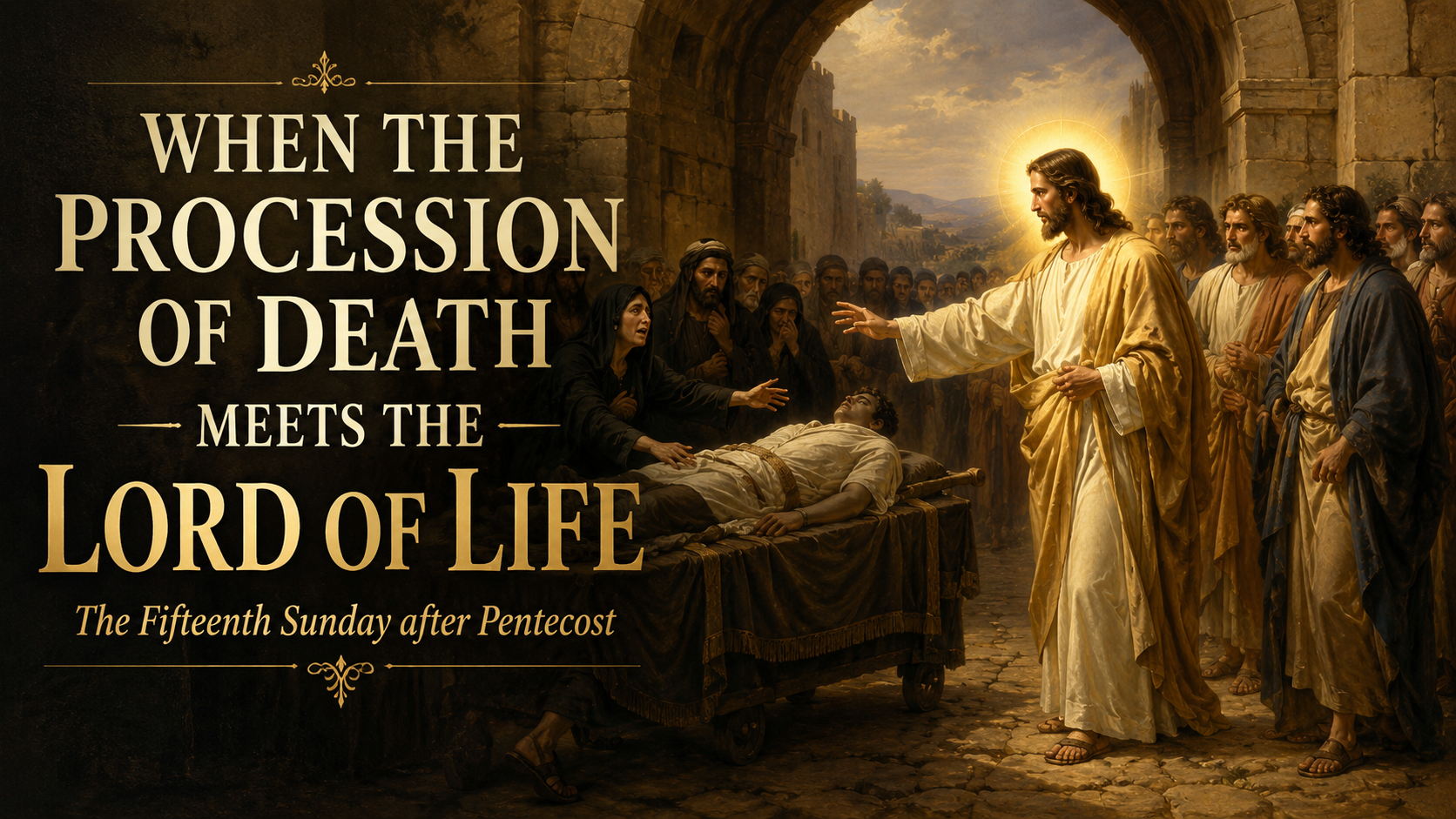
- The Fifteenth Sunday after Pentecost: When the Procession of Death Meets the Lord of LifeThe Fifteenth Sunday after Pentecost focuses on the transformative power of Christ, emphasising the supernatural life granted through grace. The liturgy highlights the Church’s role as a nurturing mother, mourning the spiritually dead while seeking their restoration. Christ’s compassion leads to resurrection, demonstrating that true life is found in dependence on Him.
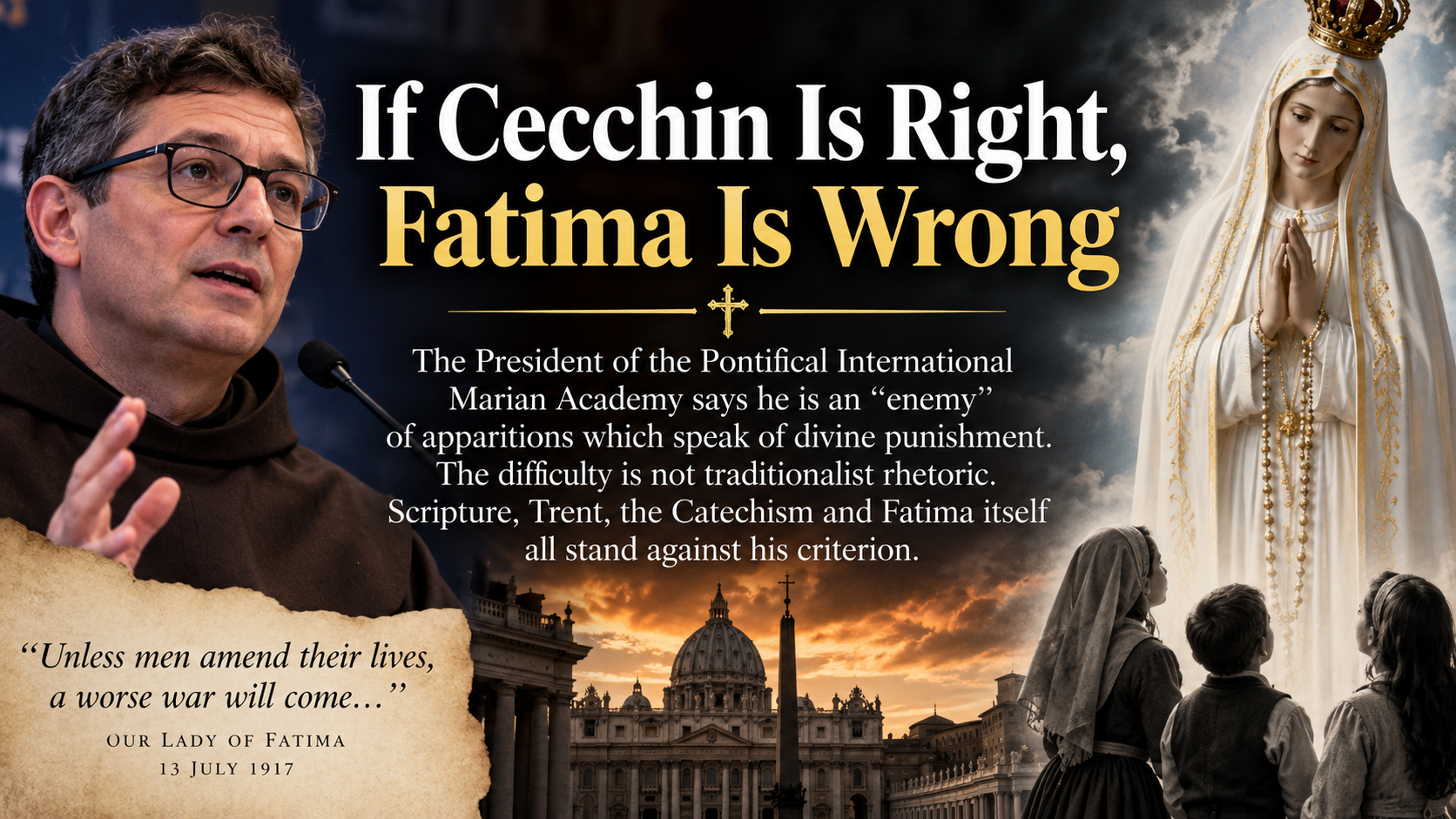
- If Cecchin Is Right, Fatima Is WrongFr Stefano Cecchin, President of the Pontifical International Marian Academy, has declared opposition to apparitions that speak of divine punishment, suggesting they are false. This stance contradicts fundamental Catholic doctrine, including teachings from Scripture, the Catechism, and specifically the Message of Fatima, which warns of divine consequences for sin.
CURRENT EDITION


Today’s Mass Propers
- Today’s Mass: September 05 Saint Lawrence Justinian
 Saint Lawrence Justinian, the first Patriarch of Venice, dedicated his life to the poor and the establishment of monasteries, rejecting noble marriage. Renowned for his humility and pastoral dedication, he emphasised the spiritual integrity of Venice’s safety. He was a precursor to the reforms of the Council of Trent, dying on 8 January 1455.



Leave a Reply