
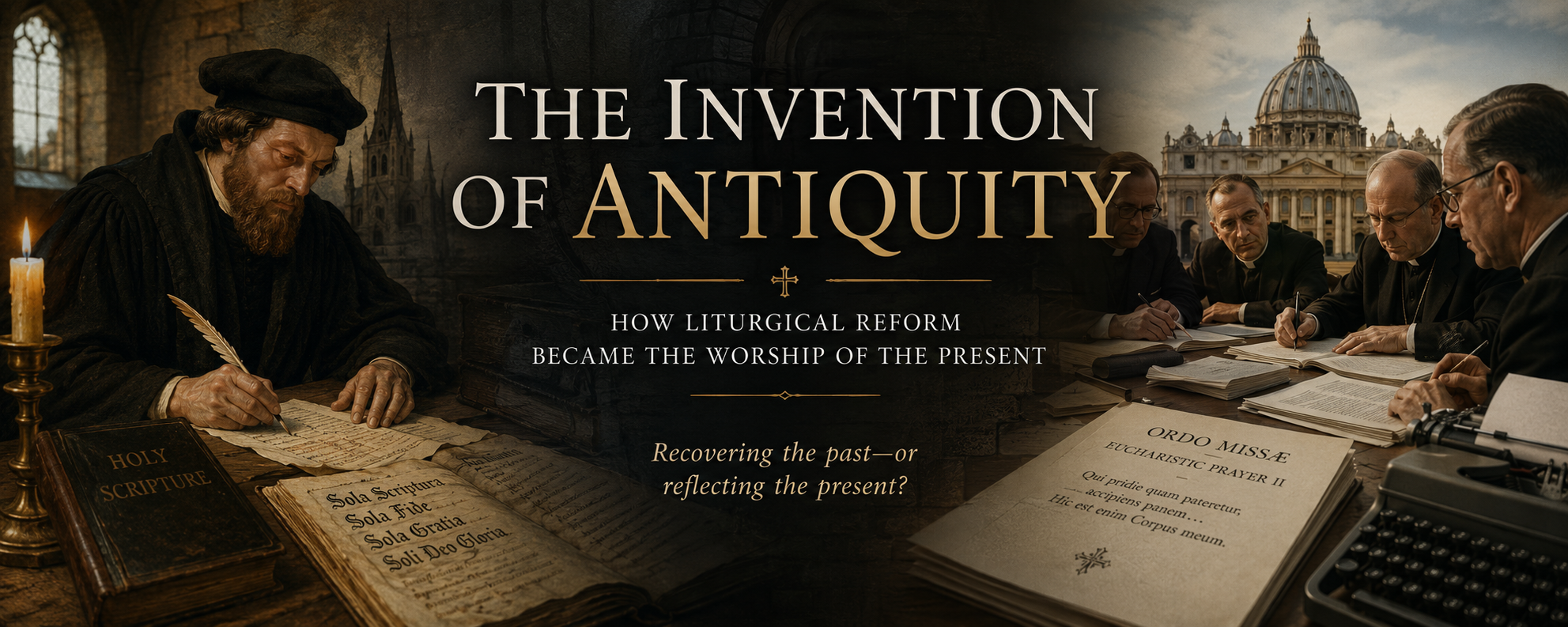
The Invention of Antiquity: How Liturgical Reform Became the Worship of the Present
Both Protestant and post-conciliar liturgical reformers claimed to recover the worship of the primitive Church. In practice, they discarded or marginalised prayers that genuinely linked Christians to antiquity and replaced them with modern compositions shaped by the preoccupations of their own age.

There is a recurring temptation in the history of Christianity to imagine that the Church can be renewed by escaping from her own history. It begins with the conviction that the worship received from previous generations has become cluttered, corrupted or unintelligible, and that beneath the accumulated traditions of the centuries there lies a purer, simpler and more authentic form of Christian prayer waiting to be recovered. Yet the quest for this imagined primitive purity almost invariably produces the same paradox: reformers reject genuinely ancient prayers in order to manufacture new ones which reflect the assumptions of their own time.
This was one of the defining impulses of the Protestant Reformation. Men such as John Calvin and Huldrych Zwingli regarded the historic Western liturgy, and especially the Roman doctrine and celebration of the Mass, not as the organic inheritance of Christian antiquity but as the product of theological corruption. Its sacrificial character, prayers for the dead and invocation of the saints were treated as evidence that the Church had departed from apostolic simplicity.¹ The remedy, they believed, was to return to Scripture and to what they understood to have been the worship of the primitive Church.
The difficulty was that the New Testament contains no complete liturgical order and remarkably few fixed texts for Christian worship. Having rejected or substantially recast the prayers and ceremonies which history had handed down, the Reformers were therefore compelled to construct orders of worship of their own. Calvin’s Strasbourg and Genevan liturgies, for example, were deliberate new arrangements assembled from Scripture, earlier Reformed precedents and selected elements of inherited Christian worship.² Zwingli’s Zurich rite replaced the sacrificial Mass with an explicitly commemorative service shaped by his own understanding of the Eucharist.³
The result was not simply a recovery of apostolic worship but the creation of an unmistakably sixteenth-century form of religion. The inherited liturgy was replaced by services in which preaching, doctrinal instruction and verbal exhortation assumed a greatly enlarged place. Worship became less visibly an objective and propitiatory offering made to God and more an occasion for the proclamation and reception of the reformers’ theological programme.
The supposed return to primitive simplicity had produced something historically new. The Reformers believed they were escaping the medieval world, but they were also enthroning the assumptions of their own. The liturgy ceased to be received in its integrity and became something reconstructed; no longer principally an inheritance to which the worshipper submitted, but an instrument through which the reformer communicated doctrine.
Four centuries later, a strikingly similar mentality emerged within parts of the Catholic liturgical movement and subsequently influenced the reform of the Roman Rite following the Second Vatican Council. Pope Pius XII had already identified the danger in his 1947 encyclical Mediator Dei. He warned that the liturgy of the earliest ages should not be regarded as intrinsically superior merely because it was more ancient:
“The liturgy of the early ages is most certainly worthy of all veneration. But ancient usage must not be esteemed more suitable and proper, either in its own right or in its significance for later times and new situations, on the simple ground that it carries the savour and aroma of antiquity.”⁴
Pius XII expressly rejected the notion that the Church should restore every ancient practice while condemning legitimate subsequent development. He compared such antiquarianism to the theological error of attempting to revive the earliest formulations of Christian doctrine while disregarding their authoritative development under the guidance of the Church.⁵
His warning was prescient. During the post-conciliar reform, ancient rites and prayers were frequently judged according to their supposed intelligibility or pastoral usefulness to modern man. The traditional Roman Canon, whose essential arrangement had remained substantially stable since at least the age of Pope St Gregory the Great, was criticised by influential liturgists as repetitive, structurally difficult and insufficiently expressive of certain theological themes favoured by twentieth-century scholarship.⁶ Its very antiquity, once understood as a guarantee of continuity, became an argument for supplementing or displacing it.
It is important to distinguish the constitution of the Council from the reform subsequently implemented in its name. Sacrosanctum Concilium ordered that liturgical innovation should occur only when the good of the Church “genuinely and certainly requires” it, and that new forms should grow organically from forms already existing.⁷ The Council itself did not order the composition of several new Eucharistic prayers. That development emerged during the work of the Consilium established by Paul VI to implement the conciliar reform.⁸
The Consilium eventually introduced three alternatives to the Roman Canon. These were presented as expressions of ancient liturgical patterns and restored theological variety, but they were also products of twentieth-century scholarship, pastoral theory and committee deliberation. Nowhere is the contradiction more evident than in the creation of Eucharistic Prayer II.
This prayer was based partly upon the Eucharistic text found in the document long known as the Apostolic Tradition of Hippolytus. At the time of the reform, the document was widely regarded as the work of the early third-century Roman priest Hippolytus and therefore as a privileged witness to ancient Roman worship.⁹ The use of this material allowed the new prayer to be represented as a recovery of something more primitive than the Roman Canon which the Church had actually preserved.
Subsequent scholarship, however, has seriously weakened the assumptions upon which that reconstruction rested. The Apostolic Tradition cannot securely be attributed to Hippolytus, may be a composite document reflecting several periods or geographical settings, and cannot safely be treated as a straightforward description of the liturgical practice of early third-century Rome.¹⁰ As the Jesuit liturgical scholar John F. Baldovin concluded after reviewing the modern debate, the work cannot confidently be assigned to a single author and does not provide certain information about the worship of the early Roman Church.¹¹
Nor was the ancient text simply translated and restored. Eucharistic Prayer II was extensively adapted and supplemented. The Consilium added the Sanctus, an explicit epiclesis, the words of institution in the form adopted for the new missal, the memorial acclamation, developed intercessions and references to the universal Church and the Pope.¹² The resulting prayer was therefore neither the historic Roman Canon nor a literal restoration of the text once attributed to Hippolytus. It was a new composition fashioned from ancient material according to modern structural and pastoral requirements.
The irony could hardly be more complete. The reformers marginalised the one Eucharistic prayer which had unquestionably been prayed in Rome for well over a millennium in favour of a twentieth-century composition given the appearance and authority of primitive antiquity. They displaced the actual liturgical inheritance of the ancient Roman Church in pursuit of an antiquity reconstructed by modern experts.
The familiar story that the final text of Eucharistic Prayer II was prepared under intense time pressure in a Roman restaurant does not originate merely in hostile traditionalist folklore. Louis Bouyer, himself a member of the Consilium and one of the theologians involved, recalled that he and the Benedictine scholar Dom Bernard Botte had to revise the proposed text hurriedly at a table in a Trastevere restaurant, with the expectation that it be completed by the following morning.¹³ The anecdote should not be exaggerated into the claim that the entire prayer was casually invented over dinner, but it does illustrate the haste and contingency involved in producing a text subsequently presented to the faithful as a recovery of ancient Christian prayer.
A text represented as a return to primitive worship was therefore the product of editorial urgency, disputed scholarship and modern liturgical engineering. The ancient Church had become less a historical reality to be received than a screen upon which reformers projected contemporary pastoral theories.
The same broad pattern links the Protestant liturgical revolutions of the sixteenth century with the Catholic reforms of the twentieth. The comparison is not an assertion that their intentions, doctrines or ecclesiastical authority were identical. They plainly were not. It is a comparison of method and mentality. Both exhibited dissatisfaction with received tradition. Both appealed to an idealised primitive Church. Both discovered that the surviving evidence for the earliest Christian liturgies was partial and uncertain. Both therefore filled the historical gaps with compositions reflecting the priorities of their own age.
The result was not antiquity but modernity wearing an ancient costume.
This preference for construction over inheritance often disguises itself as pastoral concern. Traditional prayers are described as too difficult, too repetitive, too theological, too silent or too mysterious for contemporary worshippers. Yet such criticisms reveal a deeper assumption: that the liturgy must be immediately comprehensible, verbally explicit and capable of being managed by its planners.
Ancient worship, by contrast, demands receptivity. It asks the faithful to enter a sacred world which they did not create and cannot entirely control. Traditional liturgy is not primarily designed to explain itself. It forms the worshipper gradually through repetition, symbolism, silence and doctrinal density. Its prayers do not constantly turn towards the congregation to instruct, reassure or stimulate it. They are directed towards God. They assume that worship is first an act of adoration and sacrifice, not a programme of religious education or a communal exercise in self-expression.
Modern reformers, whether Protestant or Catholic, have often found this difficult to tolerate. They prefer prayers which state their purpose plainly, articulate approved theological themes and generate predictable responses. The reformer wishes to manage the meaning of the rite. Mystery becomes ambiguity; repetition becomes redundancy; silence becomes exclusion; inherited language becomes an obstacle to participation. What cannot be immediately explained is presumed to require alteration.
Yet the desire to control the liturgy ultimately reverses its proper relationship with the Church. The traditional understanding holds that the Church receives her worship and is formed by it. The modern reforming mentality treats worship as material to be reshaped according to current priorities. The liturgy becomes a vehicle for pastoral strategies, academic theories and contemporary causes. Once that principle is accepted, no rite is secure, because every generation will believe itself competent to reconstruct worship according to its own supposed needs.
This is where the apparently humble appeal to the early Church becomes a form of chronological arrogance. The reformer claims to strip away later accretions, but in practice he sits in judgement upon the entire intervening Christian tradition. Centuries of saints, theologians, monks, priests and faithful are treated as though they had misunderstood or obscured the worship of the apostles, while the modern scholar or committee is presumed capable of recovering it from incomplete manuscripts and speculative reconstructions.
The instinct is not truly ancient but profoundly modern. It rests upon the confidence that contemporary man sees more clearly than his predecessors and is therefore entitled to remake what they handed down. History becomes a catalogue of errors from which the present must liberate itself. Tradition is no longer a living continuity but a burden requiring critical dismantling.
The tragedy is that the prayers rejected as medieval, obscure or pastorally ineffective were themselves among the most tangible links with the worship of earlier generations. They had survived not merely because ecclesiastical authorities imposed them, but because they had nourished saints, sanctified cultures and expressed the faith of the Church across centuries. Their repetition was not evidence of stagnation but of stability. Their mystery was not a defect but an acknowledgement that divine worship exceeds immediate comprehension.
A tradition is not preserved by pretending that history never happened. Nor can the Church recover her origins by discarding the rites through which those origins were transmitted. The organic development of worship may include later additions, clarifications and enrichments, but these are not necessarily betrayals of antiquity. They are often the means by which antiquity remained alive.
This was precisely the principle articulated by Pius XII. The Church is a living organism, and her liturgy develops under legitimate authority as doctrine is more fully expressed, devotion matures and the needs of Christian society change.¹⁴ True liturgical tradition is therefore neither immobility nor archaeological reconstruction. It is continuity through organic growth.
The real choice is not between pristine apostolic simplicity and a corrupted historical liturgy. It is between a living tradition received across the centuries and an imagined antiquity reconstructed according to modern preferences. The former may be complex, demanding and resistant to manipulation. The latter is attractive precisely because it can be made to say whatever the present wishes to hear.
Both the Protestant Reformers and the twentieth-century Catholic liturgical innovators believed that they were liberating Christian worship from the burdens of history. In practice, they exchanged the authority of inherited tradition for the authority of the contemporary scholar, reformer or committee. They rejected or marginalised prayers shaped and preserved by centuries of faith in favour of prayers shaped by controversy, academic hypothesis and pastoral fashion.
The attempt to invent a “new antiquity” is therefore not a return to the past at all. It is the worship of the present, disguised as archaeological recovery. The surest path to genuine antiquity is not to reconstruct the worship of Christians whom we scarcely know, but to preserve the prayers through which the ancient faith was actually handed down.
- Huldrych Zwingli, An Exposition of the Articles (1523), especially his treatment of Article XVIII concerning the Mass; John Calvin, Institutes of the Christian Religion, IV.17–18; Joseph Herl, Worship Wars in Early Lutheranism: Choir, Congregation, and Three Centuries of Conflict (Oxford: Oxford University Press, 2004), pp. 20–39.
- John Calvin, The Form of Prayers and Manner of Ministering the Sacraments According to the Use of the Ancient Church (1542); Elsie Anne McKee, ed., John Calvin: Writings on Pastoral Piety (Mahwah, NJ: Paulist Press, 2001), pp. 97–130; Alasdair I. C. Heron, “Shaping the Worship of the Reformed Church in Geneva,” HTS Teologiese Studies/Theological Studies, vol. 68, no. 1 (2012).
- Huldrych Zwingli, Action or Use of the Lord’s Supper (1525); W. P. Stephens, The Theology of Huldrych Zwingli (Oxford: Clarendon Press, 1986), pp. 218–259.
- Pius XII, Encyclical Mediator Dei, 20 November 1947, §61.
- Ibid., §§62–64.
- Joseph A. Jungmann, S.J., The Mass of the Roman Rite: Its Origins and Development, trans. Francis A. Brunner, C.Ss.R., 2 vols. (New York: Benziger Brothers, 1951–1955), vol. II, pp. 101–162; Cipriano Vagaggini, O.S.B., The Canon of the Mass and Liturgical Reform, trans. Peter Coughlan (London: Geoffrey Chapman, 1967).
- Second Vatican Council, Constitution Sacrosanctum Concilium, 4 December 1963, §23.
- Annibale Bugnini, C.M., The Reform of the Liturgy 1948–1975, trans. Matthew J. O’Connell (Collegeville, MN: Liturgical Press, 1990), pp. 447–478.
- Bernard Botte, O.S.B., La Tradition apostolique de saint Hippolyte: Essai de reconstitution, 5th ed. (Münster: Aschendorff, 1989); Bugnini, The Reform of the Liturgy, pp. 456–457.
- Paul F. Bradshaw, Maxwell E. Johnson and L. Edward Phillips, The Apostolic Tradition: A Commentary (Minneapolis: Fortress Press, 2002), pp. 1–17; Paul F. Bradshaw, The Search for the Origins of Christian Worship, 2nd ed. (Oxford: Oxford University Press, 2002), pp. 78–83.
- John F. Baldovin, S.J., “Hippolytus and the Apostolic Tradition: Recent Research and Commentary,” Theological Studies, vol. 64, no. 3 (September 2003), pp. 520–542.
- Bugnini, The Reform of the Liturgy, pp. 456–458; Enrico Mazza, The Eucharistic Prayers of the Roman Rite, trans. Matthew J. O’Connell (New York: Pueblo Publishing Company, 1986), pp. 99–122.
- Louis Bouyer, Memoirs, trans. John Pepino (Kettering, OH: Angelico Press, 2015), pp. 222–223.
- Pius XII, Mediator Dei, §§49–59 and 61–64.
RELATED ARTiCLES


LATEST ARTICLES
- Today’s Mass: October 21 St Ursula, Virgin Martyr & CompanionsSt Ursula and Companions, Virgins and Martyrs; Commemoration of St Hilarion, Confessor. Though legends concerning Ursula and eleven thousand virgins are historically uncertain, early Christian martyrs were venerated at Cologne. St Hilarion, Palestinian hermit and disciple of St Anthony, embraced severe penance and solitude, dying in 371 aged eighty.
- FR RIPPERGER’S YEAR OF SILENCE: Obedience is not an explanationFr Chad Ripperger has accepted a year-long withdrawal from public speaking as requested by Archbishop Golka of Denver, aimed at focusing on his priestly community. This decision, following the removal of another exorcist, raises concerns about the Church’s balance between discretion and public witness regarding exorcism and supernatural matters.
- Today’s Mass: October 20 Octave Day of St Edward, King & ConfessorEdward the Confessor, England’s last Saxon king, ruled from 1042 until his death in 1066. Born in 1003, he fled to Normandy during Danish rule and returned to take the throne. His reign is debated, seen as both weak and a time of peace. Edward’s legacy includes the establishment of Westminster Abbey, where he is buried.
- SYNODALITY CANNOT SUBSTITUTE FOR GOOD BISHOPSCardinal José Cobo has highlighted the extensive process behind episcopal appointments, which includes numerous consultations and documentation, yet questions the effectiveness of this method in selecting suitable bishops. He stresses the need for reform in canon law and cautions against equating thorough procedures with genuine ecclesiastical wisdom and accountability.
- GAZA’S DEAD and the Claims Made in Their NameWestern politicians and media vilify Israel with double standards, while ignoring massacres of Christians across the Middle East. A century ago Christians were 20% of the region; now less than 4%, with persecution “close to genocide.” Yet Israel is the only state where Christians grow and worship freely. The Vatican mobilises diplomacy for Palestine, climate, and migration, but whispers for its own martyrs. Truth, then justice, then peace — anything less is counterfeit.
CURRENT EDITION


Today’s Mass Propers
- Today’s Mass: October 21 St Ursula, Virgin Martyr & Companions
 St Ursula and Companions, Virgins and Martyrs; Commemoration of St Hilarion, Confessor. Though legends concerning Ursula and eleven thousand virgins are historically uncertain, early Christian martyrs were venerated at Cologne. St Hilarion, Palestinian hermit and disciple of St Anthony, embraced severe penance and solitude, dying in 371 aged eighty.

Leave a Reply