
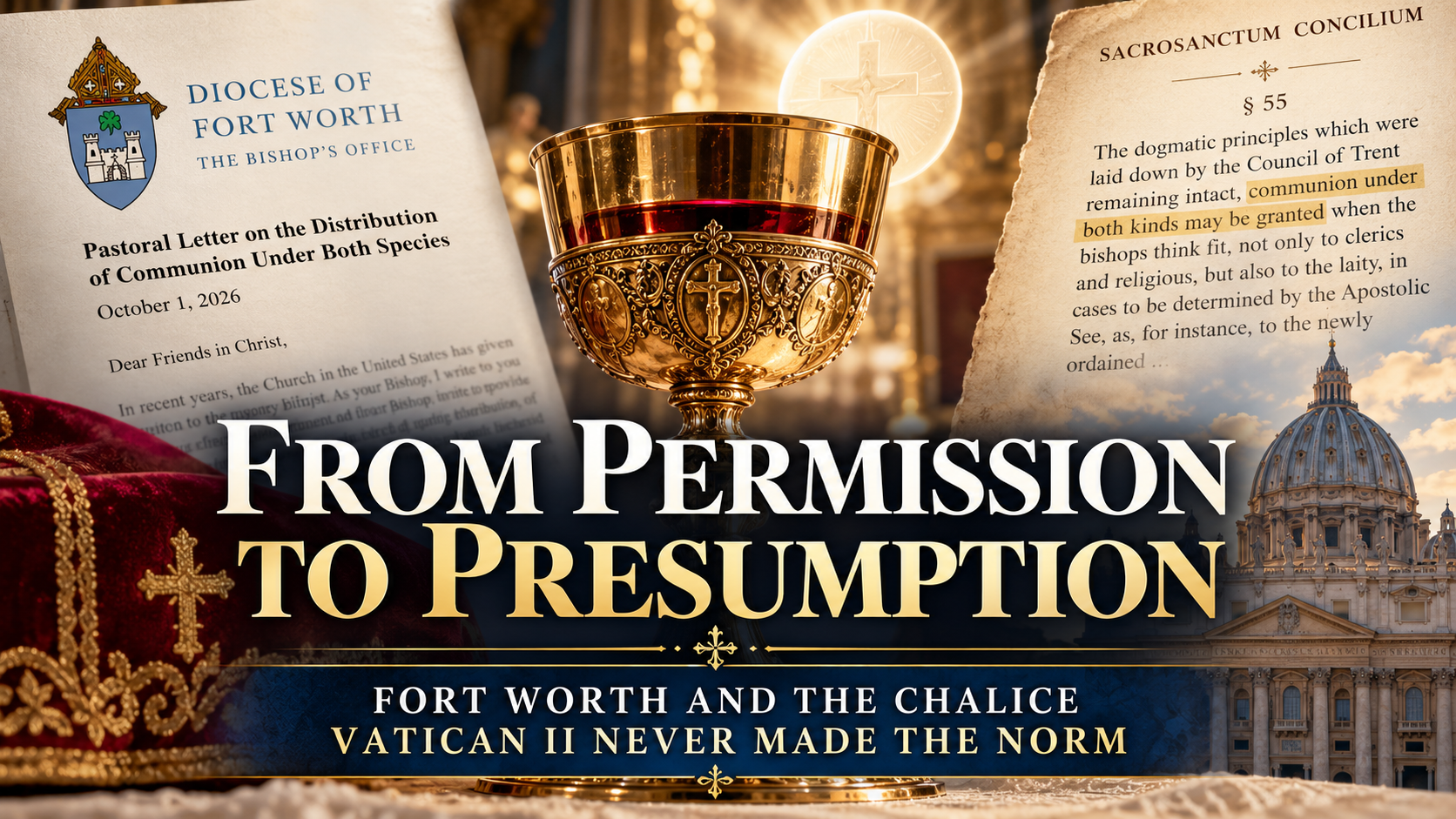
Bishop Michael Olson has sharply restricted Communion under both species in the Diocese of Fort Worth. Far from repudiating Vatican II, his decision exposes a more uncomfortable history: the Council authorised a carefully circumscribed permission, subsequent legislation widened it, and parish custom eventually made it appear normal. What Catholics later came to call “Vatican II” was often considerably more expansive than the Council’s own words. Fort Worth’s new Eucharistic discipline shows how a limited conciliar permission became an ordinary expectation — and how recovering restraint can now appear more radical than the expansion which preceded it.
How did the words “may be granted … in cases to be determined” become a practice so commonplace that restricting it can now look like a repudiation of the Second Vatican Council? That is the question raised by Bishop Michael F. Olson of Fort Worth. In a pastoral letter dated 1 October 2026, Olson has directed that Holy Communion under both species be confined within his diocese to specified occasions: priestly and diaconal ordinations, the Chrism Mass, the Mass of the Lord’s Supper on Holy Thursday, the Easter Vigil, Masses at which adults are confirmed and receive their First Communion, Holy Matrimony for the Catholic bride and groom, religious professions, Corpus Christi, Masses at convents and retreat centres, and the first Mass of a newly ordained priest. Celebrations of similar solemnity require the bishop’s explicit approval. Even on those occasions, the chalice is not to be offered if reverent distribution cannot be assured; outside them, Holy Communion is to be distributed under one species.¹


The practical effect is obvious: fewer chalices, fewer occasions on which the Precious Blood is carried through a congregation, fewer additional ministers required to distribute it, and fewer opportunities for spillage or profanation. Yet to describe this simply as a diocesan restriction upon the chalice would be to miss its importance. Olson has touched one of the most revealing fault-lines in post-conciliar Catholicism: the distance between what the Council itself authorised, what subsequent legislation progressively expanded, and what several generations of Catholics eventually came to regard as an ordinary requirement of the conciliar liturgy. The question is not whether Catholics may receive under both species. They may. The more interesting question is how a permission became a widespread custom, and how that custom acquired the authority of something supposedly demanded by Vatican II.
Olson begins where a Catholic bishop ought to begin: not with convenience, symbolism or pastoral preference, but with doctrine. The Most Holy Eucharist is Jesus Christ Himself, truly and substantially present — Body, Blood, Soul and Divinity. By the doctrine of concomitance, Christ is received whole and entire under either Eucharistic species. The communicant who receives the Sacred Host does not receive Christ’s Body separated from His Blood, nor does he receive some incomplete portion of Our Lord which must subsequently be completed by drinking from the chalice. Olson therefore states plainly that “nothing is lacking” when Holy Communion is received under the species of bread alone or, in those exceptional circumstances in which this occurs, under the species of wine alone.²
This is not a theological device invented to justify a modern disciplinary decision. It is settled Catholic doctrine. The Council of Trent addressed the question precisely because reception from the chalice had become entangled with the contention that Communion under both species was required by divine command or necessary for salvation. Trent rejected those propositions. It taught that the whole and entire Christ is received under either species, that the faithful receiving under one species are not deprived of any grace necessary for salvation, and that the Church possesses authority to determine the discipline governing sacramental reception. The Western practice of communicating the faithful under the species of bread alone was therefore neither defective nor a mutilation of the Sacrament.³
That Tridentine background is indispensable to understanding Vatican II, because the Council did not abandon it. Quite the contrary. When Sacrosanctum Concilium addressed Communion under both kinds in paragraph 55, it began by expressly preserving “the dogmatic principles which were laid down by the Council of Trent”. Only then did it say that Communion under both kinds “may be granted” to clergy, religious and laity in cases to be determined by the Apostolic See, offering as examples the newly ordained at their ordination Mass, the newly professed at the Mass of religious profession, and the newly baptised at the Mass following their baptism.⁴ The wording matters. “May be granted” is not “shall normally be given”, and “in cases to be determined” is not a mandate for routine distribution from the chalice at ordinary parish Masses. Vatican II opened a possibility; it did not establish a universal expectation.

There is another point in paragraph 55 which deserves particular attention because the text itself is more restrained than the mythology which subsequently surrounded it. Immediately before discussing Communion under both species, Sacrosanctum Concilium strongly commends what its English text calls the “more perfect form of participation in the Mass”. Read carelessly, that phrase can be made to sound as though the Council were declaring reception from the chalice to be a more perfect form of Holy Communion. It was doing nothing of the sort. The sentence concerns the faithful receiving the Lord’s Body from the same Sacrifice after the priest’s Communion — that is, receiving Hosts consecrated at the Mass in which they are actually participating rather than routinely communicating from Hosts reserved from an earlier Mass. Only in the next sentence does the Council turn separately to Communion under both kinds.⁵
That is not a pedantic distinction. It is an illuminating example of how a generalised appeal to “what Vatican II wanted” can become detached from what Vatican II actually said. The Council certainly permitted an extension of the chalice. It did not identify drinking from it as the “more perfect form of participation”, nor did it suggest that reception under one species was an inferior sacramental Communion. The actual conciliar text is considerably more cautious than the popular post-conciliar impression.
The story did not, of course, end in 1963. Subsequent legislation broadened the circumstances in which Communion under both species could be offered, and the present General Instruction of the Roman Missal goes considerably further than the three examples supplied by Sacrosanctum Concilium. It speaks positively of reception under both kinds because the sign of the Eucharistic banquet is thereby displayed more fully: eating and drinking together express more visibly the New Covenant in Christ’s Blood and anticipate the eschatological banquet of the Kingdom. It also entrusts the diocesan bishop with authority to establish norms governing the practice.⁶ To acknowledge this is not to weaken the argument; it is necessary if the history is to be presented honestly. Vatican II permitted, subsequent Roman legislation expanded, and pastoral custom in many places normalised.
The theological qualification contained in the GIRM is therefore crucial. Communion under both species provides a fuller sign; it does not provide a fuller Christ. The same legislation which commends the sign immediately requires pastors to teach the faithful that Christ whole and entire, together with the true Sacrament, is received under one species alone, and that those who communicate in this manner are deprived of no grace necessary for salvation.⁶ That distinction is perfectly coherent in sacramental theology. The outward sign can be more complete in its representation of the Eucharistic banquet while the sacramental reality received by the communicant remains complete under either species.
What is clear in theology, however, can become blurred by liturgical habit. Practices teach. They create assumptions long before anyone formulates those assumptions as propositions. If several chalices stand upon the altar every Sunday, if lay ministers routinely take up stations to distribute the Precious Blood, if the congregation is repeatedly invited to receive from both species, and if the language of a “fuller” sign is heard more often than the doctrine of concomitance, it is hardly surprising that some Catholics eventually acquire the impression that Communion under the species of bread alone is somehow incomplete. Nobody need formally teach the error. The visual grammar of the liturgy can suggest it perfectly well on its own.
This is why Olson’s intervention is more significant than a simple reduction in the number of chalices used in Fort Worth. His pastoral letter deliberately reunites discipline with catechesis. He requires parishes to teach the Real Presence, the Eucharist as Sacrifice and sacred banquet, the sacramental character imparted by priestly ordination, the doctrine of concomitance, and the truth that Christ is received completely under either species. He explicitly reminds the faithful that reception from the chalice is not required and that nobody should feel obliged to receive under both species.² The discipline is therefore intended to make the doctrine visible again. Catholic teaching says that nothing is lacking in the Sacred Host; Catholic practice should not inadvertently create the opposite impression.
The history of the Western discipline also deserves more serious treatment than either side of the modern liturgical argument sometimes gives it. Communion under both kinds was widely practised in the ancient and early medieval Church. The Western practice of communicating the faithful ordinarily under the species of bread alone developed gradually and was well established by the high Middle Ages. Its development cannot honestly be reduced to fear of spillage, although the danger of profaning the Precious Blood was obviously a legitimate consideration. The eventual discipline also bore witness to the doctrine of concomitance and became especially significant once the necessity of receiving from the chalice was itself asserted as a matter of doctrine. Trent’s defence of Communion under one species was therefore not simply the defence of a medieval habit. It defended the truth that Christ cannot be divided and that the efficacy of the Sacrament does not depend upon reception of both outward species.³
The sacramental species are distinct; the risen Christ received beneath them is not. Where Christ’s Body is sacramentally present, His Blood is not absent. Where His Blood is sacramentally present, His Body is not absent. His Soul and Divinity are not divided between Host and chalice. The communicant receiving the Sacred Host receives totus Christus — Christ whole and entire. This is precisely why the traditional Western discipline could serve as a powerful catechesis in itself: the very act of receiving under one species proclaimed that Christ is indivisible.
None of this requires pretending that Communion under both species is somehow un-Catholic. It plainly is not. Nor does it require denying the richer symbolism which the current Roman books identify in eating and drinking from the Eucharistic banquet. What it does require is keeping three quite different categories distinct: what is permitted, what may possess a fuller sign value, and what is normative. Post-conciliar liturgical discussion has repeatedly blurred those categories. A permitted practice becomes common, common practice becomes expected, and expectation is eventually projected backwards until people imagine that the Council itself required what it merely allowed in particular circumstances.
Fort Worth provides an unusually clear example because Olson has not stepped outside the present liturgical legislation. He expressly grounds his authority in GIRM 283, which permits the diocesan bishop to establish norms for Communion under both kinds. His letter accepts the fuller signification recognised by the reformed Missal. He permits reception from the chalice on a substantial number of solemn occasions. His conclusion is not that the practice is illegitimate, but that it should be governed by restraint, doctrinal clarity and the requirements of reverence. The modern Roman books themselves permit him to arrive at a practice considerably more conservative than the parish customs which have developed in many parts of the United States.
There is also a connection with extraordinary ministers which should not be ignored. Routine distribution of the Precious Blood to a large congregation normally requires more ministers than distribution of the Sacred Host alone. Several chalices require several people to administer them. The American norms themselves caution that when extraordinary ministers are required, their numbers should not be multiplied beyond what is necessary for the orderly and reverent distribution of Holy Communion. They also recognise practical circumstances in which Communion under both kinds ought not to be attempted, including the amount of wine required, the danger that the Precious Blood may be spilled, and the availability of properly formed ministers.⁷ Redemptionis Sacramentum similarly insists that the fuller sign must be accompanied by proper Eucharistic catechesis and recognises circumstances in which access to the chalice should not be provided.⁸
There is a revealing pastoral dynamic here. One optional practice can create the apparent necessity for another. Multiple chalices produce a demand for multiple ministers; multiple extraordinary ministers become a familiar feature of ordinary parish worship; familiarity becomes expectation; and an arrangement produced by an optional form of distribution begins to look indispensable. Olson reverses the process. Instead of beginning with the assumption that routine distribution from the chalice must somehow be staffed, he first asks when the chalice itself should be offered. Once that question is answered more restrictively, much of the supposed necessity for proliferating ministers disappears with it.
His instructions concerning the handling of the Eucharist reinforce the same principle. Self-service is forbidden. Communicants may not pass the chalice among themselves. Self-intinction is forbidden. Sacred vessels are to be purified only by priests, deacons and instituted acolytes, and the bishop specifies where that purification is to take place.¹ These provisions are not fastidious ceremonialism. If Catholic Eucharistic doctrine is true, they are the natural consequences of what Catholics profess to believe. If the chalice really contains the Precious Blood of Christ, spilling it is not comparable to spilling ordinary wine; if the ciborium has contained His Sacred Body, its purification is not analogous to washing ordinary crockery after a meal.
Catholic Eucharistic discipline is necessarily meticulous because Catholic Eucharistic belief is radical. The Church does not say that the Eucharistic elements merely remind us of Jesus, symbolise His absence, or become sacred because the community regards them with affection. She says that after the consecration this is Christ. The seriousness with which the Sacred Species are distributed, consumed, reserved and purified must therefore follow from the seriousness of that claim. Reverence which never results in restraint, care or concrete discipline risks becoming little more than a liturgical sentiment.
Traditional Catholics have long objected that much post-conciliar practice has moved habitually in the other direction: more handling, more ministers, more options, and an increasing tendency for exceptional faculties to acquire the appearance of ordinary norms. The usual answer has been that such developments represent “Vatican II”. Olson’s letter is useful because on this particular question one need not invoke the traditional Roman Rite at all to expose the inadequacy of that answer. One need only read Sacrosanctum Concilium, then read the subsequent legislation, and notice what changed between permission, expansion and eventual pastoral custom.
The conciliar text did not establish routine lay reception from the chalice. Later legislation substantially enlarged the faculty. Local custom often took the enlargement further in practical effect. None of that automatically renders the later practice illegitimate, but neither can historical development be collapsed backwards into the claim that this is simply what “the Council” prescribed. It did not. The distinction matters because genuine fidelity to a Council means fidelity to what it actually taught and legislated, not to every practice which subsequently acquired a conciliar label.
There is also something salutary in a bishop being willing to say that not every legitimate option must become an habitual one. The modern liturgical mentality too easily supposes that an option exists in order to be exercised and that a permission which remains unused represents an opportunity somehow denied to the faithful. Catholic tradition has never worked that way. The Church possesses many legitimate rites, faculties and permissions whose appropriateness depends upon circumstances. Prudence consists precisely in distinguishing what may be done from what ought habitually to be done.
This becomes particularly important when the subject is the Most Holy Eucharist. The great pastoral crisis facing Western Catholicism is not that ordinary Catholics have insufficient access to additional modes of receiving Holy Communion. It is that Eucharistic faith itself has had to be repeatedly re-taught. Bishops have devoted enormous resources to Eucharistic catechesis because basic understanding of the Real Presence, the Sacrifice of the Mass and worthy reception cannot simply be assumed. Yet catechesis cannot operate in one room while liturgical habit operates in another. What Catholics repeatedly see at the altar inevitably shapes how they understand what the Church teaches.
A priest’s careful handling of the Sacred Host teaches something. The guarded purification of the chalice teaches something. The distinction between ordinary and extraordinary ministers teaches something. Silence before the Blessed Sacrament teaches something. Restraint teaches something. The ordinary reception of Holy Communion under one species, when properly explained, also teaches something profound: the communicant is not receiving half of Christ. The Sacred Host is not Christ’s Body awaiting completion by His Blood. It is not an abbreviated Eucharist for those who decline the chalice. It is the living Jesus Christ, Body, Blood, Soul and Divinity, whole and entire beneath the sacramental species.
That is the truth around which Olson has constructed his letter. It is also the reason this local decision deserves attention far beyond Texas. The controversy is not really about taking something away from Catholics. It is about recovering the distinction between sacramental reality and liturgical sign, between permission and obligation, and between what Vatican II actually authorised and what subsequent Catholic culture came to assume it authorised.
There is a useful irony in the fact that what now appears to some as a restrictive development is, in an important respect, closer to the cautious language of Sacrosanctum Concilium than the routine parish practice to which they have become accustomed. Vatican II opened a limited faculty. Later legislation opened it more widely. Pastoral custom in many places made the opening appear permanent. Fort Worth has not denied the legitimacy of the faculty; Bishop Olson has simply put its exercise back under discipline.
That ought not to be revolutionary. It ought to be recognisably Catholic. The Church is not obliged to do everything she permits, nor does the multiplication of outward forms necessarily produce deeper faith in the sacramental reality. Sometimes the recovery of restraint is itself catechetical. And when what is being guarded is the Most Precious Blood of Jesus Christ, restraint can itself be an act of faith.
¹ Most Rev. Michael F. Olson, Pastoral Letter on the Distribution of Communion Under Both Species, Diocese of Fort Worth, 1 October 2026.
² Ibid.
³ Council of Trent, Twenty-First Session: Doctrine on Communion under Both Species and on the Communion of Infants, Chapters I–III and Canons I–III, 16 July 1562; see also Session XIII, Chapter III.
⁴ Second Vatican Council, Sacrosanctum Concilium: Constitution on the Sacred Liturgy, §55, 4 December 1963.
⁵ Ibid.
⁶ Congregation for Divine Worship and the Discipline of the Sacraments, General Instruction of the Roman Missal, §§281–283.
⁷ United States Conference of Catholic Bishops, Norms for the Distribution and Reception of Holy Communion under Both Kinds in the Dioceses of the United States of America, especially §§23–28.
⁸ Congregation for Divine Worship and the Discipline of the Sacraments, Redemptionis Sacramentum, especially §§100–107, 25 March 2004.






Leave a Reply