
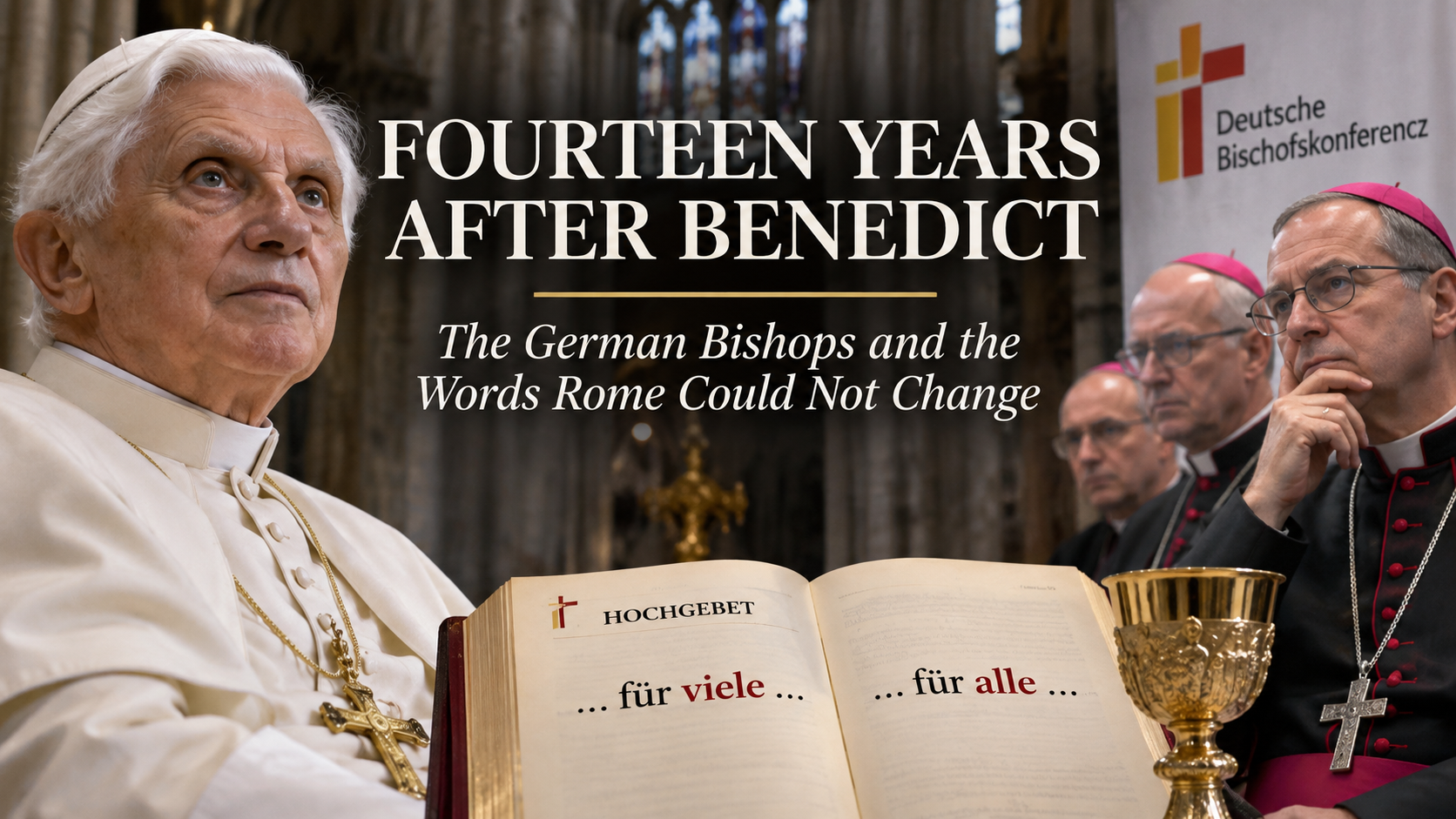
Benedict XVI instructed the German-speaking bishops to restore “for many” to the words of Consecration and explain the reasons to the faithful. They never implemented the change. Now, as a new Missal is prepared with inclusive language and greater sensitivity towards masculine images of God, its principal liturgical advisers expect the bishops to retain the disputed translation. The history reveals rather more about contemporary ecclesiastical authority than a disagreement over two German words.
In April 2012, Pope Benedict XVI wrote personally to Archbishop Robert Zollitsch of Freiburg, then president of the German Bishops’ Conference, concerning a matter which had already occupied the attention of Rome for several years. The German bishops had failed to agree upon translating pro multis as für viele, “for many”, in the words of Consecration. Some wished to retain für alle, “for all”, despite the Holy See’s instruction that the translation should be corrected. Benedict explained the scriptural and theological reasons for the change, anticipated the objections, and asked the bishops to prepare their priests and faithful through catechesis. Fourteen years later, the German Missal still says für alle.¹
On 3 November 2026, Fr Marius Linnenborn, director of the German Liturgical Institute in Trier and a member of the leadership overseeing the revision of the German-language Roman Missal, was asked whether the new edition would finally adopt the translation Benedict had requested. He referred to the Italian bishops, who had retained per tutti with the subsequent approval of Pope Francis, and said: “I suspect that a vote among the bishops of the German-speaking territories would produce a similar result.”²
Linnenborn was making a prediction. No such vote has yet taken place, and the new Missal is not expected before 2033. Nevertheless, the remark is hardly inconsequential. He speaks as a member of the group responsible for the revision, with direct knowledge of its history, and his interview contains another admission which helps explain how Benedict’s original instruction came to be set aside.
An entirely new German translation had already been completed under the principles established by the Vatican instruction Liturgiam authenticam in 2001. It followed the Latin text much more closely than the existing version. When the work was finished, however, the bishops of the German-speaking territories declined to approve it because they were unconvinced that it improved upon the 1975 Missal. The undertaking was abandoned.²
This deserves more attention than it has received. The translation was prepared according to the norms then governing the Church’s liturgical books. The bishops rejected the completed work, the existing Missal continued in use, and the controversy remained unresolved until Rome’s own translation policy changed. There is no need to speculate about clandestine resistance or some organised conspiracy. The essential facts are supplied by Linnenborn himself.
The original dispute can be traced to the years immediately following the Second Vatican Council. The traditional Latin formula for the Consecration of the Precious Blood contains the words qui pro vobis et pro multis effundetur in remissionem peccatorum. Their scriptural foundation lies in the institution narratives of St Matthew and St Mark, which speak of Christ’s Blood being poured out for many. The expression also recalls the Suffering Servant of Isaias 53, who bears the sins of many.
In the preparation of vernacular Missals after the Council, however, several episcopal conferences adopted “for all” or its equivalent. The translators argued that “many”, understood in its biblical and Semitic context, referred to the multitude for whom Christ offered Himself, and therefore conveyed the universality of Redemption. It was an interpretation with a respectable theological foundation, as Benedict himself acknowledged. The difficulty was that an interpretation had been incorporated into the very words of the liturgy.
Rome eventually decided that the distinction mattered.
On 17 October 2006, Cardinal Francis Arinze, Prefect of the Congregation for Divine Worship and the Discipline of the Sacraments, wrote to the presidents of episcopal conferences after consultation with the Congregation for the Doctrine of the Faith. The decision had been referred to Benedict XVI, who directed that pro multis should be translated faithfully in future editions of the Missal. Conferences using “for all” were instructed to provide the necessary catechesis over the following year or two in preparation for introducing “for many”.³
The Congregation was careful to distinguish the question of translation from sacramental validity. Masses celebrated using a duly approved formula containing “for all” were unquestionably valid. There was no suggestion that Catholics who had worshipped according to the existing vernacular Missals had been deprived of the Holy Eucharist, nor that the Church had previously taught something contrary to the universality of Christ’s saving sacrifice. The instruction concerned the faithful rendering of words which the Roman Rite had preserved for centuries.
By March 2012, the German-speaking bishops had still not reached agreement. Zollitsch informed Benedict of the situation during a visit on 15 March, explaining that even if the German conference accepted für viele, bishops elsewhere in the German-speaking world might retain für alle. The Pope was concerned that the same language might consequently be used differently at the most sacred moment of the Mass. He promised to write to the bishops personally.¹
The resulting letter, dated 14 April, is worth revisiting for reasons extending well beyond this particular controversy. Benedict did not issue another brief administrative instruction. He explained why the original post-conciliar interpretation had appeared reasonable, why subsequent biblical scholarship had weakened the assumptions upon which it rested, and why the Church ought to preserve the wording of Scripture even when its meaning required explanation.
He recognised, moreover, the pastoral difficulty involved. The faithful had heard “for all” for decades. Many would understandably wonder whether the proposed correction implied that Christ had died for only some men, or that the Church had altered her teaching. Benedict did not dismiss such concerns as ignorance or disobedience. He understood that changes in familiar liturgical expressions touch people deeply, particularly when made to the words of Consecration.
His answer was catechesis. Priests should explain why Christ’s sacrifice is sufficient for the redemption of the whole human race, while the reception of its saving fruits involves the response of man to divine grace. The Council of Trent had long since distinguished Christ’s death for all from the fact that not all receive the benefit of His death. The distinction was therefore neither a novelty nor an invention designed to justify a preferred translation.⁴
Benedict also drew attention to the different institution narratives. St Luke and St Paul record the words “for you”, while St Matthew and St Mark speak of “many”. Neither expression denies the universality of Redemption. Both convey something particular about the manner in which Christ’s sacrifice is offered and received. The Roman Canon preserves both biblical expressions in its formula.
There is a theological richness here which disappears if the translator assumes that the task is to make every expression immediately intelligible according to a single preferred interpretation. Scripture is not always immediately intelligible, and the liturgy was never intended to relieve the Church of her duty to teach.
Benedict’s letter identified a defect which had become increasingly apparent during the first decades of vernacular worship. The principle of conveying the meaning of a text, rather than translating its actual words, had sometimes produced versions so different that the original common text could scarcely be recognised. He had encountered the problem himself while celebrating Mass in different languages. The instruction Liturgiam authenticam represented an effort to recover fidelity to the Latin original without demanding an impossibly mechanical word-for-word translation.
What is striking in the present German controversy is that the bishops were offered a practical means of implementing this recovery. Rome had explained the change, authorised the necessary preparation, and allowed time for the faithful to understand it. Benedict then supplied the substance of the catechesis himself. The principal obstacle was no longer the absence of theological guidance from the Holy See.
It was the unwillingness of the relevant episcopal authorities to adopt the translation.
The difficulty acquired a different character under Pope Francis. His motu proprio Magnum principium, issued on 3 September 2017, amended canon 838 of the Code of Canon Law and gave episcopal conferences greater responsibility for preparing and approving vernacular liturgical translations, subject to confirmation by the Apostolic See. The reform did not abolish the requirement of fidelity to the original texts, although it altered the respective responsibilities of Rome and the conferences and permitted a different practical approach to translation.⁵
In Italy, the bishops subsequently approved retaining per tutti in the revised Missal. Pope Francis granted his approval to the Italian edition on 16 May 2019. The book was published in 2020 and became obligatory on Easter Sunday, 4 April 2021. The precedent is genuine, and Linnenborn is entitled to cite it.⁶
It also presents an awkward theological problem which cannot be disposed of by referring simply to papal approval.
Benedict had determined that “for many” was the appropriate translation because it preserved the scriptural expression, and he had explained at considerable length why the distinction between translation and interpretation mattered. Francis subsequently approved a vernacular Missal which retained the interpretative rendering Benedict had sought to replace. The latter decision altered the practical position of the Italian bishops and established a precedent for others. It did not demonstrate that Benedict’s theological reasoning was mistaken, nor did it provide a new account of why pro multis ought to be translated as “for all”.
Those who treat the Italian approval as settling the entire question are confusing the canonical authorisation of a liturgical text with the theological merits of a particular translation. An authorised text may be valid and lawful while still inviting legitimate criticism of its accuracy. Rome’s own declaration of 2006 had already acknowledged that distinction.
There is another aspect of Linnenborn’s interview which makes the present revision especially revealing. Asked about expressions in the existing Missal which might require correction, he cited a collect used towards the end of the liturgical year. Its German wording asks the faithful to understand that they become free by submitting to God’s will. He considers this difficult for contemporary worshippers, particularly at the beginning of Mass, and observes that the thought does not actually appear in the corresponding Latin prayer. A different formulation would therefore be possible.²
The admission is instructive. An idea absent from the original Latin text is acknowledged as potentially unsuitable for retention in German. Yet when the subject turns to the words of Consecration, where the Holy See itself identified an interpretative rendering and requested a correction, Linnenborn expects the bishops to retain the familiar translation. Fidelity to the original evidently remains an important consideration, but its practical application appears considerably more flexible when the expression concerned has become established in the post-conciliar liturgy.
Linnenborn also explained that the revised Missal would employ language intended to be as inclusive as possible. Where texts presently address only brothers, sisters would be included. He added that the revisers would deal carefully with strongly masculine images of God.²
There is a proper distinction to be made here. A German expression conventionally addressing men and women together may reasonably be rendered in a manner which makes that common address explicit. Liturgical translators have always exercised judgement concerning grammar, idiom and the differing conventions of languages.
The language employed by divine revelation is another matter.
God is neither male nor female. The Catholic Church has never taught that the divine nature possesses biological sex, and Scripture itself uses maternal imagery to describe aspects of God’s tenderness and care. The Catechism of the Catholic Church acknowledges this in paragraph 239. It immediately proceeds, however, to explain that Jesus Christ revealed God as Father in a unique and eternal sense, in relation to His only-begotten Son.⁷
The names Father and Son express revealed relations within the Most Holy Trinity. They are not simply masculine images inherited from the social arrangements of ancient Palestine. The Church’s confession of the divine Persons depends upon the distinction, and the language cannot be revised merely because contemporary society has become uncomfortable with masculine forms of address.
Linnenborn has not supplied examples of proposed alterations to the revealed names of the divine Persons, and it would be improper to attribute such an intention to him without evidence. His statement nevertheless invites examination of the criteria by which the revisers intend to distinguish between unnecessarily exclusive language and expressions whose theological content is inseparable from their scriptural form.
The more interesting question is why the proposed revision should be so sensitive to the linguistic expectations of contemporary society while remaining apparently reluctant to implement a correction which Benedict considered necessary for fidelity to Scripture.
Perhaps the answer lies partly in the character of the project itself. The German-speaking bishops resolved in 2022 to undertake another revision, and the work began in July 2024. It is being directed through the Conference for Liturgy in the German-Speaking Territories, representing the bishops’ conferences of Germany, Austria and Switzerland, together with the relevant bishops in Luxembourg, Liechtenstein, France, Italy and Belgium. The revision is deliberately described as moderate. Existing texts are generally to be retained rather than translated afresh from the Latin, while additional prayers and alternative texts are being prepared.⁸
The official project documentation is quite explicit that the exercise does not envisage a general return to the Latin originals. Indeed, the public consultation, running from 1 November 2026 until 30 June 2027, invites specific proposals for improving existing texts rather than wider reconsideration of the translation principles themselves. The drafting work is expected to finish in 2028, followed by episcopal approval and Roman confirmation before the proposed publication in 2033.
There is nothing inherently unreasonable about preserving familiar liturgical texts where they are accurate and suitable. But the justification becomes less persuasive when familiarity is invoked to retain a translation which the Holy See specifically directed should be corrected. The German bishops previously declined to approve an entirely new translation. Their present undertaking begins from a presumption in favour of the existing Missal. It is hardly surprising that Linnenborn expects the disputed formula to survive.
The history also belongs within a wider examination of ecclesiastical government in Germany. Nuntiatoria has previously considered the controversy surrounding the proposed permanent Synodal Conference and the willingness of German ecclesiastical authorities to advance national arrangements whose relationship with the government of the universal Church remains contested. In September, attention was drawn to the Apostolic Nuncio Archbishop Hubertus van Megen’s criticism of the preoccupation with institutional processes and the apparent disappearance of Christ from much of the discussion. More recently, Bishop Georg Bätzing’s public challenge to Pope Leo XIV over the description of clerical abuse as systemic revealed another dispute in which German churchmen appealed to their own institutional experience in challenging a Roman judgement.⁹
The circumstances are different, and the translation of a Missal must not be confused with the theological and canonical questions surrounding the Synodal Way. Nevertheless, the recurring problem concerns how ecclesiastical authority operates when national institutions possess the practical means to determine whether the instructions of Rome are implemented.
The German bishops cannot be accused collectively of having formally rejected a translation upon which they have not yet voted. Nor would it be accurate to disregard the change in Roman policy under Francis, which now affords them a precedent that did not exist when Benedict wrote his letter. But the earlier refusal to approve the completed translation, the persistence of für alle, and the present expectation that it will be retained are matters of record. They deserve examination without the convenient pretence that nothing more than an innocent difference of linguistic preference is involved.
There is also a pastoral consequence which Benedict understood rather better than many subsequent discussions have acknowledged. His proposal did not require the faithful to possess advanced knowledge of biblical exegesis before attending Mass. It required bishops to teach them. The argument that “for many” might be misunderstood was precisely why he asked for catechesis. The possibility of misunderstanding was a reason to explain the received words, not to abandon them.
Such teaching might also have recovered an aspect of Catholic doctrine too frequently obscured in contemporary preaching: the distinction between the Redemption accomplished by Christ and the salvation which men must receive through grace. Christ died for all. His saving work is sufficient for all. Yet the Church has never taught that every man is saved irrespective of his response to God. The traditional formula preserves an expression which invites precisely this consideration. Its retention in the Roman liturgical inheritance was neither accidental nor the product of some later theological eccentricity.
Here one encounters the curious priorities of contemporary liturgical revision. Language may be considered unsuitable because it appears insufficiently inclusive, too masculine, or difficult for modern worshippers to understand. Yet a formulation whose correction was expressly requested by a Pope, on grounds of scriptural fidelity, may be retained because people have become accustomed to hearing it. The readiness to reconsider inherited language appears to depend rather considerably upon which inheritance is under examination.
The new German Missal will eventually require Roman confirmation. Its final text remains undecided, and Pope Leo XIV has not yet been asked to approve the proposed translation. The question, therefore, remains open in law and practice, even if Linnenborn’s expectations prove well founded.
But Benedict’s letter has not vanished from the Church’s documentary record. Its biblical reasoning remains available, as does the instruction issued in 2006. The German bishops have had fourteen years to prepare the catechesis he requested, and the passage of time has not supplied an answer to his arguments.
When Rome is eventually presented with another German Missal containing für alle, the decision will rest with the ecclesiastical authorities then responsible for its approval. Whatever judgement they make, they will inherit the unresolved question Benedict placed before the bishops in 2012: whether the words of the Eucharistic Prayer should faithfully reproduce the expression received from Scripture, leaving the Church to explain its meaning, or whether an authorised interpretation may permanently take its place.
It is difficult to imagine that Benedict, having devoted so careful a letter to the matter, supposed the bishops would still be discussing the desirability of implementing his instructions fourteen years later.
- Pope Benedict XVI, Letter to the President of the German Episcopal Conference concerning Pro Multis, 14 April 2012.
- Felix Neumann, Das Messbuch soll neu herausgegeben werden – was wird sich ändern?, katholisch.de, 3 November 2026.
- Congregation for Divine Worship and the Discipline of the Sacraments, Letter from Cardinal Francis Arinze on the Translation of Pro Multis, 17 October 2006.
- Council of Trent, Session VI, Decree Concerning Justification, chapter III, 13 January 1547.
- Pope Francis, Magnum principium, 3 September 2017.
- Diocese of Frosinone, Messale Romano 2020, 29 August 2020.
- Catechism of the Catholic Church, The Father, §§239–240.
- Deutsches Liturgisches Institut, Messbuch-Revision, official project documentation, 2026.
- Nuntiatoria, Where Is Jesus Christ? Germany’s Synodal Way Reaches Its Roman Reckoning, 25 September 2026; The Bishop Who Rebuked Rome: Bätzing, Systemic Abuse and the German Synodal Agenda, 6 November 2026.






Leave a Reply