
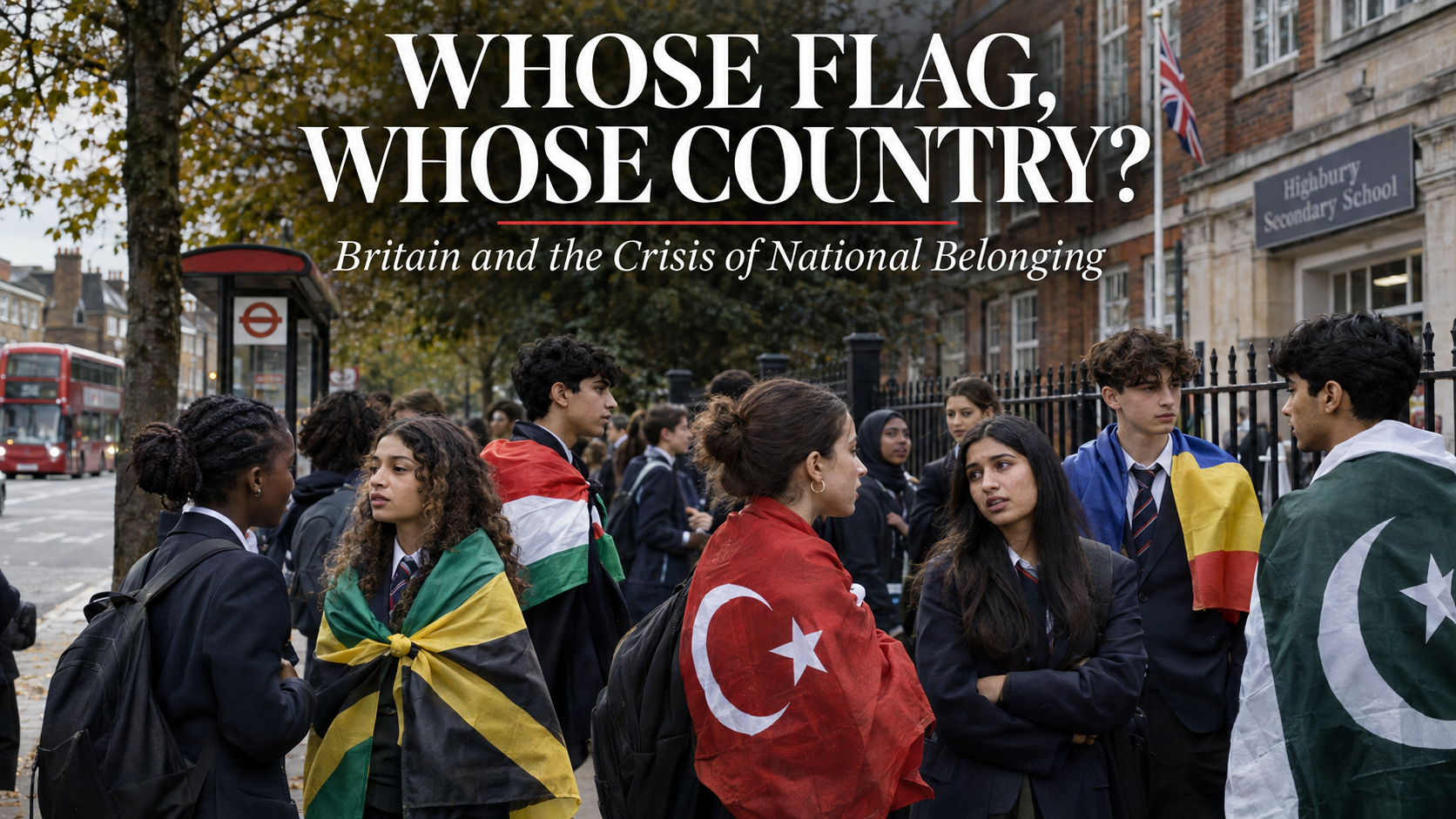
Katharine Birbalsingh’s warning about multiculturalism exposes a peculiar contradiction in contemporary Britain. Children are encouraged to celebrate the national identities of their ancestors, while expressions of British patriotism are increasingly regarded with suspicion. Across Europe, national flags are familiar features of public and domestic life. What has happened to Britain’s confidence in its own identity?
Katharine Birbalsingh describes an ordinary Tuesday morning in London. On her way to work, she encounters schoolchildren carrying Jamaican, Palestinian, Turkish, Romanian and Pakistani flags. They are not demonstrating or attending a political rally. Their teachers have encouraged them to bring flags representing their respective cultures to school, presumably in the belief that celebrating their differences will promote mutual understanding. Yet something about the scene troubles her. Most of these children, she observes, will have been born in Britain. Some may scarcely know the countries whose flags they carry. Nevertheless, their school encourages them to identify publicly with those ancestral homelands while, according to Birbalsingh, declining to fly the Union Jack for fear of appearing racist.¹
The children gather at a bus stop. Those carrying Caribbean and African flags gravitate towards one another. So do those carrying Eastern European flags, while two boys holding Pakistani flags converse in Urdu. Their teachers intend an occasion for inclusion, yet the children organise themselves around the very distinctions the exercise has emphasised. Children born and raised in Britain are encouraged to understand themselves through the national identities of their ancestors, while the country they actually share is conspicuously absent from the celebration.
Birbalsingh, headmistress of Michaela Community School in Wembley, has spent thirty years teaching principally children from ethnic minority backgrounds. Her new book, Diversity Is Not Our Strength: How the Left and Right Broke Multiculturalism and How to Fix It, challenges the assumption that encouraging children to identify principally with their ethnic or cultural differences produces a more harmonious society. She believes schools are fostering a sense of alienation amongst minority pupils while encouraging others to understand themselves through inherited privilege and historical guilt. The result is an educational culture increasingly occupied with the differences separating children and less interested in what they share.¹
Her observation about the Union Jack will be familiar to Nuntiatoria readers. In June, we examined the controversy surrounding national flags at Hastings Pride, where a reported prohibition on national flags while permitting Pride banners raised questions about the meaning of inclusion. In The Flag They Fear: Hastings Pride and the Crisis of Belonging in Britain, we considered how national symbols could themselves become objects of suspicion because political extremists had appropriated them. The Union Flag belongs to the nation, and its meaning cannot be determined by whichever political movement happens to wave it most conspicuously.²
A similar difficulty arose during the Unite the Kingdom demonstration in September 2025, when Christian leaders expressed concern about the appropriation of the Cross and Christian language by participants in the rally. Nuntiatoria subsequently examined the reaction in The Cross in the Streets, the Silence of the Shepherds. The controversy concerned both the political character of the demonstration and the public expression of Christian and national identity. The symbols themselves possessed a history extending far beyond the circumstances of that particular gathering.³
Earlier reporting on the Epping demonstrations had illustrated how readily a national emblem could become implicated in disputes about immigration and political extremism. Sarah White, a Reform UK activist, was arrested following an incident involving the Union Jack at Epping’s civic offices during protests concerning asylum accommodation. Nuntiatoria’s coverage examined the legal restrictions surrounding her conduct and the competing interpretations of her arrest.⁴
Birbalsingh’s account brings these controversies into the classroom, where children are learning what it means to belong to a country. They may celebrate Jamaica, Pakistan, Romania or Turkey, yet the British flag apparently carries implications too troublesome for their teachers to contemplate. What are they supposed to conclude about Britishness? That it belongs to somebody else? That their own country is less worthy of public affection than the countries from which their families originated?
The situation becomes especially peculiar when considered from a European perspective.
Travel through Denmark and the Dannebrog is everywhere. It flies outside public buildings, businesses and private houses, and appears at birthday parties, family celebrations and weddings. The Danes even decorate birthday cakes with miniature national flags. Such displays are entirely ordinary expressions of belonging, embedded in domestic custom rather than confined to occasions of political ceremony. The Danish flag can accompany the celebration of a child’s birthday without anyone supposing that the family is making a declaration about immigration or national purity.⁵
In Norway, Constitution Day on 17 May brings children onto the streets carrying Norwegian flags, often dressed in traditional national costume. Families gather, schools participate in processions, and the national colours fill town centres and residential streets. The children’s procession is a principal feature of the celebrations, an occasion through which successive generations are introduced to their country’s history and institutions.⁶
Across France, the Tricolore marks public buildings and civic ceremonies. In Italy, the national flag is displayed on municipal buildings, schools and other public institutions. Poland’s red and white flags appear on homes and balconies during national anniversaries, accompanied by commemorations of the country’s struggles for independence. Spain possesses its own complications, particularly the competing historical loyalties expressed through national and regional flags, but such symbols remain established features of public life.
The practices vary considerably, yet the underlying assumption is familiar throughout Europe: a country has a history and a recognisable public identity, and its citizens may express their attachment to it without requiring an elaborate political explanation. The Norwegian child carrying the national flag on Constitution Day participates in an inherited civic custom. The Danish household displaying the Dannebrog marks an occasion of family happiness. The national symbol belongs to the ordinary vocabulary of public and private life.
Britain’s position is rather more curious. In March 2021, the Government introduced a policy encouraging more frequent display of the Union Flag on UK government buildings. Current guidance encourages its display throughout the year and specifies that the Union Flag should ordinarily occupy a government building’s single flagpole.⁷ Official recognition has not prevented controversy surrounding displays elsewhere.
During the Raise the Colours campaign in 2025, Union Flags and Crosses of St George attached to lampposts and other public structures provoked arguments about political extremism, immigration and public order. Some objections concerned unauthorised installations; others reflected the political associations of those promoting the campaign. The controversy demonstrated how readily an ordinary national emblem could become entangled in contemporary political disputes.
A Jamaican flag is ordinarily understood as an expression of cultural pride, while an English flag may invite speculation about the political opinions of the person carrying it. The national attachment which appears entirely unremarkable elsewhere can become a subject for ideological scrutiny in Britain.
Birbalsingh has little patience with this attitude. At Michaela, pupils sing the National Anthem and the Union Jack is displayed. When visitors ask whether such practices are colonial, she points out that colonialism involves planting one’s flag in somebody else’s country. Displaying the flag of one’s own country is something altogether different.¹
One might have thought the distinction elementary. Yet it exposes a deeper confusion about the purpose of education. Schools which celebrate the cultural inheritance of their pupils are sometimes reluctant to teach those same pupils that they belong to a particular historical nation, with a common inheritance and corresponding obligations. Ancestry then assumes an importance which citizenship and shared national life struggle to match.
There is nothing objectionable about preserving family traditions. Catholics should understand this particularly well. Irish, Italian, Polish and other immigrant communities have maintained distinctive customs, languages and devotions while becoming part of British society. The parish church has frequently provided the setting in which such differences could be accommodated within a common religious life. Indeed, some immigrant families have preserved religious practices which the surrounding British population has largely abandoned.
But remembering one’s ancestry is not the same thing as allowing it to determine one’s principal national identity. Many families came to Britain precisely because they intended to establish their future here. They acquired citizenship, found employment, built businesses and raised children. Those children inherited something from the countries of their parents and grandparents, but they also inherited membership of the country in which their families had chosen to settle. Continually directing their attention towards an ancestral homeland can obscure the significance of that decision.
Birbalsingh proposes what she calls multicultural patriotism, a shared appreciation of British history, institutions and values which embraces citizens of differing ethnic and religious backgrounds. Her argument carries particular force because she rejects the suggestion that Britishness belongs exclusively to one ancestry. She describes the hostility which can confront ethnically diverse children celebrating England’s football team, including abuse from people who insist that such children do not properly belong in the country. The children identify with England, support its national team and participate in its public culture, yet their entitlement to do so is questioned because of their appearance or family origins.¹
Such hostility undermines the very national cohesion its advocates profess to defend. If people born and educated in Britain are told that they cannot be British because of their ancestry, integration becomes an impossible undertaking. Their attachment to the country is rejected precisely when it ought to be welcomed.
The history of British Catholicism offers an instructive comparison. For centuries, Catholics were suspected of divided loyalties because their spiritual allegiance extended beyond the authority of the Crown. The Reformation and subsequent penal legislation made fidelity to Rome a potential obstacle to participation in public life. Catholics endured exclusion, discrimination and repeated demands to demonstrate that their religious convictions did not render them enemies of their own country.
Yet they remained English, Scottish or Welsh. Their loyalty to their homeland did not require them to surrender their Faith, and fidelity to the Catholic Church did not extinguish their natural affection for their country. Catholic emancipation in 1829 marked a decisive stage in the recovery of civic rights long denied on grounds of religion. The historical lesson remains pertinent whenever national belonging is made dependent upon conformity to a particular religious, racial or ideological identity.
The Catholic understanding of patriotism is more substantial than the emotional attachment sometimes encouraged by political movements. St Thomas Aquinas places the honour owed to one’s parents and country under the virtue of piety, related to justice, because both have contributed to our existence and upbringing. Pope Leo XIII, in his 1890 encyclical Sapientiae Christianae, likewise affirmed the duties which citizens owe their country while insisting that political authority remains subject to the higher law of God.⁸
Patriotism arises from gratitude and the obligations of membership in a political community. It recognises what we have received from previous generations and what we owe to those who will follow us. The Catechism of the Catholic Church places love and service of country within the order of charity, connecting them with the responsibilities of citizens towards the common good.⁹
This understanding gives national identity a moral content which neither ethnic exclusivity nor an endless celebration of cultural difference can adequately supply. A country possesses a legitimate historical character, and its citizens have responsibilities towards its preservation and welfare. Those responsibilities extend to fellow citizens irrespective of ancestry, while the rights and dignity of persons remain grounded in a moral order higher than the state itself.
Multiculturalism as an ideology has frequently struggled with these obligations. Its emphasis upon the recognition of particular identities can encourage people to understand society principally through the groups to which they belong. Public policy becomes an exercise in accommodating competing claims, while the cultivation of shared loyalties receives comparatively little attention.
Birbalsingh’s criticism of educational approaches built around racial privilege and victimhood deserves attention here. There are genuine experiences of discrimination which require justice, but the moral standing of a child cannot be established by ancestry. To encourage one pupil to regard himself as disadvantaged because of the sufferings of earlier generations, while inviting another to accept collective guilt for historical injustices, confuses personal responsibility with inherited identity.
Such teaching risks burdening children with controversies in which they have played no part. The proper response to discrimination is to identify the wrong, establish responsibility and secure justice. Children should be equipped to recognise injustice wherever it occurs, rather than encouraged to approach society as representatives of competing historical grievances.
The problem reaches well beyond education. Britain has experienced a substantial weakening of the institutions through which common loyalties and moral assumptions were once transmitted. Religious observance has declined, family and community life have changed, and the country’s Christian inheritance increasingly occupies an uncertain position in public discussion.
The 2021 Census recorded that Christians constituted 46.2 per cent of the population of England and Wales, compared with 59.3 per cent in 2011.¹⁰ The figures describe a profound transformation in the religious character of the country, with consequences extending beyond the numbers attending church.
Christianity shaped the institutions, customs and moral understanding of these islands over many centuries. Long before the emergence of the modern British state, monasteries, cathedral schools, religious foundations and parish communities had established patterns of education, charity and social obligation which continued to influence British society after the Reformation. The Christian calendar ordered public and domestic life, while religious teaching supplied much of the language through which authority, justice, charity and human dignity were understood.
The country’s history includes religious persecution and grave injustices, some committed by those professing Christianity. An honest account of these failures belongs within the transmission of that history, just as the achievements of preceding generations deserve recognition. The past is an inheritance from which subsequent generations must learn, including where their predecessors failed to live according to the principles they professed.
Britain increasingly attempts to preserve the social benefits of its Christian inheritance while becoming reluctant to acknowledge the foundations upon which many of them developed. Democracy, individual liberty, tolerance and the rule of law are regularly presented as British values, although their practical application requires a moral understanding of human dignity, justice and authority. These principles alone cannot explain the particular history of Britain or the obligations which arise from belonging to it.
This uncertainty becomes especially apparent in the context of integration. A society which expects newcomers to participate in its common life must possess some confidence about the character of that life. It must be prepared to explain its history, language, customs and institutions, together with the responsibilities which citizenship entails. When public bodies become embarrassed by these matters, integration risks becoming little more than administrative accommodation between communities whose members increasingly understand themselves through separate identities.
A nation embarrassed by its own history is poorly equipped to communicate a confident sense of belonging to others.
The census figures also demonstrate that British identity has not disappeared. In 2021, 90.3 per cent of residents in England and Wales identified with at least one UK national identity, including those who also claimed another national affiliation.¹¹ The question concerns what that identity means in practice and whether institutions are prepared to cultivate the attachments and obligations upon which it depends.
Here Birbalsingh’s educational approach is particularly interesting. Michaela’s emphasis upon shared routines, mutual responsibility and gratitude reflects her conviction that a common institutional culture must be deliberately formed. Pupils eat together, undertake responsibilities towards one another and are encouraged to understand their conduct in relation to the wider school community. At Pepperdine University in October, Birbalsingh discussed the formation of character through habitual conduct and connected her understanding of community with the Christian tradition.¹²
Community is sustained through habits as well as principles. Children learn responsibility by exercising it, courtesy through ordinary dealings with others, and loyalty through participation in institutions which deserve their attachment. National identity likewise acquires substance through education, shared practices and the relationships of civic life.
The flag belongs within that understanding. It represents a country whose citizens inherit a particular history and assume obligations towards one another. A child whose parents came from Jamaica or Pakistan may know and cherish those countries while recognising Britain as his own. Indeed, the ability to incorporate people of differing origins into a common national community is among the most important tests of successful integration.
The Cross of St George illustrates how deeply these questions are rooted in history. Its association with England long predates contemporary political nationalism and belongs to the country’s medieval Christian inheritance. St George was honoured in England for centuries, his feast became established in its religious calendar, and his cross developed into a national emblem. Modern political movements may employ that symbol for their own purposes, but they cannot claim ownership of its history.
The same principle applies to the Union Flag, which represents a political union containing several historic national identities. England, Scotland, Wales and Northern Ireland possess their own histories and loyalties, sometimes expressed through distinctive national symbols. Their relationship within the United Kingdom has never required the complete disappearance of those differences. Common political belonging has existed alongside particular historical attachments, even where the relationship has been contested.
There is something to be learned from this when considering the descendants of immigrant families. National identity does not require the abandonment of every other loyalty. It does, however, involve responsibilities extending beyond one’s immediate family, ethnic community or ancestral homeland. The cultivation of those responsibilities should be among the central purposes of civic education.
The children at Birbalsingh’s bus stop deserve to know the histories of their families. They also deserve to be taught that the history of Britain belongs to them, that its institutions are theirs to participate in and that its future will be shaped by the responsibilities they assume as citizens. Their national identity should not be presented as something provisional, dependent upon the approval of those who claim a longer ancestry in the country.
Across Europe, national flags remain familiar reminders of such membership. They appear on homes, public buildings and businesses because people recognise their place within a particular historical community. Britain might usefully recover that ordinary confidence, beginning with the institutions responsible for educating its children.
There is a final irony in Birbalsingh’s account. The teachers presumably believe that celebrating the children’s differing national identities will help them feel included. Yet the one national identity capable of including them all is precisely the one they have apparently decided not to celebrate. It is a remarkable lesson to teach children about the country which is their home.
FOOTNOTES
- Katharine Birbalsingh, Britain’s ‘strictest headmistress’ says our obsession with celebrating the ethnic heritage of children is wrong, divisive and may end in civil unrest, Daily Mail, 7 November 2026.
- Nuntiatoria, The Flag They Fear: Hastings Pride and the Crisis of Belonging in Britain, 5 June 2026.
- Nuntiatoria, Unite the Kingdom: The Cross in the Streets, the Silence of the Shepherds, 3 October 2025.
- Nuntiatoria, Nuntiatoria LX: Haec est Via, 5 September 2025, ‘From Protest to Vindication: Epping’s Pink Ladies and the Politics of Justice’.
- Danish Ministry of Foreign Affairs, Danish National Flag; Folkevirke, Celebration Days and Public Holidays.
- City of Oslo, 17th of May: The Official Programme in Oslo, 2026.
- UK Government, Union Flag Flying Guidance for UK Government Buildings, updated 28 January 2026.
- St Thomas Aquinas, Summa Theologiae, II–II, q.101, a.1; Pope Leo XIII, Sapientiae Christianae, 10 January 1890.
- Catechism of the Catholic Church, §§2238–2240.
- Office for National Statistics, Religion, England and Wales: Census 2021, 29 November 2022.
- Office for National Statistics, National Identity, England and Wales: Census 2021, 29 November 2022.
- Pepperdine University, Pepperdine University Hosts Katharine Birbalsingh, Headmistress of the Michaela Community School in London, 23 October 2026.





Leave a Reply