
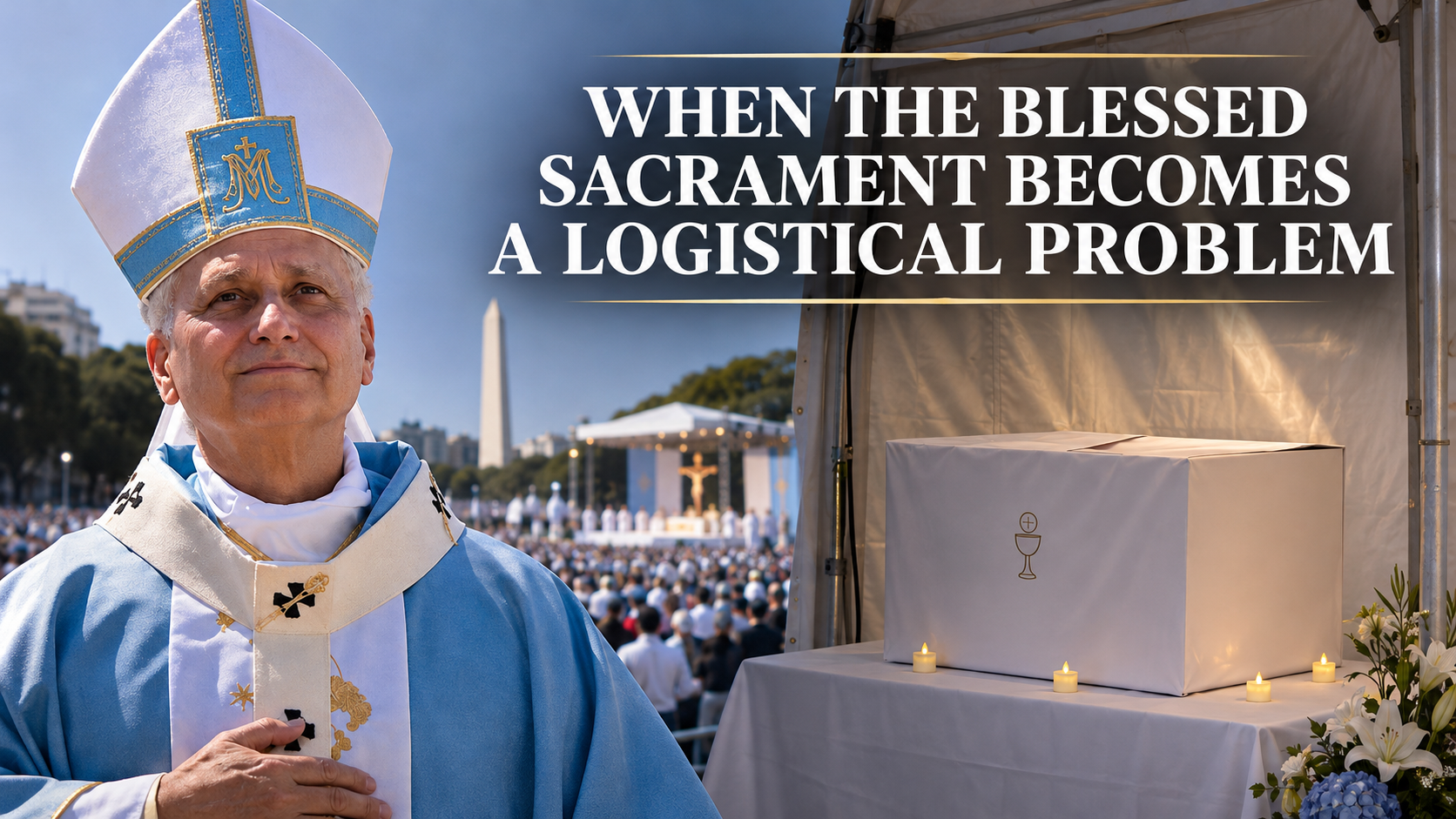
Half a million Hosts consecrated in advance for Pope Leo XIV’s Mass in Buenos Aires, thousands of priests expected to participate, and controversies familiar from World Youth Day in Lisbon expose a troubling contradiction. The Church’s authoritative teaching preserves the individual offering of Mass, the distinction between attendance and sacramental Communion, and the primacy of Eucharistic reverence. Why, then, have arrangements which frequently obscure these distinctions become so firmly established in contemporary liturgical practice?
On Thursday, 5 November, more than half a million Hosts were consecrated at the parish church of San Benito Abad in Buenos Aires, four days before Pope Leo XIV was due to celebrate Mass at the Monumento de los Españoles. The preparations involved seventy-five volunteers, more than 2,000 ciboria, thirty temporary Eucharistic tents and an elaborate system of transport, supervision and distribution across central Buenos Aires. According to the Argentine Catholic news agency AICA, the consecrated Hosts would be delivered by vehicle to designated stations, where accredited ministers would receive them for distribution to the enormous congregation. Periods of prayer and adoration were planned while the Blessed Sacrament remained in temporary custody.¹
The operation was intended to serve a papal gathering for which Argentine reports gave an estimated attendance of 2.5 million, including those assembled along the papal route and in surrounding streets. Whatever the precise number present throughout the Mass, the scale of the Eucharistic preparations was extraordinary. One can appreciate the difficulties faced by the organisers without accepting that their chosen arrangements were the only practicable means of meeting them.
For here was the Body, Blood, Soul and Divinity of Our Lord Jesus Christ, truly and substantially present beneath the appearances of bread, being transported, guarded and distributed on an almost industrial scale. The organisers undoubtedly intended to provide Holy Communion to the faithful. Yet the very magnitude of the undertaking invites a question which appears to receive comparatively little attention in the planning of such events: why must the sacramental life of an enormous gathering be concentrated upon one celebration, particularly when thousands of priests are available?
On 11 November, InfoVaticana published complaints concerning the administration of Holy Communion during the Buenos Aires Mass. One attendee alleged disorderly distribution by extraordinary ministers, the apparent absence of priests from the stations visible to him, and Communion continuing after the final blessing. The publication contrasted these accounts with footage from the Pope’s subsequent Mass in Córdoba, where the arrangements appeared more orderly.²
The testimony concerns particular sections of a gathering extending across several streets. EWTN described a more favourable experience, reporting worshippers kneeling during the Consecration and approaching Communion in an atmosphere of recollection. Nor would distribution continuing after the final blessing necessarily constitute an abuse, since Holy Communion may be administered outside Mass in appropriate circumstances. The published evidence does not establish widespread sacrilege or deliberate profanation.
The controversy nevertheless recalls the arrangements for Pope Francis’s closing Mass at World Youth Day in Lisbon in August 2023, when photographs circulated showing the Blessed Sacrament reserved within large grey plastic containers inside temporary tents. Pilgrims were photographed kneeling before them in adoration, while the appearance of the containers provoked considerable indignation.
Subsequent investigation established that the consecrated Hosts were contained in metal ciboria or pyxes placed within protective plastic containers. Volunteers had been assigned to guard them, although the temporary facilities varied in security. The arrangements were intended for storage rather than public adoration, which arose spontaneously when pilgrims discovered what the containers held. Reports of Hosts being distributed from plastic bowls covered with cling film concerned a separate celebration organised by Spanish pilgrims and should not be confused with the principal papal Mass.³
These distinctions matter. The use of protective transport containers is not intrinsically irreverent, and the organisers had made provision for custody. Yet the controversy revealed how much elaborate organisation had become necessary to accommodate enormous quantities of the Blessed Sacrament prepared for a single celebration.
Three years later, Buenos Aires presented another version of the same difficulty.
The resemblance became more striking following a report circulated by LifeSiteNews concerning the arrangements in Buenos Aires. Its accompanying photograph showed a large rectangular structure, apparently covered in white material, bearing a Eucharistic symbol and surrounded by small artificial candles. LifeSite described it as a cardboard box in which the Blessed Sacrament had been kept beneath one of the temporary tents during Leo XIV’s Mass.¹⁸
The photograph does not establish what was contained within the enclosure or whether it concealed properly secured ciboria or another suitable receptacle. Yet the image recalls the controversy at Lisbon with uncomfortable precision. Once again, the faithful were presented with temporary arrangements for the custody of consecrated Hosts prepared in enormous quantities for distribution at a papal celebration. EWTN independently confirmed that worshippers had knelt in prayer before the Blessed Sacrament in the Buenos Aires tents.
The question concerns more than the material from which an outer covering was constructed. The Church requires the Blessed Sacrament to be safeguarded in a manner appropriate to its sacred character, and the Vatican’s own 2014 guidance specifically addresses secure reservation during large celebrations. If ordinary cardboard structures were employed as the principal places of reservation, the organisers should explain what security and liturgical provisions they contained. If the boxes merely concealed properly secured receptacles, that distinction should equally be established.
After the controversy at Lisbon in 2023, the recurrence of such imagery at Buenos Aires deserves particular attention. The ecclesiastical authorities responsible for organising enormous celebrations have had ample opportunity to consider the practical safeguards required and the manner in which those safeguards communicate the Church’s belief in the Real Presence. An arrangement may have a perfectly intelligible logistical explanation while still giving rise to questions about whether a more fitting provision ought to have been made.
Catholic doctrine establishes the nature of the obligation before any logistical decision is considered. By transubstantiation, the substance of bread and wine becomes the Body and Blood of Christ, while the appearances remain. Under each species Christ is wholly present, Body, Blood, Soul and Divinity. The Council of Trent defined this teaching with deliberate precision.⁴
The smallest fragment retaining the appearances of bread contains the whole Christ. The reverence owed to Him does not diminish because there are hundreds of thousands of consecrated Hosts rather than one.
Nuntiatoria examined this distinction in August in Before the Blood, the Body, following reports of an alleged Eucharistic miracle in Guatemala. Its argument was that Catholics ought not to require extraordinary physical manifestations to rediscover reverence for what the Church already professes to be present upon the altar. A Eucharistic miracle, if genuine, draws attention to a reality which exists independently of any miraculous appearance. The consecrated Host deserves adoration before anything unusual happens to it.⁵
An earlier AICA report provides an illuminating detail concerning Buenos Aires. On 7 October, Fr Alejandro Russo, responsible for the liturgical preparations, explained that approximately 500,000 Hosts would be required and that more than 2,000 priests were expected to participate. His arrangements envisaged twenty-nine Eucharistic tents, subsequently increased to thirty, together with a separate provision for concelebrating priests near the principal altar. Extraordinary ministers would be supplied by Buenos Aires and neighbouring dioceses.⁶
The number of priests actually concelebrating has not been independently established, and the quantity of Hosts prepared does not prove that organisers expected everyone present to communicate. What the records demonstrate is the decision to organise a vast distribution operation around one principal celebration, notwithstanding the anticipated presence of an unusually large number of priests.
The Church’s own liturgical authorities have already considered precisely these difficulties, and their guidance is more flexible than the prevailing practice might suggest.
In June 2014, the Congregation for Divine Worship and the Discipline of the Sacraments issued its Guide for Large-Scale Celebrations. Prepared following concerns raised during the 2005 Synod of Bishops and Benedict XVI’s subsequent teaching, it received Pope Francis’s approval on 7 June 2014. The document provides an authoritative reference for preparing enormous liturgical gatherings.⁷
Paragraph 8 recognises that circumstances may make it appropriate to consider whether Mass is the most suitable form of celebration. The Liturgy of the Hours, a solemn procession, Eucharistic adoration, Benediction or another properly ordered act of worship may better serve a particular occasion.
Paragraph 9 addresses excessive numbers of concelebrants. Priests situated at considerable distances from the principal altar may be unable adequately to manifest their sacramental relationship to the celebration. The Guide recommends limiting their number to those reasonably accommodated within the sanctuary or equivalent area, perhaps selecting a representative group. For the remaining priests, it suggests arranging other celebrations at suitable times in different churches or locations.
The same document requires careful provision for sacramental Confession, including during the preceding days, with confessors readily identifiable. The faithful should be reminded of the dispositions necessary for worthy Communion. Previously consecrated Hosts may be used where circumstances warrant it, but appropriate arrangements must be made for secure reservation and custody. The Guide also recommends Communion-plates, particular care over sacred fragments and consideration of distribution exclusively on the tongue where the danger of profanation requires it.⁷
These provisions supply an exacting standard against which the Buenos Aires arrangements may be examined. Were the thirty Eucharistic tents equipped with the secure reservation facilities envisaged by the Guide? How were the ciboria supervised during transport and distribution? Were Communion-plates used? What instructions governed Communion in the hand amid enormous crowds? How many priests actually distributed the Sacrament, and what opportunities had been provided for Confession?
AICA’s reports establish considerable preparation, accreditation and planned supervision. They do not give a complete account of these matters. Their absence from published reporting is no proof that the necessary safeguards were lacking, but the organisers should be able to explain how they were implemented.
The more revealing point is that the Vatican’s own guidance recognises alternatives to concentrating thousands of priests and hundreds of thousands of communicants around one principal Mass. That concentration is an organisational and pastoral decision, made under considerable constraints, rather than a requirement imposed by Eucharistic doctrine.
Here we encounter what Nuntiatoria has previously examined as the development of an institutionally entrenched official theology: a particular interpretation of the Church’s teaching acquiring practical authority through ecclesiastical administration, sometimes exceeding the requirements of the doctrine and law upon which it claims to rest.
In The Revolution Had an Office, published in September, Nuntiatoria considered how the post-conciliar transformation of Catholic life was developed, interpreted and enforced through clerical institutions which frequently presented themselves as instruments for liberating the laity from an excessively clerical Church. Diocesan offices, liturgical commissions, theological faculties and seminaries exercised influence extending beyond the formal texts of the Council. Particular interpretations became embedded in institutional expectations, sometimes acquiring the appearance of obligations which the Council itself had never imposed.⁸
The restrictions introduced at St Peter’s Basilica during the pontificate of Francis provide a particularly revealing example.
On 12 March 2021, the Vatican Secretariat of State issued instructions reorganising morning Masses at the basilica, effective from 22 March. Individual celebrations at its numerous side altars during the customary early morning period were displaced by scheduled concelebrations. Celebrations according to the 1962 Missal were restricted to the Clementine Chapel at designated times.
For generations, priests visiting Rome or serving in the Vatican had offered Mass at the basilica’s altars, frequently with no congregation beyond a server or a few faithful. The practice expressed the priest’s daily offering of the Holy Sacrifice, which possesses its full sacrificial character independently of the size of the congregation.
The new arrangements directed priests towards common celebrations in the interests of recollection, order and liturgical decorum. Cardinals Raymond Burke, Robert Sarah and other senior churchmen objected, questioning the canonical basis of the restrictions and the implications for individual priestly celebration. Sarah was particularly concerned about the wider consequences of treating such Masses as something to be discouraged.⁹
Cardinal Mauro Gambetti, Archpriest of St Peter’s, subsequently published an explanation on 22 June. He appealed to the communal character of liturgical worship and the unity manifested through concelebration. Individual Masses remained legitimate, he acknowledged, and particular requests could be considered. The original directive concerned the defined morning period rather than every Mass celebrated at the basilica.
Nevertheless, the governing preference was unmistakable. Concelebration had become the ordinary arrangement, while individual celebrations depended increasingly upon exceptional consideration.¹⁰
This distinction between the legitimacy of concelebration and the institutional preference for it is important. The Second Vatican Council, whose authority was invoked to support the policy, expressly preserved the priest’s right to celebrate Mass individually.
Sacrosanctum Concilium, paragraph 57, extended the circumstances in which priests might concelebrate while retaining that right, subject to the restriction upon simultaneous individual celebration and concelebration in the same church and the particular discipline of Holy Thursday.
Canon 902 of the 1983 Code of Canon Law preserves the same freedom. Canon 904 positively recommends daily Mass, even without a congregation, because the priest exercises his principal function in offering the Eucharistic Sacrifice. The current General Instruction of the Roman Missal recognises the value of concelebration but does not impose it whenever priests gather together.¹¹
The expression private Mass can itself obscure the issue. A priest offering Mass without a congregation is never performing a merely private devotional exercise. Every valid Mass is an act of Christ and His Church, offered for the living and the dead. Its ecclesial character is independent of the number of priests or faithful physically present.
Pius XII addressed this question in Mediator Dei in 1947. He explained that the integrity of the Eucharistic Sacrifice requires the sacramental Communion of the celebrating priest, while the reception of Communion by the faithful, although earnestly encouraged, is not necessary to its integrity. He rejected the suggestion that Masses at which the priest alone communicates are unlawful or deficient.¹²
This teaching bears directly upon another assumption which has become increasingly influential in contemporary liturgical practice: that virtually everyone attending Mass ought to receive Holy Communion.
Nuntiatoria examined the subject in Everybody Receives. Who Confesses?, published on 11 September, and returned to it in The Faithful Who Do Not Receive on 16 October. Both articles considered the distance between St Pius X’s encouragement of frequent Communion and the contemporary tendency towards habitual reception without a corresponding recovery of Confession, examination of conscience and an adequate understanding of mortal sin.¹³
The decree Sacra Tridentina Synodus of 1905 encouraged frequent and even daily Communion for Catholics in the state of grace who approached with a right intention. It neither required Confession before every Communion nor made sacramental reception an automatic consequence of attending Mass. The reform was intended to foster sanctity. As Archbishop Jerome Lloyd observed in the OldRomanTV discussion examined by Nuntiatoria, Pius X wanted Catholics to become more holy.
That purpose cannot be measured by the length of the Communion procession.
Catholics conscious of unconfessed mortal sin must ordinarily receive sacramental absolution before approaching Holy Communion. Canon 916 concerns the communicant’s own responsibility; canon 915 addresses circumstances in which ministers must withhold the Sacrament. These are distinct obligations, neither of which authorises speculation about another person’s conscience.
A Catholic who refrains from Communion because he recognises himself to be improperly disposed may be performing an act of profound reverence. His participation in the Holy Sacrifice remains real, and spiritual Communion offers a fitting expression of his desire for union with Christ.
Benedict XVI made precisely this point in Sacramentum Caritatis, paragraph 55, warning against the assumption that attendance at Mass confers a right or obligation to receive Holy Communion. In paragraph 61, he addressed the difficulties of enormous concelebrations, particularly those surrounding the Eucharistic Prayer and the administration of Communion, and considered that such celebrations should remain exceptional.¹⁴
It is difficult to reconcile this teaching with the pastoral assumption that an enormous congregation ought ordinarily to become an equally enormous procession of communicants during one celebration. Neither Catholic doctrine nor liturgical law requires that arrangement.
Instead, priests could offer Mass earlier in the day, or during preceding days, for smaller and more manageable groups of pilgrims. These might be individual celebrations or smaller concelebrations, according to circumstances and the applicable law. The faithful could receive Holy Communion with adequate preparation, opportunities for Confession and time for thanksgiving, subsequently joining the principal papal gathering without any presumption that they must communicate again.
The canonical limits upon the number of Masses a priest may celebrate in one day would naturally have to be observed, and suitable churches, chapels or temporary altars provided. Yet organisers capable of arranging the transport of half a million consecrated Hosts and deploying thousands of ministers possess considerable resources for meeting such difficulties.
Priests offering Mass for smaller congregations, hearing Confessions and administering Holy Communion are exercising substantial pastoral responsibilities. Their absence from the massed ranks of concelebrants would diminish neither the dignity nor the sacrificial character of the principal papal celebration.
Traditional Catholic pilgrimages provide practical evidence of how such arrangements can operate.
The annual Pentecost pilgrimage from Paris to Chartres, organised by Notre-Dame de Chrétienté, attracted approximately 20,000 participants in 2026. Pilgrims travel over three days, accompanied by priests providing Confession, spiritual direction, Mass and Holy Communion.
The organisers’ written instructions for clergy are particularly instructive. Priests celebrate individual Masses in designated locations and at allocated times. During the pilgrimage, they are principally assigned to hearing Confessions and providing spiritual assistance. At the public Masses, they cease hearing Confessions after the Pater Noster and assist with the distribution of Communion.
The instructions expressly require Communion to be administered on the tongue, kneeling wherever physically possible, with a server carrying a Communion-plate. Stewards guide priests to their assigned distribution areas. There is no concelebration during the pilgrimage.¹⁵
The traditional discipline determines the arrangements. Priests, servers and stewards are organised accordingly, while individual Masses and Confessions form part of the ordinary pastoral preparation.
The episcopal consecrations conducted by the Society of St Pius X at Écône on 1 July 2026 provide another instructive example.
The Society recorded 16,639 participants, comprising 15,217 lay faithful and 1,422 clergy and religious, including 552 priests. Contemporary reporting described a predominantly adult gathering, with families and children also present. Confessions were provided in six languages, while priests celebrated individual Masses at numerous altars around the seminary from before dawn.¹⁶
The principal ceremony therefore formed part of a wider programme of sacramental ministry. Extensive provision had already been made for reconciliation, the celebration of Mass and the preparation of the faithful for Holy Communion.
During the four-hour Pontifical Mass, a violent thunderstorm broke over the congregation. Torrential rain and lightning interrupted the proceedings, while many of the faithful remained kneeling in the wet conditions, reciting the Rosary and praying for the Pope and the universal Church. When the storm passed, Holy Communion proceeded according to the traditional rite, administered by priests to communicants kneeling and receiving on the tongue.
The precise number who communicated was not published. The figure of 16,639 represents reported attendance, rather than a verified count of communicants. Nevertheless, the scale and predominantly adult composition of the congregation, together with the documented provision of Confession and individual Masses, establish the substantial character of the arrangements.
Whatever judgement one makes concerning the canonical controversy surrounding the consecrations, their practical organisation deserves consideration on its own merits. Priests were employed in offering Mass, hearing Confessions and administering the Blessed Sacrament. Traditional Eucharistic discipline was maintained despite exceptionally difficult weather.
Neither Chartres nor Écône provides an exact logistical comparison with Buenos Aires. A gathering of sixteen or twenty thousand presents different difficulties from one extending across several streets and numbering hundreds of thousands. The comparison establishes something more limited, but important: substantial outdoor congregations can be organised around traditional sacramental discipline, with priests employed in a manner which makes Confession, individual celebration and reverent administration of Holy Communion central to pastoral preparation.
At Écône, the organisers did not first determine that every available priest should concelebrate one principal Mass and subsequently attempt to accommodate all sacramental requirements within that decision. Nor did the Chartres organisers regard kneeling reception and Communion on the tongue as obstacles to efficient administration. Their arrangements were designed around the practices they intended to preserve.
The same principle could inform the organisation of larger gatherings, although the particular arrangements would necessarily differ.
There is also the problem of distance at immense concelebrations. Hundreds or thousands of priests may be situated far from the principal altar, sometimes dependent upon amplification and screens to follow the sacred action. Such participation may be permitted under the applicable norms, but the question of how meaningfully it expresses the unity of the priesthood has already been raised by Benedict XVI and the Vatican’s own 2014 guidance.
The Guide also addresses the dignity of vestments and sacred furnishings, including those manufactured specially for large celebrations, and cautions against allowing simplicity to become an impoverishment of the sacred signs. No judgement about the suitability or expense of particular vestments can responsibly be made without examining them. Nevertheless, their provision belongs to the wider question of how the considerable resources required for an immense concelebration might otherwise serve the sacramental and pastoral needs of the faithful.⁷
The documented decisions at St Peter’s in 2021 and Buenos Aires in 2026 arose in different circumstances and were taken by different authorities. They do not establish a coordinated policy operating throughout the Church. What they illustrate is a recurring preference within identifiable ecclesiastical settings for the visible unity of one large celebration, sometimes accompanied by a diminished practical place for individual priestly Masses and the distinction between attendance and sacramental Communion.
It is this recurring preference which Nuntiatoria describes as official theology. The expression identifies an institutional tendency and its consequences; it does not suggest that the Church has formally promulgated a doctrine requiring universal concelebration or Communion at every Mass.
Indeed, the authoritative teaching remains clear. Every Mass is the Holy Sacrifice of Christ. Individual priestly celebration retains its legitimate place. The faithful are encouraged to receive Holy Communion frequently and worthily, while no obligation exists to communicate at every Mass attended. Concelebration has genuine theological value, but neither the Council nor the reformed Missal requires the largest possible number of priests to concelebrate whenever a bishop or Pope celebrates.
The tension arises when a preferred pastoral model becomes so habitual that the alternatives preserved in the Church’s law receive little practical consideration.
When sacramental reception becomes the principal organisational objective of a celebration, the sacrificial character of the Mass may also recede from popular understanding. The Eucharist increasingly appears to be something distributed to an assembly, rather than the Sacrifice offered to Almighty God in which the faithful participate through prayer, adoration and union with Christ, receiving Holy Communion when properly disposed.
At enormous public gatherings, practising Catholics, occasional churchgoers and visitors with limited understanding of Catholic sacramental discipline may all be present. The collective movement towards Communion stations can become an expected feature of participation, with comparatively little attention given to individual preparation or examination of conscience.
The Church’s regulations provide safeguards. Redemptionis Sacramentum protects the right to receive Communion on the tongue, prohibits denying Communion solely because a person kneels, and requires appropriate measures against profanation. Its provisions concerning extraordinary ministers distinguish genuine pastoral necessity from convenience. The number of communicants is relevant, but does not abolish the responsibilities of ordinary ministers or diminish the reverence owed to the Sacrament.¹⁷
The organisers of Buenos Aires may have implemented extensive safeguards beyond those described in the available reports. Their account would be valuable, particularly concerning Eucharistic reservation, the deployment of clergy, Communion-plates and opportunities for Confession.
Yet even if every arrangement complied with the law, the wider pastoral question would remain. Lawfulness does not establish that the wisest arrangement has necessarily been chosen.
The Vatican’s Guide expressly contemplates alternatives to immense concelebrations and, where appropriate, alternatives to Mass as the principal form of a large gathering. These provisions belong to the post-conciliar discipline itself, approved under Francis following concerns already identified by Benedict XVI.
The Church possesses thousands of priests so that the Holy Sacrifice may be offered throughout the world, in churches, chapels, religious houses, hospitals and missions, and so that the faithful may receive the Sacraments through their ministry. Their priesthood does not acquire greater sacrificial efficacy merely because they are assembled together in extraordinary numbers.
Nor does the multiplication of Masses multiply Christ’s one Sacrifice. Each celebration makes sacramentally present the same unique Sacrifice of Calvary, with its proper ecclesial and spiritual fruits. The distinction was understood long before the modern age acquired its enthusiasm for measuring religious success by the size of the congregation assembled before a single altar.
Lisbon in 2023 exposed difficulties involved in the custody and distribution of immense quantities of the Blessed Sacrament. Buenos Aires has raised similar questions in 2026, though the available evidence does not establish widespread sacrilege or the absence of proper safeguards. St Peter’s demonstrated how an administrative preference for concelebration could restrict the individual offering of Mass. Chartres and Écône provide practical examples of arrangements in which priests celebrate individually, hear Confessions and distribute Communion according to traditional discipline.
These cases differ in scale, circumstances and ecclesiastical responsibility. Considered together, however, they invite examination of the pastoral assumptions influencing contemporary liturgical organisation.
Pius XII insisted that the integrity of the Eucharistic Sacrifice does not depend upon the whole congregation communicating. St Pius X encouraged frequent Communion as a means of sanctification, presupposing proper dispositions. The Second Vatican Council preserved the priest’s right to celebrate Mass individually. Benedict XVI warned against enormous concelebrations becoming routine and against confusing attendance with an obligation to receive Communion. Even the Vatican’s own guidance approved under Francis recognises the need for alternatives.
The difficulty is therefore scarcely a lack of authoritative teaching.
The real question is why ecclesiastical practice so frequently appears to proceed as though these distinctions had been forgotten.
- Visita de León XIV: preparan más de 2.000 copones para la misa en Buenos Aires, AICA, 3 November 2026; Misa que presidirá León XIV en Palermo: consagraron más de 500.000 hostias, AICA, 6 November 2026.
- Reverencia en Córdoba, quejas en Buenos Aires: la comunión en las misas de León XIV, InfoVaticana, 11 November 2026.
- World Youth Day and Plastic Containers: What Really Happened, Claire Domingues and Pedro Gabriel, The City and the World, 13 August 2023.
- Council of Trent, Session XIII: Decree Concerning the Most Holy Sacrament of the Eucharist, 11 October 1551.
- Before the Blood, the Body: Cuilapa, the Alleged Eucharistic Miracle — and the Greater Scandal We Already Know Is Real, Nuntiatoria, 28 August 2026.
- Misa de León XIV en el Monumento de los Españoles: preparativos litúrgicos, AICA, 7 October 2026.
- Guida per le grandi celebrazioni, Congregation for Divine Worship and the Discipline of the Sacraments, 13 June 2014, especially §§6, 8–10, 14, 17 and 29–30; approved by Pope Francis, 7 June 2014.
- The Revolution Had an Office, Nuntiatoria, 18 September 2026.
- The Vatican Restricts Traditional Latin Mass and Suppresses Private Masses at St Peter’s Basilica, America, 12 March 2021.
- Note from Saint Peter’s Basilica on the Order of Eucharistic Celebrations, Cardinal Mauro Gambetti, 22 June 2021.
- Sacrosanctum Concilium, §57, Second Vatican Council, 4 December 1963; Code of Canon Law, canons 902–905, 1983; General Instruction of the Roman Missal, §§114, 199–209.
- Mediator Dei, §§112–118, Pope Pius XII, 20 November 1947.
- Everybody receives. Who Confesses?, Nuntiatoria, 11 September 2026; The Faithful Who Do Not Receive, Nuntiatoria, 16 October 2026; Sacred Congregation of the Council, Sacra Tridentina Synodus, 20 December 1905.
- Sacramentum Caritatis, §§55, 61, Pope Benedict XVI, 22 February 2007.
- Informations pratiques pour le clergé — Pèlerinage de Chrétienté 2025, Notre-Dame de Chrétienté; Mot du président au terme du 44e pèlerinage, Notre-Dame de Chrétienté, 2026.
- Miles de fieles en Écône: las cifras de las consagraciones episcopales, FSSPX Actualidad, 22 July 2026; Écône 2026, SSPX District of Great Britain; Accused of Schism, They Pray in a Storm for the Holy Father and the Church, FSSPX News, 8 July 2026.
- Redemptionis Sacramentum, §§88–94, 154–160, Congregation for Divine Worship and the Discipline of the Sacraments, 25 March 2004.
- Eucharist kept in cardboard boxes during Pope Leo’s Mass in Buenos Aires, LifeSiteNews, Facebook report, November 2026; EWTN Noticias, reporting on Eucharistic reservation and adoration at the Buenos Aires papal Mass, 9 November 2026.





Leave a Reply